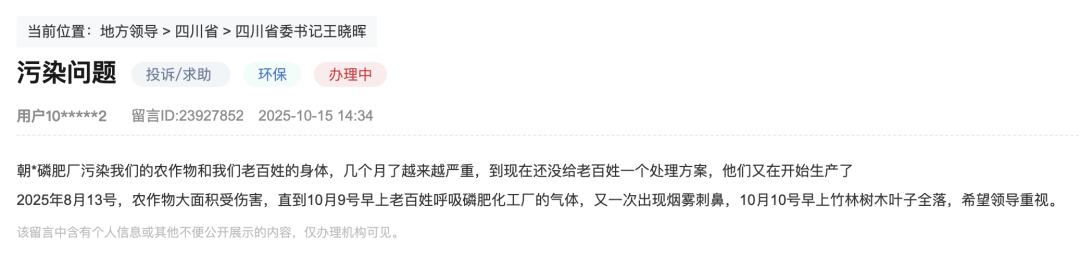
Message recipient: Wang Xiaohui, Secretary of the Sichuan Provincial Party Committee
“The pollution from the Cha* Phosphate Fertilizer Plant is affecting our crops and the health of our people. It has been several months and is getting worse, and there is still no solution for the people. They have started production again. On August 13, 2025, a large area of crops was damaged. Until the morning of October 9, the people were breathing the gas from the phosphate fertilizer plant, and there was a pungent smoke again. On the morning of October 10, the leaves of the bamboo forests and trees all fell. I hope the leaders will pay attention.”
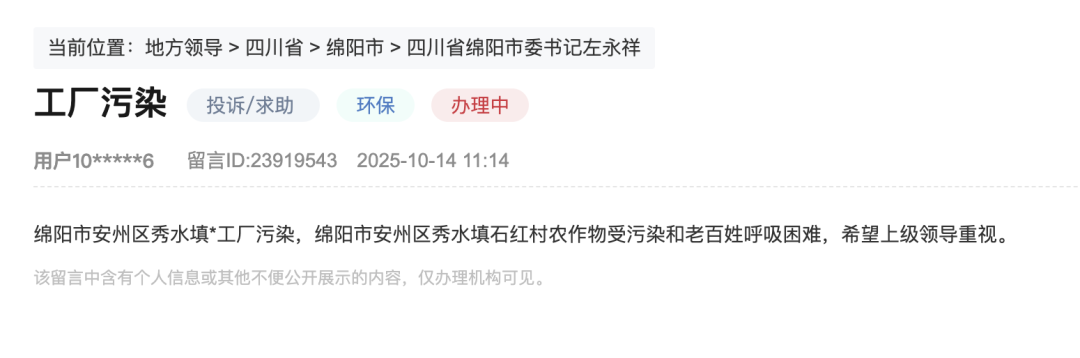
Message recipient: Zuo Yongxiang, Secretary of the Mianyang Municipal Party Committee, Sichuan Province
“The pollution from the Xiushui Filling* Factory in Anzhou District, Mianyang City, and the difficulty in breathing for the residents of Shihong Village, Xiushui Town, Anzhou District, Mianyang City, I hope the leaders at the higher level will pay attention.”
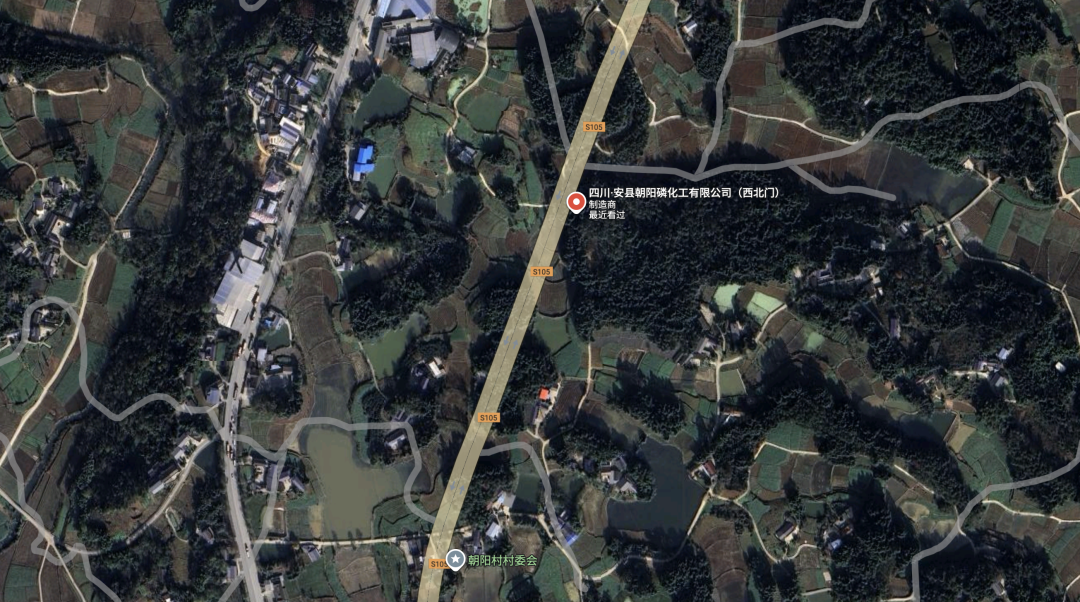
Satellite map of Chaoyang Phosphate Fertilizer Plant
In response to the urgent complaints filed by residents of Shihong Village, Xiushui Town, Anzhou District, Mianyang City, Sichuan Province, through the People’s Daily Online Message Board, an analysis based on environmental toxicology and regional regulatory background shows that the pollution incident caused by the local Sichuan Chaoyang Phosphate Fertilizer Plant (hereinafter referred to as Chaoyang Plant) in the second half of 2025 has escalated from the usual excessive emissions to an acute leakage accident with serious public health and ecological risks.
In addition to difficulty breathing,
What kind of damage will high-concentration toxic gases cause to people?
The complaint shows that the damage to crops and residents’ health has lasted for “several months and is getting worse”. This indicates that the plant’s pollutant treatment system or daily operations may have been in a state of long-term inefficiency, leading to the continuous leakage of pollutants at a lower concentration, causing symptoms of chronic poisoning in residents and crops.
It is crucial that the complaint clearly points out that the factory “started production again” on August 13, 2025, after the crops had already been “damaged over a large area”. This decision to restart production, which occurred after clear signs of ecological damage, constitutes a management oversight that directly led to the subsequent acute crisis.
On the morning of October 9, 2025, residents reported breathing “pungent smoke” and experiencing “difficulty breathing”. This acute symptom is consistent with acute respiratory tract damage caused by exposure to high concentrations of irritating acidic fumes (such as phosphoric acid mist or hydrogen fluoride gas).
The next day, the environmental damage escalated to the highest level: “The leaves of the bamboo forests and trees all fell”. This phenomenon marks a catastrophic failure of the emission control facilities (such as the key scrubbing towers), leading to the instantaneous emission of high-concentration toxic gases.
“The leaves of the bamboo forests and trees all fell”: Release far exceeding the toxicity of sulfur dioxide
As a phosphate fertilizer manufacturing enterprise, the production process of Chaoyang Plant determines its characteristic pollutants. During the acidolysis or high-temperature treatment of phosphate ore, hydrogen fluoride (HF) gas, which is highly corrosive and highly toxic, will be released.
Scientific research shows that the toxicity of fluorides to plants is far higher than that of common industrial pollutants such as sulfur dioxide, up to 20 to 300 times. Therefore, the “pungent smoke” on October 9 was highly determined to be a high-concentration HF leak, which is the only reasonable explanation for the subsequent large-scale ecological damage.
“The leaves of the bamboo forests and trees all fell” is a typical and catastrophic response to acute high-dose fluoride poisoning in environmental toxicology. Hydrogen fluoride gas accumulates in plants, causing severe damage to cell membrane structures. At the same time, it will abnormally activate cellulose enzymes in plants related to leaf abscission, causing plants to be forced to start the separation of leaves and branches non-seasonally to discard the leaves that have accumulated toxins. Shihong Village is located in an agricultural area, and this complete defoliation means that the pollutant concentration has reached the acute lethal dose of the vegetation, leading to the instantaneous loss of photosynthetic capacity of crops and economic forests, resulting in complete and irreversible economic losses. The repair cost of this damage is extremely high and the cycle is long.
Four phosphate plants in the same area were once fined 74 million
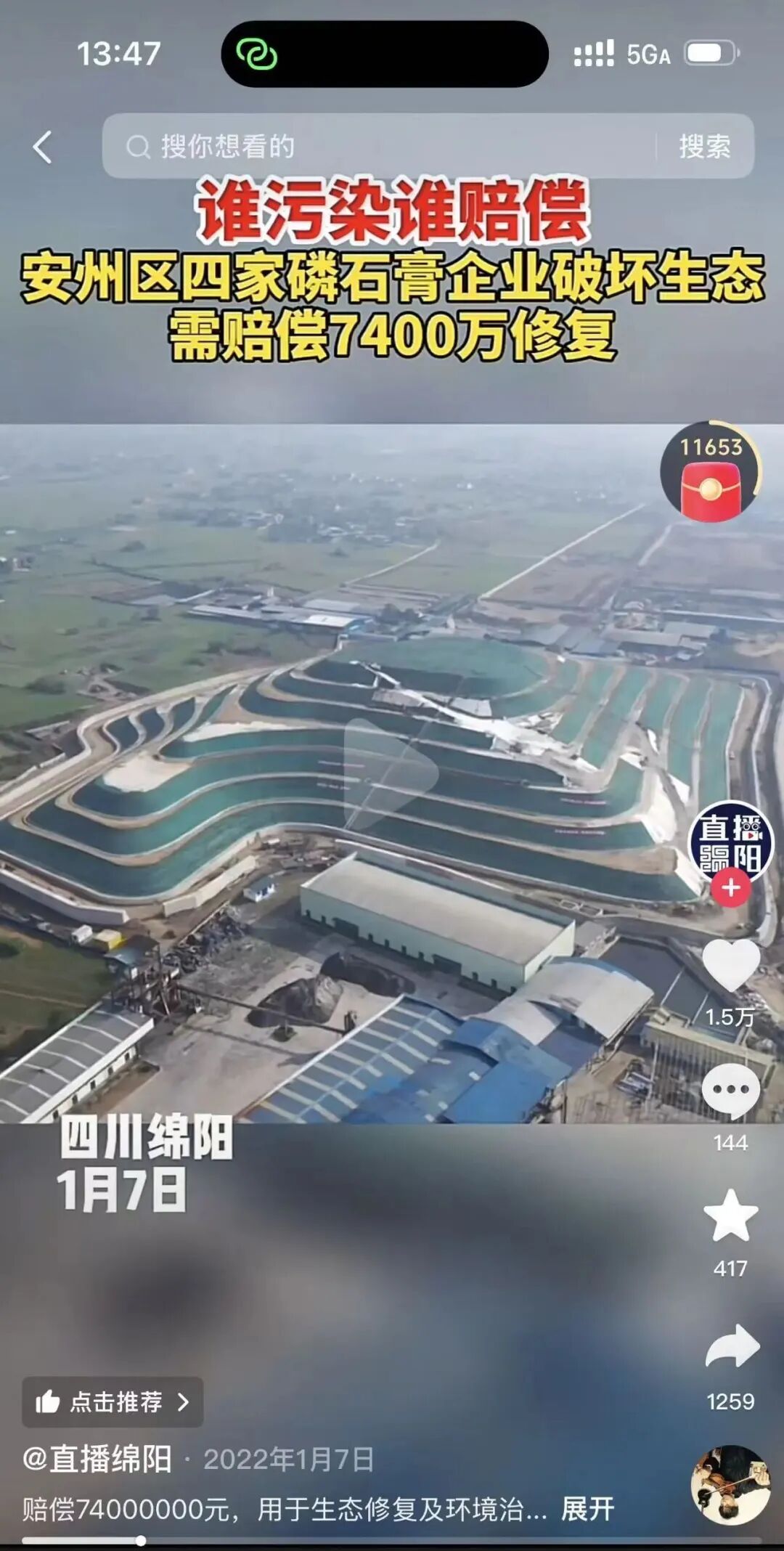
Chaoyang Phosphate Fertilizer Plant and four enterprises (Jinhong Feed, Lulin Chemical, Shenlong Heavy Industry, and Chuan Yin Chemical) that were once named by the Central Ecological Environmental Protection Inspection Team are located in the Ganhezi Basin of Anzhou District, Mianyang City. This area is a historical concentration area of phosphate chemical industry and has paid a heavy price for poor environmental management: from 2017 to 2018, these four enterprises in the same area were reported 18 times by the public due to environmental problems and suffered 11 administrative penalties, which were characterized as “repeated violations and violations while changing”. Due to the lack of “three-prevention” measures in the phosphogypsum storage yard, the leachate was directly discharged, leading to the overall phosphorus and fluoride exceeding the standard in the Ganhezi water body, and the water quality had deteriorated to Class V. In the end, these four enterprises were required to jointly bear the ecological environment damage compensation of up to 74.133871 million yuan due to ecological environment damage.
The fact that Chaoyang Plant still experienced repeated and lethal acute pollution incidents under such a high-risk and high-cost accountability background indicates that the environmental responsibility awareness of enterprises and the deterrent power of local supervision still have structural defects.
Accountability and governance, how to rebuild regional environmental trust?
The repeated pollution crisis of Chaoyang Phosphate Fertilizer Plant has escalated into a serious public safety and economic issue. Future accountability paths must go beyond traditional administrative fines.
In view of the risk of high-concentration fluoride leakage, the local regulatory authorities must require the factory to:
1. Permanent Production Suspension Audit: Production must not be resumed until a thorough audit has been conducted by an independent third-party safety and technical institution. The audit should focus on the design, maintenance, and emergency response capabilities of the HF capture and purification system.
2. Application of Best Available Technology: Enterprises are required to adopt the highest standards of fluoride neutralization and capture technology and install a continuous emission monitoring system to ensure real-time data connection with the regulatory authorities.
3. Local government departments should launch an investigation: to determine who approved the decision to allow the factory to resume operations in August after the damage occurred, and to hold the relevant management accountable.
4. Initiate the ecological environment damage compensation procedure: The compensation amount must cover the full economic losses of the damaged crops, the long-term restoration costs of the bamboo forests, and the long-term medical monitoring costs for the residents of the affected community. Only by raising the illegal costs of enterprises to a level far exceeding their compliance costs can the risk vicious cycle of the phosphate chemical industry cluster in Anzhou District be effectively avoided.
Discover more from 自由档案馆
Subscribe to get the latest posts sent to your email.