

(I have a last-minute engagement tonight and don't have time to write an article, so I'm sharing one that was previously banned.)
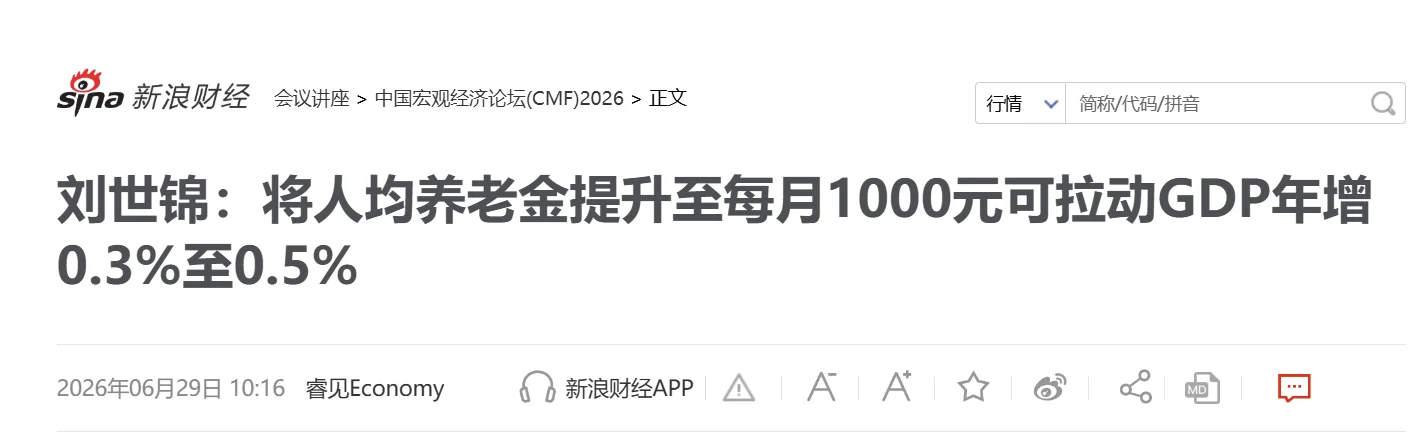
Liu Shijin, Vice Chairman of the Economic Committee of the 13th National Committee of the Chinese People's Political Consultative Conference and former Vice Director of the Development Research Center of the State Council, proposed a figure at the China Macroeconomic Forum on June 27:
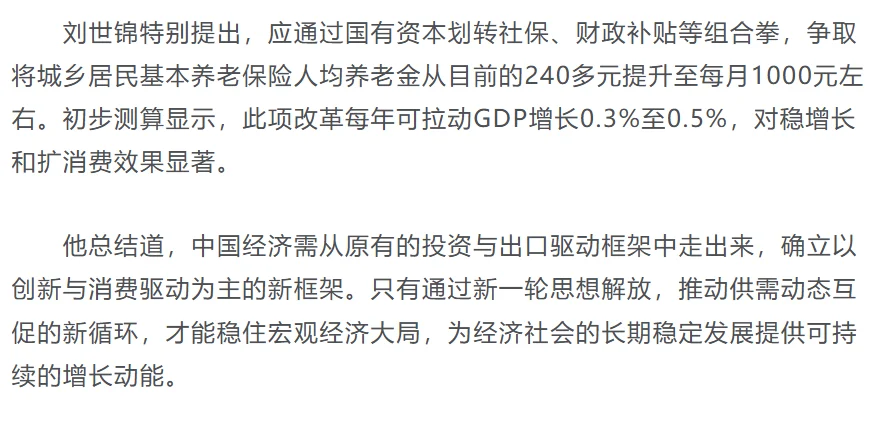
Increase the basic pension for urban and rural residents from the current over 240 yuan to 1,000 yuan per month.
He said this is one of the ways to solve the problem of insufficient domestic demand.
Preliminary estimates suggest it could boost GDP growth by 0.3% to 0.5% annually.
He is not the first to make this suggestion.
Zheng Gongcheng has proposed it, Cai Fang has proposed it, and Xing Ziqiang has also calculated it.
Every time it is proposed, there is a discussion, and then it is drowned out by louder voices.
This year is different.
Retail sales have turned negative in the first five months, investment is in negative growth, and exports are facing increasing uncertainty.
The two engines are slowing down, and the third engine – consumption – cannot afford to stand still.
The timing of Liu Shijin's speech is more mature than ever before.
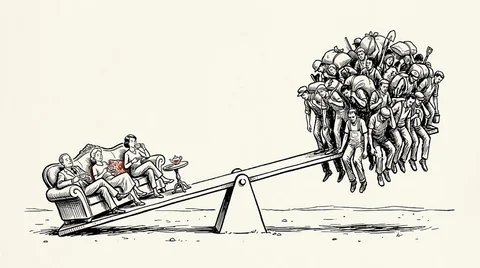
Liu Shijin used a term: “K-shaped development.”
This term has often been used in recent years to describe the stock market – a few sectors going up, and most sectors going down.
But he is referring to the entire economy: exports and innovation are going up, while domestic demand and consumption are going down.
The gap between the two lines is widening.
He attributes the root cause of the gap to one thing: savings rate is too high, and consumption rate is too low.
China's savings rate has long been above 40%.
Corporate savings are high because state-owned capital retains more profits and distributes less dividends, leading to a large amount of funds being converted into investment.
High household savings mainly come from high-income groups – they contribute the vast majority of savings but have a very low propensity to consume.
And low-income groups who truly want to consume do not have surplus money.
This structural mismatch is not new.
In the past, when real estate and infrastructure investment were at high levels, non-productive investment supported terminal demand, masking the contradiction of low consumption as a proportion of GDP.
Now that real estate and infrastructure have declined, the weakness of consumption is fully exposed.
According to Liu Shijin, China's consumption as a percentage of GDP is about 20 percentage points lower than the international average – not “slightly low,” but a “structural deviation.”
For some time, the main means of boosting domestic demand has been consumption subsidies.
Last year, the total national subsidy was about 300 billion yuan, and the third batch of 62.5 billion yuan was launched at the end of last month. These measures logically fall into the category of tapping into existing resources – encouraging those who already have the ability to consume to spend more.
At this point, the potential in this direction has largely been exhausted.
High-income groups already have a low propensity to consume, so the increase in spending, no matter how stimulated, will be limited. When it comes to spending money, there is strength in numbers. We need to enable those without money to have the ability to spend, so that the proportion of consumption in GDP can move from 40% upwards.
The simplest way to enable those without money to have money is to give them money.
The most troublesome aspect of giving money is the cost of identification – how to ensure the money reaches those who truly need it, and how to prevent it from being lost through layers of approval.
Elderly rural residents are the optimal solution to this problem.
This group is clearly defined and requires almost no identification.
The basic pension insurance for urban and rural residents already covers about 170 million beneficiaries, and the accounts are in place; only the amount needs to be increased.
No new registration, no eligibility verification, no new systems are needed. The administrative cost is almost zero.
The conversion rate to consumption is also almost certain.
The average monthly pension for elderly rural residents is over 240 yuan, and their daily expenses are squeezed to the limit.
Every extra yuan received will be spent – to buy groceries, to buy a piece of clothing.
It's not that they don't know how to spend money; it's that they have been poor their whole lives and have no surplus money.
If they have a stable monthly income, consumption is something that doesn't need to be taught.
The ripple effect may be more significant than direct stimulus.
The two most struggling generations in China are often in the same family: elderly rural residents in their sixties and seventies, and their children in their thirties and forties.
The latter group is the main force of migrant workers and also one of the groups that dare not consume the most – not because they have no income, but because they have no safety net behind them.
If parents in their hometowns receive a fixed pension of several hundred or a thousand yuan per month, their children's anxiety about the future will be significantly reduced.
They don't need to save enough for their entire retirement; they can afford to spend a little more today.
Liu Shijin's estimate is relatively conservative, with an annual boost to GDP growth of 0.3% to 0.5%, or about 1.2 trillion yuan.
Xing Ziqiang's estimate is more aggressive: consumption as a proportion of GDP can increase from 40% to 45%, and China's consumer market size can reach 10 trillion US dollars.
Regardless of the calculation method, the numbers add up positively.
But the old problem remains, where does the money come from?
The premise of asking “where it comes from” is to first ask “where the money is now.”
The current fiscal subsidy for pension insurance exceeds 2 trillion yuan annually.
The vast majority of this money flows to the basic pension insurance for urban employees.
Beneficiaries of the basic pension insurance for urban and rural residents – mainly elderly rural residents – receive only over 240 yuan per month on average.
In the same country's pension system, one group receives five or six thousand yuan or even more per month, while another receives over two hundred yuan.
The gap is not a few times, but twenty to thirty times.
During the pension convergence reform in 2014, to avoid opposition from within the system, it was explicitly promised that “interests would not be harmed.”
To offset the expenditure of individual contributions, the average wage of in-service employees increased by 50% in three years, and the average retirement pension within the system rose from over 2,000 yuan per month to the current over 6,000 yuan.
This was carried out very thoroughly – demonstrating that there are no technical obstacles to increasing pensions, and the money can be found.
It's just a matter of which direction to apply the effort.
Therefore, the money to increase farmers' pensions does not need to be raised from scratch.
The existing fund of over 2 trillion yuan only needs to be reallocated.
Shift from favoring urban areas to considering rural areas, from subsidizing relatively well-off groups to subsidizing groups with almost no security.
This is not a question of “whether there is money,” but a question of “how to distribute the money.”
There are roughly three paths to achieve this.
The simplest is to directly increase the basic pension.
Raising the standard from 240 yuan upwards has no operational threshold.
However, if the other end – the excessively high retirement pensions within the system – is not addressed.
Simply adding new funds will accumulate fiscal pressure and will not completely resolve the issue of fairness.
If this path is taken, at least a mechanism to suspend the growth of retirement pensions should be established concurrently.
For example, if it is higher than the average wage, it should not be increased for now.
A more thorough solution is the universal non-contributory pension that Cai Fang has always advocated: no individual contributions are required, it is borne by the fiscal budget, and covers all groups.
Based on the current total subsidy of over 2 trillion yuan (note: this refers to the subsidy portion being equally distributed; individual account contributions will still be received as before), each person would receive about 560 yuan per month.
No additional compensation will be provided beyond this, and the employee pension insurance fund will strive to achieve a balance in the current period.
The benefit of doing so is that it naturally achieves “one declines, the other rises” — there is no longer a need to adjust the pensions within the system separately, and the system itself becomes fair.
On this basis, the contribution ratio for employee pension insurance can be reduced from the current 24% to around 12%, leveling it with the United States, Canada, and South Korea, which is beneficial for activating the economy and promoting employment.
The biggest and most obvious resistance to this path is that the group that benefits the least is precisely the group with the greatest voice.
There is also a compromise route in between.
Chengdu's approach is that after farmers contribute to the urban-rural resident pension insurance at the upper limit, the basic pension is calculated by referencing the method for urban employees, determined by multiplying the average social wage by a coefficient.
Currently, farmers in Chengdu who contribute at the upper limit receive 707 yuan per month, plus a fiscal subsidy of 163 yuan, totaling over 800 yuan, second only to Beijing and Shanghai.
The cleverness of this model lies in its use of the same set of calculation formulas, which naturally bridges the urban-rural gap.
The drawback is that it requires higher contributions and needs a patch of interest-free or low-interest loans for low-income groups.
Returning to the question at the beginning: can increasing farmers' pensions solve the problem of insufficient domestic demand?
Yes, but it can only solve part of it.
Not all of them, but it might be the one with the highest cost-effectiveness, broadest coverage, and fewest side effects among all feasible solutions currently available.
It has simultaneously activated the two generations with the least spending power and the most reluctance to spend.
Frankly, it is not common for a policy tool to reach these two groups at the same time.
And its positive side effects are not limited to the economy.
An elderly person in the countryside can receive a decent pension every month, and no longer needs to curry favor for a bag of rice or a bucket of oil; their children working in the city can also have one less worry at the end of the month.
This is not charity, but a part of the dividends accumulated from decades of high-speed economic growth—released from the path of high savings and high investment, and flowing back to those who once contributed but were forgotten by the distribution mechanism.
Liu Shijin said that this requires a new round of ideological emancipation.
The “ideological emancipation” he mentioned probably refers to looking at the problem from a different perspective:
When consumption becomes the biggest bottleneck for economic growth, social security expenditures, previously considered “draining the treasury,” are no longer costs, but investments.
And possibly the investment with the highest rate of return right now.