Source: Yanshu Lou Channel
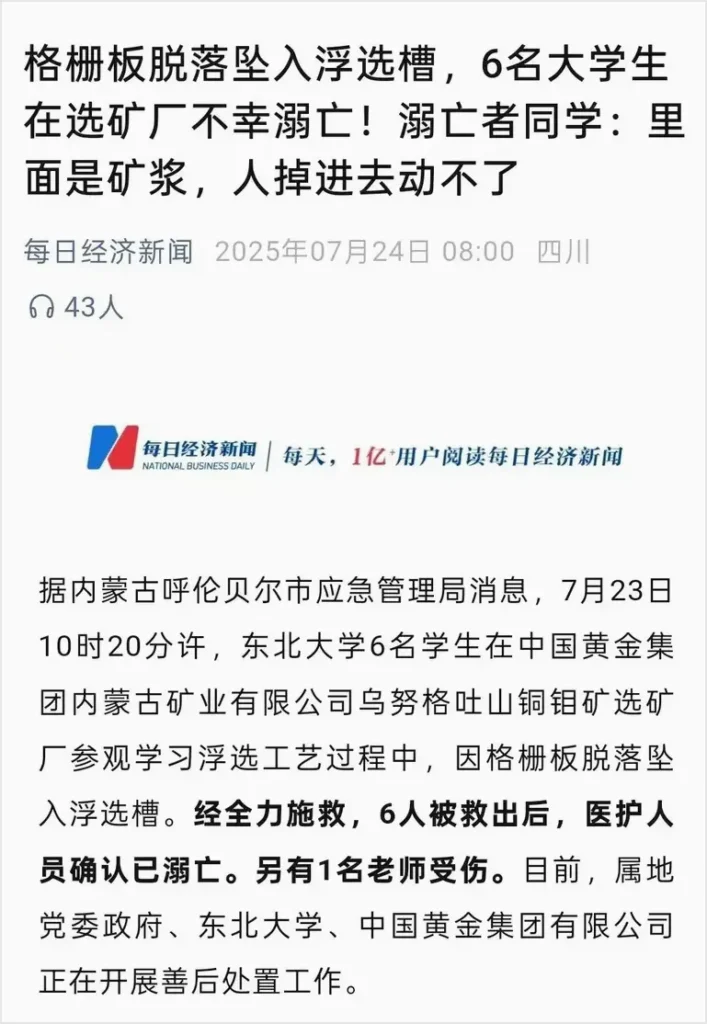
At six o’clock in the morning, a push notification popped up on my phone: Six third-year students from Northeastern University, during their internship at the Wungetu Mountain beneficiation plant in Inner Mongolia, fell into a flotation tank due to the grating plate falling off, and all drowned.
I stared at the words “drowned” for a long time, and felt that Chinese characters are truly merciful—that wasn’t water, it was a mine slurry thicker than cement; that wasn’t drowning, it was a tearing orchestrated by chemical agents, mechanical impellers, and tens of thousands of tons of ore powder. Six children, the oldest 22 years old, the youngest only 20.
They were studying mineral processing engineering, and many were the first 985 graduates in their villages. Their parents mostly worked in county towns, scrimping and saving to pay for their tuition, hoping their children would graduate and go to Africa to repair copper mines, sending back a hundred thousand yuan a year, which would be enough to add a second floor to their house.
Now, the second floor will never be built, but the sky of six families has already collapsed. The official report was very short:
“At approximately 10:20 a.m. on July 23, the grating plate suddenly fell off, and the teachers and students fell into the flotation tank. After all-out rescue efforts, the six students showed no vital signs.”
The wording was restrained to the point of cold-bloodedness. But the students at the scene told me:
“What ‘all-out rescue’? From falling in to being completely fished out, 47 minutes.
The flotation tank is 12 meters deep, with a slurry density of 1.6, which is even harsher than a swamp. People don’t even bubble up when they go down.
Rescue? That was salvage. A grating plate became the broken bridge for six families.
According to industry standards, it should have been able to bear 800 kilograms per square meter, and seven people with an average weight of 65 kilograms stood on it, using only 60% of the safety factor.
But it just happened to break that day.
The students said: “Before we stood on it, no one warned us of the danger, nor did anyone count the number of people. The teacher just said, ‘Everyone get closer, so you can see clearly.'” Ironically, this enterprise under China Gold, just issued a tweet in February this year, “The flotation workshop successfully completed the grating plate replacement, zero accidents for the whole year”, and the red banner in the picture was wider than the mine pit.
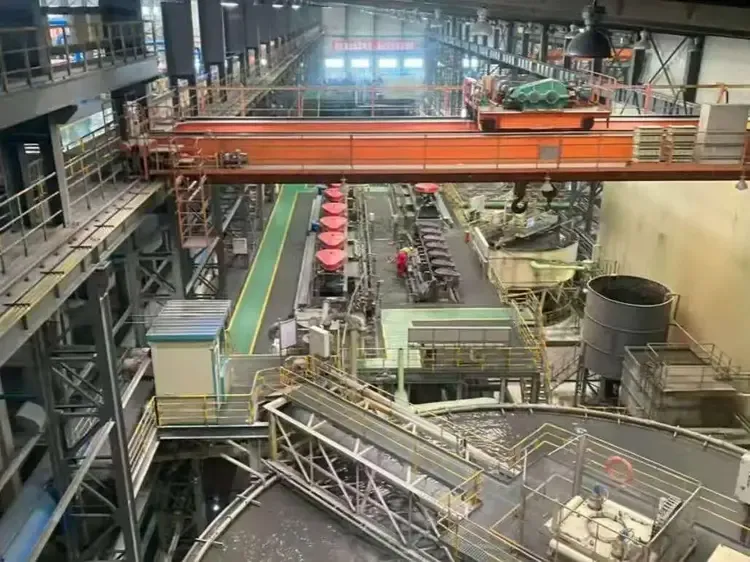
On July 11, they also held a safety production meeting, and the first page of the leader’s PPT read “Life First” in four big characters.
Before the words were finished, six children used their lives to fill in the footnote for the PPT:
“Life first, but the grating plate is an exception.” What’s more absurd is that some students found the rectification notice issued by the Inner Mongolia Emergency Management Bureau to the plant in 2023:
“The grating plate’s load-bearing capacity is insufficient, with multiple areas of rust, and safety warning signs are missing, with a three-month deadline for rectification.”
Now, more than a year has passed since the deadline, the plate has rusted and broken, and lives have also been lost. Someone asked: Why did you let the students stand directly above the flotation tank?
The answer is simple—to save money.
The factory treated the internship as an “image project”, and the school treated the internship as a “teaching task”. Neither side regarded the students’ lives as a “cost”.
The 30-person internship group crammed the workshop, which was originally a two-shift operation. The enterprise saved on explainers, and the school saved on practical training equipment. It was a win-win situation, until the moment the children fell in. Some people say this was an “accident”.
But the word “accident” cannot stop three glaring violations:
First, the high-risk area was not subjected to load assessment, allowing 7 people to stand on the grating plate at the same time;
Second, before the internship, no three-level safety education was conducted in accordance with the “Safety Production Law”, and the students were brought into the plant without even knowing the composition of the slurry;
Third, the equipment was not scrapped after its service life expired, and the area of rust was visible to the naked eye, but it was suppressed by the KPI of “repairing the old and making use of it”. Behind each violation is a small calculation of “saving a bit”:
Saving the money for a new grating plate, saving the money for a safety training, saving the money for a site administrator.
Six children became the rounding in this “saving” that was erased. The most heartbreaking thing is that the teacher in charge had only been working for two years, and the students said he was “a very nice person, afraid of us getting heatstroke, and bought us ice-cold cola with his own money”.
Now he is lying in the ICU, with 40% chemical burns all over his body, and the first thing he said when he woke up was:
“Where are the students?”
No one dared to answer. One of the predecessors of Northeastern University is the Shenyang Gold College, the “Whampoa Military Academy” of the national non-ferrous metal system.
Among the children who died this time, three were from Chaoyang, Liaoning, two were from Handan, Hebei, and one was from Suihua, Heilongjiang, all of whom were “small-town test takers”.
They were originally going to sign three-party agreements this October, to go to Africa, to South America, to the places in the country that need ore the most. The money they sent back in three years would be enough to pay off their student loans.
Now, the loans don’t need to be repaid, and the people are gone. Zhou Zhou, the chairman of China Gold, is an alumnus of Northeastern University. On the day of the incident, he reposted a “deep condolences” in his Moments, with a picture of a black candle.
Someone in the alumni group @ him: “Senior, the children went to see the mines of our group.”
He replied with a folded-hands emoji and said nothing more. The dormitories of the six children are still in their original state.
On the desk of the lower bunk, there is a copy of “Flotation Principles”, with the inscription:
“Study science and mathematics well, and you won’t be afraid to go anywhere.”
They didn’t go anywhere, they only went to the 12-meter-deep mine slurry. According to Article 1179 of the “Civil Code”, the death compensation = the per capita disposable income of urban residents in the previous year × 20 years.
The figure for 2024 is 49,283 yuan, multiplied by 20, and then multiplied by 6, totaling 5.9 million.
On average, less than 1 million for each child.
A netizen said: “1 million, you can’t buy a toilet in Beijing, Shanghai, and Guangzhou, but it can buy a lifetime of a 985 university student.” What’s more pessimistic is that this money will likely still come from the insurance company.
The enterprise’s annual safety budget will still have a surplus, because they “saved” the money for six new grating plates.
At the year-end summary meeting, the PPT will still read “zero work-related deaths for the whole year”, because those six are “interns” and are not counted as “workers”. When I wrote this, it was already dark.
I found the Wungetu Mountain mining area on the map. In the satellite image, the huge mine pit looks like a black hole, swallowing the mountain and also swallowing youth.
The names of the six children have not yet been updated on the official website, and the status on the Xuexin.com is still “enrolled”.
Their WeChat avatars will never light up again, but they will always be stuck in “internship”. Finally, let’s end with a safety slogan from the mining area—
“Today’s safety investment is tomorrow’s life interest.”
Unfortunately, the six children will never receive tomorrow’s interest again.
Discover more from 自由档案馆
Subscribe to get the latest posts sent to your email.