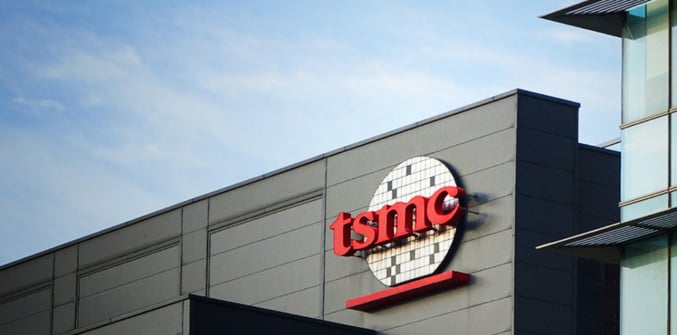
A major piece of news: TSMC is going to stop supplying. According to information obtained by Jiwei.com from multiple sources, TSMC has sent formal emails to all current mainland Chinese AI chip customers, announcing that starting November 11th, which is next Monday, it will suspend the supply of all 7-nanometer and more advanced process chips to mainland Chinese AI and GPU customers.
As for whether it can be restored and when it will be restored, there is no accurate news yet.
But considering that TSMC’s supply suspension order was issued after Trump’s election, it is hard not to suspect that this move is in advance to cooperate with the United States in fighting a tech war.
Since the Trump 1.0 era, the chip war has become one of the main axes of Sino-US relations, and as the world’s largest chip foundry, TSMC plays a crucial role in it. From the beginning of prohibiting the foundry of advanced chips for Huawei to building factories in the United States, TSMC has become a finger of the hand that the United States is holding to choke China’s chip neck.
The other four fingers are the core patents held by the United States, the lithography machines of the Netherlands, the semiconductor materials of Japan, and Samsung, which is closely following TSMC. These five fingers together constitute the United States’ comprehensive blockade of China’s chips.
After Trump returns to the White House, the flames of war in the chip field will only become more intense, and TSMC’s suspension of AI chips this time is the top priority.
In the digital age, artificial intelligence is regarded as a strategic high ground for technology, and countries that take the lead in promoting artificial intelligence are expected to completely liberate human productivity. Imagine, all the work and operation of human society are done by robots, how much value and wealth will this create? If it is said that in the 20th century, whoever controlled oil controlled the world, then in the 21st century, whoever controls artificial intelligence can control the world. Therefore, as early as Trump’s first term, China and the United States made long-term strategic plans for artificial intelligence. For example, in 2017, China pointed out in the notice of the new generation of artificial intelligence development plan that by 2030, China will build a world artificial intelligence innovation center and a strong science and technology country. In the same year, the core industry scale of artificial intelligence exceeded one trillion yuan, driving the related industry scale to exceed 10 trillion yuan.
After seven years of development, China and the United States have their own strengths in this war that has long been filled with smoke. China occupies an absolute advantage in application and market. Data show that the number of supercomputers used by China to support artificial intelligence is 1.54 times that of the United States, cloud computing applications are 7 times that of the United States, mobile payment is 7 times that of the United States, the employment categories covered by AI are 13 times that of the United States, the progress of industrial internet is 2.3 times that of the United States, and the estimated industry scale in 2030 is 2.23 times that of the United States.
The United States, on the other hand, has technological advantages. The underlying architecture of artificial intelligence is chips, because the premise of AI operation is calculation, and all projects involving calculation need chips to complete. Currently, the top five AI chip manufacturers in the world are TSMC, Samsung, Nvidia, Intel, and Foxconn. Nvidia and Intel are American companies. Although TSMC, Samsung, and Foxconn are not American companies, the equipment they use to produce chips comes from the supply chain controlled by the United States, ASML.
And TSMC, as the largest chip foundry, its AI chip production capacity accounts for more than 90% of the global market share, which is enough to see TSMC’s absolute influence in the field of AI chips.
2024 is almost over, and there are only six years left before China builds a global AI power. This is also our most critical 6 years. TSMC’s suspension of AI chips in the mainland at such a critical juncture, who would believe that it has no intention of cooperating with Trump to suppress China’s artificial intelligence? Some people may say that TSMC’s suspension this time is only for AI and GPU chips, and it has not touched consumer electronics chips with higher output value and a wider range, such as mobile phone chips and automotive-grade chips, which shows that TSMC does not really want to stop supplying, but just can’t withstand the pressure.
Yiyi wants to say that TSMC is not unwilling, but dare not, because China solved the mass production problem of domestic 7-nanometer chips as early as last year. On March 30, 2023, the first domestic 7-nanometer automotive-grade SoC chip, Longying No. 1, was officially mass-produced and released in Wuhan Economic and Technological Development Zone; in June of the same year, the Mate60 equipped with domestic 7-nanometer chips was born, and thus, the domestic core problems of the two largest downstream markets of advanced process chips were all solved. In this case, if TSMC dares to completely stop supplying 7nm chips, it will immediately lose the world’s largest chip market.
Misfortune may be a blessing in disguise. The pressure from the enemy is the driving force for our growth. Just like Huawei faced the suppression of the United States, Mr. Ren Zhengfei did not complain, but thanked Trump, thanking him for letting the world know the strength of Huawei. We should remember a sentence: what does not kill you will eventually make you stronger.
Discover more from 自由档案馆
Subscribe to get the latest posts sent to your email.