
Recently, I’ve needed to research some relatively low-level technologies at work, so I’ve been searching for information and doing various investigations online.
I usually just look up some simple knowledge points, so Chinese technical content is sufficient. But in the current situation, I’ve found that high-quality content in China is dead.
Specifically, in the past 10 years, China’s internet technology and business have flourished. Many people, whether based on interest or other motivations, would share their learning and summaries of some technologies.
So we can see a lot of open-source programs online. Early on, there were discuz open-source forums, SNS open-source platforms, shopex e-commerce open-source programs, as well as many blog technology websites, such as Sina Blog, CSDN, and CSDN, these websites mainly provide various technical knowledge points, tutorials, and other content from programmers.
But recently, I found that the updates of this content seemed to have stopped abruptly. Instead, there are the old recycled content, article copy-pasting, and marketing-oriented interview training courses, mainly used for cutting leeks, etc.
At the same time, a friend of mine just quit his job to start his own business full-time, and he’s doing developer content. According to him, CSDN’s current behavior is very unsightly, and he still wants to dedicate himself to creating a clean, refreshing, and high-quality content blog forum.
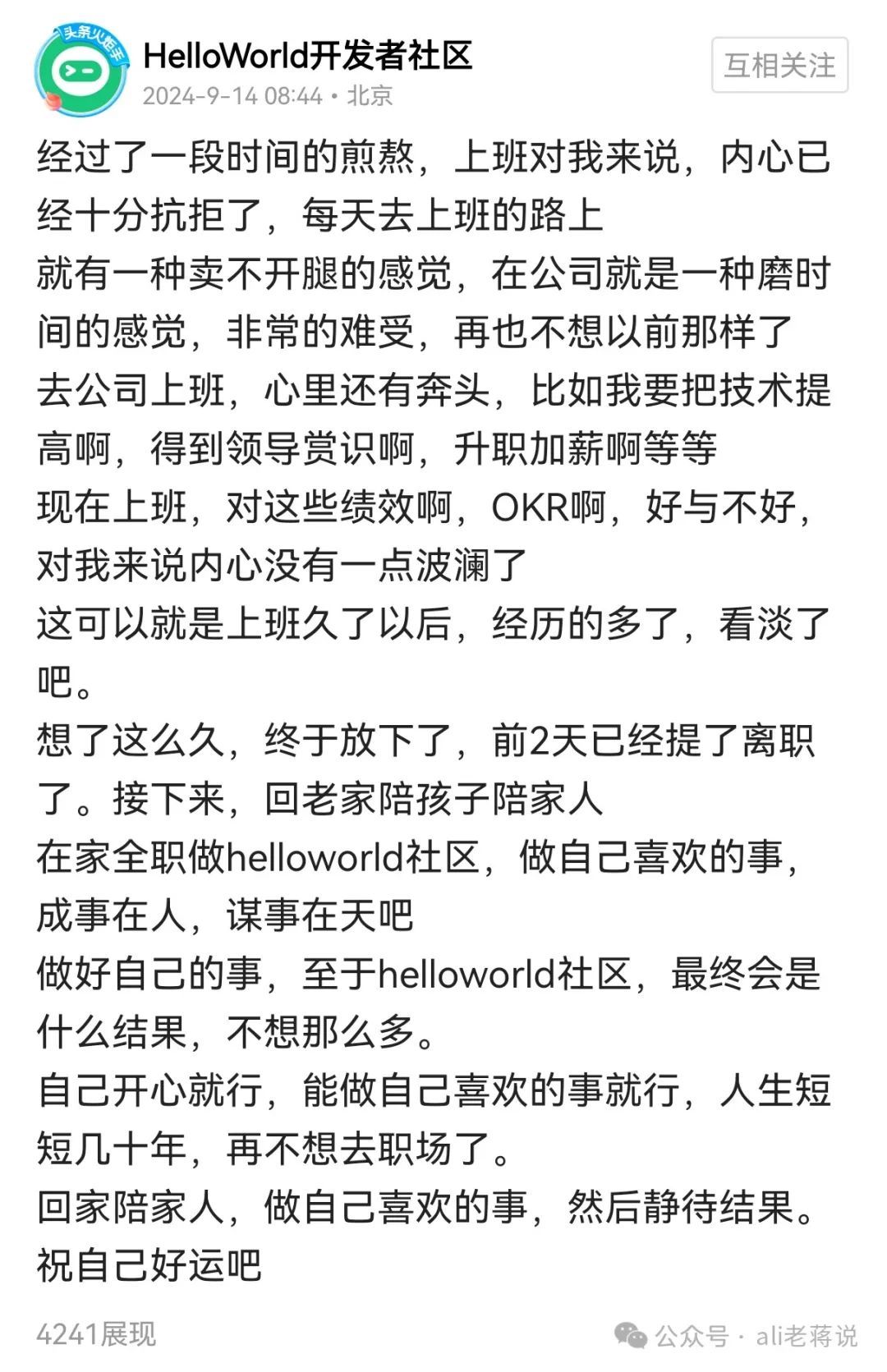
He used to operate part-time, but now he feels the pressure is increasing, so after careful consideration, he quit his job to start a full-time business.
He really has a sense of mission. The website is as follows, you can take a look, https\://www.helloworld.net/.
I really admire him, but in fact, the difficulty of starting a business now is also very great, especially in the direction of a content platform, let alone a technical content platform. Therefore, after he announced his full-time entrepreneurial news, many friends below also mocked him.
Of course, most of them are not optimistic about China’s technical ecosystem, feeling that it’s a dead end to do a technical platform now.
Why are high-quality blogs dead? I have summarized the following reasons.
A very important reason is that internet business is not doing well.
Many people may ignore this important objective factor. Generally, when an industry is booming, it will be accompanied by various ecosystems.
For example, when the internet first started to develop, it was accompanied by a large amount of high-quality original content, because many people, after doing this thing for the first time, had new ideas, new ideas, or new code, and they would often share it immediately.
At the same time, the supporting tools and services in this process will flourish, which is the content’s rising period. As the internet is now starting to mature, the content continues to enrich and improve, and it has reached the platform’s stable period. Finally, with the decline of the industry, content production gradually decreases, and it is filled with low-quality content, until the business eventually disappears, and the content becomes antiques and fossils.
The second is that China’s developer ecosystem is in low-end involution.
This is reflected in the fact that when the internet was first introduced, many people didn’t even know how to make a webpage, so it was easy for people to share some tutorials or blogs at this time.
Especially some basic knowledge, many graduates basically didn’t learn much in their 4 years of university, but they could simply string together a line through various knowledge points on the internet, enabling themselves to have the most basic interview skills.
For interviews and work, China’s internet content is enough to cope with general interviews and actual work.
But most of our content stays at the level of the simplest application layer, such as what some basic concepts are, or what some common interview questions are, or how to add, delete, modify, and query a database, how to start a front-end module, and how to fix some basic bugs.
These all stay at the level of the exam or application layer. Relatively speaking, it is relatively simple and is often suitable for relatively entry-level players to view.
But because we ourselves do not have a rich underlying ecosystem, so no one understands what the underlying logic is, and no one is interested in digging into the underlying logic. For example, MySQL’s source code analysis, the underlying introduction of distributed databases, there are not many decent articles on these contents.
The third is the lack of a long-term incentive environment for content production.
Simply put, if I spend a lot of effort writing very low-level technology or source code, but there is no incentive and reward, it means that this logic is definitely not sustainable.
So now, the technical content in China is filled with short-termism. Whatever makes money fast, do it, such as AI has recently become popular, and countless AI courses have been launched. Many teachers themselves don’t even know what AI is, what the underlying principle is, and they come out to write things and start to swindle money.

And often, what you write is very low-level, and no one reads it, so the author also thinks, why bother writing it so complicated. I believe that we have a lot of technologies and modules in China that have a certain technical depth, but these programmers are not willing to write these contents.
On the one hand, this is the core secret of the company, which will have a certain moat, so from the company’s perspective, it will not encourage everyone to share these very complex technologies.
On the other hand, even if the author is willing to share these technologies, it is difficult for readers to apply them in other companies, so there is no motivation to update these things. After all, it’s hard to find someone who agrees with you, no matter what high-quality content is just a pile of garbage.
So from the current situation, the high-quality content in China, in the near future or even the long term, I think there is no hope. The only thing that can be relied on is the international content, of course, international content is not only the United States, but refers to all countries in the world.
It can be seen that although our productivity in this area may be relatively weak, it is relatively rich from a global perspective. In fact, high-quality content is basically in English now, including some open-source frameworks and their documentation, as well as rich communities.
Of course, it’s not to say that all foreign content is high-quality. I also looked at the technical content on Twitter after bypassing the wall, and there are many low-grade and substandard products. In fact, as long as there is an opportunity, people at home and abroad want to cut leeks and make hot money. Where there is honey, there is a large group of people flocking to it, both at home and abroad.
But one thing is different. Because there are so many people abroad, a hundred flowers bloom, and they advocate individuality, so you can still see many big shots who are willing to share some content, which is to test whether you can get something from it and find nutritious content from it.
Overall, if you want to learn some high-quality content and improve your skills, reading the original English content is an indispensable path. I have talked with many top technical experts in many companies, and they will basically talk about the original English technical articles.

For any technical content, being able to understand the original content means you have the prerequisite to become a great god. If you are just reading content that others have chewed, your level is unlikely to exceed the author of the article.
Discover more from 自由档案馆
Subscribe to get the latest posts sent to your email.