On June 7-8, it was the “Gaokao” (National College Entrance Examination) in mainland China. On the 7th, a Douban user posted: “Record that this Gaokao is the last Mongolian language exam in Inner Mongolia.” The post was quickly deleted after being published.

Later, a Twitter user also posted that it was not only Mongolian, but this year’s Gaokao was the closing ceremony for many ethnic minority language exams.
This year is the last Mongolian language Gaokao in Inner Mongolia, the last Korean language Gaokao in Yanbian, and the last Uyghur, Kazakh, and Kyrgyz language Gaokao in Xinjiang.
“To promote and popularize the national common language and writing”
Currently, there is almost no content related to the topic of “the last Mongolian language Gaokao” on Weibo.
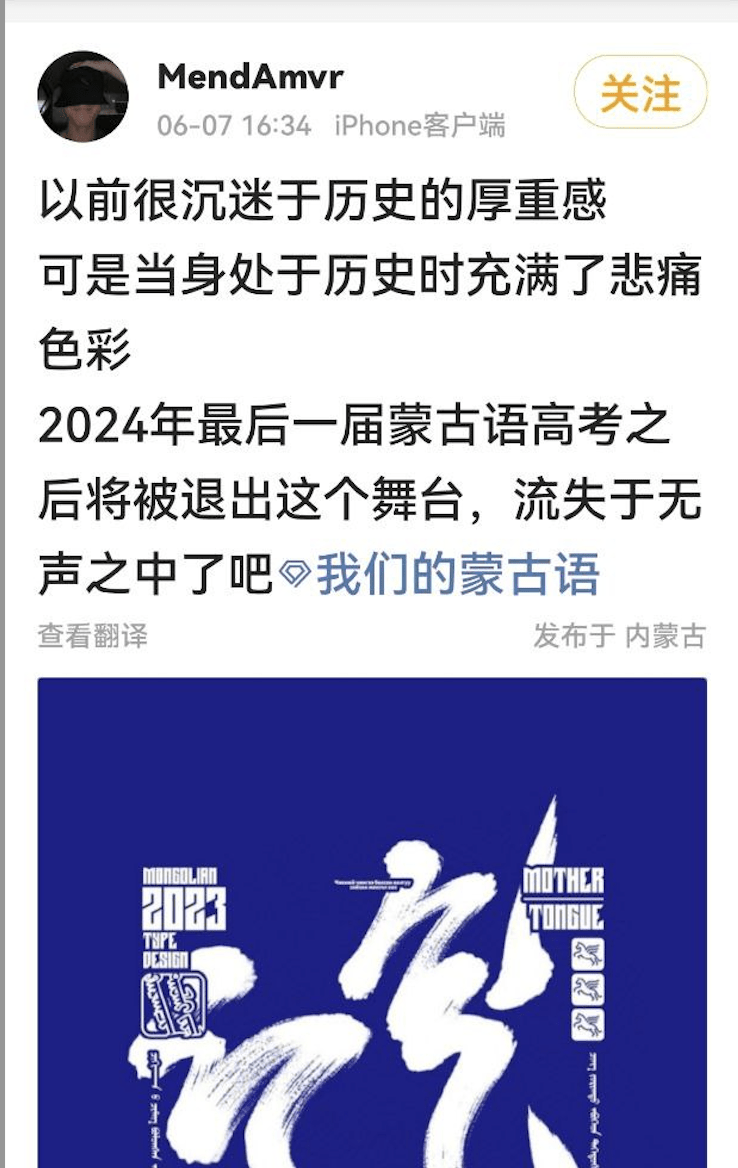
A Weibo user said:
“I used to be very immersed in the weight of history, but when I am in history, it is filled with a tragic color
After the last Mongolian language Gaokao in 2024, it will be withdrawn from this stage and lost in silence.”
Some netizens also expressed their incomprehension about the topic being censored:
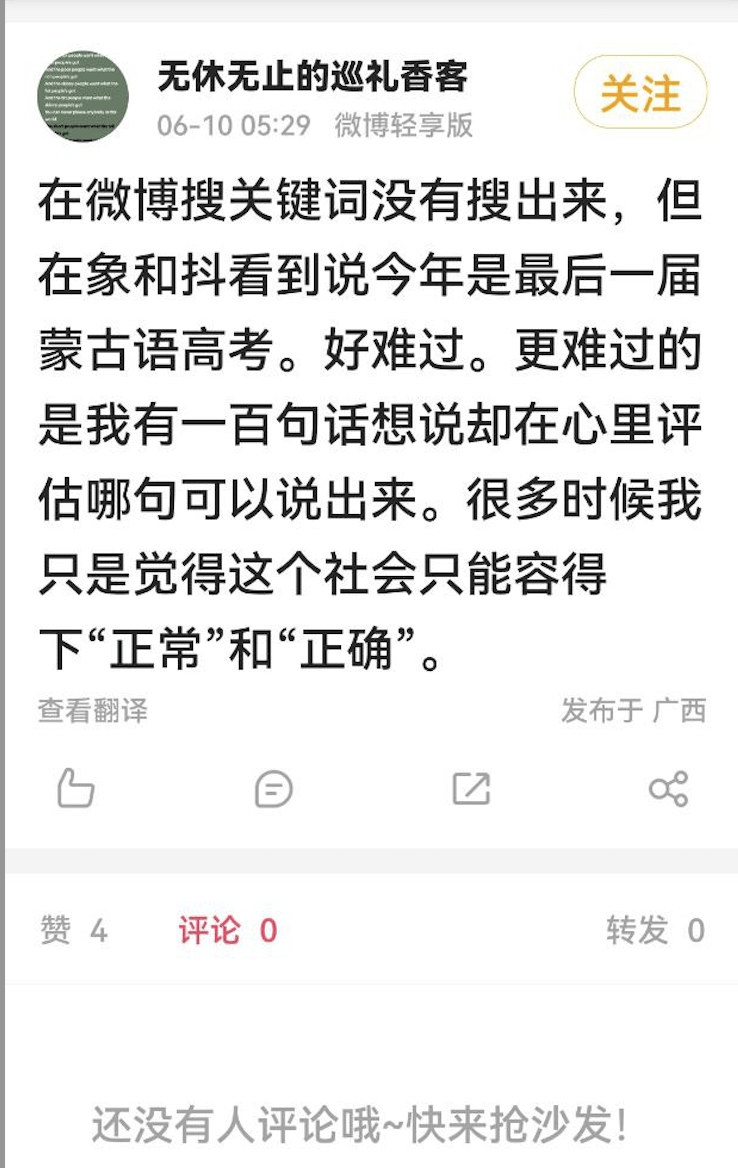
I couldn’t search for the keywords on Weibo, but I saw on Xiang and Douyin that this year is the last Mongolian language Gaokao. I’m so sad. What’s even sadder is that I have a hundred things I want to say, but I’m evaluating in my heart which ones I can say. Many times I just feel that this society can only accommodate “normal” and “correct”.
According to the verification edited by China Digital Times, starting in 2025, 8 new provinces will implement the “3+1+2” Gaokao model. Among them, “3” means Chinese, mathematics, and foreign languages are 3 unified Gaokao subjects, no longer divided into liberal arts and sciences, and the papers are uniformly prepared nationwide, each with a full score of 150 points. “1” means that candidates choose one of the physics or history subjects as the first choice subject, each with a full score of 100 points, and the original score on the paper is included in the total score of the Gaokao cultural subjects. “2” means that candidates choose 2 subjects from ideological and political education, geography, chemistry, and biology as the second choice subjects, each with a full score of 100 points, and the scores are included in the total score of the Gaokao cultural subjects according to the level conversion score.
The 8 new provinces include Inner Mongolia, Qinghai, Ningxia and other areas where ethnic minorities gather.

The Chinese government has been promoting a nationwide campaign to popularize Mandarin, with the goal of increasing the popularity of Mandarin to 85% by 2025. This move raises concerns that local dialects, such as the long-standing Cantonese and Hakka, will further wither under pressure, while ethnic minority languages such as Tibetan, Mongolian, and Uyghur are gradually disappearing due to the authorities’ suppression.
On November 30, 2021, the General Office of the State Council of China issued the “Opinions on Comprehensively Strengthening Language and Writing Work in the New Era”.
The document points out that the use of Mandarin in China is still “unbalanced and inappropriate”, so it requires that by 2025, the popularity of Mandarin in the country will be increased to 85%, further improving the standardization, standardization, and informatization of language and writing, and at the same time significantly improving the technological level and innovation ability of language and writing.
In 2023, Radio Free Asia reported that the Education Bureau of Hohhot, Inner Mongolia, decided in an internal meeting that primary and secondary schools in the city would implement the national common language, Mandarin, from September 1. Mongolian language classes were reduced from 7 classes a week to 1 to 3 classes.
The report said that according to a Mongolian who did not want to disclose his name, the middle school exams in 2025 and the Gaokao in 2028 will use Chinese test papers. The future trend is that Mongolian language will gradually withdraw from Chinese students’ textbooks, but currently, Chinese universities still have Mongolian language departments. This Mongolian said: “It is difficult to judge the future.”
And from the current situation, the Chinese government’s promotion of the popularization of Mandarin is proceeding even faster than expected.