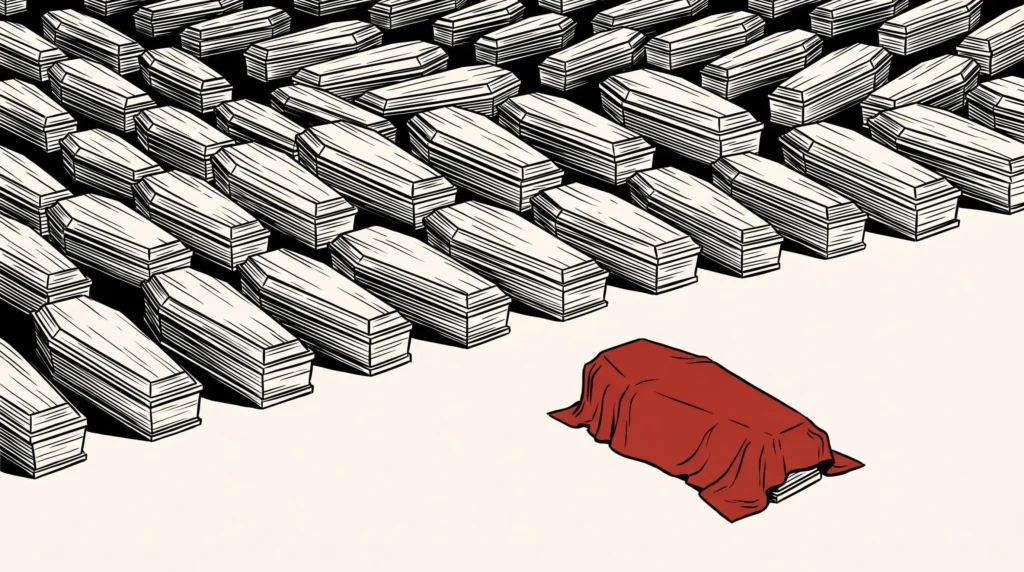
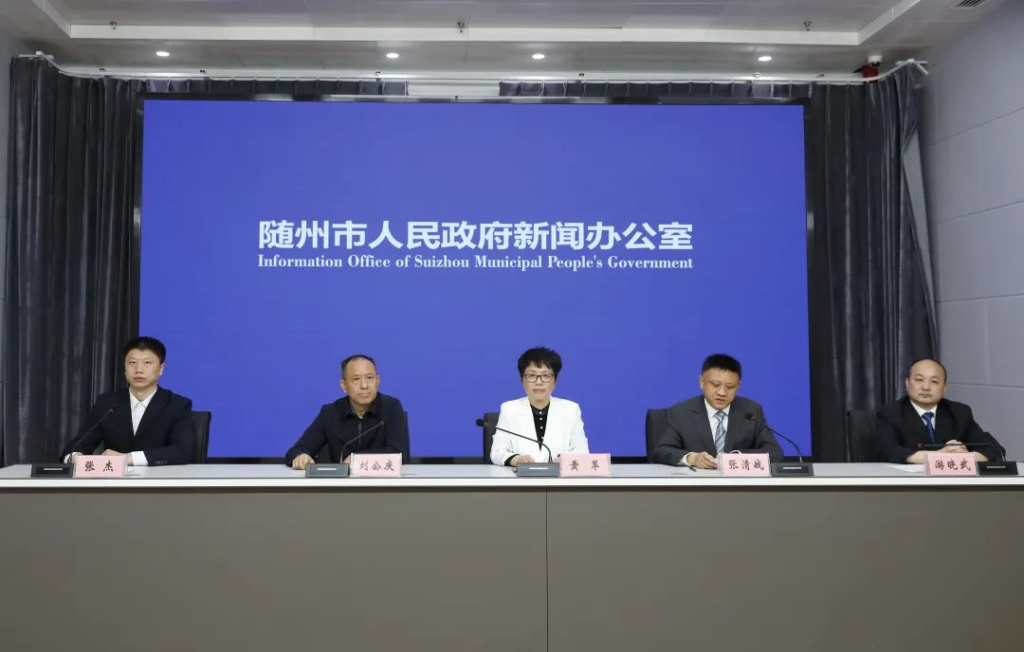
Starting March 20, 2024, the Suizhou municipal government has ordered all residents in the entire area to purchase public cemeteries after death. Even farmers living in the mountains must buy a public cemetery, otherwise their ashes will be withheld and storage fees will be charged. This is an open case of forced buying and selling, and a large-scale ‘real estate for the dead’. All village officials in Suizhou must keep a close watch on the villagers 24 hours a day. Once they find someone has died, they will immediately go to the scene to follow and supervise, ensuring that every deceased person enters the paid public cemetery.
During the May Day holiday this year, a large number of residents in Changling Town, Guangshui City, Suizhou, took to the streets for three consecutive days and blocked National Highway 316, demanding a halt to the forced buying and selling of public cemeteries. The authorities dispatched a large number of police, special police, and auxiliary police to the scene to maintain order, and attempted to take away a young man, but were stopped by the crowd.
Even in the big city of Wuhan, there is no mandatory purchase of public cemeteries. Ashes can be deeply buried without leaving a tombstone, or they can be scattered into the Yangtze River, or they can be brought back to the hometown for burial. In fact, last year, the national funeral regulations deleted the clause of ‘mandatory cremation’, only saying that cremation should be promoted. It neither said that cremation should be mandatory, nor did it mention ‘must purchase public cemeteries’, which is purely the Suizhou local government’s arbitrary violation of national laws and extortion of farmers.
Suizhou is a region of low mountains and hills, with the Tongbai Mountains to the north and the Dahong Mountains to the south. More than 90% of the area is mountainous with sparse population, and plains only account for 7.6%. There are barren hills everywhere that can be used for burial, which does not occupy farmland at all. Moreover, earthen tombs will weather and disappear in at most a hundred years, so there is no need to bury in public cemeteries. Instead of forcing cremation and buying public cemeteries, intensifying conflicts between officials and the people, it is better to prohibit cement-covered tombs and encourage deep burial without leaving tombstones. This way, it neither wastes money and harms the people, nor does it occupy land.
Now that houses are not selling well, the previous land finance is unsustainable. In order to urge farmers to cremate and buy public cemeteries as soon as possible, the Suizhou local government has also launched a series of so-called ‘reduction and exemption policies’, but the common people all know that this is just to lure you into the trap first, and in the later stages, they will definitely increase the price step by step to slaughter you, which is an extra burden on the farmers. Although rural burial also costs money, this money is after all circulated internally among the villagers, and the human relationships help each other. In the end, after offsetting each other, it actually doesn’t cost much money. However, the official deliberately pretends to be stupid and says ‘mandatory cremation and buying public cemeteries is to reduce the burden on farmers’ and ‘mandatory charity’, and then forcibly intercepts this money from the people’s human relationships and takes it for themselves, forcibly competing with the people for profit.
Moreover, public cemeteries only have a 20-year usage period, which is only temporary storage, which is equivalent to making the common people pay fees permanently. When the third and fourth generations no longer renew the fees, they will be dug out and thrown away, which is not at all ‘resting in peace’. To put it bluntly: even if you don’t buy a house while you’re alive, you will be forced to buy a public cemetery when you die.
Suizhou is a small, fifth-tier mountainous city with an economy mainly based on agriculture, and the lives of the vast number of farmers are not rich. As local administrative leaders, instead of thinking about how to attract investment to develop the economy and benefit the people, they are instead thinking about how to extort the common people. They consider themselves clever and ‘discovered business opportunities’, and they actually see the aging population as a wonderful opportunity to exploit farmers, so they came up with the unethical idea of ‘real estate for the dead’.
According to reports from Shangguan News——
On January 15, 2024, local media published ‘Suizhou Releases the Latest Policy Q&A, Concerning This Reform’ (hereinafter referred to as ‘Q&A’), which answered questions related to the funeral reform policy of Suizhou City.
The ‘Q&A’ mentioned that the city’s old funeral customs have a far-reaching impact, with private burial, scattered burial, and reburial of ashes in coffins being very common. The use of burial land is becoming increasingly tight, the ecological environment is being damaged, and mountain fires during sacrificial activities occur from time to time. The phenomenon of extravagant funerals and ostentatious displays puts a great burden on the masses.
‘The cremation rate in the city’s original cremation area was only about 40%, far below the provincial average.’ The goal of the all-area cremation policy is ‘100% coverage of funeral facilities, 100% cremation of remains, and 100% burial of ashes in public cemeteries’.
The aforementioned ‘Notice’ and ‘Q&A’ sparked heated discussions among netizens. Some supporters said: ‘Entering the public cemetery reduces the cost of coffins and coffin bearers, and the overall expenses are reduced.’ ‘Traditional funeral customs are not good, generally costing sixty to seventy thousand, it is enough to be filial before death and have a simple burial after death’.
There are also a large number of people who disagree with the mandatory entry into public cemeteries, believing that ‘as long as it doesn’t occupy basic farmland, it’s better to let nature take its course’. In addition, they worry about ‘having to spend money on subsequent management, and what if future generations don’t renew the fees’.
The reporter noticed that the ‘Q&A’ also mentioned that after the ‘Notice’ is implemented, in special circumstances, couples cannot be buried together in a tomb. ‘If one spouse has been buried and a grave has been reserved for the other spouse, and the other spouse dies after 0:00 on March 20, 2024, they cannot be buried together with the previously buried spouse. The remains must be cremated, and the ashes must be buried in a public cemetery. Otherwise, it will cause comparison and make it difficult to ensure the fair implementation of the all-area cremation policy.’
This clause also sparked heated discussions among netizens, with comments like ‘Are they not allowed to be buried together in the future? Are they going to tear people apart? Special circumstances require special handling’.
Discover more from 自由档案馆
Subscribe to get the latest posts sent to your email.