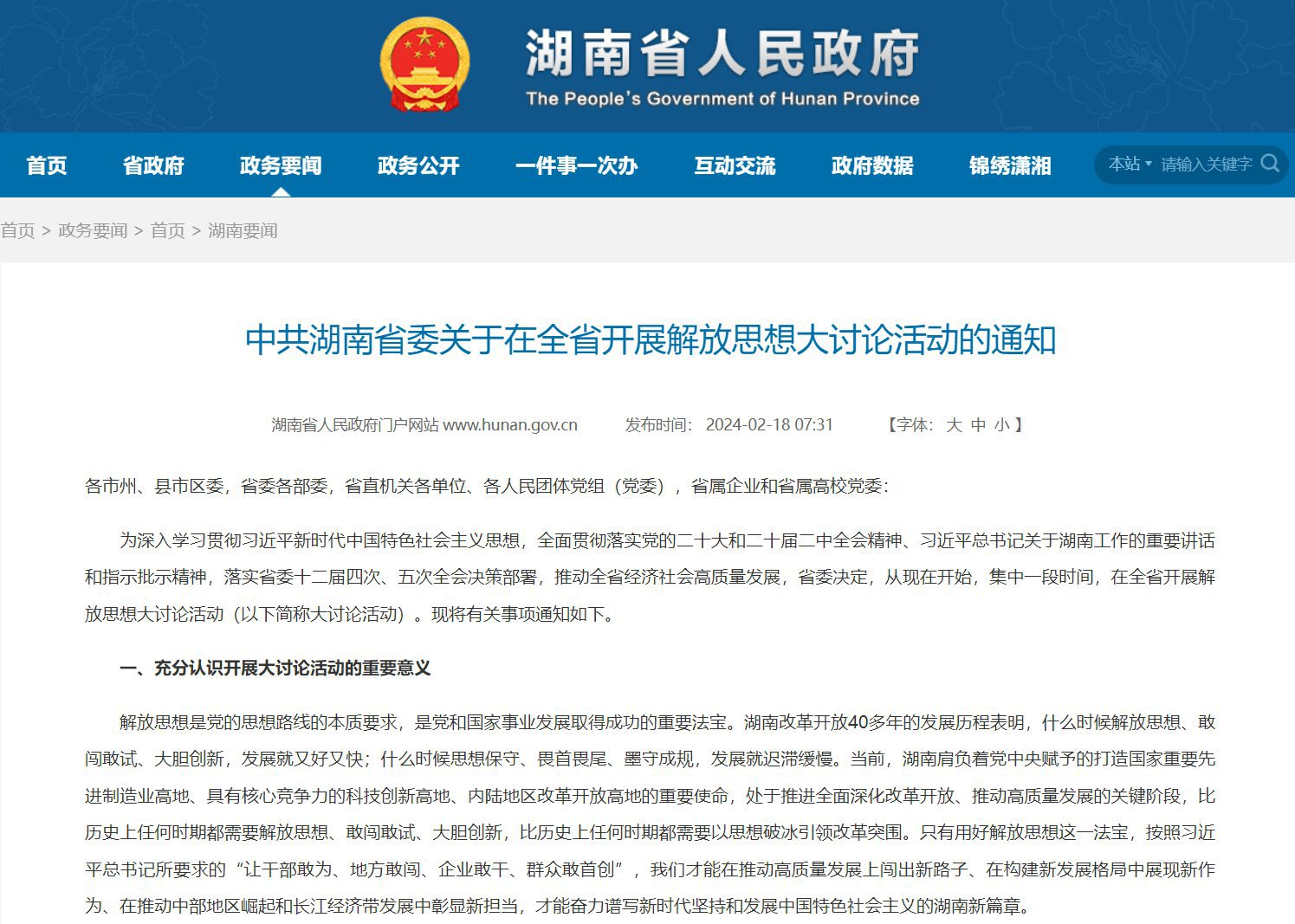
On the first day of work after the Lunar New Year, the Hunan Provincial Party Committee issued a notice calling for “a major discussion on the emancipation of minds throughout the province.”
Everyone is very sensitive and excited about the emancipation of minds, because the two emancipations of minds in the past 50 years have changed the fate of the country and led China onto the fast track of development. Therefore, when they see the words ’emancipation of minds’, they will subconsciously refer to these two times.
The first emancipation of minds was in 1978. At that time, the top leader wanted to continue on the old path, “We firmly uphold all the decisions made by Chairman Mao, and we will always adhere to all the instructions of Chairman Mao.” Deng Xiaoping, who had been reinstated, made a speech titled “Emancipate the Mind, Seek Truth from Facts, and Unite to Look Forward.”
The second emancipation of minds was in 1992. At that time, the reform had stalled, and many old comrades wanted to go back. Deng Xiaoping made a speech during his tour of the south, telling everyone not to get entangled in whether it was socialism or capitalism, and the reform was restarted.
These two emancipations of minds had similar environments and backgrounds, that is, the past thoughts, systems, and people obscured the direction of progress and restricted the driving force of progress. Then, the emancipation of minds also meant changing the system, changing policies, and replacing personnel. Deng Xiaoping’s words at the time, “Whoever does not reform will step down,” revealed the true meaning of emancipating the mind.
At the level of public opinion, it is freedom, tolerance, and diversity. Many forbidden areas were broken through, many topics could be discussed, many authorities could be questioned, and many works could be published.
And now, the situation in some aspects may also have similarities with the backgrounds of the above two eras, with similar anxieties, worries, and expectations. Therefore, as soon as they hear “emancipation of minds”, they will stop what they are doing and see what is going on.
Not emancipation, but unification
But if you look at the major discussion on the emancipation of minds in Hunan Province by this standard, it is destined to be disappointing.
Hunan’s notice is more like unifying minds than emancipating minds.
The notice sets six “must firmly adhere to” for the major discussion. Some netizens have marked the key points, which is quite intuitive and clear.
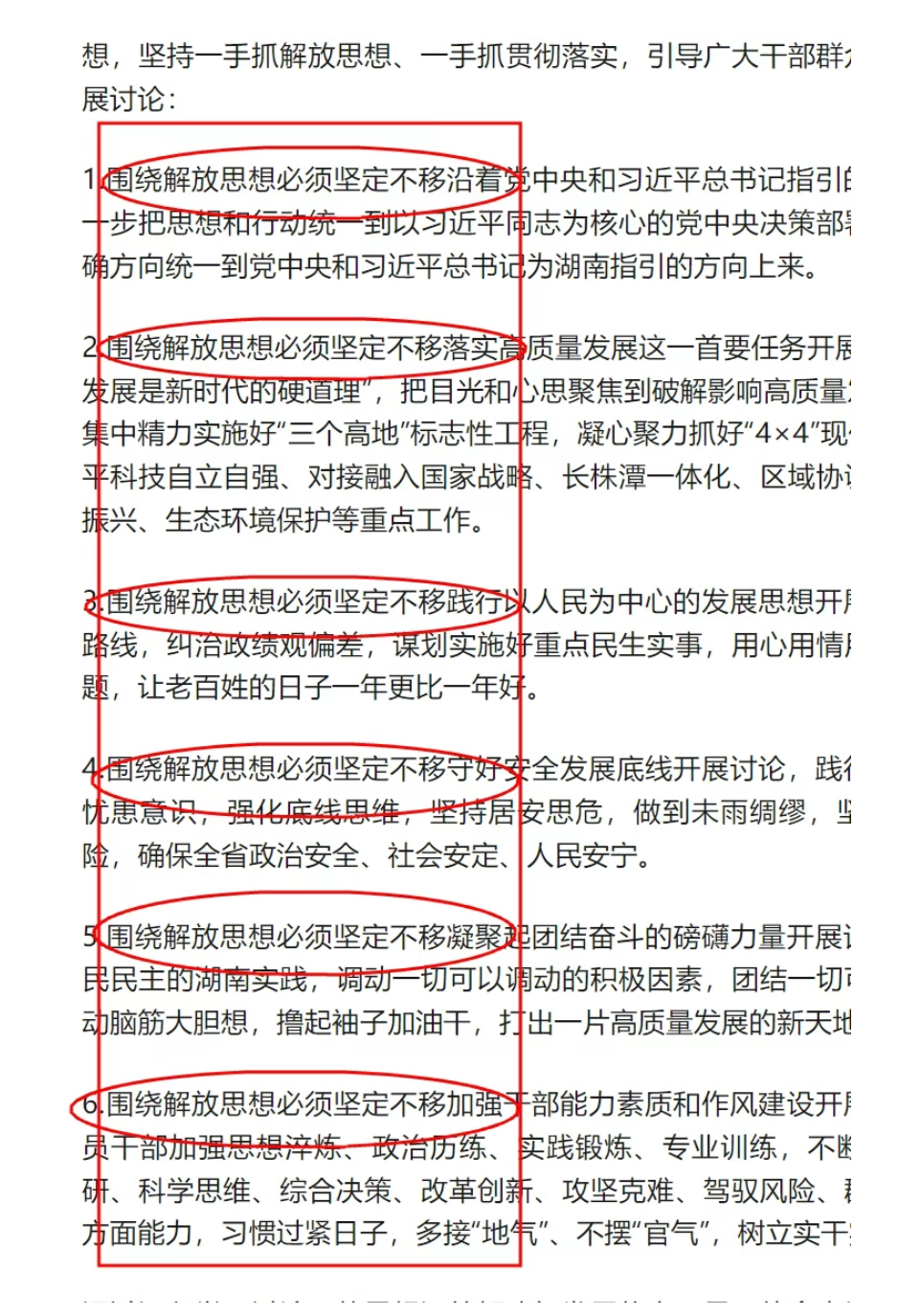
If you are firm in all aspects, how can you emancipate your mind?
There is a sentence in the notice that initially puzzled me: “The launch of the major discussion is an intrinsic requirement to consolidate achievements and further unify thoughts, will, and actions.” This sentence means that the result of unifying thoughts is to emancipate thoughts, and emancipating thoughts is an intrinsic requirement of unifying thoughts.
Emancipation and unification, one is to release, the other is to collect, one is the strongest spear, the other is the strongest shield. What kind of genius can treat them as the same thing?
It turns out that there is another sentence after this sentence, which says that the thoughts that need to be resolutely implemented embody the emancipation of minds and seeking truth from facts, so emancipating minds is unifying minds.
The logic is perfect!
No wonder someone advised me: Your articles are always blocked because your thinking is conservative. You need to emancipate your mind and keep consistent with the above.
A kind of belittling
The previous two emancipations of minds were driven by central authority, and the linkage between the party and the outside world changed the direction of the tide.
The notice of the Hunan Provincial Party Committee naturally cannot produce similar effects.
Of course, the original intention of the Hunan Provincial Party Committee is not to do so.
This notice from Hunan, like most government documents, has a shining reason at the beginning to show its importance, which is equivalent to the words “By the grace of Heaven”, and the latter part is the problem they want to solve. This is contrary to news theory, which requires putting the most important information at the beginning to let people grasp the key points most efficiently.
I carefully read the notice of the Hunan Provincial Party Committee twice, and it was really difficult to understand those vague words.
The notice hides a premise: there are “insufficient confidence in development, lack of mission awareness, and insufficient spirit of responsibility” in the Hunan civil servant system. Many people “build things in a stable manner and seek development step by step”, unwilling to do difficult and practical things, or “rather not do things to avoid trouble”, in a word: they are lying flat.
Hunan people boast that they “can endure hardship, be patient, not be afraid of death, and be domineering.” Now even Hunan people are in this state, and other places should not be more optimistic.
The major discussion on the emancipation of minds is to make everyone change this state, so it requires various departments to give themselves a shot in the arm, set their own KPIs, and study and solve practical problems.
Emancipating minds is equivalent to daring to do things, and conservative thinking is equivalent to not doing things. The so-called “major discussion on the emancipation of minds” is probably about this.
This mind is not that mind, this emancipation is not that emancipation.
You can all leave.
Of course, Hunan’s “emancipation of minds” can produce results, allowing Hunan officials to cheer up, put down their goji berries, and do some things that are meaningful to the business environment, which is naturally welcome.
However, in any case, the word “emancipation of minds” has been belittled.
And at this moment, the situation we are facing requires true emancipation of minds and seeking truth from facts, just like the previous two times, to gather consensus on reform and stimulate confidence in the future.
But, let’s still leave.
Image: Works by Yue Minjun
Discover more from 自由档案馆
Subscribe to get the latest posts sent to your email.