

By Fu Song (Host of “Chasing the Moon and Stars”)
On the evening of October 17th, I received a call from someone claiming to be from the Chinese Academy of Sciences Investigation Team. After verifying my identity, the person said: “Recently, you reported that tourists can enter the core area of ‘China Sky Eye’ for a fee by staying at a specific hotel. Our academy takes this matter very seriously and has established an investigation team to conduct a comprehensive review of this incident. Thank you for your attention and supervision of our relevant work.”
The staff member stated that the investigation is currently being carried out thoroughly and in-depth with overtime work, “May I ask if you have any other questions you need us to understand further, or any other information to provide us?”
The staff member finally said: “Thank you again for your attention to our work. Please continue to follow the official website for updates.”
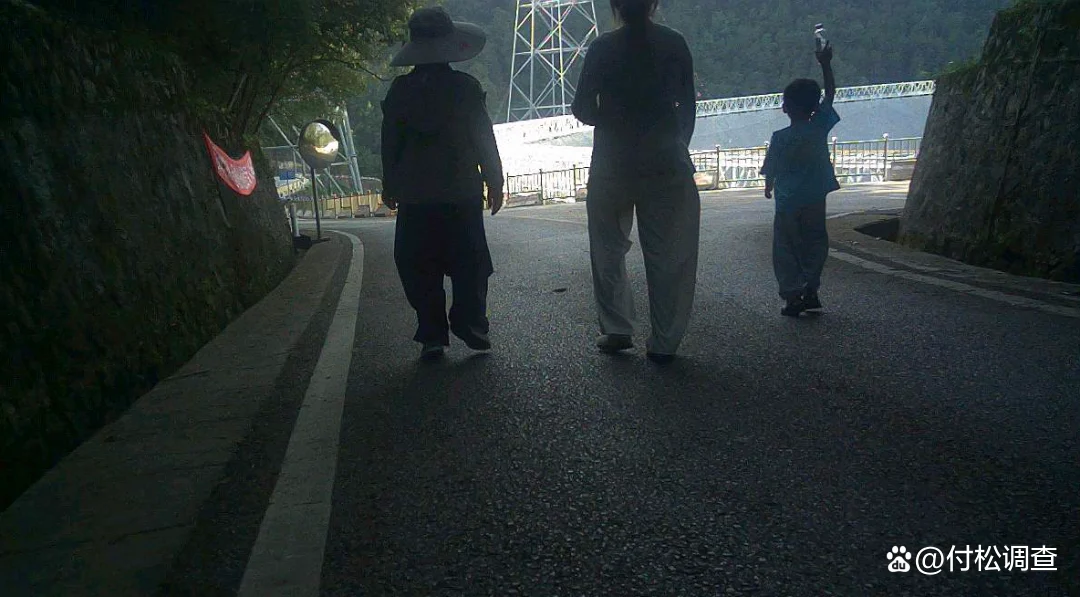
Image captured under non-standard conditions
Regarding the matter of “China Sky Eye” being turned into a commercial enterprise, I first heard about it two years ago, but I didn’t quite believe it. In my understanding, a national strategic asset like “China Sky Eye” would never be used as a gimmick to make money.
This is because “China Sky Eye” is a national strategic asset, for which the state has invested over 1 billion yuan, and even poured in decades of hard work and lives of Chinese scientists like Nan Rendong to build it. It shoulders the historical mission of exploring the origin and evolution of the universe, searching for extraterrestrial civilizations, and detecting gravitational waves, with a daily operating cost of up to 400,000 yuan.
One night in early May this year, a reader called me to report again about “China Sky Eye” being turned into a commercial enterprise, saying that after spending over 2,000 yuan to stay at a hotel called “Guangnian Zhiwai” (Beyond Light Years), they were able to enter the “China Sky Eye” ring beam for a visit.
This news shocked me immensely. As early as before the official completion and commissioning of “China Sky Eye” on September 25, 2016, I knew that the management of “China Sky Eye” was extremely strict.
At that time, I was still working in the media. Following my editor’s instructions, I rushed to the site five days before the official completion and commissioning of “China Sky Eye” to conduct an interview.
As the world’s largest and most sensitive single-aperture radio telescope, “China Sky Eye” captures extremely weak electromagnetic signals from the depths of the universe.
To protect “China Sky Eye” from any radio interference, Guizhou proposed to “protect ‘China Sky Eye’ as we protect our eyes” and designated a 30-kilometer radius around the “China Sky Eye” site as an electromagnetic wave quiet zone.
On June 28, 2013, the 7th Executive Meeting of the Guizhou Provincial People’s Government deliberated and adopted the “Measures for the Protection of the Electromagnetic Wave Quiet Zone of the Five-hundred-meter Aperture Spherical Radio Telescope in Guizhou Province.” It was promulgated by Decree No. 143 of the Guizhou Provincial People’s Government on July 16 of the same year and came into effect on October 1, 2013.
In January 2019, the Guizhou Provincial People’s Government promulgated new “Measures for the Protection of the Electromagnetic Wave Quiet Zone of the Five-hundred-meter Aperture Spherical Radio Telescope in Guizhou Province,” which came into effect on April 1, 2019. The “Measures for the Protection of the Electromagnetic Wave Quiet Zone of the Five-hundred-meter Aperture Spherical Radio Telescope in Guizhou Province” promulgated on October 1, 2013, were simultaneously repealed.
At the same time, Guizhou also issued the “Regulations of Guizhou Province on Radio Management,” Chapter III of which specifically addresses the protection of the electromagnetic environment of the five-hundred-meter aperture spherical radio telescope.
Both the “Measures” and the “Regulations” stipulate that it is forbidden to carry electronic products that generate electromagnetic radiation, such as mobile phones, digital cameras, tablet computers, and drones, into the core area; and unauthorized vehicles are not allowed to enter the core area of “China Sky Eye.”
With approval, the photographer and I were allowed to enter the core area and wrote a six-page report titled “Our Reporter’s Exclusive Exploration – I Entered the ‘Sky Eye’.”
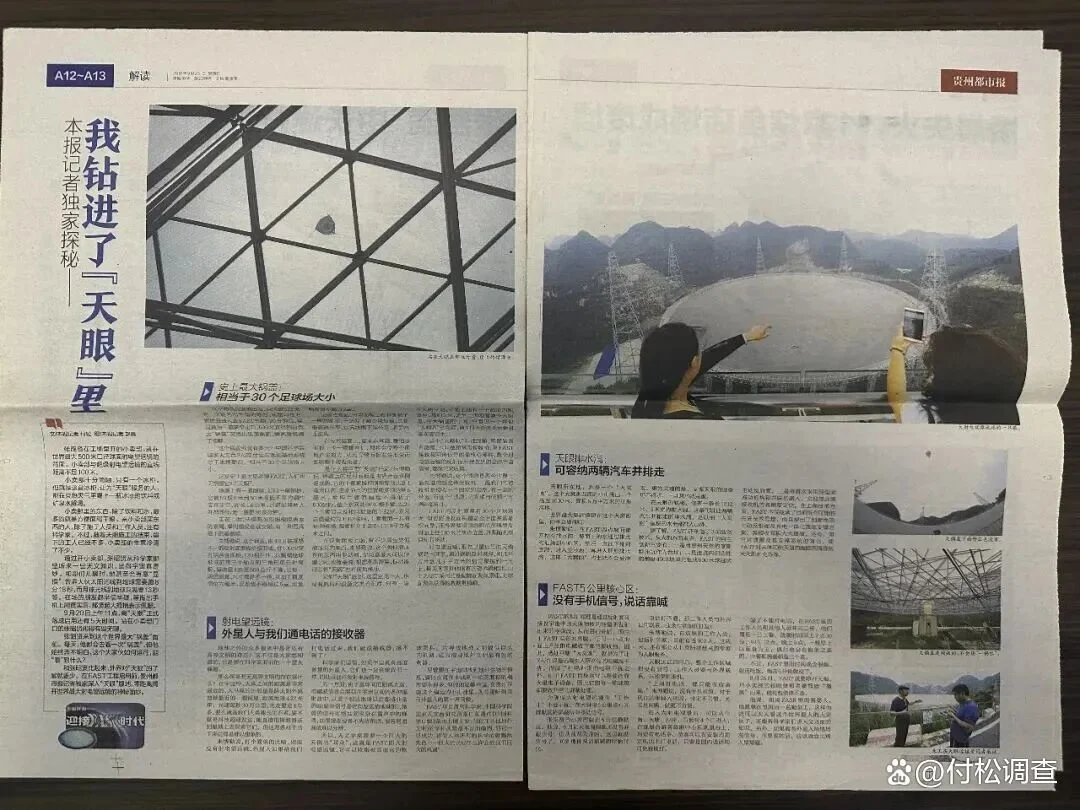
The report I wrote that year, “Our Reporter’s Exclusive Exploration – I Entered the ‘Sky Eye’”
Therefore, every time someone says that “China Sky Eye” is being used as a gimmick for business, I am skeptical. What I know is that the only legal way to visit “China Sky Eye” is through the China Sky Eye Scenic Area, where after undergoing strict security checks, one takes a shuttle bus to the observation deck on the mountaintop for a long-distance visit.
To verify the authenticity of the reader’s report, I decided to conduct an undercover investigation of the hotel in question.
At 9:27 PM on May 21st, I paid 2,688 yuan on the Ctrip travel app to book a twin room at the “China Sky Eye Guangnian Zhiwai Hotel.”
The next morning, I drove with two friends from Guiyang, the provincial capital of Guizhou, and headed straight for “China Sky Eye” according to the location provided by the hotel.
The car entered Kedu Town, Pingtang County, and drove along National Highway 522. Upon reaching the “Niujiao” T-junction, a right turn led into “China Sky Eye.” There was a checkpoint with multiple guards. This means that walking past the checkpoint led into the core area of “China Sky Eye.”
The security guards did not conduct any security checks on us. They only asked us to get out of the car to register before letting us drive into the core area of “China Sky Eye” with mobile phones and other electronic devices. The security guard clearly stated that others could not enter, but we were allowed because the hotel had reported us in advance. It was at this moment that I realized that the “Guangnian Zhiwai” hotel was located within the core area of “China Sky Eye.” That day, after checking in, we were led by a director to visit the “China Sky Eye” ring beam with our undercover equipment and captured images.
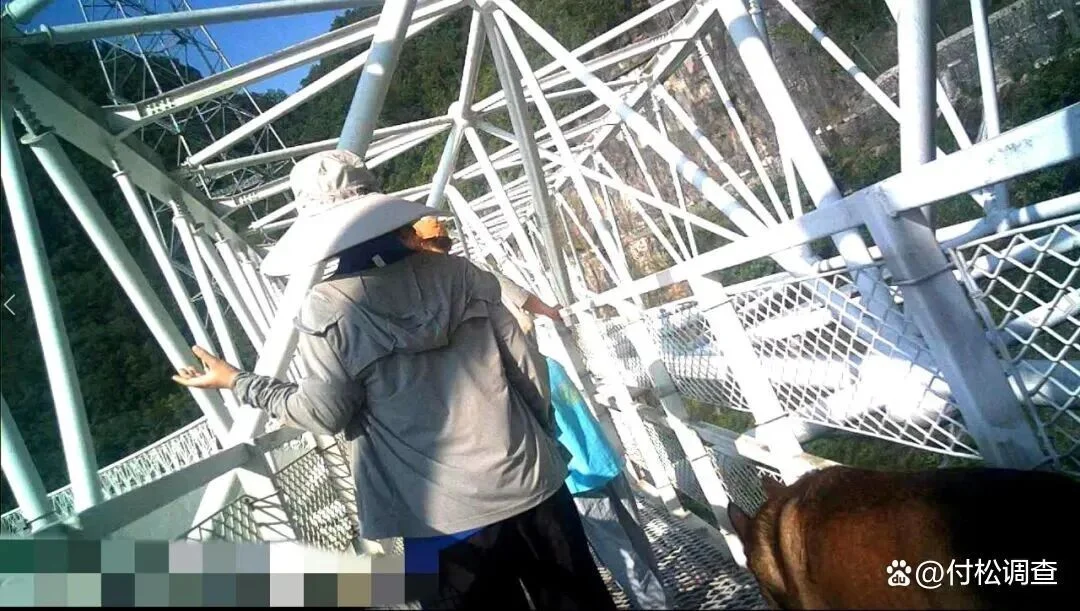
Tourists being led by a guide on the “China Sky Eye” ring beam, captured under non-standard conditions
Detailed reports on specific aspects have been published previously and will not be repeated here. Interested readers can learn more by clicking on the link: Investigation into the National Astronomical Observatories’ Illegal Business: Staying at a hotel for 2,688 yuan allows mobile phones and other electronic devices into the core area of “China Sky Eye,” scientists worry about contaminated observation data and risks of leaks.
Through the investigation, I discovered that the behind-the-scenes owner of the “Guangnian Zhiwai Hotel” was actually the National Astronomical Observatories. This shocked me even more, but I finally seemed to understand why paying a high price to stay at the “Guangnian Zhiwai Hotel” could open the “door” to “China Sky Eye,” allow mobile phones and other electronic devices to enter the core area of “China Sky Eye” freely, and even allow zero-distance visits to the “China Sky Eye” ring beam.
According to public information, the “head” of “China Sky Eye” is Jiang Peng, a deputy to the 14th National People’s Congress, deputy director of the National Astronomical Observatories, Chinese Academy of Sciences, chief engineer of FAST (“China Sky Eye”), and executive director of the Guizhou Radio Astronomy Observatory.
On June 23rd, I submitted a real-name report to the Thirteenth Inspection Team of the Central Inspection Group with the relevant information I had learned and collected during my investigation.
What I did not expect was that after the real-name report, a series of “troubles” followed.
On the evening of June 30, I suddenly received a call from a friend, saying that police officers from the police station went to his home to question him about his real-name举报 (reporting/whistleblowing), even though he had never reported anything to any unit. I said, “What does the police have to do with my real-name举报? Besides, it wasn’t you who reported it, so why are the police looking for you?” My friend said, “They must have found out that we went to ‘China Sky Eye’ together on May 22, so they came to my house to inquire about the situation.”
On the phone, we had a big argument. My friend blamed me for not discussing the举报 with him beforehand, putting all the pressure on him. “It means you’ve hit a sore spot, and they’re starting to retaliate… When you return to Guizhou, they’ll arrest you as soon as you get off the train… Maybe they wanted to find you today, couldn’t find you, and came to me instead…”
Then, the call from the local leader came, asking what I had done. “I received a call from the Political and Legal Affairs Commission, dispatching you for inquiry.”
I asked, “What does ‘dispatching’ mean?”
The leader said, “It means understanding your situation.”
I told the leader on the phone that I hadn’t done anything, just reported the National Astronomical Observatories under my real name. The leader immediately said, “So that’s the matter.” and reminded me that no matter what I did, it must be legal and compliant, according to laws and regulations.
Even more frighteningly, not long after, I received a call from personnel from the administrative competent authority, who also asked me what I had done. “Someone has complained and reported your company and winery, and we need to conduct a routine inspection at your premises.”
I felt dizzy. The events that followed my举报 left me bewildered. I really don’t understand why the cost of real-name举报 is so high, but what is wrong with real-name举报?
Article 41 of the Constitution stipulates that citizens of the People’s Republic of China have the right to criticize and make suggestions regarding any state organ and state functionary; they have the right to make appeals, accusations, or exposures to relevant state organs regarding any illegal or derelict acts of any state organ and state functionary. Furthermore, regarding citizens’ appeals, accusations, or exposures, relevant state organs must investigate the facts and be responsible for handling them. No one shall suppress or retaliate against them.
Moreover, don’t national relevant organs publish举报 hotlines precisely to listen to the voices of the common people? If the personal information of whistleblowers is not protected, is arbitrarily leaked, or even falls into the hands of the reported party, who would dare to report in the future?
But I do not regret reporting the National Astronomical Observatories. In my opinion, this is the historical responsibility and social duty that a former investigative journalist and veteran media person should have. The nation’s key facilities must not be used for profit by certain individuals. More importantly, allowing tourists to drive with their mobile phones into the core area of ‘China Sky Eye’ would cause serious interference with ‘China Sky Eye’s’ capture of cosmic electromagnetic signals.
More than four months after my举报, on September 29, the National Astronomical Observatories replied that a working group had been established to investigate and had submitted the investigation results to the Disciplinary Committee of the Chinese Academy of Sciences.
What makes me despair is that the “Beyond Light Years” hotel, located in the core area of “China Sky Eye,” is still openly sold online, with prices as low as over 6,000 yuan during the National Day holiday, and some room types are sold out. Furthermore, tourists are still allowed to bring electronic devices such as mobile phones into “China Sky Eye.”
I have no other choice but to take a risk and attract social attention and the attention of relevant parties through public exposure.
I am well aware of the consequences of real-name举报 and public exposure of the National Astronomical Observatories, just as netizens are worried about my safety.
But no matter how dangerous this path is, even if I might encounter misfortune, I will not take half a step back.
Now, the Chinese Academy of Sciences has established an investigation working group to conduct a comprehensive review. I believe that the relevant parties will take this matter seriously and ascertain the truth.