

By丨Wei Chunliang
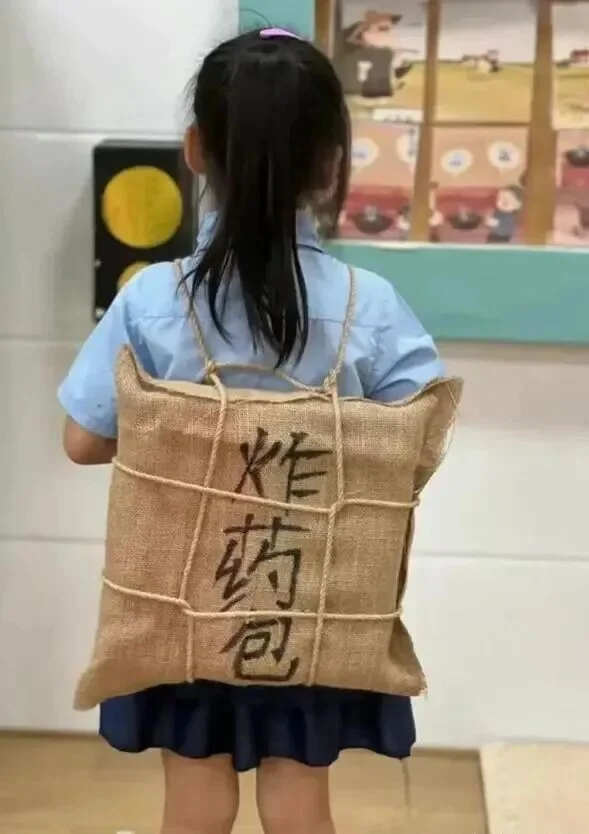
The appearance of “explosive packs” in kindergartens is a worrying matter.
Even if it appears in the form of a game.
A kindergarten in Wuhan held a sports meeting with the theme of “Little Red Army of the Long March”. In order for the children to have an immersive experience, parents were asked to make simple explosive packs for each child.
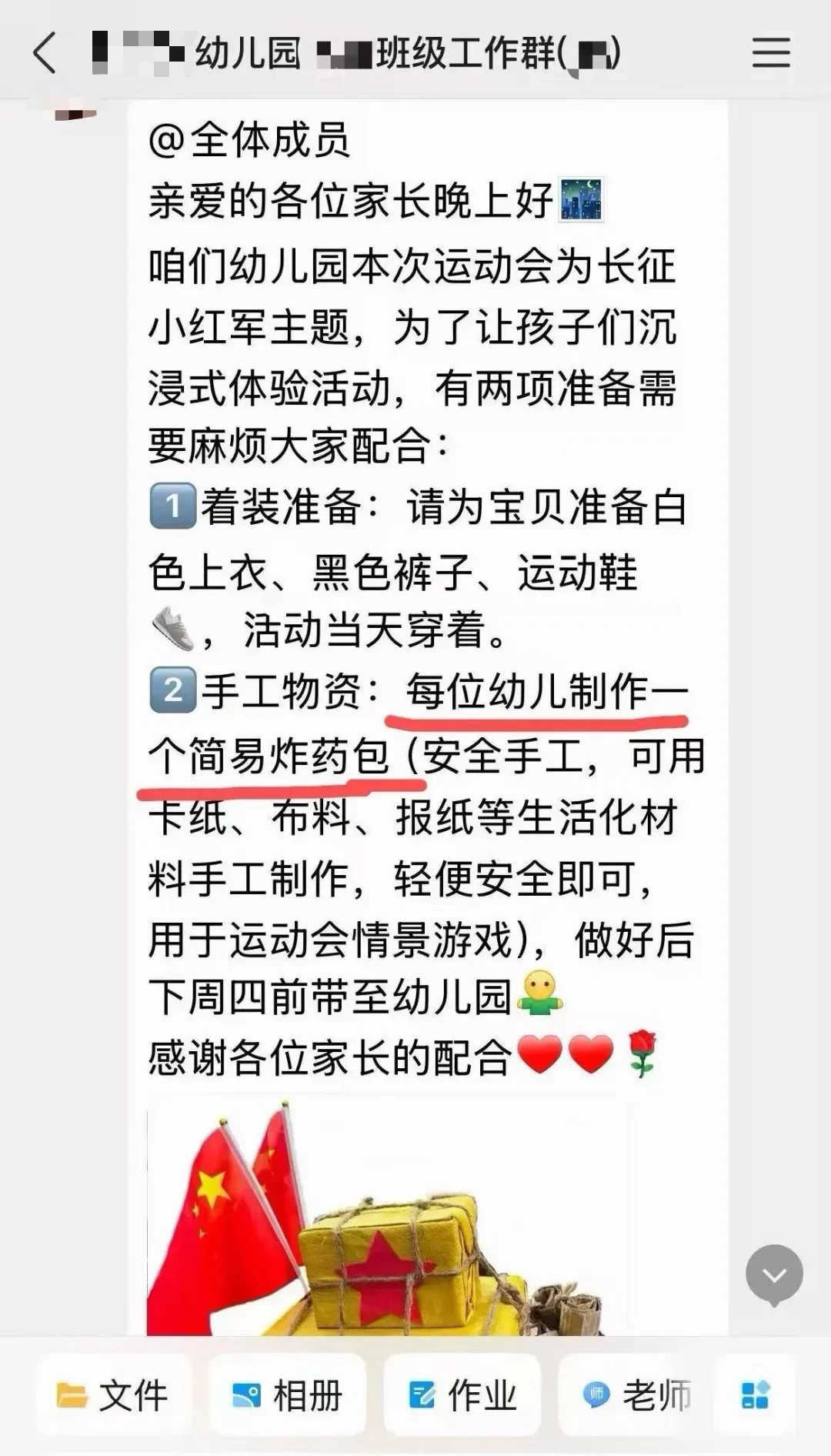
In case parents had not seen explosive packs, the kindergarten thoughtfully provided reference pictures. In the reference pictures, cute babies were carrying handmade explosive packs, looking young and tender, and the props were glaring.
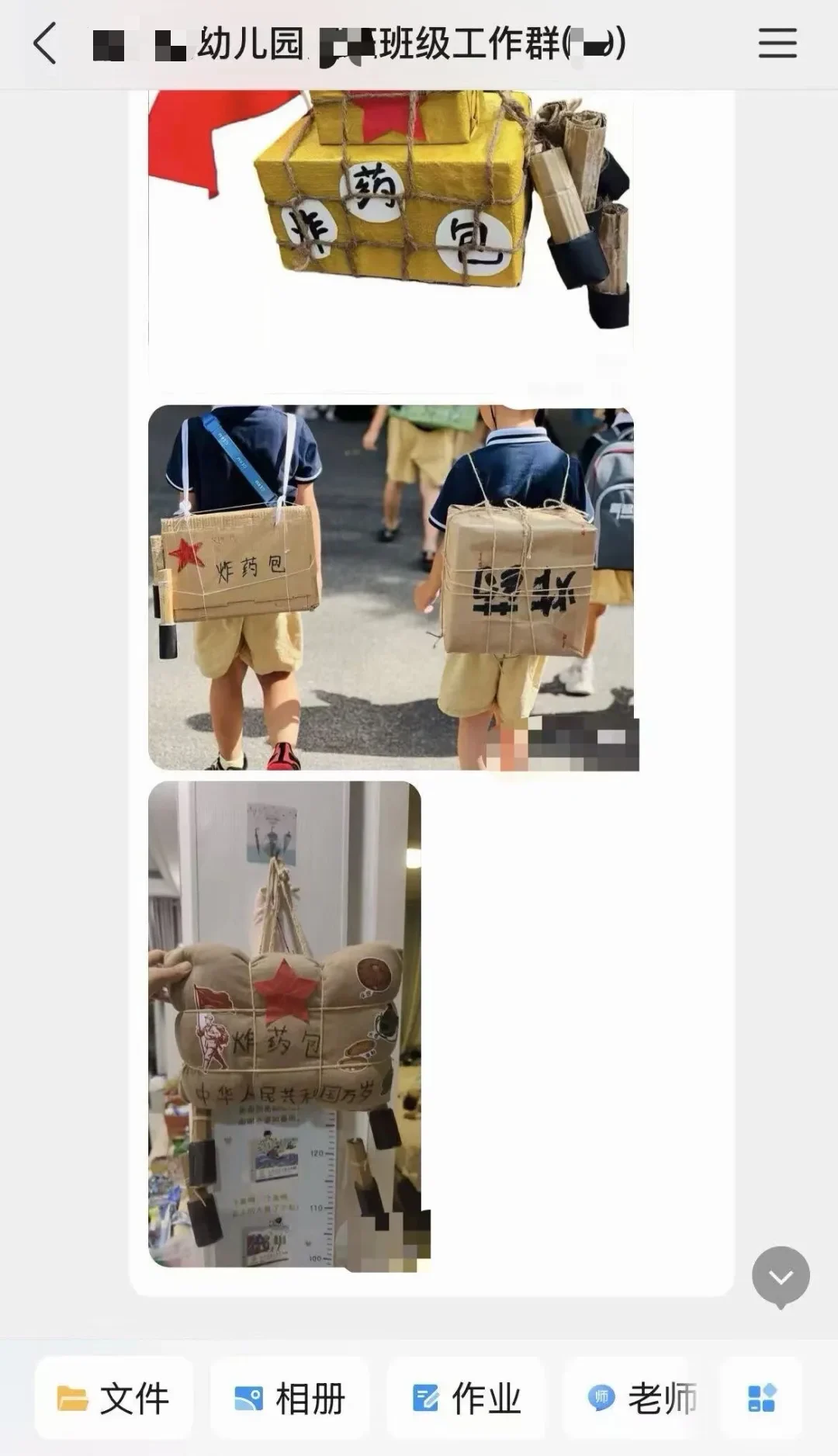
As you can see from the reference pictures provided by the kindergarten, this behavior of letting young children make explosive packs is not new at all, and has long been a common practice.
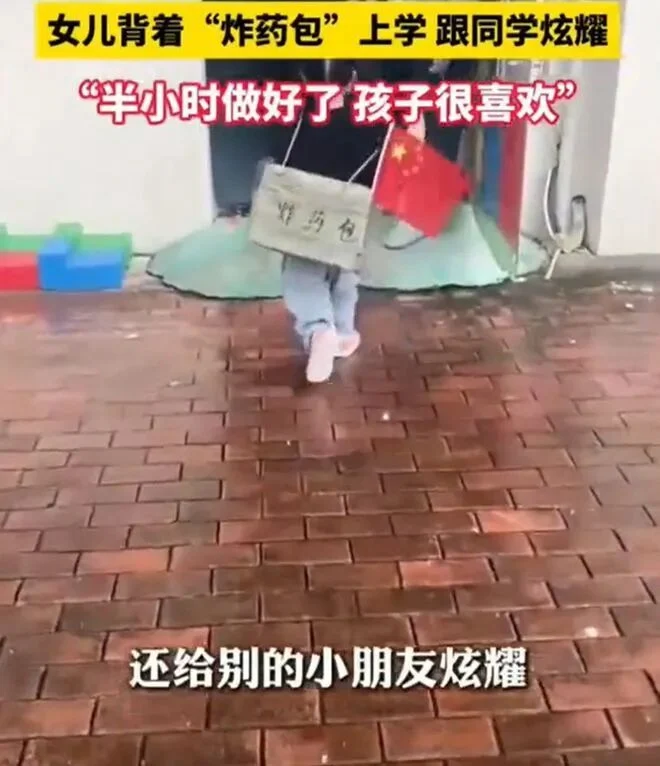
Of course, I can understand the kindergarten's original intention for this activity: red education should start from the娃娃 (children), and they want children to have an immersive experience of the history of the Long March and inherit the spirit of the Long March.
Some people will surely say that this is just simulating history, it is to let children understand the spirit of the Long March, and the intention is good.
But the problem is that a correct intention does not mean that the method is necessarily appropriate. Education cannot only look at the motive, but also at what the children actually receive.
Explosive packs have never been ordinary game props; their essence is a symbol of weapons deeply bound to death, harm, and brutal warfare.
Kindergarten children are still very young. They can understand “children should help each other” and “persist when tired”, but it is difficult for them to understand abstract concepts such as “the weight of life” and “the cruelty of war”, let alone understand that the explosion of an explosive pack often means sacrifice and annihilation.
Once historical education exceeds the cognitive abilities of children, the more lively it becomes, the further it may be from the original intention and truth.
So I don't understand, what is the purpose of letting children carry explosive packs in kindergarten? Is it really to understand the spirit of the Long March?
The core of the Long March spirit is resilience in desperate situations, unity in adversity, adherence to beliefs, unyielding spirit in crossing snowy mountains and grasslands, and the warmth of mutual assistance between the army and the people.
None of these spiritual cores must be conveyed through “making a satchel of explosives” or “carrying a satchel of explosives”.
Remembering history has never meant replicating war props, nor has it meant letting children simulate combat scenarios.
Having children personally make props that are “imagined to be able to kill” using newspapers and cardstock, and then carrying them on their backs to participate in games, essentially normalizes, cute-ifies, and gamifies heavy symbols of war.
Children can neither understand the sacrifice behind the satchels of explosives nor comprehend the justice and injustice of war. Their most direct impression will only be: “Oh, so fighting a war is playing games with satchels of explosives.”
When the heaviness of history is dissolved in laughter and running, and when symbols of weapons become amusing props at a sports meet, you might expect children to understand the greatness of the Long March, but what you might ultimately gain is merely a dismissive perception of war.
This is completely unrelated to revering history or remembering history; it has not a single bit of connection.
What’s more, the Long March was so complex, so arduous, and so spiritually profound, yet it is reduced in kindergarten to a satchel of explosives carried on one’s back. This is a simplification of history and an irresponsible approach to education.
However, these are not the issues that concern me the most. What is more worthy of vigilance is the underlying logic hidden behind this educational approach.
The core of education in early childhood should be to instill love and kindness, build a sense of security and basic understanding of the world, and cultivate basic life skills and empathy.
Taking “red education” as an example, it can certainly be introduced into kindergartens, but it must also be tailored to the cognitive level of young children:
If you want children to experience hardship, you can design physical games like “climbing mountains and crossing ridges”; if you want children to understand mutual aid, you can design collaborative tasks like carrying stretchers, building bridges, and transporting supplies; if you want children to know that today’s life is hard-won, you can tell heroic stories, read picture books suitable for young children, and engage in labor experiences within their capabilities.
These methods can all sow the seeds of patriotism,without having to stuff symbols of weapons into children’s hands prematurely.
Unprofessional historical enlightenment often backfires. At an age when they cannot yet understand what war is or what death means, letting children carry satchels of explosives to simulate combat does not convey patriotism, but rather a desensitization to symbols of violence.
We always say we want children to understand the preciousness of peace, but the first step in peace education is always to keep children away from symbols of war, not to make weapons into homework for a craft class.
Spending effort on having children make satchels of explosives is a misunderstanding of the essence of early childhood education. If we educate our children with such a philosophy, what kind of adults will they grow up to be?
Please return weapons to history, and gentleness to childhood. Do not trouble parents, and do not demonize children!