


By the end of August this year, overseas institutions had issued more than RMB 170 billion in renminbi-denominated bonds in China, 70% more than in the same period last year. Outstanding bonds in this category passed RMB 500 billion for the first time. (Figures cited from CCTV Finance's July 2026 reporting.) To put RMB 500 billion in perspective, consider railway construction: the Beijing–Shanghai high-speed railway cost approximately RMB 220 billion in total. That outstanding debt would be enough to build more than two additional railways of that scale.
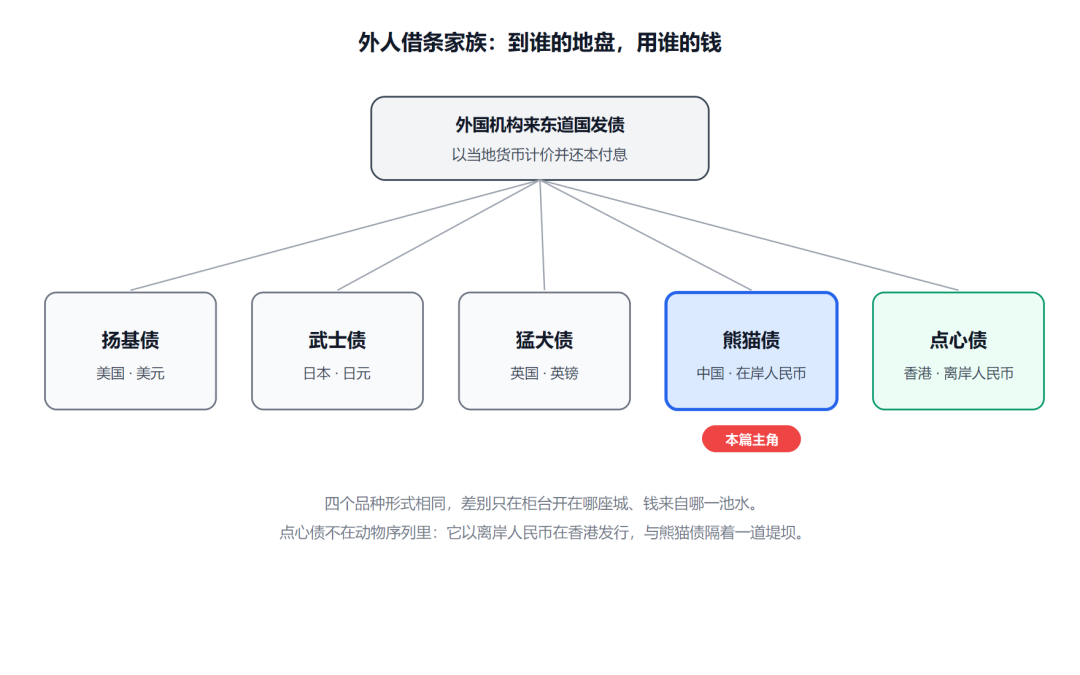
They have an endearing name: panda bonds. Institutions registered outside China enter the domestic Chinese market to raise funds by issuing bonds denominated in renminbi, repaying principal and interest in renminbi when they fall due. Borrowing and repaying in the currency of the market you enter is an old convention in finance. China's version of this IOU bears the name of its national treasure.
Do not get the direction of the borrowing wrong: the borrowers are foreigners, not us. And they are borrowing money they can actually spend. Foreign companies with factories or stores in China must pay wages and suppliers in renminbi every month. Rather than convert dollars into renminbi and go through successive complications, they can issue a renminbi IOU directly in China. That removes the currency-conversion step altogether, along with the exchange-rate risk hanging over it.
China did not invent this arrangement. When foreign borrowers issue dollar bonds in the United States, they are called Yankee bonds; yen bonds issued in Japan are Samurai bonds; sterling bonds issued in Britain are Bulldog bonds. Each mature market gives its foreign borrowers' IOUs a national symbol. China chose the most gentle-looking animal of the group.
If this is a routine practice available in many countries, the real question becomes clear: why is there suddenly a queue at a Chinese borrowing counter that was quiet for so many years?
Who is borrowing the RMB 170 billion? Overseas financial institutions, foreign companies and foreign governments together issued nearly RMB 90 billion, accounting for more than half. The list includes sovereign borrowers such as Slovenia, Pakistan and Kazakhstan, as well as major foreign banks such as BNP Paribas. At the end of June, Brazil's Ministry of Finance submitted its first application. If approved, Brazil would become the first Latin American country to issue sovereign panda bonds in China.
One example is particularly revealing. Deutsche Bank issued RMB 9 billion in panda bonds this year and is the foreign financial institution with the largest cumulative issuance in this market. Regular issuance means rolling out bonds according to a plan and treating the Chinese market as an established source of funding. A German bank returning to China year after year to borrow is like a neighbourhood regular returning to the same market each day: it is well past the stage of trying something new.
The reasons for the queue are written on two bills: one for interest, the other for exchange rates.
On the interest bill, the People's Bank of China's open-market operations in late August showed the seven-day reverse repo rate holding at 1.40%. Think of it as the central bank's price for short-term funding supplied to banks. Domestic funding costs revolve around this anchor, which is currently at a relatively low level by historical standards. Industry assessments generally consider ample liquidity to have created a favourable pricing window for panda bonds. Put simply, borrowing at the Chinese counter is currently among the cheapest options in the world.
The exchange-rate bill is even more convenient. Panda bonds raise renminbi. For institutions that already need to spend money in China, the currency borrowed matches the currency spent, reducing the foreign-exchange gains and losses for which their accounts must make provisions each year. Those who arrange cross-border funding know that opportunities to improve both interest-rate costs and exchange-rate exposure at the same time do not come along very often.
Follow the exchange-rate question a little further and you encounter an easily confused concept. Renminbi borrowing has a sibling called dim sum bonds, issued in Hong Kong. The difference lies in the pool of money. Renminbi exists in onshore and offshore pools: the Hong Kong pool moves with international supply and demand, while the domestic pool follows monetary policy. A barrier separates them, and their levels have long differed. Institutions repeatedly compare funding prices in both pools before deciding where to issue their IOUs. The very fact that this comparison takes place shows that offshore renminbi has grown into a market substantial enough to be compared with explicitly quoted onshore prices.
According to figures disclosed by Bank of China, it has cumulatively helped more than 80 overseas clients issue over 370 panda bonds, with a total value exceeding RMB 700 billion. Panda bonds are also the category of Chinese bonds with the highest proportion of overseas institutional ownership, above government bonds.
When overseas investors hold a country's bonds, their largest allocation is conventionally to its government debt for safety. In China, however, the category attracting the strongest foreign ownership is one issued by overseas institutions themselves. Behind the money buying these bonds is a judgement: renminbi assets are worth allocating to, and renminbi can be held in reserve.
Issuing panda bonds is an active financing decision. It reflects a growing number of companies incorporating renminbi into the currencies they use for global treasury management, with the proceeds supporting cross-border trade settlement, project investment and working capital across industrial supply chains. (Tian Lihui, professor of finance at Nankai University.)
In plain language, renminbi used to appear mainly when exporters received payment: it was a settlement tool. Now foreign borrowers deliberately hold it, spend it and use it to finance their businesses. Growing from a settlement currency into an investment and financing currency is one of the most consequential steps in a currency's internationalisation. Panda bonds are helping lay the foundations for that step.
The RMB 500 billion in panda bonds tells a straightforward story: interest-rate differences explain why borrowers come, while holding renminbi is the real reason they stay.
RMB 500 billion sounds enormous, but against a Chinese bond market worth more than RMB 100 trillion it is only a tiny fraction. Panda bonds currently represent a valuable addition and a signal of direction, rather than the main force in the market. Their popularity depends on two conditions: domestic interest rates remaining low and the renminbi's value remaining stable. A change in either would change the market's temperature. Those are the two variables to watch going forward.
When increasing numbers of overseas institutions use a country's currency for financing, it is usually accompanied by a broader rise in the attraction of its capital market to foreign participants. Such changes do not show up in one day's gains or losses, but in the level reached over several years.
Capital has no sentiment, only price differences. Governments and banks from different countries are queuing to issue IOUs in China not to flatter anyone, but to cast a vote of confidence in the renminbi with real money. Five years ago, this would have been hard to imagine. Today it is a routine, recurring occurrence.
Disclaimer: The figures in this article come from CCTV Finance's July 2026 reporting, Wallstreetcn and public information from the People's Bank of China. The interest rate quoted is a snapshot from the date the data were collected, at the end of August 2026; the latest disclosures take precedence. This article is for financial education only and does not constitute investment advice.