The colorful, abandoned shared bicycles gather here, with plastic woven bags filled with cardboard and plastic bottles piled up between the trees planted on the sidewalks. Near the flower beds, there is a set of mats and bedding every few steps, and a large cart is piled with daily necessities, mats, and clothing for all seasons. These are the street people’s entire belongings.
On the last day of 2024, a row of red lanterns, like curtains, burst into the eyes of passersby from the roadside shops. Red envelopes, spring couplets, and paper-cuts were densely displayed, overflowing with the atmosphere of the New Year. The light show of the Canton Tower announced the arrival of 2025 with a 360-degree display.
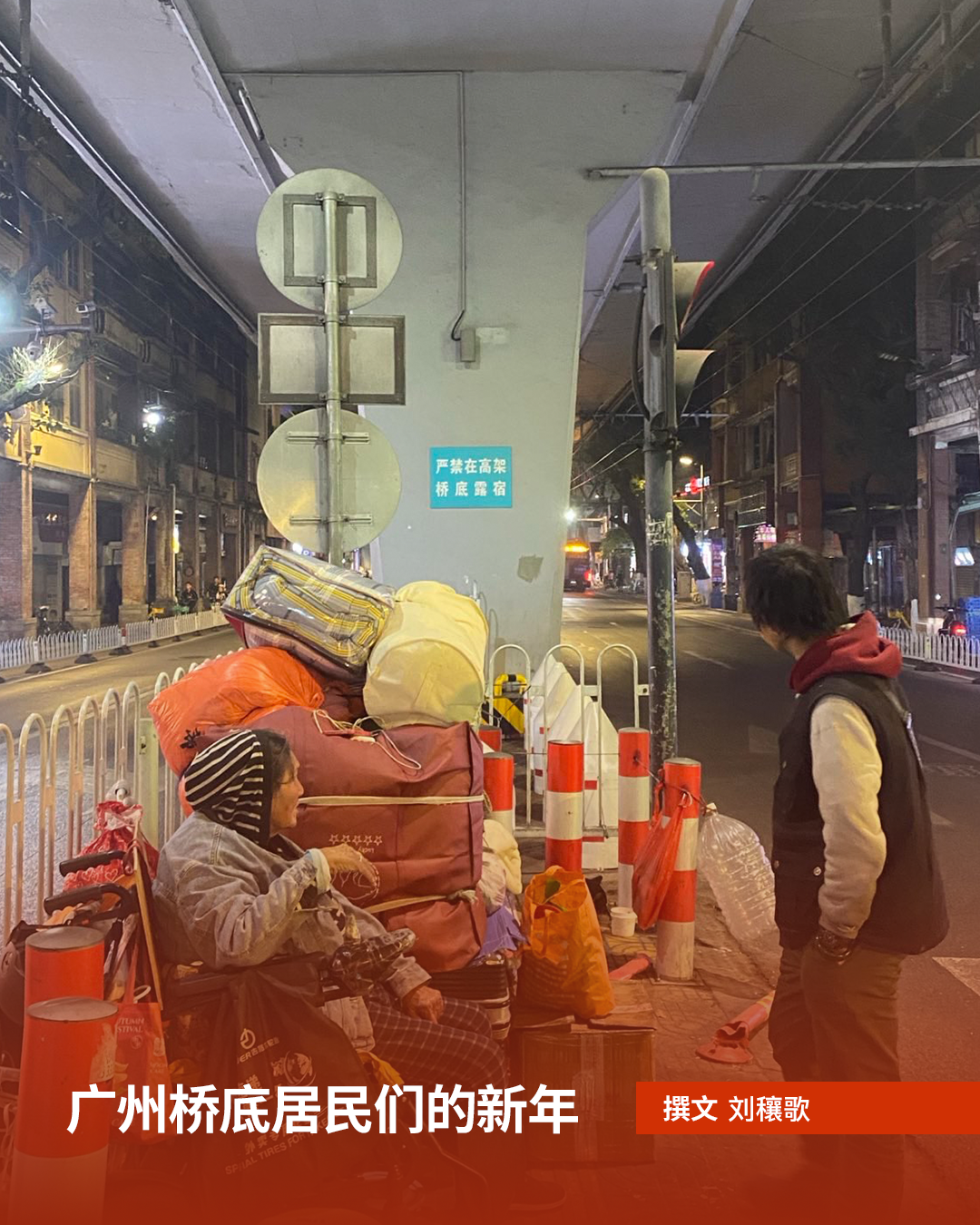
The Children’s Hospital of Guangzhou Women and Children’s Medical Center is located near Beijing Road Pedestrian Street, the most prosperous area in Guangzhou. This is another world. There are no dazzling high-rise shopping malls, mostly low-rise, single-family buildings. Each household has a red wooden plaque and incense burner with “May Heaven Bless You” nailed to the door and wall – the ancient Guangxiao Temple is located two streets away. On the other side, under the People’s Overpass, water drips down along the messy wires, the ground is wet, and blue signs are posted on the bridge piers that read “No camping or piling up items under the overpass.”
The colorful, abandoned shared bicycles gather here, with plastic woven bags filled with cardboard and plastic bottles piled up between the trees planted on the sidewalks. Near the flower beds, there is a set of mats and bedding every few steps, and a large cart is piled with daily necessities, mats, and clothing for all seasons. These are the street people’s entire belongings.
At ten o’clock in the evening, Sister Wang and her husband had already fallen asleep. The festive atmosphere couldn’t disturb them, but this day was a little different. The cart was filled with white steamed buns, canned food, mineral water, and oranges, which were New Year’s gifts from unknown kind-hearted people. Three or four street people wrapped dumplings together. After the dumplings were quickly eaten, the remaining uncooked dumplings lay plumply on the cutting board, very eye-catching in the dim and messy surroundings.
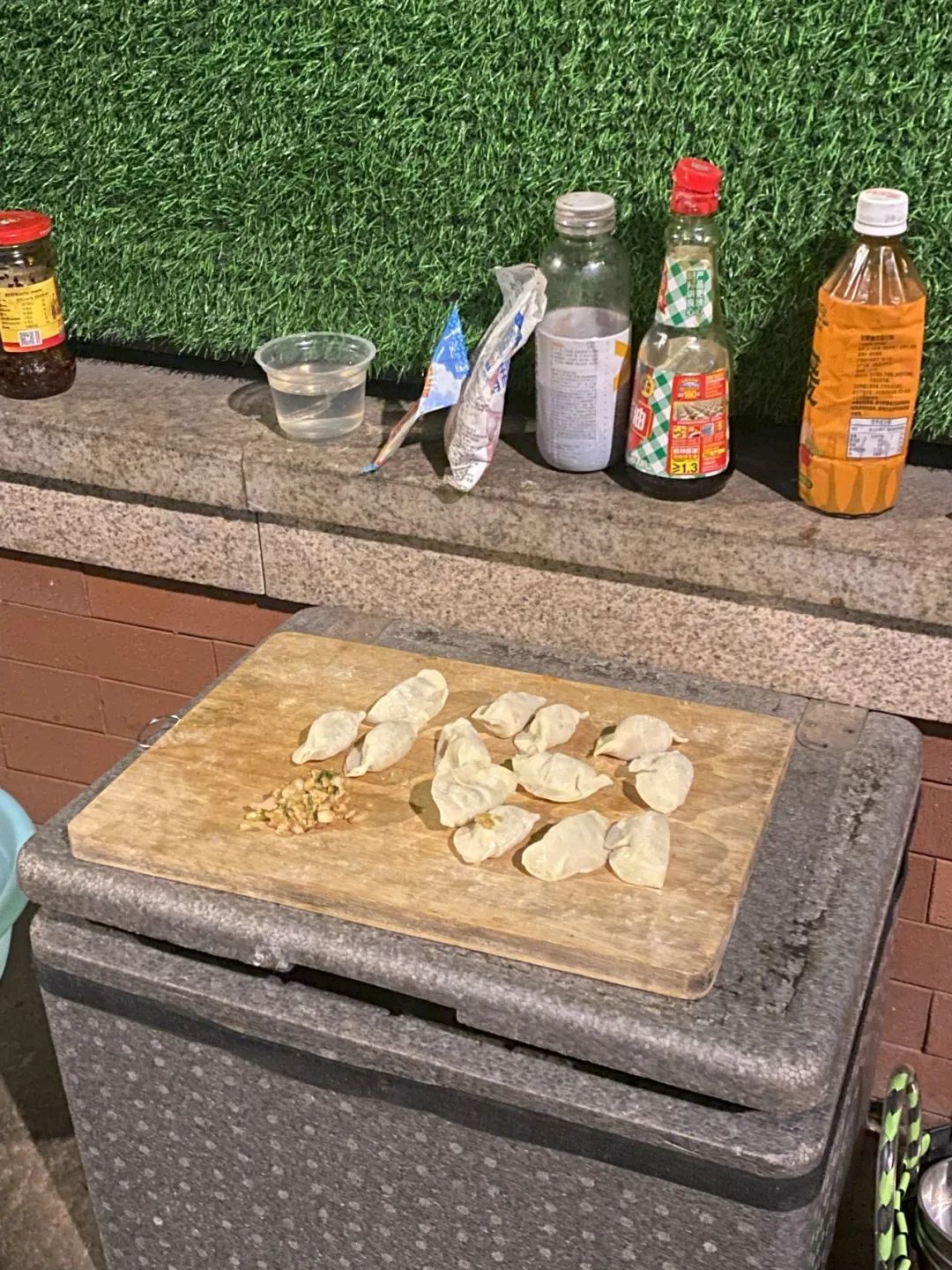
Dumplings made and cooked by the street people themselves
Wage arrears and wage claims
Xu Cheng and his dog haven’t come back yet.
I met him the night before. He was tall, with a crew cut and long, flat facial features. He wore a dark red hoodie and was brushing his phone on a pink quilt, with a light yellow mat under him that was already damaged, revealing the cotton inside. This pink quilt was picked up from the garbage station behind him, as his original quilt had been stolen. He tied the quilt with a rope and threw it into the Pearl River, letting the river wash away the dirt, and then hung it on the stone railing to dry.
Xu Cheng is 32 years old this year, from Tianshui, Gansu Province, and has been working outside for nineteen years. He claims that his grandfather was a university student in the Republic of China and taught him to write seven-character quatrains and lyrics. He started school early, finishing elementary school at the age of ten, but his family was poor, and he was taken to Xinjiang to work for his family a few days after starting junior high school. His father drove a large truck, and he helped load and unload goods.
In his spare time, he writes poems in a spiral-bound notebook with a watercolor painting on the cover, printed with Zhang Ji’s “Night Mooring by Maple Bridge.” He wrote a poem called “Self-Reflection”: “Seeking high salary, striving for gold and stone. Seeing profit, clinging to relatives and friends, flattering the trend. All are like this, the masses are prone to evil. Thousands of schemes for the mundane world, oblivious to self-reflection. The ancients had gentlemen who abandoned, why can’t they seek? Sorrowful not for national affairs, sadly indignant for family affairs.”
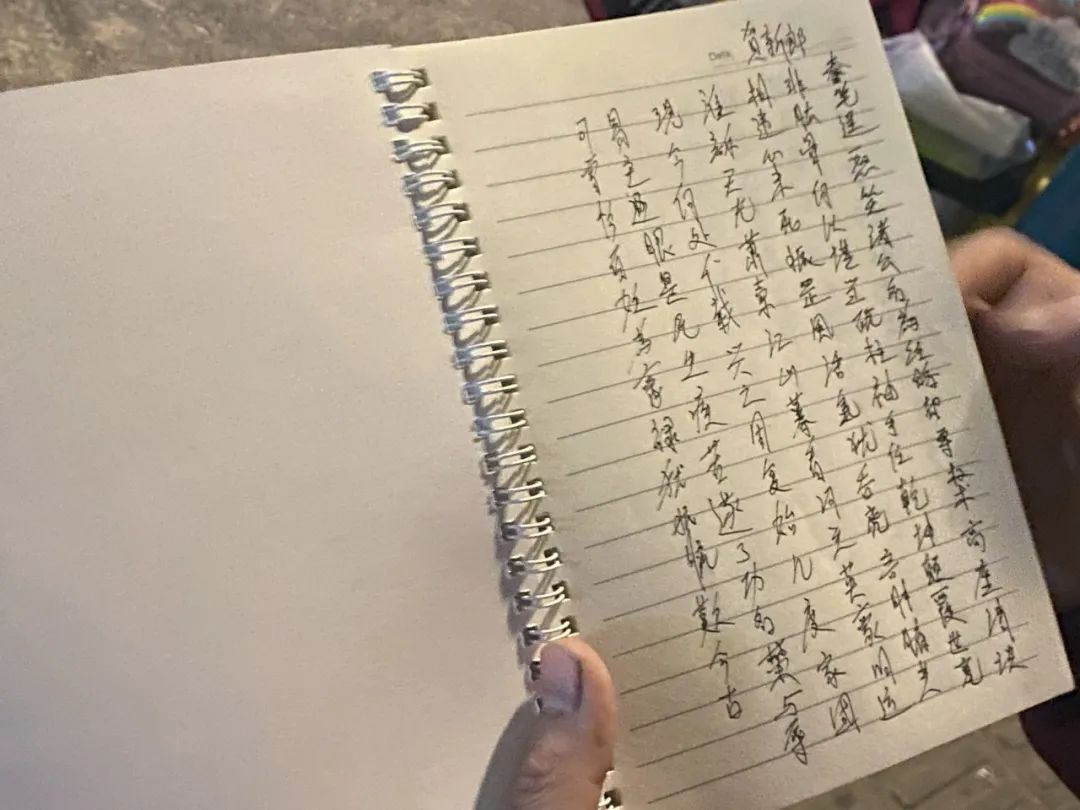
Poems written by Xu Cheng
Because he was not allowed to go to school, he was at odds with his family, and at the age of thirteen, he “jumped trains” from Aksu, Xinjiang, to Guangdong to work. There were times when life was affluent. He drove a truck for a boss, delivering goods to cement factories, salt factories, and discos. He clearly remembers that the boss gave him 12,800 yuan in one month at most, which was in 2009.
Until he invested more than 400,000 yuan in opening a barbecue restaurant, and then the pandemic hit, the situation took a sharp turn for the worse. “I lost all the money, sold a Honda car for 90,000 yuan, and sold the refrigerator to pay off debts.” Quarantine consumed his last savings, “It cost four thousand to quarantine in Zhuhai, six thousand to go to Jinan to visit ancestors and be quarantined again, and more than ten thousand to rent a house in Shenzhen for a month, and the food was very expensive.”
He returned to the construction site to work, and then encountered wage arrears. The construction site paid twenty yuan per hour for hard labor, and sometimes he would work for a day and a night continuously. Xu Cheng could not refuse, as the wages were settled once a year. If he left, he would not get paid. The year-end settlement would not be cleared either, and some would always be left to keep the workers working next year. He talked to the foreman for a long time, only working for half a year, from March to August 2023, but in the end, he only received one thousand, and three thousand yuan has not been received to this day. When working, his foot was pierced by a nail, and the foreman did not pay him medical expenses.
More than a dozen migrant workers who were owed wages slept in front of the Guangzhou City Investment Building. One of the migrant workers, Zhang Xing, told me that they had been sitting here for half a month. The police arranged for them to stay in a hotel for a few days. They slept in the hall of the City Investment Building for two days, and after being driven out, they slept at the door. They went to the police station the day before to make a statement.
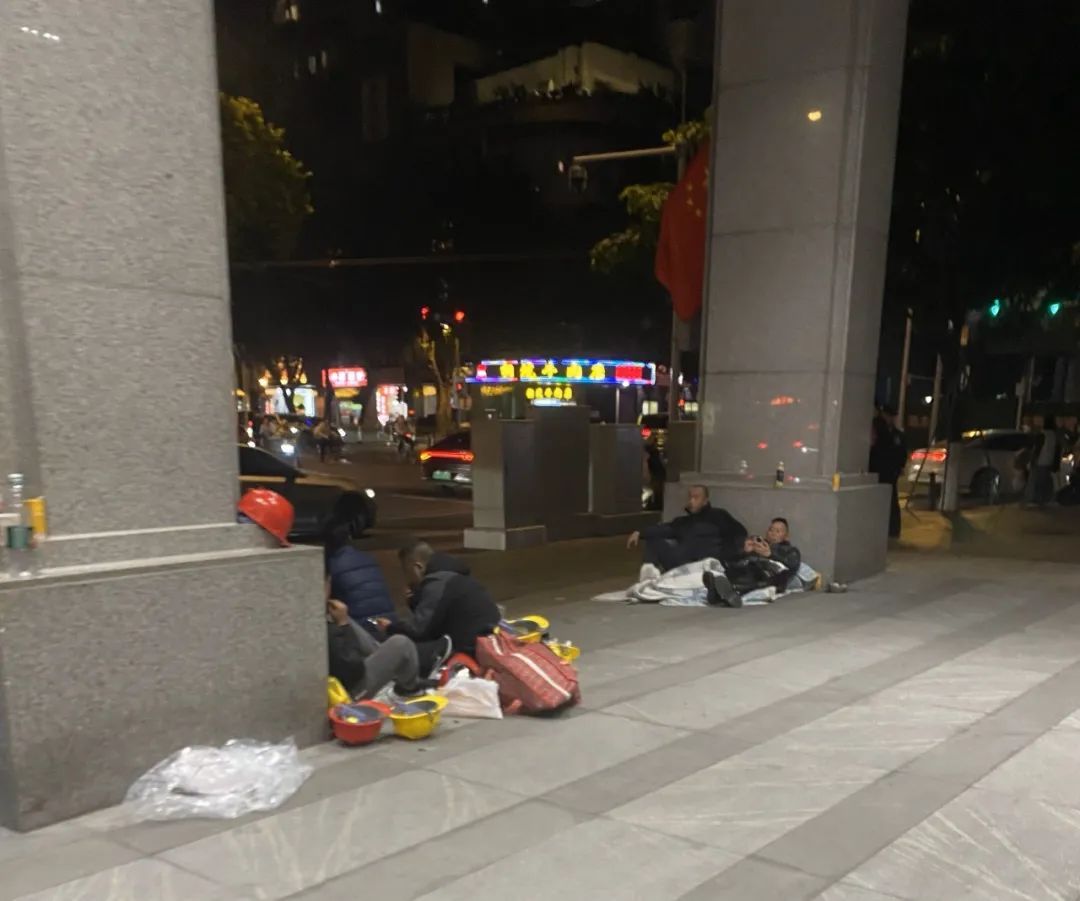
Migrant workers at the entrance of the City Investment Building
Among them are people from Sichuan and Guangdong, who have been owed one hundred million yuan in project funds and have been seeking payment for three or four years. The project is a nursing home project in Zhuhai.
When mentioning going home, Zhang Xing said that he didn’t even have money for the train ticket. If he went home without money, he would have to borrow money from relatives, fearing being ridiculed. His gray-blue thin socks were torn at the heels, split into strips. A migrant worker next to him was playing Fight the Landlord on his phone, and the phone screen had come off, exposing the electronic components.
The City Investment Building is located in the concentrated area of government office buildings, and opposite is the Guangdong Provincial Department of Finance Cangbian Road Office Building. The Yuexiu District People’s Court of Guangzhou is less than 150 meters away from the City Investment Building, adjacent to a series of supporting judicial organs, the Guangzhou Legal Aid Hall of the Guangzhou Judicial Bureau, the Guangzhou Notary Office, the Guangzhou Citizen’s Criminal Record Certificate Processing Office, and the Guangzhou Municipal Public Security Bureau Criminal Investigation Brigade.
At 8:10 p.m., the staff of the City Investment Building had already left work, the lights in the hall dimmed, and the workers on the ground were gone. The place originally occupied by the workers was neatly lined up with four or five rows of people, and more than a dozen people stood as a wall to block the entrance passage.
Thieves and defensive knives
Xu Cheng has also worked as a delivery person and a courier, but neither lasted long. “Delivering food is dangerous, always late, and you’re late if you don’t run red lights. Delivering express mail is also not good. I worked for more than a month, and if you said you didn’t receive the package, you had to pay for it if it was lost, so it’s not easy to do.” When he delivered food in Kecun, his electric bike was parked downstairs and was lost twice, once confiscated by the traffic police and once stolen.
He started looking for odd jobs everywhere. At a factory in Dongguan Chang’an Town, he was dissatisfied with the recruitment and the actual work content. “They said it was a forklift, but it was actually an assembly line.” He wanted to leave on the spot, but his ID card was taken away in the name of getting a factory certificate. After working for half a day, he “climbed to the top of the building, with hundreds of people watching,” and threatened the factory to return his ID card. He only left after getting 100 yuan in wages.
Xu Cheng picked up this dog on the road from Dongguan to Guangzhou by bicycle.
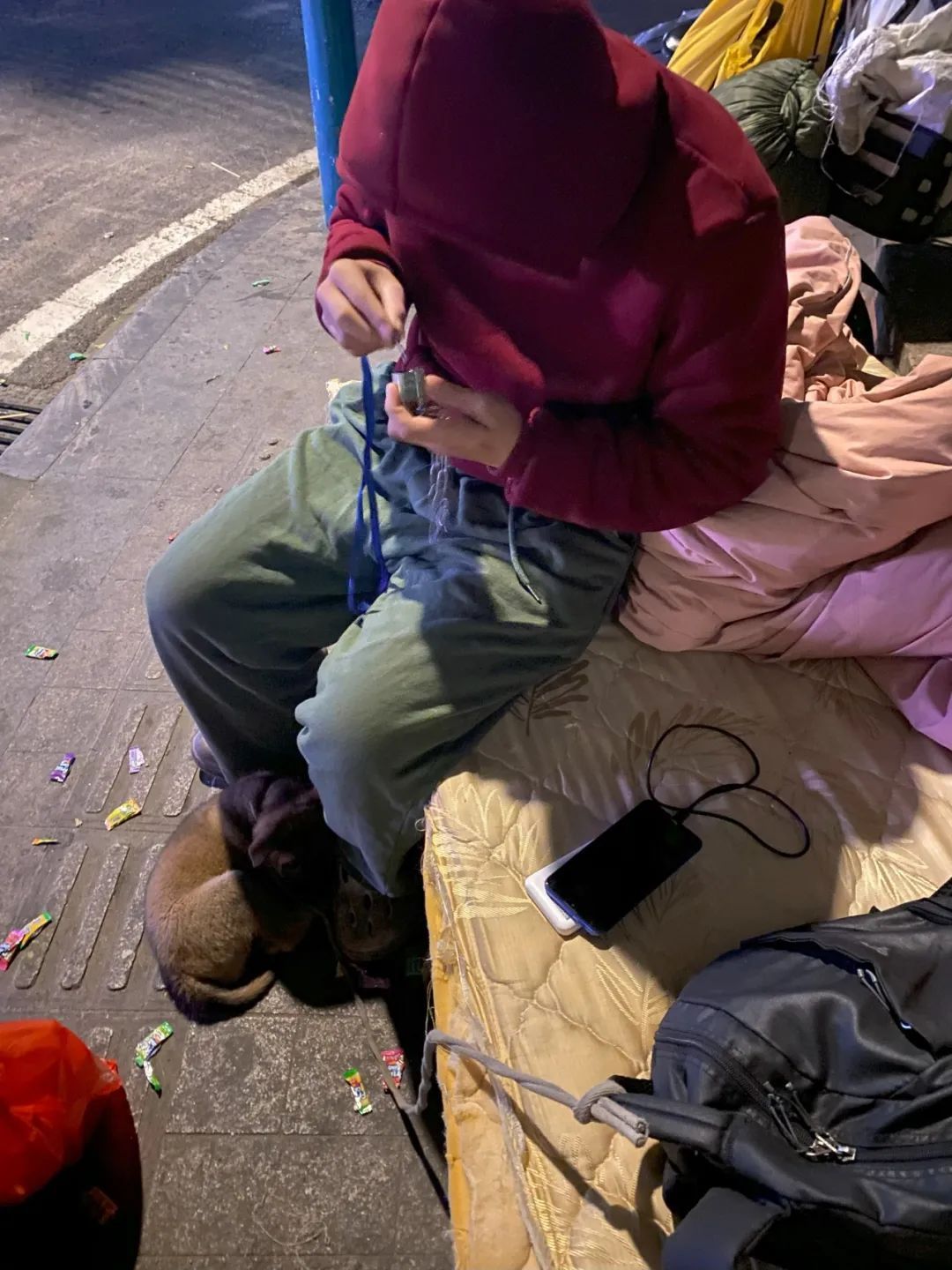
Xu Cheng and his dog opening locks
He rented a single room in Dongguan for almost half a year, with a monthly rent of more than a thousand yuan. The monthly electricity bill was several hundred yuan, and he felt that the landlord had tampered with the electricity meter. The deposit was also deducted, and he felt cheated, so he didn’t want to rent a house anymore, and he slept on the roadside. He now sometimes goes to move goods for people, earning more than a hundred a day, and goes to Beijing Road to stroll and pick up some plastic bottles, which can also bring in ten yuan.
When he goes out to work, the dog stays on the street, and the street people around will feed it some vegetables and rice. During the conversation, the takeout arrived, which was the rice noodles he ordered for the dog. It sniffed and didn’t eat. Xu Cheng pointed at its head with his finger, “I’ll buy you chicken legs later.”
He plans to go to Zhejiang after the New Year to find work, “where there are no wage arrears, only in Guangdong have I been owed.” If his bicycle wasn’t stolen, he might be on his way to Zhejiang now. “I rode through several provinces and wasn’t stolen, but I was stolen here.” Xu Cheng said indignantly. He pointed to the group of people next to him and said, “There are a lot of thieves here.”
Another street person who picks up waste helped him pick up a shared bicycle. He was afraid of being stolen again, so he bought a lock for ten yuan and tied the bike to a lamppost. His phone was also stolen. He doesn’t dare to sleep at night now, and is vigilant all night, only able to sleep peacefully during the day. In order to remind others to pay attention to the safety of their belongings, he wrote on the electrical box: “Homeless people steal phones, beggars steal takeout here”, “Thieves’ meeting place.”
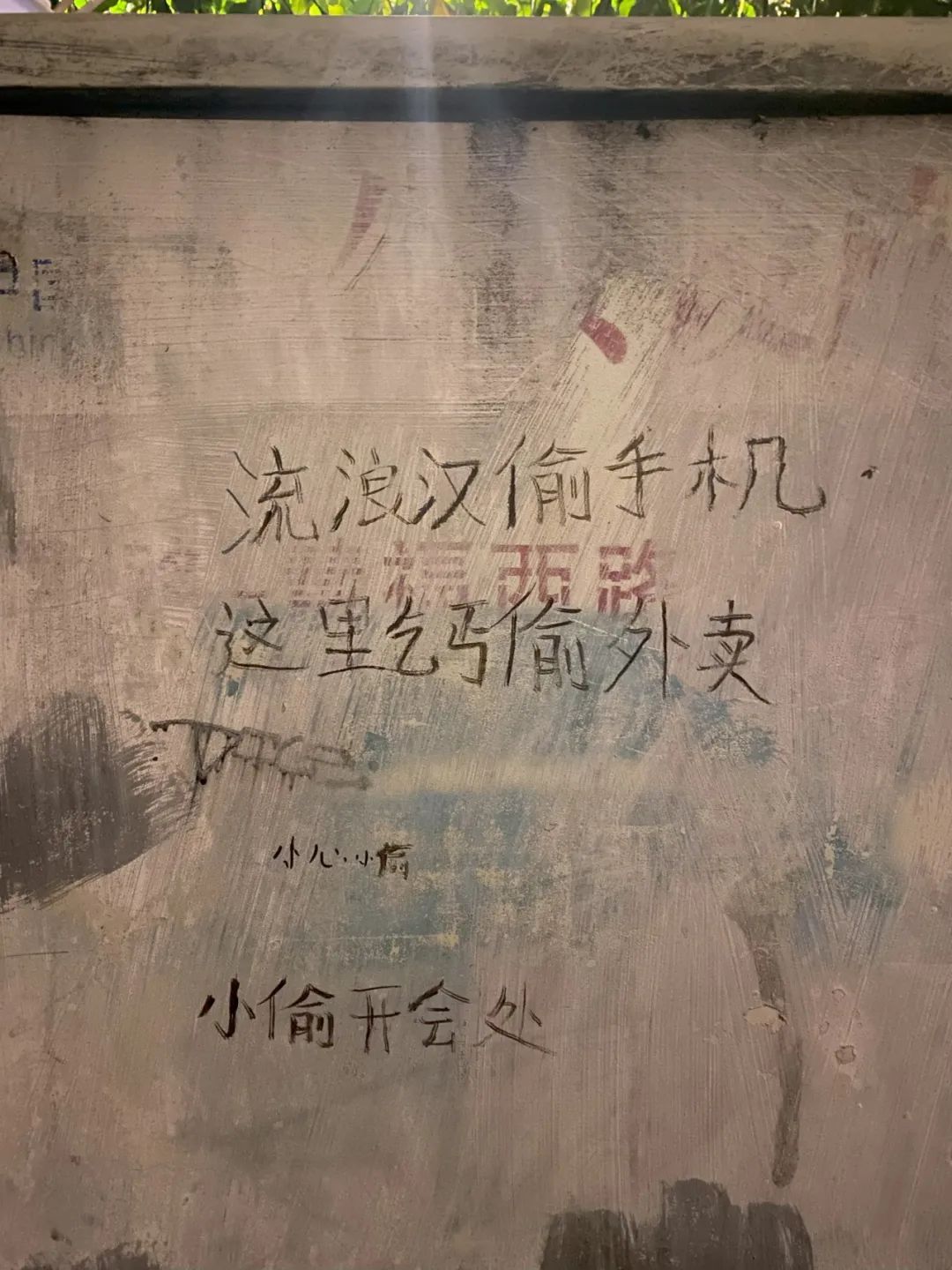
Xu Cheng’s reminder written on the electrical box
Huang Yi is the coordinator of the 2024 “Christmas Robbery” material assistance activity. This assistance activity was initially initiated by the Pink Cool Band and has been continued for two years. Volunteers put on “Santa Claus” clothes and go to the people who have been “robbed” to collect donated materials, and deliver them to the street people before Christmas Eve.
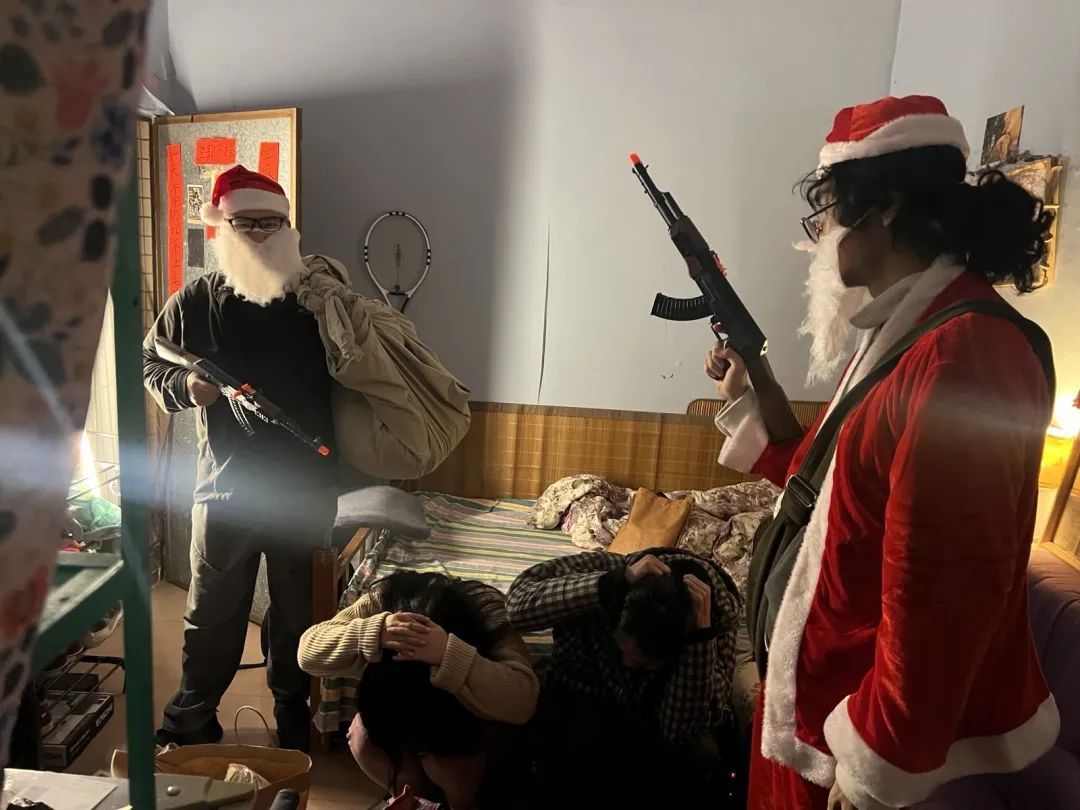
The “Christmas Robbery” volunteers will put on “Santa Claus” clothes and go to the donors who have been “robbed” to collect donated materials.
He observed that the Guangzhou street people group includes different types of people, including construction workers, scavengers, and people with disabilities. Some street people will form small groups and may snatch supplies or resell the items they get. Therefore, volunteers will specifically look for street people who are alone, who often need more help than the gathered street people. The former’s living place is not fixed, they have fewer belongings, and they usually only take what they really need.
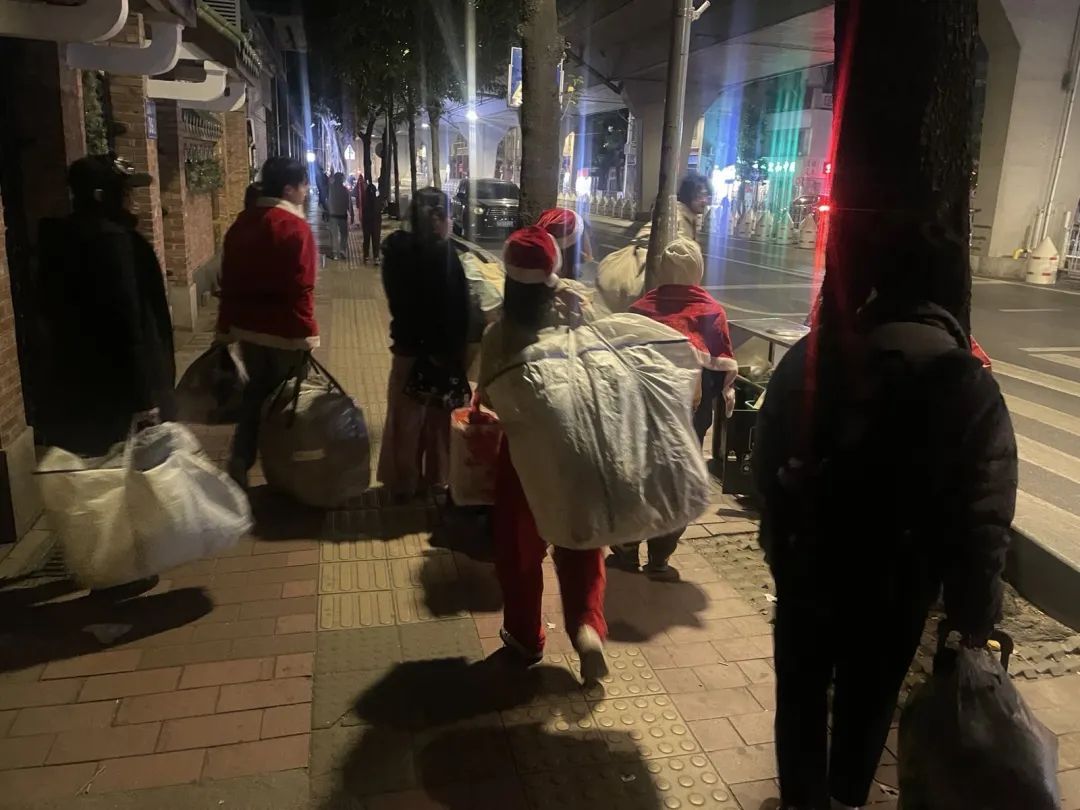
“Christmas Robbery” volunteers carrying large and small bags of donated materials
Xu Cheng said that he doesn’t want to be with “those people”, so he found a place to sleep on the side. But he is not prepared to stay away from them either, because they are “bodyguards”. There are many of them, and the urban management officers will not easily drive them away. The urban management officers sometimes turn a blind eye and let him clear his things away, and then put them back after taking photos to get the job done.
The police often come to “ask questions”, and Xu Cheng complained: “It’s enough to check once, they check every day.” He guessed that the police were not there to catch thieves, but to investigate people who had escaped from crime. “It’s useless to catch homeless people, they can’t even pay a five hundred yuan fine.” He said that those with small guts steal from the homeless, and those with big guts steal electric bikes, and someone comes to collect these items of unknown origin.
He was also robbed of his belongings. He was sure that “that fat man from Zhanjiang stole it.” After a scuffle at the police station, he showed a 30-centimeter-long knife for self-defense, which was confiscated by the police. The “fat man from Zhanjiang” did not fulfill his promise to sign and compensate. Xu Cheng said: “After these things, my mentality has changed a lot in recent years. I used to think about myself, but now I don’t care. Whoever provokes me, I’ll stab him.”
He took out five books from his backpack to show me, including a copy of “Zizhi Tongjian.” He said that he originally had more than a dozen, but they were not easy to carry, so he threw some away. On the last day of 2024, he set off early in the morning for Baiyun Mountain, 16 kilometers, and rode for two or three hours, arriving at noon. He walked with his dog, climbed the mountain to see the scenery, and rode back late at night.
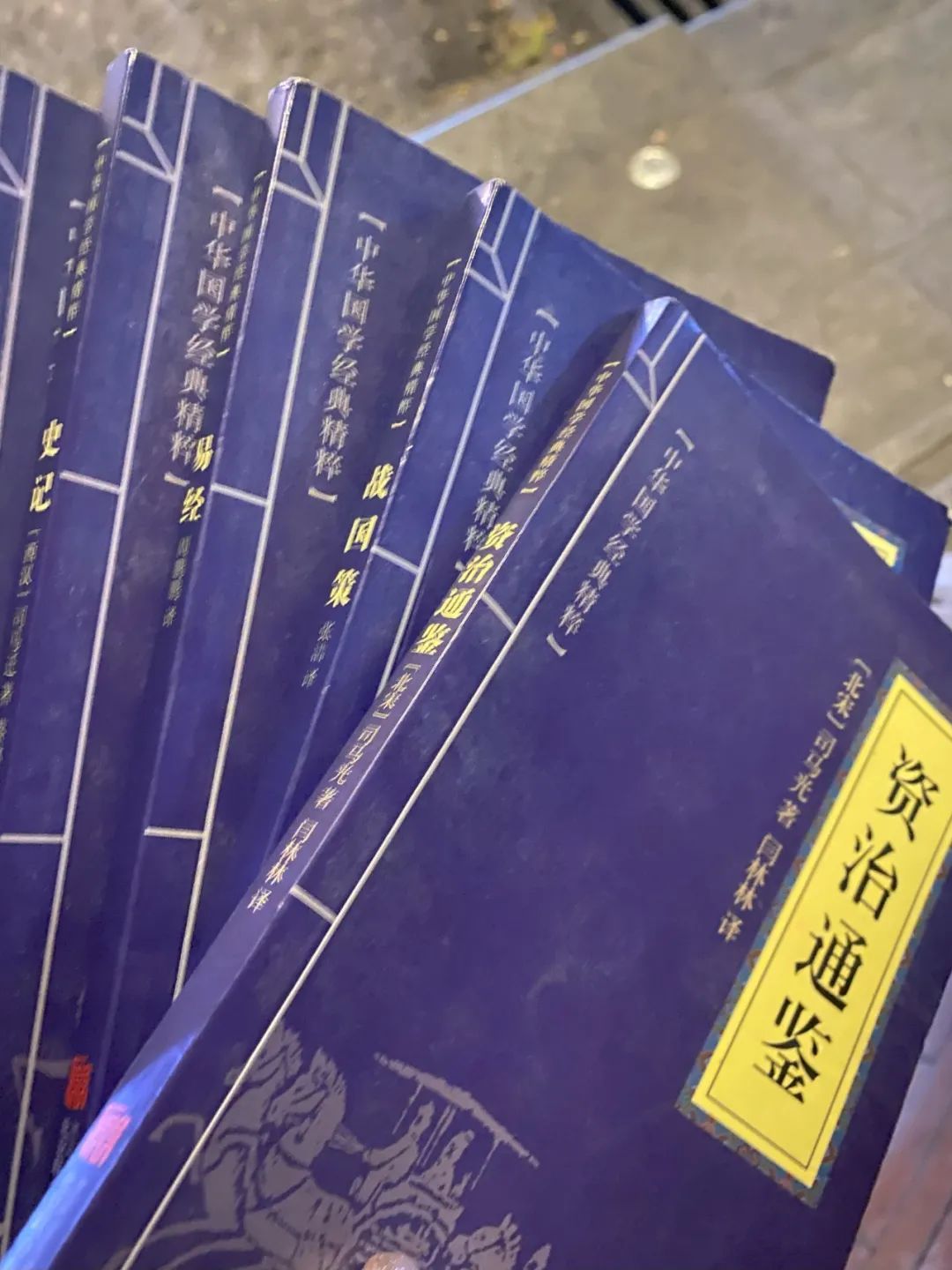
Xu Cheng’s books
ID card, bicycle and freedom
Uncle Huang sleeps in front of the glass door of a shop selling hearing aids. He often comes here because it closes early. He put a shared bicycle next to him to prevent passersby from approaching. He rests his head on a pile of clothes, his short, almost bald hair is exposed outside the green quilt, his red fleece hoodie covers his face with both arms, the mat is bright yellow, two socks are spread on the steps, and his gray shoes are placed on the side. There is a small bottle of essential balm the size of a fingernail next to his ear, which he applies to his face to prevent mosquitoes. Sometimes he also drops essential balm into his teeth to relieve toothache.
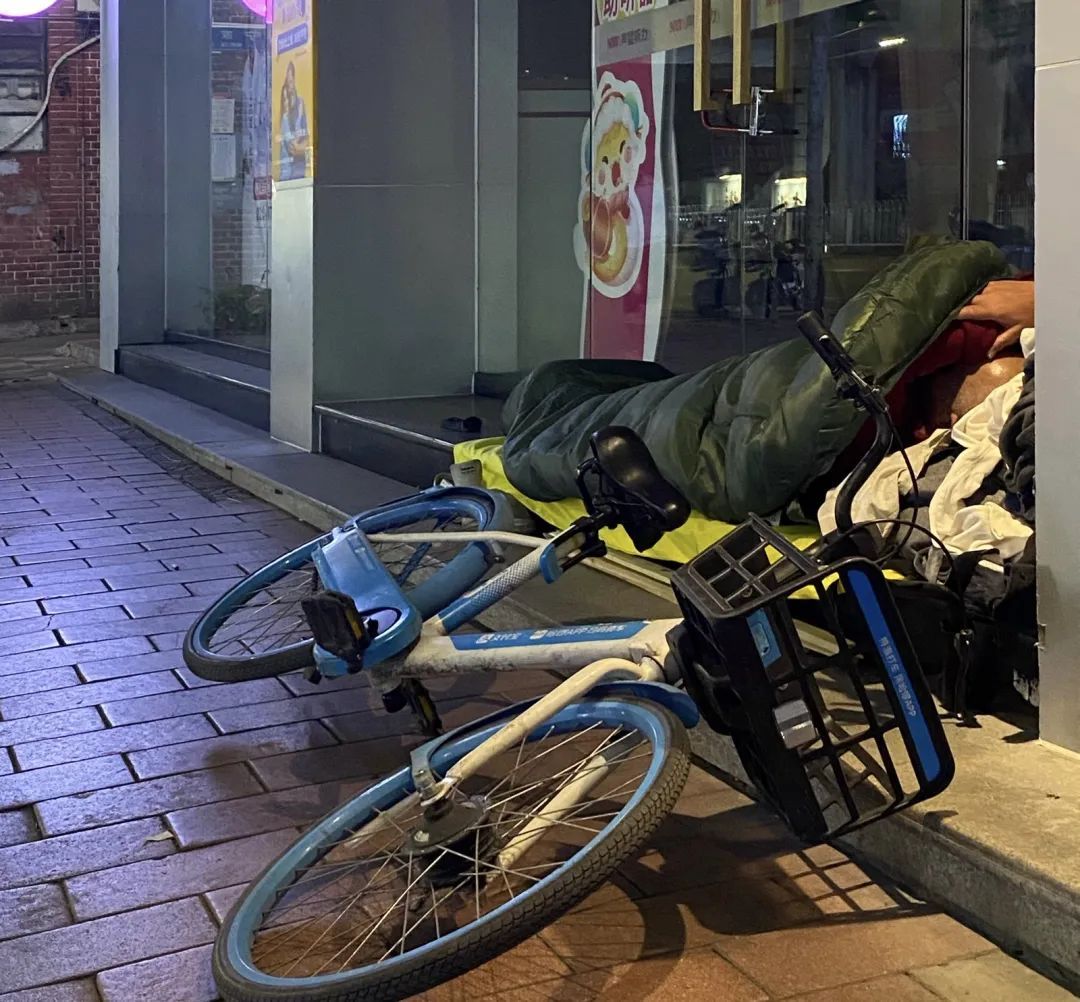
Uncle Huang and his bicycle lying on the ground
He is sixty years old this year and has been homeless in Guangzhou for two months. He has delivered newspapers and also “worked odd jobs” in the government. He recalled that at that time, there were no roads in the village, and he had to walk to carry the ballot boxes for the grassroots elections to the village, and he also helped collect agricultural taxes, but because he was owed wages, he quit in a fit of anger and went out to work in the 1990s.
He started wandering around 2018, riding a bicycle all over the country. He once rode from Fujian to Beijing, wanting to enter Chang’an Avenue, but couldn’t get in because he didn’t have an ID card, and rode to Tianjin in disappointment.
He lost his first-generation ID card. At first, he didn’t think it was a problem. “Before, you could get a loan without an ID card, and you could open a small shop for a few thousand or ten thousand yuan.” He didn’t know from which year onwards, the places where he worked had to check ID cards, and he couldn’t open online shops either.
The staff of the rescue station helped him ask the township in his hometown, but there was no news, and he no longer had any hope of getting a replacement. He feels that if he could have an ID card, he could do a small business, wouldn’t have to sleep on the ground, and could change his life trajectory and realize the value of his life.
When he was still working, he went to the bookstore to read, thinking, “Why is it like this when I work all day long?” He thought, “People can’t do too many boring things, can’t do too many evil things, and must have kindness.”
He goes to libraries and bookstores in every city. But in Guangzhou, there are few. The library doesn’t allow him to bring luggage in, so he puts it in the basket of his bicycle and goes in to read. After the winter is over, he will throw all his bulky clothes into the trash can. He likes summer, and he washes a set of clothes every day, so he can enter the library empty-handed.
He loves cleanliness and doesn’t want to pick up waste. During the day, he eats the vegetarian food from Guangxiao Temple or the boxed lunches sent by kind people, reads books, and goes to the river to think about where consciousness goes after death, and spends the day like this.
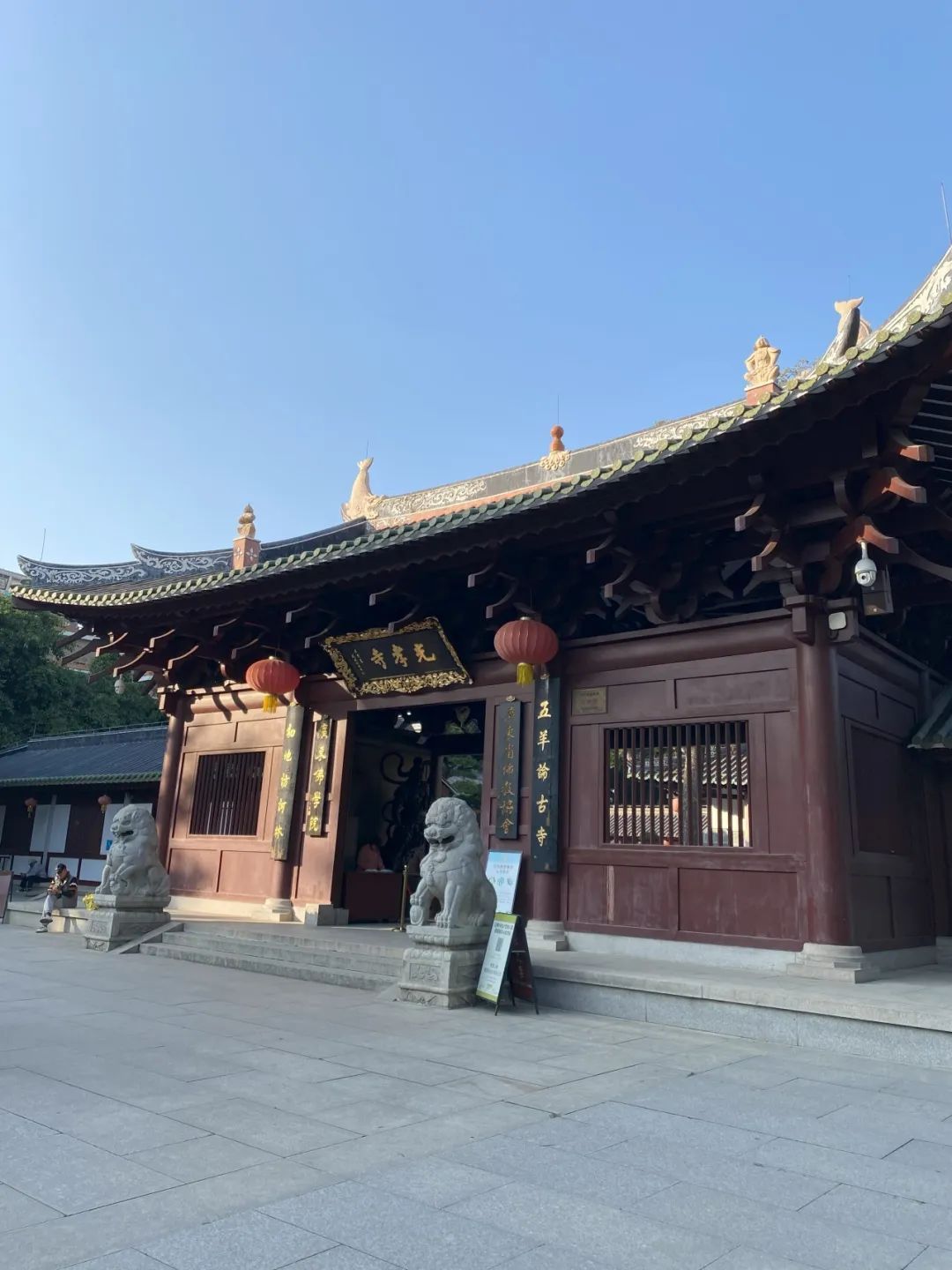
Guangxiao Temple, Yuexiu District, Guangzhou
During our conversation, a fist-sized, plump old rat ran towards us along the steps, and was frightened away by my exclamation. Homeless life has improved his health. He said that when he was working, his roommates played cards and smoked, and he got acute bronchitis from inhaling secondhand smoke. After becoming homeless, the outside air was good, and his illness healed itself.
The pandemic is even better in his impression than it is now. The new coronavirus couldn’t infect him, and the lockdown made the streets quiet. The traffic disappeared, and no one was walking on the streets, so it was quiet to sleep. He doesn’t have an ID card or a mobile phone, doesn’t do nucleic acid tests, and rides a bicycle from one province to another, and his itinerary code can’t track his whereabouts.
As soon as it gets light, he leaves the place where he sleeps, bundles up his clothes, mats, and quilts, and rides an unlocked Meituan bicycle to wander around Guangzhou, “It’s a little happier to wander around.” But unfortunately, the day I met him, this Meituan bicycle was “taken back” by the Meituan company.
The days without a bicycle are idle, and he feels that he will quickly get a mental illness. He said that he won’t stay in Guangzhou for long, and he wants to find another bicycle next year to “wander around.”
“Community of Shared Future for Mankind”
On Renmin North Road under the People’s Overpass, my eyes were attracted by two whiteboards filled with words. These words, “People First, Life First” and “Community of Shared Future for Mankind”, belong to Uncle Zuo.
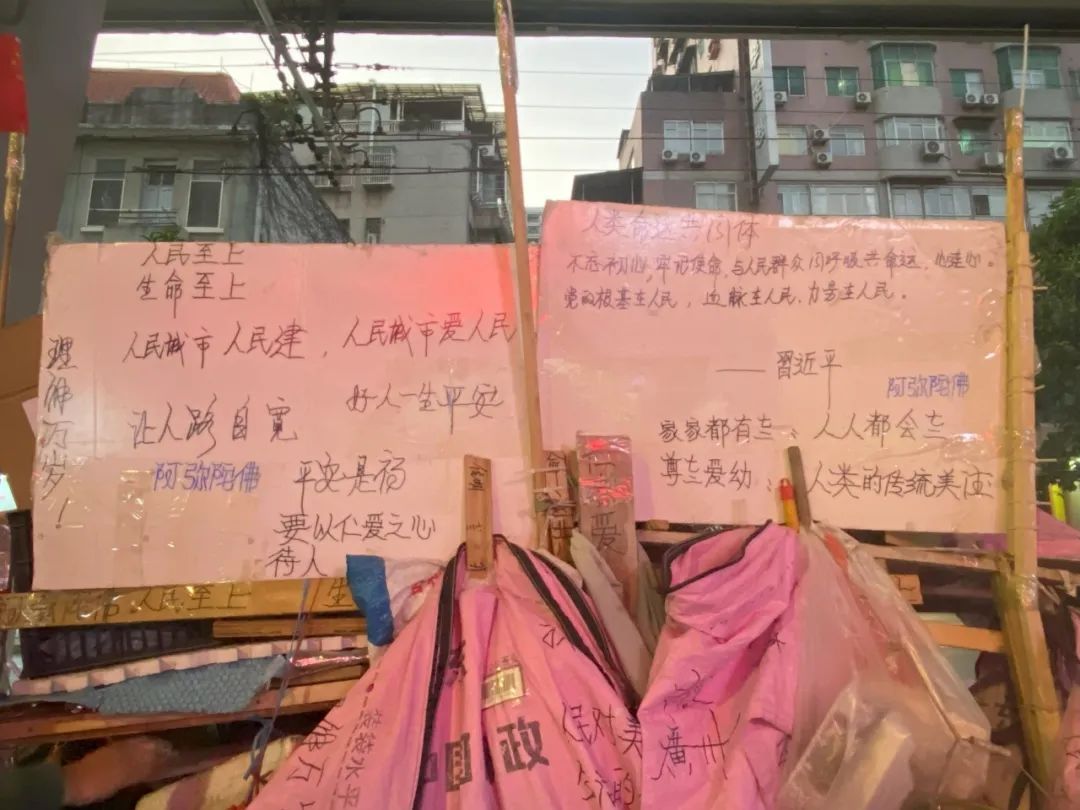
Two whiteboards on Uncle Zuo’s cart
He wears a yellow safety helmet, and the green hoodie he wears says “China Supply and Marketing Cooperative”. He sits on the protruding stone pier at the bottom of the bridge pier, loudly playing a radio. This is what he bought from the electronics market for a few dozen yuan, accompanying his leisure and sleep time. The whiteboard is inserted in the cart, following him on his tour of Guangzhou. When the elderly people passing by see it, they open their mouths and smile with wrinkles all over their faces, and give him a thumbs up from afar.
Uncle Zuo is over sixty years old this year and has been homeless in Guangzhou for nearly ten years. He is from Yingcheng, Hubei Province, and has attended high school. At that time, more than six hundred people took the exam, and the admission rate was less than 20%. He didn’t get into university. Later, he stayed in the village as an agricultural technician, teaching farmers how to use pesticides and when to transplant rice seedlings and spray pesticides. Two years later, he went to Wuhan to work and met a Mr. Sun who ran a calligraphy training institution. He often went to Mr. Sun’s place to watch calligraphy lessons. Mr. Sun saw that he was a worker and didn’t charge him, so he studied for free for more than a year.
In the 1990s, he went to Shenzhen to work, working as a decorator, mover, and security guard. In his fifties, he “lost his passion for life” and went to Guangzhou to pick up waste. The place where he slept for a long time was next to a public toilet on Zhongshan Eight Road, “The one who sweeps the floor is an old friend of mine.” He carefully wrote the shops behind the place where he slept on a foam board, just like writing an address. “Writing is a hobby of mine.” He said, “Even the fifty-something police officers at the nearby police station praise my calligraphy.”
Most of what he writes is President Xi’s speeches. Uncle Zuo calls himself a “worshiper of President Xi, and his character is top-notch in all aspects.” He appreciates the idea of “Community of Shared Future for Mankind”: “There are more than a thousand ethnic groups in the world (Note: actually more than two thousand), and more than one hundred and ninety countries. No matter which country or ethnic group, whether they are civilians or officials, they are one in eight billion, and they are all equal and cannot do bad things.”
He gave an example to explain his idea to me. When he was picking up bottles on Zhongshan Eight Road, a handsome young man in his thirties passed by him and spat at him. He responded: “You are very beautiful, but your heart is very dirty.” He feels that people should “not forget their original intention”, and this original intention is the kindness of “human nature is inherently good”. “A benevolent person loves others, and the two horizontal lines of benevolence are parallel, which represents that everyone is equal.” He said: “Picking up waste is also working.”
Unlike what I heard from other street people, he told me that he and the police “developed a long-term relationship” and were not driven away. “New era, new thinking, new actions, new responsibilities.” He spoke eloquently, dissatisfied with my stereotyped impression of the police, “Why are you so old-fashioned? Are the police more stupid than you? Your comprehension is very poor.”
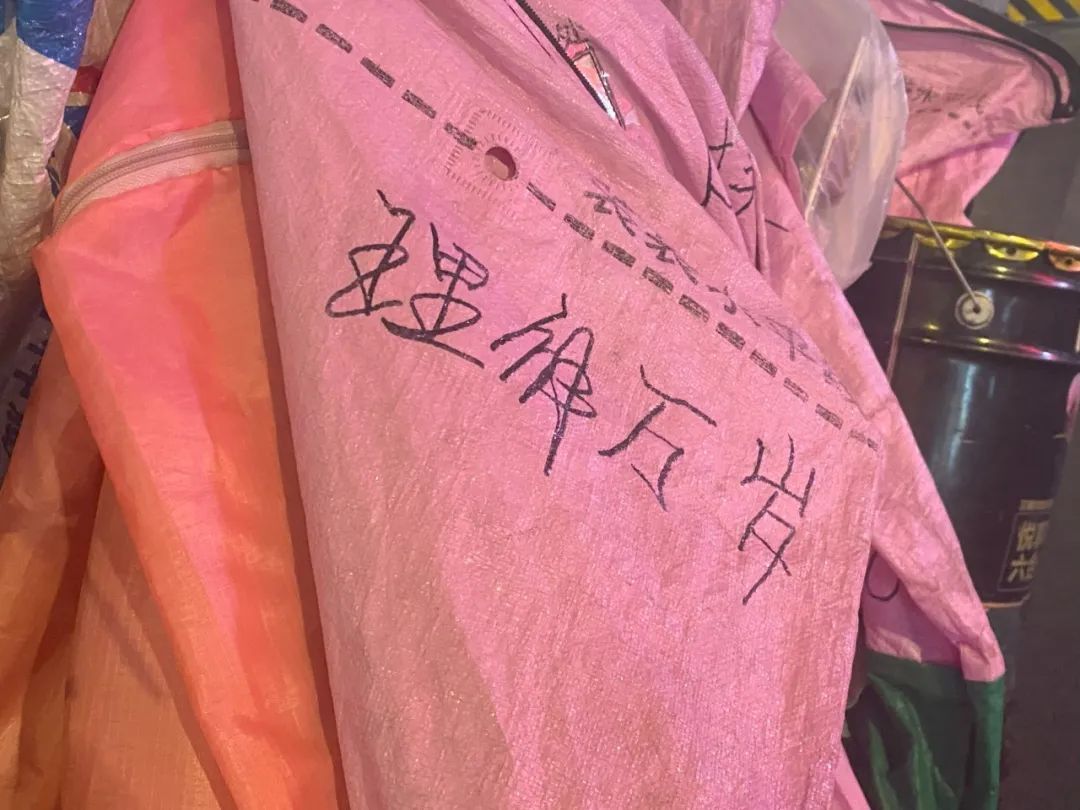
Uncle Zuo’s writing “Understanding is Supreme”
I asked, “Are you still used to street life?” He said that lowering expectations improves happiness. “President Xi said that we should let the people have more sense of gain, happiness, and security. Security is now basically guaranteed, unlike Gaza and Ukraine, which are in war. Happiness is not starving.”
From five to six o’clock, after waiting for an hour, the “Amitabha” in his mouth came on an electric bike to distribute food. It was a middle-aged man, perhaps a volunteer from Guangxiao Temple, and two stacks of white lunch boxes were stacked on the foot pedal of the electric bike. Uncle Zuo opened the lunch box he received. Today there were long beans, cabbage, carrots, and tofu. “Amitabha” asked me with his eyes if I wanted any, and I waved my hand.
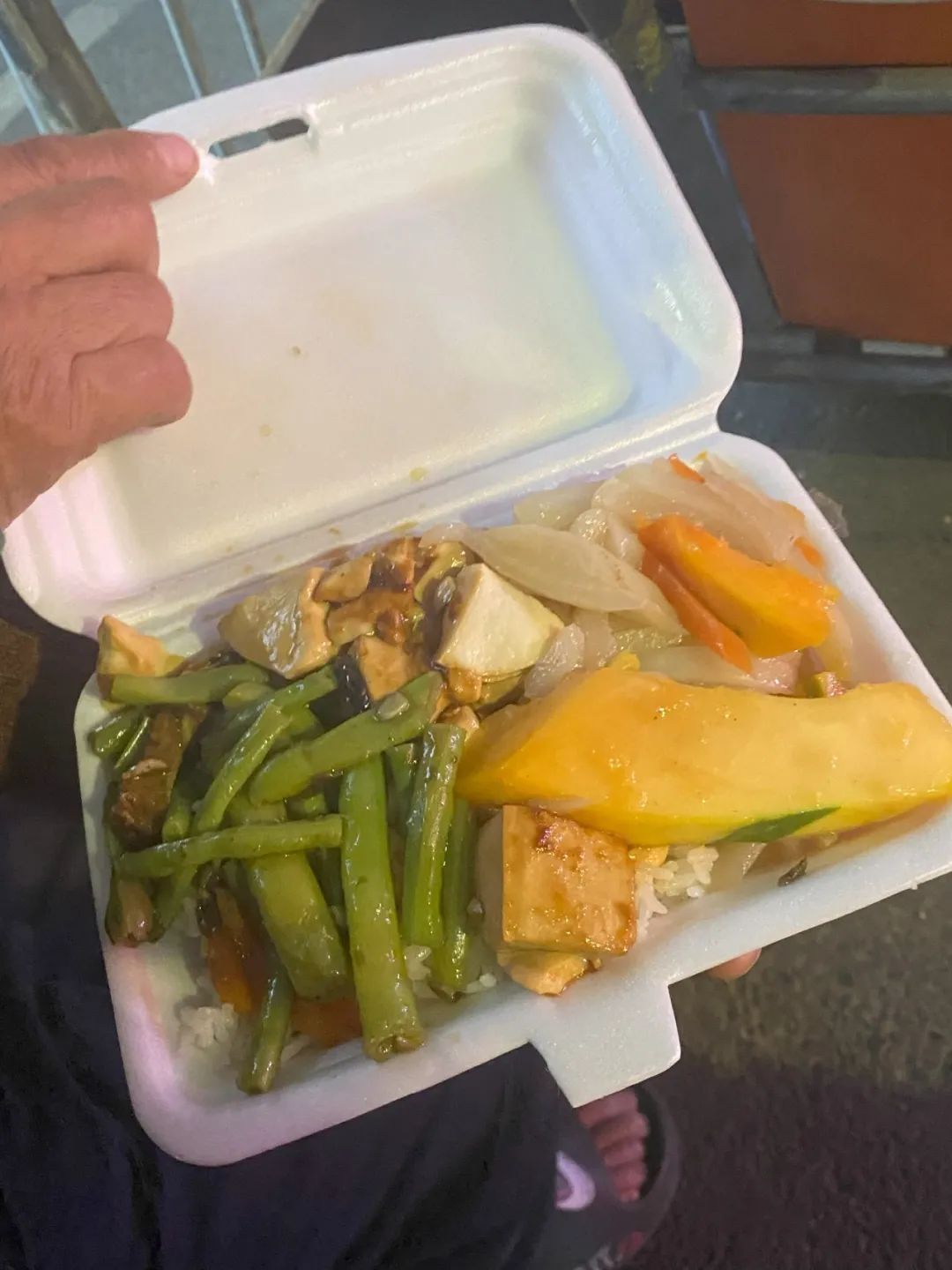
The lunch boxes distributed to Uncle Zuo by the volunteers
After I left, Uncle Zuo stood up and waved to me across the traffic: “Young people, don’t waste your youth! Come and inspect in your spare time!”
“Don’t want to be a tool”
The sources of income for street people in different areas vary. Most of the street people near Guangxiao Temple don’t have to worry about starving, and the temple, church, or nearby restaurants will distribute boxed lunches along the way at fixed times. There are also street people under the Haiyin Bridge, Guangzhou Bridge, and Liede Bridge on the Pearl River. Some of them sleep on camp beds and fish from the river to feed themselves.
It was reported online that a food delivery worker was camping under the Guangzhou Bridge. After receiving attention on the video platform, they were cleared. I met Brother Lu at the Haixinsha Asian Games Park, and he was one of the people who were recently cleared. He said that there were not only food delivery workers living under the bridge, but also many unemployed vagrants, and also day laborers like him. He remembers that there was a mother and daughter who were vagrants, and the daughter was in her twenties. He would buy food and share it with them, but he doesn’t know where they are now.
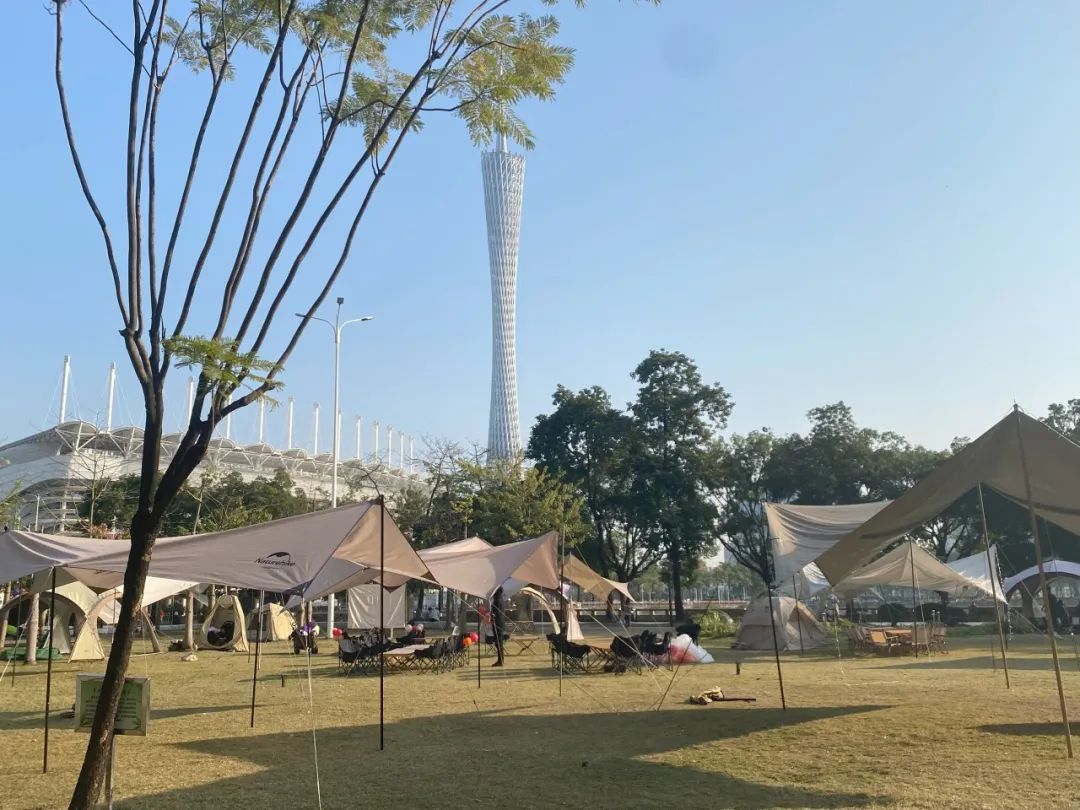
Haixinsha Asian Games Park
I met Sister Wang in a garbage station under the People’s Overpass, and she was looking for cloth to put on the ground. She is less than one meter and fifty centimeters tall, with short, messy hair, and a small braid in front to prevent it from blocking her view. Only three crooked, yellow teeth are left in her mouth. She told me that she is from Meizhou and is 38 years old this year, and has been living by picking up waste with her husband. We rummaged through the cloth that was damp and smelled of urine in the deepest black trash can and stuffed it into a bag and walked back.
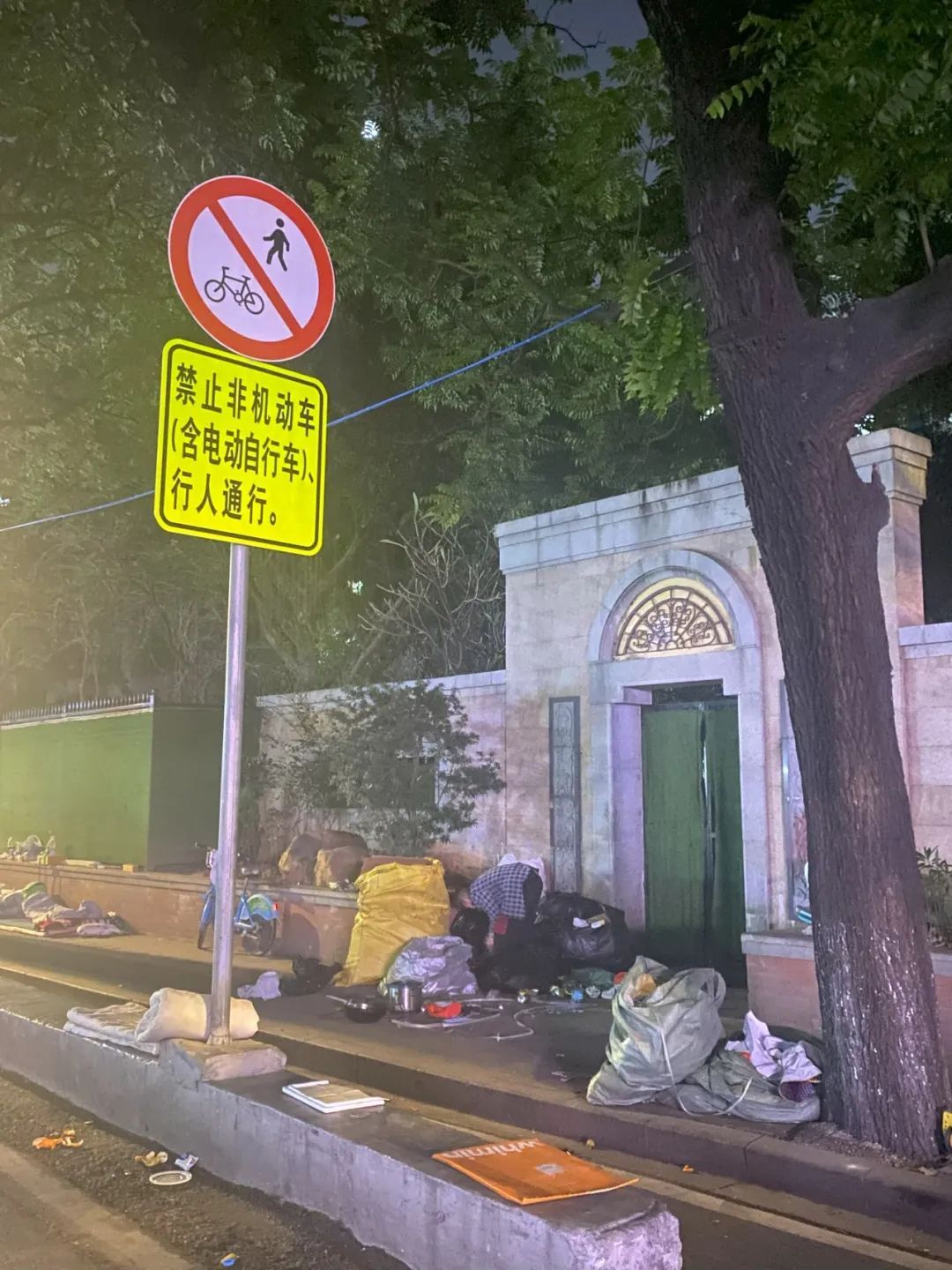
Cloth found by Sister Wang
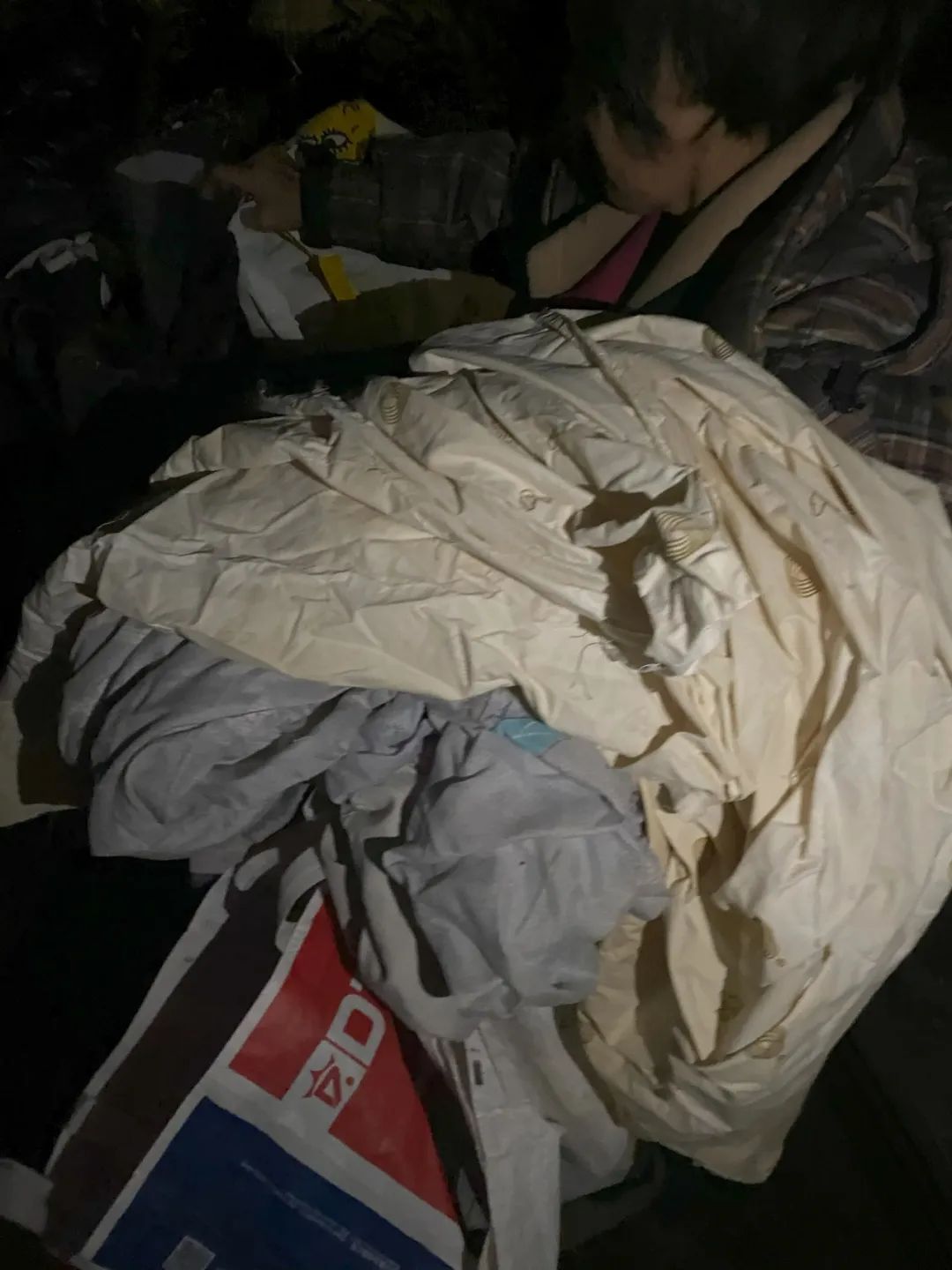
She sleeps on the street, “Water will be sprayed down from the overpass at 12 o’clock at night”, and she and her husband found a place where the water couldn’t reach. She greets the residents passing by friendly, “They often give us things.” She said that she and her husband can earn thirty yuan a day by picking up waste. I asked, what about when her period comes? She said that she would buy sanitary napkins, but she hasn’t had her period for many years. Her husband was smoking beside her.
Food given to Sister Wang by kind people on New Year’s Eve
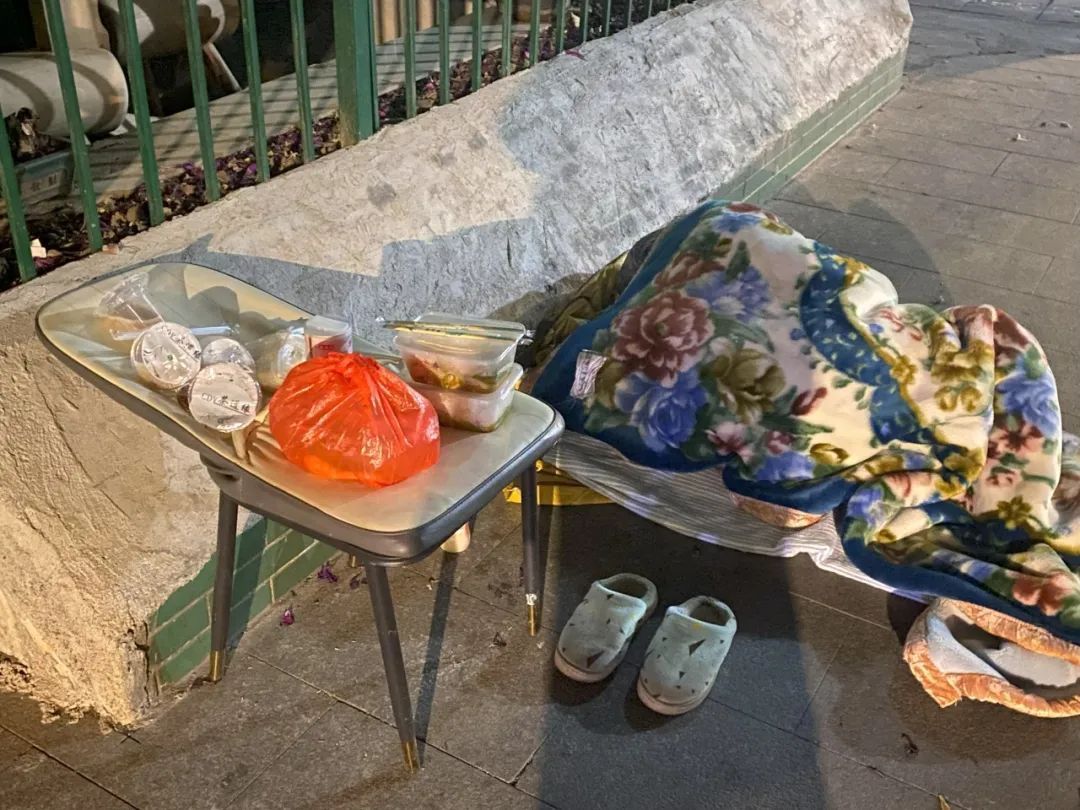
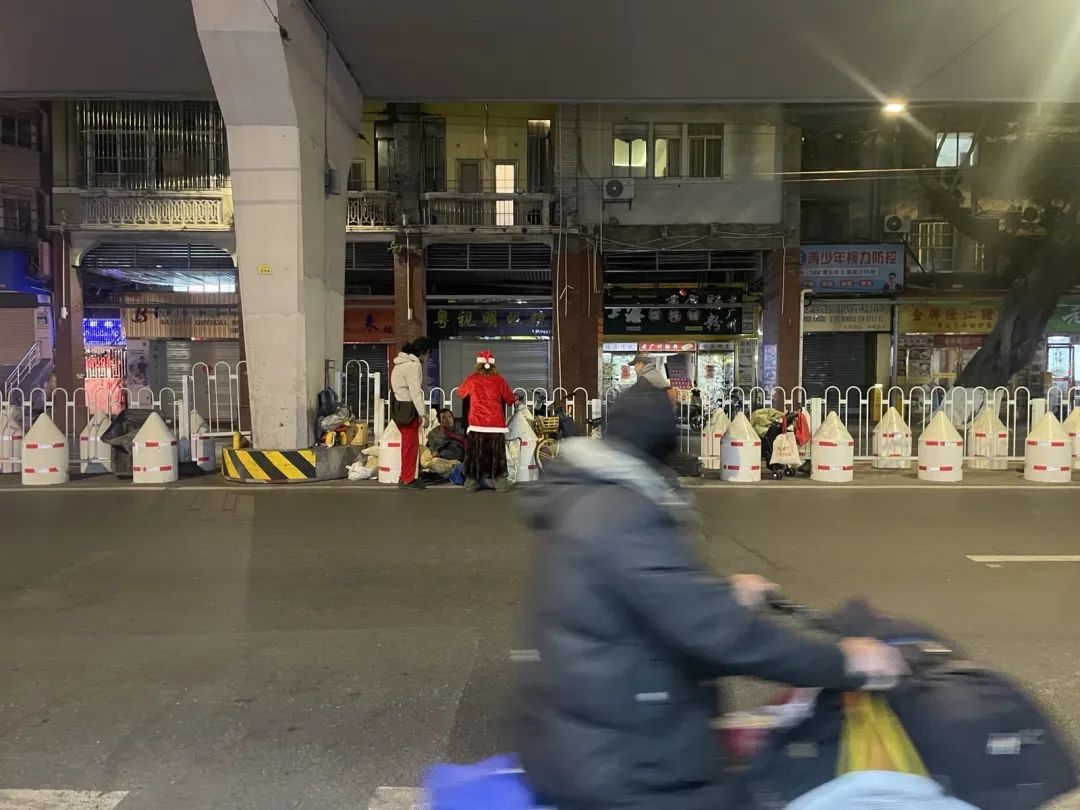
Ahua is a volunteer who has participated in the “Christmas Robbery” activity for two consecutive years. Her observation is that the climate in Guangzhou is relatively warm, suitable for street people to spend the winter, and there are fewer female street people. “In the more obvious environment of the survival of the fittest on the streets, female street people are often at higher risk of safety, and are prone to becoming victims of sexual violence, such as rape, or being forced to exchange sex for necessary clothes and food, etc.” She said, “There are very few female street people who have been homeless for many years.”
“Christmas Robbery” volunteers distributing winter donation materials to street people
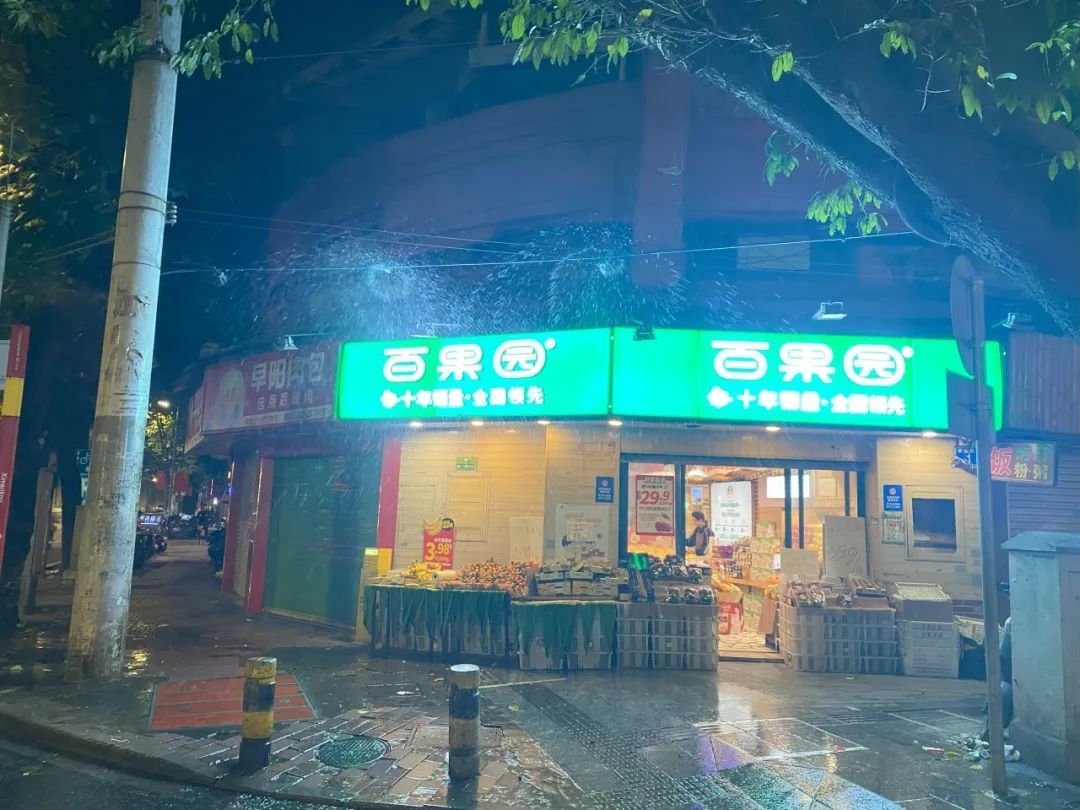
The government and the public are relatively tolerant of street people, “but we learned from our communication with several street people that there are also sprinklers on the street, which are arranged by some shop owners to prevent them from sleeping at the door of the shop.” Ahua said. Many street people are willing to share their stories, but the content may be half true and half false. Some street people have lived on the streets for many years and have their own social networks and lifestyles. Some of them are not willing to accept help or “return to society”, and enjoy their current free life more.
Shops that are sprinkling water
Many tents are pitched on the grass in the park. Some tourists have picnics to celebrate birthdays. Brother Lu and the relaxed atmosphere around him are somewhat out of place. He wears a black peaked cap, blue coral fleece pajama pants, takes off his holey shoes, sits cross-legged on a smooth stone bench, facing away from the sun and the Canton Tower, and the AI voice of a man telling the story of Liu Qiangdong and Milk Tea Sister comes from his phone.
He rides a mountain bike, and the handlebars on both sides are hung with quilts and clothing for all seasons. There is also a big lock on the handlebars, which is probably more than enough to lock car tires. This lock cost him more than a hundred yuan, and ordinary pliers can’t cut it. He said that he used to ride an electric bike, and he tied it to the guardrail on the side of the road at night, and it was gone the next day. He suspects that it was the city maintenance staff who painted the guardrail from white to black, and then painted it from black to white, who took it away.
Brother Lu’s belongings
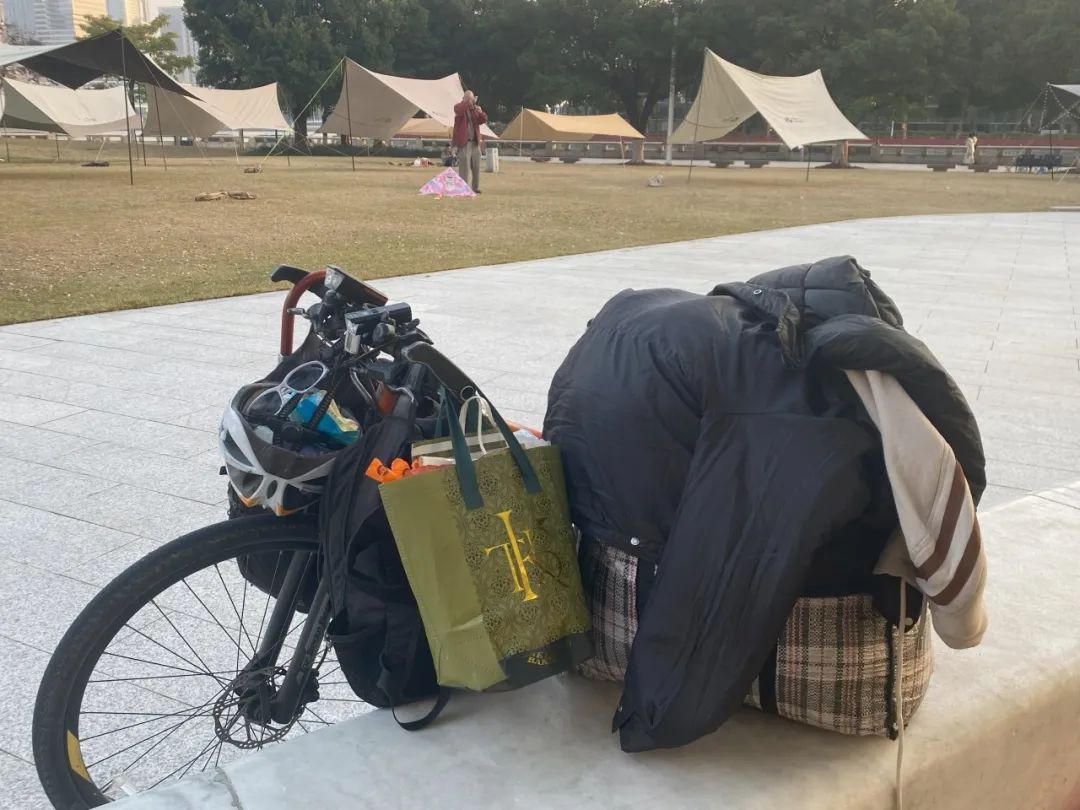
His activity range is not large, only wandering around Guangzhou. He will go to fast food restaurants to buy food for more than ten yuan, and miss the 3 yuan milk tea in the shantytowns, “You can’t even buy a cup of milk tea for 30 yuan here in Haixinsha!” He earned eighty yuan the day before, and slept from five in the morning to four in the afternoon, and hasn’t spent a penny yet this day.
He proudly mentioned how he was pursued by girls because he was too handsome, and how he was threatened to drop out of school by a gang outside of high school; how he came out to work in his early twenties, with his hair slicked back and his shoes polished, but abandoned the girls’ hearts and got into the game. “My time has passed”, he said sadly. His current life is similar to that of the “Three and a Half Gods”, doing day labor, getting money to play games, and then doing day labor when the money runs out.
I asked him if he had ever thought about finding a fixed job. He said that he could only get one yuan for ten yuan, and he wouldn’t be able to save much money even if he worked all year round. The money was used to pay the mortgage, and the house only had seventy years of property rights, “I don’t want to be a tool for others”.
*Zhang Xing is a pseudonym, and thanks to the essential balm for its contribution to this article.
*张兴为化名,感谢风油精对本文的贡献
Discover more from 自由档案馆
Subscribe to get the latest posts sent to your email.