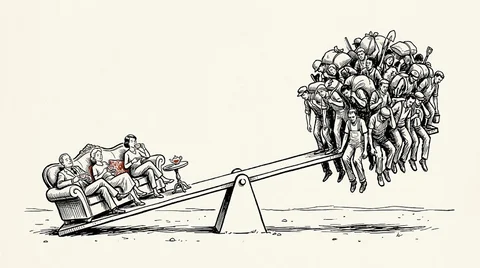



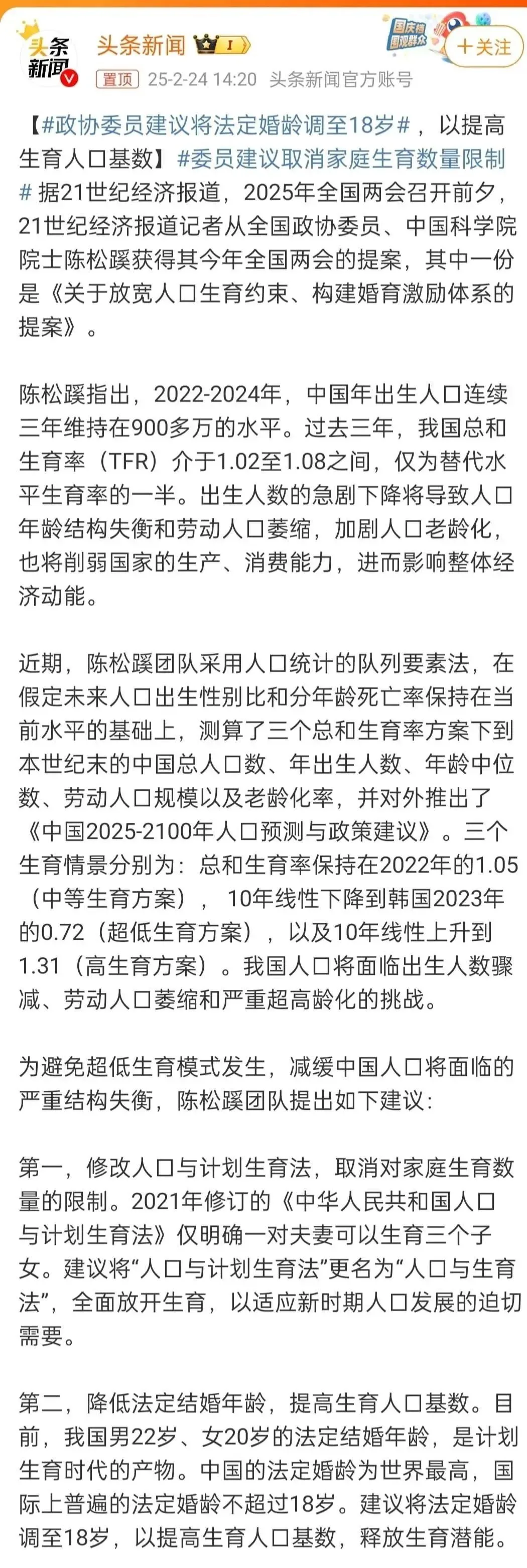
Recently, Chen Songxi, an academician of the Chinese Academy of Sciences, put forward a suggestion:
It is suggested that the legal marriage age be lowered to 18 years old.
And the purpose is:
To increase the base of the birth population and release the potential for childbirth.
The day before, you were still playing games and had to prevent addiction, but the next day you could get a marriage certificate; the day before, you were not allowed to have puppy love, but the next day you could sleep with another person of the opposite sex; this is exciting, who would believe it?
As netizens joked, "Teacher, my due date is on the day of the college entrance examination, I can't go", "Unmarried teachers catch married students in puppy love", people really want to laugh when they are speechless.
The experts' slogans are shouted in a dazzling way, but there is a practical problem that needs to be solved:
If 18 years old can get married, then at what age is it appropriate for children to start dating?
I saw an article commenting on the Observer.com, the title of which is "The suggestion to lower the legal marriage age should be taken seriously by public opinion", saying that the nature of lowering the legal marriage age to 18 years old is to fully return the right to marriage autonomy to adults in the legal sense.
The experts don't hesitate to say that this suggestion is to "increase the base of the birth population and release the potential for childbirth", but Observer.com covers its ears and steals the bell to add value, which is to deceive us who are illiterate.
What shocked me is that this proposal doesn't even care about the right of minors to education, and even attempts to fully return the right to marriage autonomy to adults in the legal sense.
Yes, if this suggestion becomes law, the consequences will inevitably be that the education opportunities of the bottom people, especially the bottom women, will be ruthlessly deprived.
In theory, the legal marriage age is indeed not the mandatory marriage age, nor is it the best marriage age, but the problem is that this suggestion ignores the actual operating logic of the grassroots society.
In our rural society, which has a deep-rooted concept of clan and a supreme concept of fertility, "legal" is often alienated into "justifiable", and "legal" often means "should", which plays a strong guiding role.
In our countryside, if someone wants to introduce a girl of sixteen or seventeen years old to a boyfriend, the parents will generally refuse with the reason that "the child is still in school, let's talk about it after graduation";
But if the marriage age of 18 is fixed in the form of law, it is equivalent to releasing a signal to the society that "allowing high school graduates to marry", and the above reason for refusal does not exist.
For the bottom families who hold the concept of "reading is useless", this will become a legitimate reason to force their daughters to give up their high school studies - after all, "legal marriage" is more in line with short-term interests than "uncertain return of education investment".
China's "Compulsory Education Law" guarantees citizens the right to receive nine years of basic education, but high school education has not yet been included in the mandatory scope. In remote rural areas and economically disadvantaged families, the dropout rate of girls is already significantly higher than that of boys. In this way, the education rights of girls, which are already lacking in protection, may be in jeopardy.
It seems to be just an adjustment of age, but in the realistic context of unbalanced urban and rural development and uneven distribution of educational resources, it is like a sharp blade accurately stabbing the bottom women.
These bottom girls who could have continued their studies are forced to become "fertility resources" and tools for the reproduction of family labor under the cover of "legal early marriage".
Some people ask, when 18-year-old teenagers hold marriage certificates and enter the college entrance examination, can their minds really balance their studies and family? But those who can hold marriage certificates and enter the examination room are still lucky, and many people may not even have the opportunity to enter the examination room.
Therefore, early marriage and childbirth will nail the bottom women to low-income positions, forming a vicious cycle of "low education - low income - dependent marriage". When the children of middle-class families in the city are still receiving higher education, rural girls may be trapped in childcare and housework.
The right to marriage autonomy should indeed be fully returned to adults in the legal sense, but the premise of autonomy must also be the ability to choose, right? For bottom women who lack educational opportunities and economic autonomy, lowering the marriage age not only cannot help them to autonomously control marriage and life, but may become an accomplice of the family and society in conspiring to deprive them of their right to development.
This will inevitably exacerbate gender and class inequality, which is not a problem of marriage and childbirth at all, but a problem of social fairness.
Supporters like to use "aligning with international standards" as an excuse, but you can't just look at the marriage age of other countries, but also look at their high school enrollment rate and vocational education system. Here, in many places, it is difficult to persuade parents to let their daughters finish high school, and it is even more unimaginable after the policy is implemented.
Admittedly, in many rural areas now, many girls get married before the age of 20, but since it is already like this, don't make the reality worse in the form of law.
I believe that the experts who put forward this suggestion certainly do not have to face the pressure of their children getting married at the age of 18, so they can use the banner of the overall situation to sacrifice the vulnerable groups as a price.
But people are not tools to be taken and demanded, and the experts who treat people as tools and sacrifice them at will, I suggest you give fewer suggestions!
—The End—