

Original title: 【Speech Interaction】When this high-ranking official said he had 6 children, everyone present burst into laughter
Editor's Note: Kazakhstan's population increased by 400,000 this year. If we compare horizontally, Kazakhstan's birth rate is 3.5 times that of China. How is this achieved? On November 22, Yerlan Karin, State Counselor of the Republic of Kazakhstan (the highest leader of the office appointed by the President of the Republic of Kazakhstan, directly responsible to the President), visited Renmin University of China and delivered a speech on the theme of "Kazakhstan's Reforms and the Sino-Kazakh Permanent Comprehensive Strategic Partnership," sharing Kazakhstan's experience in population policy reform and research on China. The full text of the speech can be found in today's WeChat headline "Kazakhstan's 'Key Figure' Appeals: Visa-free, Welcome Chinese People!", and the following is a compilation of the Q&A exchange between the audience and Karin, for readers' reference.
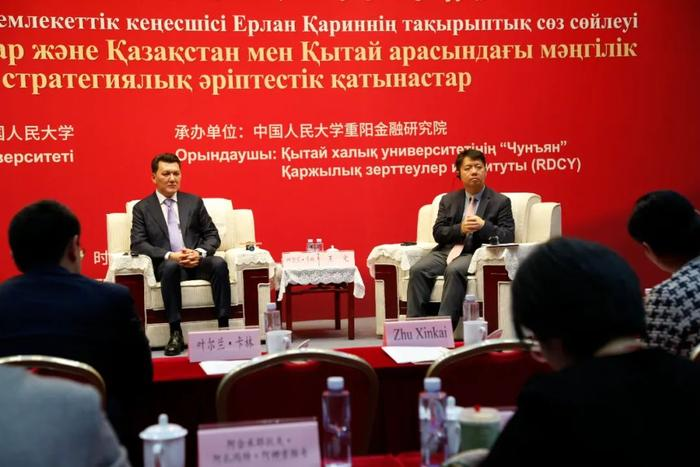
Wang Wen: Thank you very much, Mr. Karin, for your wonderful speech of more than an hour, which described the deep logic of Kazakhstan's reforms in recent years, as well as his personal precise views on systems, order, and social governance. Some viewpoints have also benefited me as a scholar. I believe that today, many people from all walks of life, including business people, investors, and students, will gain a lot.
More importantly, we still have many opportunities for communication today. For example, we heard Mr. Karin's views and understanding of the division between the East and the West. I would also like to say to Mr. Karin that we Chinese people have some of our own insistence on the "three worlds," and our respect and maintenance of these concepts of the East and the West. I think this kind of communication is very effective. Therefore, at the request of the Counselor, we have set aside more than half an hour for communication and exchange. I believe that everyone still has many questions, especially about Sino-Kazakh relations and the world格局.
Before you ask questions, we have two very important guest commentators today. I would like to ask them to make a brief comment first, for 2-3 minutes. First of all, please invite Mr. Yao Peisheng, the former Chinese Ambassador to Kazakhstan, to make a 3-minute comment.
Yao Peisheng: Respected State Counselor Yerlan Karin, I listened carefully to your keynote speech, and there was no official tone in your speech. And you can find answers to many questions and gain a lot of thinking materials. I have worked in Kazakhstan for nearly four years, and every day I observe the process of Kazakhstan's national development. I would like to briefly recall my work experience in Kazakhstan.
It was almost 20 years ago that I left Kazakhstan. However, as everyone knows, the friendship between China and Kazakhstan has a long history. Before 2000, the ancestors of our two nations already had very close exchanges and interactions. Your speech today is very wonderful and introduces Kazakhstan, which makes me feel very close, especially in the past three years, Kazakhstan's "Constitution" reform can be described as drastic and very successful. Mr. Karin has done a lot of work in this regard. How to put this cause into practice is a complex task, and I have been paying attention to what people are saying and talking about there.
China and Kazakhstan have established a reliable and solid relationship, that is, a permanent and comprehensive strategic partnership. We now attach great importance to the partnership between the two sides, and you have found that different mechanisms have been established. Therefore, I believe that we will have many cooperation results between China and Kazakhstan in the future. You have talked a lot about reforms today, and I will say that no matter how much you say, it will be summed up in one point: the reform is still ongoing. I think the reform is not over, we live in the reform, without reform there is no innovation, and a society will not progress. I believe that in the next step, your country will have more achievements to build the country and cooperate with other countries, especially with China.
Therefore, taking this opportunity, I sincerely congratulate you on achieving more results in this position, wish your country prosperity, and wish your country and other countries more exchanges. We are neighbors, we are neighbors who cannot be moved away, this is given to us by God. Thank you!
Wang Wen: Thank you, Ambassador Yao. The second commentator, please invite Professor Wang Xianju, a very famous Russian and Central Asian studies expert in China, and a researcher at the Russian Research Center of Renmin University of China-St. Petersburg State University.
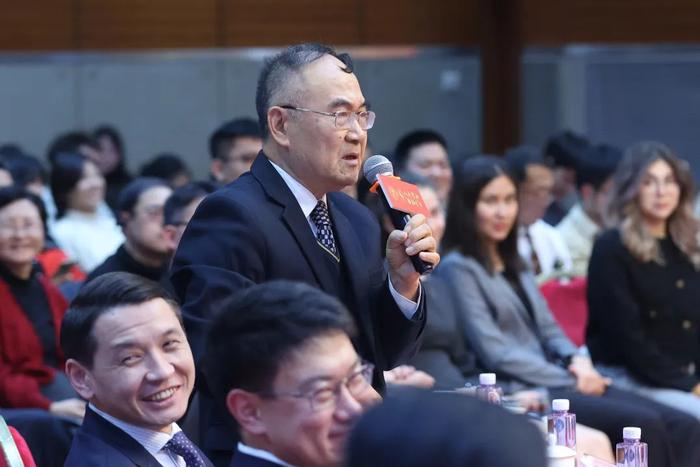
Wang Xianju: Respected Mr. Karin, I am very happy to listen to your speech today, and I feel very educated and benefited a lot. I have just visited Kazakhstan recently and went to Astana and Almaty. Astana impressed me as the youngest and even the most modern capital in the new Central Asia, which left a deep impression on me. My feeling is that the capital of Kazakhstan is very beautiful, very atmospheric, and very tidy, and the people of Kazakhstan are very confident and proud.
So, I was thinking, how can Kazakhstan achieve this level now? This country is now very vibrant, and after listening to your speech just now, I can understand some of it. You talked about reform, I thought you would talk about reform, and talk about "one, two, three, four, five", in what aspects in these years, the first one, the second one, the fifth one, the sixth one, but you didn't talk about it like that. I think you spoke very well, with both theoretical height, political height, and macro, but also down-to-earth, speaking very peacefully and very practically. I think our Chinese audience and listeners are more receptive. You talked about a just society, government efficiency, parliament, the relationship between various aspects, elections, etc. However, what impressed me most is that you mentioned one point, which is how to enhance people's social awareness and modernize people's consciousness in the current situation of rapid social development and now technology, various ideas. In fact, I have been thinking about how to make Kazakhstan achieve this after my recent visit to Kazakhstan. You introduced some experiences and practices today, and I was very inspired.
Due to time constraints, I would like to ask a question. There is a phenomenon that surprised me during my visit to Astana this time, that is, there are many children in Kazakhstan, everywhere in the streets, public places, and shops. Parents are holding one in their arms, pulling one in their hands, and a few older children are still following behind, and some younger ones are being pushed by adults in strollers. And I heard that the average age of the population in Kazakhstan is 32 years old, and the government has adopted very effective measures, that is, encouraging childbirth, early childbirth, and multiple births, which has made the population of Kazakhstan nearly 20 million, but the land area is 2.7 million square kilometers.
So, it has to solve this problem, but it solves it very effectively and very efficiently. Our country's female comrades are unwilling to get married and have children. Whether it's parents or leaders, you mobilize them and persuade them, but they don't listen. So, I'm wondering how Kazakhstan has achieved this. What are your policies, measures, preferential treatment, etc.? I even heard that female college students give birth after graduation, one after another. How can they believe you so obediently and give birth like this, early and multiple births, thank you!
Wang Wen: Special thanks to Teacher Wang Xianju. May I venture to ask the Counselor, how many children do you have? Are you planning to have more children?
Yerlan Karin: I have 6 children, 5 daughters and 1 son.
Wang Wen: Expressing respect.
Yerlan Karin: However, I don't force them, don't force women to have children, or change them, let them do what they don't want to do. Because I have a good friend, he is the first to start a family in his family, and soon after, the family had their first daughter. So, my friend, we have been worried, because Kazakhstan also has such a concept, that is, boys are now our brothers, relatives, and elders are having children, so how do we raise children, raise daughters? This is a problem, and our family tradition is to have boys, and there is no habit of educating and raising girls. I told him not to make choices for her, not to choose for her, she will grow up on her own.
So, we have such an advantage, that is, first of all, we have such a modern social problem, how is it produced? For contemporary society, it is a typical problem, that is, the degradation of traditional concepts, etc. Now we are fine, we still retain this tradition, that is, the culture of the family. I think this is one of the advantages of our society, which enables us to maintain the inheritance and promote this traditional culture and concept.
Second, in general, women in Kazakhstan are very active, they are very actively involved in all aspects of social life, and also participate in politics, and ask questions, and guarantee human rights. It is thanks to some female activists that we have passed a very important law, which involves children's safety and women's rights and interests. This law has been discussed fiercely for many years. So, we have always wanted to pass this law. We hoped to pass it in 2020, but it was not passed in the end. Because some social groups opposed the passage of such a law, they said that it could not break the traditional social concept, they organized some opposition actions, and prevented the passage of this law, this was in 2020.
And two years later, the women of Kazakhstan finally won, and this issue was put on the agenda again and finally passed. This law is indeed very groundbreaking and revolutionary, and it has formed a new mechanism to protect women's rights and interests.
Now I would like to talk about our population problem. As everyone knows, Kazakhstan is vast and sparsely populated, and the population is not very large. 20 million, I think, is not a big number for China, but Kazakhstan's population is growing very fast, with basically 400,000 newborns born every year, which will put some pressure on society and require the continuous construction of new schools, kindergartens, etc. This is a problem we urgently need to solve, that is, we need to continuously allocate funds for social undertakings and make financial investments.
The second problem is also related, that is, we have this concept of taking things for granted, our citizens, our society always expects the government to help them solve this problem, which will affect the rapid development of society. Therefore, we have also made a lot of reform attempts, and we hope to form a more active participation concept and attitude, that is, to be able to actively participate in and improve their own lives.
The last example I would like to talk about is that our parliament is now studying a law, and I hope it will be passed in the near future. It is a new outline and plan for social development, that is, the "Future Plan". The essence of the plan is that we will build a special education fund. Every newborn, that is, every child, when they are 5 years old, when they are 5 years old, he/she will have an independent account, and his/her parents can open an account for the child at the bank, and the government will deposit basically about 500 US dollars into this account, and there will be a reward every year, and there will be a 7% growth.
This is an investment by the government and the state, which is helping young parents to reduce their burden, because young parents have to bear the education of their children, this is how we help young parents, hoping that they can pay attention to their children's education. That is, the government and the state invest, 500 US dollars is not a big number, but at the same time, parents also need to invest 1000 US dollars in batches within a year. You can calculate that this is a proportionally invested number.
This makes us basically guide parents, that is, it is a plan for a children's education fund jointly formed by the state and parents. We are planning for the future of the children in advance, and this exclusive account can only be used for the children's education. We have made a statistic, basically including interest, including the annual growth rate, etc. When the child is 18 years old, it can basically reach a gap of several million, and it can basically cover the cost of his higher education. So, we are taking this path, that is, the government and the family invest together.
We also have a principle of unity. I have mentioned more than once that one of the important standards of a fair Kazakhstan is that we stipulated in the "Constitution" of 2020 that all wealth belongs to the people, and is only subject to government management, which is stipulated by our government. Then a problem arises, since it is said that all wealth belongs to the people, how do the people enjoy this wealth? Therefore, our president also put forward a very good initiative, that is, we have a national fund, that is, our energy income, that is, the income from oil and natural gas, the income from oil extraction will be included in this national fund, and now every newborn will open an account, and every newborn's account will receive dividends from this national fund account.
What is the purpose of doing this? For example, when the child is 18 years old, he/she will have a certain amount of savings, and this savings can only be used for two purposes: 1. Solve the problem of housing. 2. Solve the problem of education. Or his/her parents cannot abuse the funds of this exclusive account, for example, buying luxury goods, buying cars, buying smartphones, etc. So, we don't want to cultivate a concept of consumption and a trend of consumption. So, we are cultivating the sense of responsibility and responsibility of parents, that is, the joint participation of all parties, including the joint participation of the state and parents. I think that through the regulation of this mechanism, we can gradually form a new social habit and a new social standard. Of course, any reform needs time to verify its effect. So, we hope to establish this foundation.
Thank you very much, Ambassador Yao, and thank you very much for your high evaluation of me. I was a little flattered just now. You said a lot, and I don't have some official articles and official rhetoric here. Thank you very much for your high evaluation of me. I am also very happy to see you on this occasion today. Indeed, you have also made great contributions to the friendship and development between China and Kazakhstan. You and your predecessors, and your colleagues, including in the embassy, including some good friends in your position, should be proud of their achievements and the work they have done. Today, we look at the height of the relationship between China and Kazakhstan, and indeed, the achievement of this result today depends to a large extent on the great efforts of the diplomats of the two countries. You have done a lot of work, thank you!
Wang Wen: Mr. Karin's figure of 400,000 is very shocking. If we calculate according to Kazakhstan's population of 20 million and China's population of 1.4 billion, if we compare horizontally, it means that China needs to have 28 million births every year to be the same as Kazakhstan's birth rate. However, China's birth population this year is only 8 million, less than the tip of the iceberg of this proportion in Kazakhstan, that is, Kazakhstan's birth rate is 3.5 times that of China. So, many of my peers admire me, saying that I have two children. I suddenly realized that I should admire you, because you have 3 times more children than me. However, I think the experience you just mentioned is very worthy of China's reference. If my child deposits a sum of money when he is 5 years old, with an annualized rate of return of 7%, and takes it out when he is 18 years old, I can't use it either. I think I should consider having a third child. I believe that our young students are now ready to get married as soon as they graduate. So, thank you very much for imparting such important experience to China to solve the current aging population in China and the current population decline in China. Let's applaud and thank you for such wisdom.
We are entering the interactive session.
Question 1 from the audience: Respected Mr. Yerlan Karin, hello, my question is, under the framework of the Shanghai Cooperation Organization, the cooperation between China and Kazakhstan is not limited to traditional security and economic and trade cooperation. In the future, will Kazakhstan consider introducing some new cooperation topics, such as energy digitalization, climate change response, and some intelligent infrastructure construction? What kind of joint pilot projects will China and Kazakhstan carry out in the above-mentioned areas to achieve common interests? Thank you!
Question 2 from the audience: I am a student of the School of History, Renmin University of China, and my major is political science and history. So, the topic you are talking about today is indeed a question that I am very interested in, especially China is a very rigorous country in its diplomatic measures, so seeing the words permanent and comprehensive is really very profound. And your talk about the concept of political philosophy and specific policies has touched me deeply. I am a Kazakh student.
My question is, since the 1990s, starting from President Nazarbayev, Kazakhstan has been encouraging Kazakhs from outside the country to return to Kazakhstan, which has indeed triggered a wave of "return", and there are many relatives and friends around me who have returned there to settle down, start businesses, etc. I myself also have a plan to study at Nazarbayev University or Aflebi University in the future.
So, what I want to ask is, in the future, what impact will Kazakhstan have on Kazakhs from outside the country, the return of the people of Kazakhstan, and the population movement between China and Kazakhstan, and what impact will it have on the diplomatic policies of both sides, and what is your attitude towards the Urauman group?
Question 3 from the audience: I am a reporter from Beijing Daily's Chang'an Street Affairs. I have two questions to ask Counselor Karin. We know that the United States has strengthened its attention to the five Central Asian countries in recent years, including mentioning in the "C5+1" summit in 2023 that it will increase aid to the five Central Asian countries. In the previous "C5+1" meeting, it even mentioned the possibility of returning to Central Asia to build military bases. So, I would like to ask you, what are your views on the United States' strengthening of its attention to the Central Asian region in recent years? And how will Kazakhstan deal with the relationship between major powers?
The second question is, you mentioned in your speech that next year is Kazakhstan's "China Tourism Year". In fact, most Chinese people have not been to Kazakhstan. How would you introduce your country to these potential Chinese tourists?
Question 4 from the audience: Hello, Mr. Yerlan Karin, I am a student of the Department of Diplomacy, School of International Relations, Renmin University of China. The theme of your speech just now was Kazakhstan's political reform. In international relations theory, there is a theory that specifically emphasizes the impact of domestic politics on international relations. I would like to ask, what impact might Kazakhstan's political reform have on Kazakhstan's foreign policy? Thank you!
Yerlan Karin: There are two questions. As I said at the beginning, students should listen carefully to what I said. I am more involved in domestic affairs. Due to my position, it is not convenient for us to comment on international relations. Everyone should be able to understand.
I will say one thing, involving one of the questions, the information in your question is inaccurate, and you need to use this information very carefully. Unfortunately, this is also a problem. Many experts often use some different fake news, and then we will be surprised why they form incorrect views or distorted views. This problem does not actually need to be discussed, it needs to be treated very carefully with these information.
This question talks about the issue of Kazakh people, they return to their historical homeland Kazakhstan, first of all, I correct it, we do not use the term Urauman, since 2019, we no longer use the term Urauman, we use another definition, the other is Conpas, this also needs to be recorded, we have made relevant amendments to the five-year legislation, this is not just a replacement of terms, because there can be relevant explanations. Speaking of the slowdown in Kazakhstan's return, I don't think this is a very dramatic situation, everyone knows that these social processes, or other processes, they are cyclical, there is a period of rise, and there is a period of decline, so it is too early to draw some conclusions now.
Second, there are new regulations to regulate our immigration process, we hope to have an orderly process, which will continue to develop steadily, but it will be more orderly. I will stay away from this question a little bit, because it involves immigration issues.
I would also like to give such an example. I am in charge of the work of many national committees, the training of talents from abroad, and then gerontology, and there is also a committee, which is the issue of nationality. Before coming to China, I held another meeting of this committee on Wednesday. During the meeting, we made a decision regarding the application for granting nationality or withdrawing from this nationality. I will give you an interesting statistic. In the past five years, the number of people who want to apply to withdraw from our nationality is steadily decreasing. That is to say, in 2019, there were 1,800 applications to withdraw from Kazakhstan's nationality. Then, in 2020, there were only 800 applications, and in the subsequent years of 2021, 2022, and 2023, there were only 100 applications each year. This year, I summarized the work of the committee, and in the first 9 months, we only received 30 applications. That is to say, in the past five years, the applications for withdrawal of nationality have decreased to 1/16 of the original.
What do I mean? I remembered that when I talked about citizen credit, they were optimistic. Of course, you may not believe me, but this is a real case from life. The number of people applying for withdrawal of nationality every year, these applications are decreasing, that is, people believe that they are more optimistic, they want to stay in Kazakhstan, despite various difficulties. However, they are still optimistic, only 1/16 of the original. I think this is one of the achievements of the reforms we are carrying out.
Question 5 from the audience: Thanks to Renmin University, thanks to President Wang Wen for giving us such a platform for communication and exchange. Kazakhstan should be one of the most important countries in the "Belt and Road". In Mr. Karin's introduction to Kazakhstan's reforms and the Sino-Kazakh permanent comprehensive strategic partnership, we also feel that Kazakhstan's reforms are gradual. And, it is meticulous, including the docking of WeChat and settlement systems not long ago.
Mr. Karin's final speech ended on the cultural level. In fact, as a Chinese enterprise, we have been working on the "going out" of Chinese culture in the "Belt and Road". Next, we will start from now on and also promote the "bringing in" of the "Belt and Road" culture. We are also willing to strengthen the "Belt and Road" countries and regions at this level, especially Kazakhstan, as the initiator of the "Belt and Road", its ethnic culture and art and its customs and customs, its resource characteristics, development demands, and the development process of the investment, development, and construction achievements of the "Belt and Road" of China and Kazakhstan for more than ten years.
Question 6 from the audience: I am a student majoring in finance. Because Mr. Karin, you mainly talked about Kazakhstan's reforms today, what are the main aspects of Kazakhstan's financial reforms? How is the current development of digital finance in Kazakhstan?
Question 7 from the audience: What deployments has the Kazakh side made in promoting the development of "Belt and Road" green finance?
Question 8 from the audience: Respected Mr. Karin, hello, you mentioned the issue of对接 and conflict adjustment with traditional values in your speech. I am a history major, and I also found that you and President Tokayev's speeches also often mention the importance of traditional culture and traditional history for the current reforms. So, I would like to ask, how do you view the impact of national traditional culture on the current reforms? If possible, can you give a few keywords of the impact of national traditional culture on the reforms?
Question 9 from the audience: Hello, Mr. Karin, I would like to ask, what are the focuses of the political and academic circles in Kazakhstan on the study of contemporary Chinese political history, political thought, and political system? Compared with other countries, especially with European and American countries, what are the characteristics of your country? What aspects of China do you think are worth learning from Kazakhstan, and how to adjust and localize them according to your country's national conditions? We also hope that some of Kazakhstan's political reform experiences can also be learned by us, so that we can carry out an activity of mutual learning of civilizations. Thank you!
Yerlan Karin: Thank you very much for your questions, and of course, thank you for your attention to my speech and the great interest you have shown. Our event is coming to an end today, so I will give an overall answer, hoping that you will be satisfied.
The questions you have raised are very interesting. I think it is not only the study of national conditions, but also for me personally, as my own academic interest, the academic research I am engaged in, and the academic research I plan to engage in next year, I think its essence lies in that when we study and think about the process of society again, the changes in the entire geopolitical situation, and international relations, we often consider some traditional theories, mainly some mainstream Western scholars' theories.
We will pay close attention to and seriously study Western theories, and we will follow and use these theories, which are basically dominated by Western theories. But suddenly I thought that if we talk about a multi-polar society, the first thing we should admit is the multi-polarization of intelligence and wisdom. There are many places in the world, and other corners of the world also have their own wisdom, their own views, how the world should develop, which direction it should go, how to build a multi-polar society, there are other different forms of society, and these societies also have the right to express, to speak out, to study, including their own views on some theories and practices, etc.
So, when I was immersed in these questions, I began to study which theories, which famous scholars, thinkers, and authors do not belong to the Western camp, and do not belong to the Western trend of thought. So, I often think of some Chinese authors or thinkers, whether it is actively discovered or automatically and naturally entered my mind, that is, contemporary Chinese scholars and thoughts. Some contemporary Chinese students should be said to have studied out some quite interesting and novel academic theoretical frameworks, and are now actively discussing them in various academic circles.
First of all, I would like to point out that diversity, diversity also has a wide audience in the West, and the West has such an incorrect view, that is, in other countries and societies, there is no corresponding interest in this theory or concept. But what phenomenon do I see? It is a very special phenomenon, that is, how some Chinese scholars and researchers are studying, and what changes they have observed in the world. I think this is one of the unique advantages that China has, that is, some of China's ideas, some of the mainstream thoughts and views, and some of the mainstream views and opinions.
This should be said to be China's advantage first, and at the same time, it is also a huge contribution to society. Because China itself has a very long history of thought, and various works, thoughts, schools of thought, and thinkers have emerged in various stages of history. Because of this, it will promote the continuous changes, reforms, and evolution of Chinese society, and it will form a very stable structural society in China. I have great respect for Chinese scholars and schools of thought. Therefore, the Chinese people are very happy, including in China, including the Kazakh students studying at Renmin University, who should be said to be lucky, and you can absorb the most cutting-edge humanities, thoughts, trends of thought, and academic theories in China.
So, in this regard, on the one hand, you are studying at school, absorbing the most advanced theories and the latest knowledge, including getting in touch with the most modern contemporary Chinese society, and you have the opportunity to immerse yourselves in the study of China, to study China's traditions, China's humanities, which is the huge advantage you have, and you apply this huge advantage to practice.
So, I would like to thank the leaders of Renmin University of China again, and thank you for your invitation, to be able to be here today, on the academic platform of Renmin University, you are very responsible, responsible to me, and also responsible to your students and teachers. I think today's dialogue is very interesting. I have already felt that the education and academic circles in China have expressed a strong interest in Kazakhstan. This of course makes me feel very excited, and I also hope that you can continue to consolidate our humanities bridge, whether it is the Chinese, the faculty of Renmin University, including the lovely students of Renmin University, I hope you can achieve new academic achievements, achieve new success, and I hope you can conduct more open and more active discussions, thank you!
Wang Wen: Thank you very much, Mr. Karin. I think the students from Kazakhstan who are studying at Renmin University of China sitting in the front row should be very lucky, and I am also very lucky. I have been to Kazakhstan three times in the past ten years, and I have felt changes every time I go to Kazakhstan. I think the capital of Kazakhstan, Astana, is the most avant-garde city in the world in terms of architecture, and there is no one. Many buildings are very postmodern in color, and it is simply a test field for the world's huge architecture. I am especially impressed by the Kazakhstan National Museum in Astana. As soon as I entered, I remember that there was a very large map of Kazakhstan's land area. This map showed the great ambition of the Kazakh people to build a nation for the first time in a thousand years and realize the great revival of the nation.
Today, after listening to Mr. Karin's speech, I feel more and more the rise of a new generation of politicians in Kazakhstan, and I also feel more and more the vigorous vitality of Kazakhstan under the reform in the past 30 years, especially the reform in recent years. I strongly recommend that you travel to Kazakhstan, and it is visa-free, which is very convenient. It takes about 4 hours to fly from Beijing to Kazakhstan, and it takes 1 hour to fly from Urumqi to Kazakhstan, to Almaty, and 2 hours to fly from Urumqi to Astana. So, it is actually very, very close. Today, I think Mr. Karin's speech at Renmin University is actually also promoting the friendship between China and Kazakhstan, and the communication and exchange between the young generation of China and the rising generation of politicians in Kazakhstan have built a very deep bridge. So, let us once again thank Mr. Karin with warm applause.
The speech activity today ends here, thank you again!