On August 8, lawyer Yi Shenghua publicly released case materials online regarding a case of theft, insult, and intentional damage to a corpse. The materials were produced by the Taiyuan City Public Security Bureau of Shanxi Province on May 23 of this year, indicating that the case has been transferred to the Taiyuan City Procuratorate for review and prosecution.
The materials state that Shanxi Aorui Biological Materials Co., Ltd. (hereinafter referred to as Shanxi Aorui) is suspected of illegally purchasing corpses and limbs as raw materials for the production of “allogeneic bone implant materials” products. From 2015 to 2023, the company’s operating income totaled 380 million yuan. In investigating the case, the police seized over 18 tons of human bone raw materials and semi-finished products, and 34,077 finished products from the involved company. They also seized and froze over 100 million yuan in funds from the involved company and personnel, froze assets worth over 60 million yuan from insurance funds, and seized 16 properties and 29 vehicles.
According to a report by The Paper, a relevant person in charge of the Taiyuan City Procuratorate stated that the case involves a wide range of issues and has not yet been concluded. “The police are investigating the suspects, and the specific details of the case cannot be disclosed.”
So, what is the background of the core company involved, Shanxi Aorui, and other companies? What exactly are the “allogeneic bone implant materials” products they produce? According to the actual operator of Shanxi Aorui, Li Baoxing, in his previous articles, the Shanxi Medical Tissue Bank has a decryption cooperation relationship with Shanxi Aorui. Is it also related to this case?
Long-term illegal acquisition of corpses
According to the indictment, there are 75 suspects in the case, all of whom have confessed to their crimes and pleaded guilty. The units involved in the case include Shanxi Aorui Company (hereinafter referred to as “Shanxi Aorui”), Sichuan Hengpu Technology Co., Ltd. (hereinafter referred to as “Sichuan Hengpu”), the Liver Disease Center of the Affiliated Hospital of Qingdao University in Shandong, Guilin Medical University, Guilin Funeral Home, Pingle County Funeral Home, and Yongfu County Funeral Home, as well as the Yunnan Shuifu City Crematorium, Chongqing Banan District Crematorium, Guizhou Shiqian County Crematorium, and Sichuan Daying County Crematorium controlled by the suspect Su Chengzhong.
From 2015 to 2023, the companies involved in the case, Shanxi Aorui, illegally purchased corpses and limbs as raw materials in many places across the country, and brutally dismembered the illegally obtained corpses and bones. During this period, the company’s operating income totaled 380 million yuan.
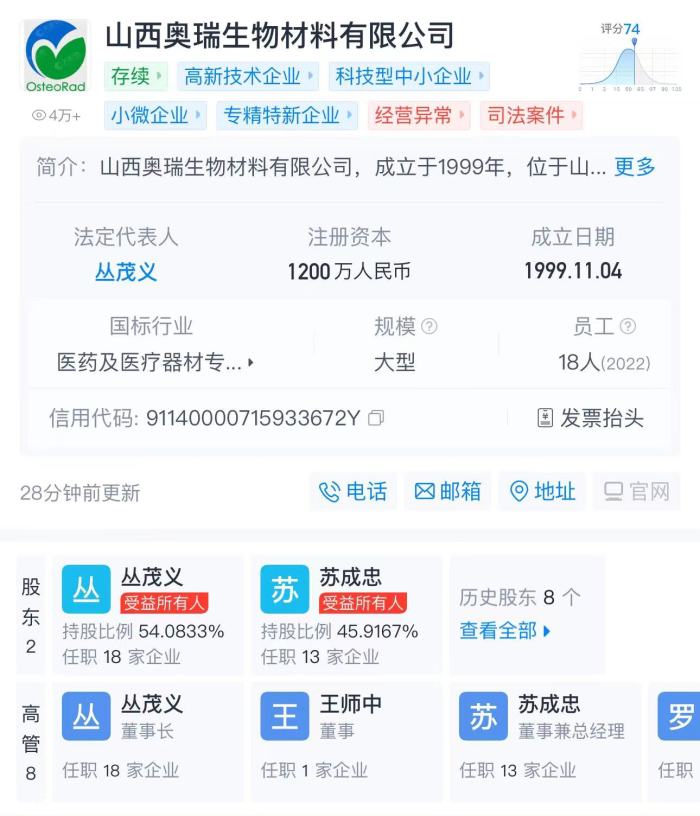
Shanxi Aorui was originally established in 1999 by the China Radiation Protection Research Institute, with a business scope of research and development, production, and sales of “allogeneic bone implant materials.”
Starting in 2007, Shanxi Aorui began to gradually introduce Cong Maoyi and Su Chengzhong to acquire the shares of the China Radiation Protection Research Institute and its employees. In 2012, the shareholding system reform of Shanxi Aorui was completed, with Cong Maoyi holding 54.08% of the shares, being the largest shareholder and legal representative, and serving as chairman; Su Chengzhong held 45.92% of the shares and served as general manager; Li Baoxing was actually responsible for the company’s operations.
According to the official website of the Drug Administration, the allogeneic bone implant materials of Shanxi Aorui are human bones, which are processed into the required shapes for orthopedics through deep freezing, freeze-drying, surface demineralization, or complete demineralization, and need to be sterilized and packaged, suitable for bone defect filling, repair, auxiliary reinforcement, and spinal fusion.
During the treatment of patients with comminuted fractures of the limbs in clinical practice, bone transplantation is often required. Allogeneic bone implant materials are currently the most commonly used bone implant materials (bone im—plant)Ⅲ in orthopedics.
Bone transplantation is a surgery that transplants healthy bone tissue to the affected area to fill defects, strengthen fixation, and promote healing. The sources of transplanted bone mainly include autologous bone, allogeneic bone, and xenogeneic bone. Autologous bone is mostly taken from the iliac bone or fibula, allogeneic bone is mostly provided by the patient’s family members, and stock bone mostly comes from the bones of surgical or trauma victims. Xenogeneic bone is mostly used after removing the organic components of bovine bone.
However, in the case of Shanxi Aorui, the biggest problem is that the source of the company’s human bones is illegal. According to the indictment, from 2015 to 2023, in order to obtain a large amount of raw materials for the production of “allogeneic bone,” Shanxi Aorui went to many places across the country to transport human bones.
Moreover, to conceal the illegal source of human bone raw materials, Shanxi Aorui forged voluntary donation registration forms and inspection reports to prove the legality and safety of its corpse sources, and organized most of the company’s employees to falsely sign as family members on the corpse donation registration forms.
Sichuan Hengpu, established by Su Chengzhong, was specifically used for illegally obtaining corpses. From 2017 to 2019, in order to expand the source of corpses and limbs, Su Chengzhong successively controlled the Yunnan Shuifu City Crematorium, Chongqing Banan District Crematorium, Guizhou Shiqian County Crematorium, and Sichuan Daying County Crematorium through methods such as contracting, investing, and sending people to reside there, and then instructed his arranged personnel to steal and dismember corpses. Su Chengzhong confessed that the above four crematoriums provided Sichuan Hengpu with more than 4,000 human skeletons. The illegal income of the four crematoriums was more than 2 million yuan, 600,000-800,000 yuan, more than 300,000 yuan, and more than 1 million yuan, respectively, with a total illegal income of between 3.9 million and 4.1 million yuan.
In 2019, at the Chongqing Banan District Crematorium, Su Chengzhong also instructed employees to dismember corpses of people aged 20 to 60 who had no diseases without the knowledge of the deceased’s family members, and after collecting about 30 artificial skeletons, they were transported back to Sichuan Hengpu. From 2019 to 2023, the funeral home stole and sold 300-400 human skeletons to Sichuan Hengpu, illegally profiting 600,000-800,000 yuan. In addition, Su Chengzhong did the same in several other crematoriums.
The indictment also revealed that from 2015 to 2021, Li Zhiqiang, the deputy director of the Liver Disease Center of the Affiliated Hospital of Qingdao University in Shandong, sold more than a dozen human skeletons to Shanxi Aorui, with a price of 10,000-22,000 yuan per skeleton.
In addition, Lan Lingyuan, a laboratory technician in the Anatomy Teaching and Research Section of Guilin Medical University, used the school’s scientific research as a pretext and purchased more than 450 corpses from three funeral homes from 2017 to 2023, selling 300 of them to Shanxi Aorui. He even allowed Shanxi Aorui to install tools for dismembering corpses in a farewell hall in the school’s teaching building and gathered many people to dismember more than 300 corpses, with a remuneration of 1,600 yuan per corpse. Lan Lingyuan profited about 800,000 yuan from this.
The indictment stated that during the investigation of this case, more than 18 tons of human bone raw materials and semi-finished products, and 34,077 finished products were seized from the involved companies. Currently, the case has been transferred for review and prosecution.
Is there a connection with the Shanxi Medical Tissue Bank?
The Interface News reporter found that Li Baoxing, the actual operator of Shanxi Aorui, the core person involved in the case, once worked at the Shanxi Medical Tissue Bank. In May 2009, he published an article in the “Journal of Chinese Reconstructive Surgery” titled “20 Years of Shanxi Medical Tissue Bank” (hereinafter referred to as “20 Years”), which introduced the establishment and development process of the Shanxi Medical Tissue Bank and Shanxi Aorui (OsteoRad) Biological Materials Co., Ltd.
The article introduces that the modern bone bank appeared in the United States in the 1950s. In the 1970s, the introduction of irradiation sterilization technology reduced the risk of disease transmission caused by bone transplantation to a negligible level. Subsequently, the International Atomic Energy Agency (IAEA) issued a tissue bank plan in the 1980s.
In December 1985, the IAEA sent officials to the China Atomic Energy Authority and signed a research project contract on the biological effects of irradiation of allogeneic transplanted tissues with Professor Sun Shiquan of the China Radiation Protection Research Institute (CIRP). CIRP is located in Taiyuan, Shanxi, and is affiliated with China National Nuclear Corporation Nuclear Environmental Protection Co., Ltd., and is the only scientific research institution specializing in radiation protection research and application.
With the smooth progress of the scientific research project, the project team successively explored the preparation techniques of antigen-automatically dissolved allogeneic bone, deep-frozen skin, and freeze-dried amnion, and successfully tested them in some medical institutions in the province.
By 1994, the Shanxi Provincial Health Department approved the establishment of the Shanxi Medical Tissue Bank, which was included in the Shanxi Provincial Health System, and determined its scope of work as “engaging in the development, research, production, preparation, quality management, and distribution and supply of human tissue transplantation materials.” Therefore, the Shanxi Tissue Bank had the legal status to produce and supply allogeneic transplantation tissue materials.
At that time, the Shanxi Tissue Bank mainly researched and produced deep-low temperature freeze-dried irradiated allogeneic bone, and cooperated with external units to produce a small amount of allogeneic skin for the treatment of deep burns, mainly for use in hospitals within the province.
The establishment of Shanxi Aorui began with policy changes. In 1999, the State Council Order (No. 276) “Regulations on the Supervision and Administration of Medical Devices” was issued, and medical devices implemented a registration system, and the registration of three types of implantable medical devices was uniformly managed by the State Drug Administration. The Shanxi Tissue Bank had to obtain a production license and legal person qualification in the form of an entity to provide products for clinical use.
Li Baoxing said in the article “20 Years” that he was appointed as the director of the Shanxi Tissue Bank by CIRP at that time, “keenly aware of the arrival of the opportunity, after many appeals and efforts, finally established and registered Shanxi Aorui Biological Materials Co., Ltd. in the form of a shareholding system.”
After that, the allogeneic bone implant materials of Shanxi Aorui were converted to pre-production registration in January 2001. Li Baoxing said in the article “20 Years”, “By the end of 2001, the annual output of allogeneic bone of Shanxi Aorui exceeded 15,000 pieces (3,000 pieces in 1999), reaching 20,000 pieces in 2002, truly embarking on the road of large-scale development.” “In the past 20 years, the Shanxi Tissue Bank/Shanxi Aorui Company has produced and provided more than 200,000 pieces of allogeneic tissue transplantation materials for clinical use, which have been applied to more than 100,000 patients.”
Allogeneic bone repair materials are not uncommon
In fact, in addition to Shanxi Aorui Company, there are many companies in China that operate allogeneic bone implant materials and allogeneic bone repair materials.
In fact, whether it is allogeneic bone implant materials or allogeneic bone repair materials, they are all Class III medical devices of the state. In layman’s terms, although these “human bone” products sound “eerie,” they are indeed orthopedic implants and repair materials approved for use in clinical medicine.
For example, in the public announcement of the material filing results of Sinopharm Holding Quanzhou Co., Ltd., Shanxi Aorui Biological Materials Co., Ltd. appeared as the manufacturer of allogeneic bone implant materials of Sinopharm Holding Quanzhou Company, and its B role as the filing result involved multiple specifications and models of products. In addition, the company was also mentioned in multiple winning bid announcements.
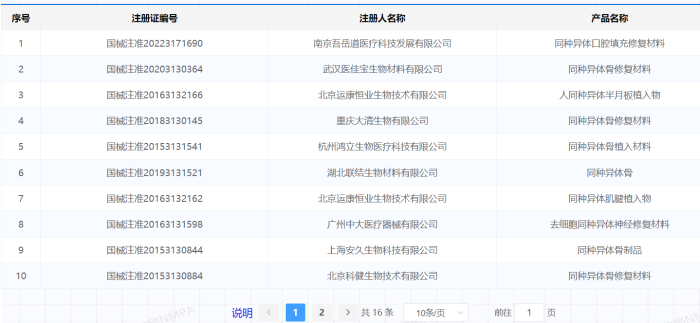
Allogeneic bone implant materials approved by the State Drug Administration. Source: Database of the State Drug Administration
The Medical Device Technical Review Center of the State Drug Administration also issued an article in May 2023 to popularize this type of orthopedic product.
Specifically, more than 6 million patients in China suffer from bone dysfunction every year due to accidents and orthopedic diseases, and there is a strong demand for bone defect filling and repair materials in clinical practice. Bone repair materials are important medical devices for bone defect repair, and they are also classified as a separate category in the medical device classification catalog, which is a relatively important category of orthopedic implant medical devices.
The aforementioned article introduces that in addition to allogeneic materials, there are also five major categories of metal, inorganic salt, animal-derived materials, organic polymers, and composite materials, which are also the main materials for bone repair products. In 2020, the market size of China’s orthopedic filling and repair materials industry was 5.53 billion yuan, and it is estimated that the market size of China’s bone repair materials industry will reach 9.69 billion yuan in 2023.
However, the information that differs from public perception is that natural bone repair materials are still the mainstream materials for bone repair in China. That is, more bone repair may still use “human bones,” also known as “natural bones,” which are divided into autologous and allogeneic, and allogeneic accounts for a considerable proportion.
According to data from the Southern Institute of the State Drug Administration, in 2018, natural bone repair materials accounted for about two-thirds of the market share of China’s orthopedic bone defect repair materials industry, and allogeneic bone accounted for more than 90% of the market share.
As of August 8, according to the query results on the official website of the State Drug Administration, Shanghai Yapeng Biotechnology Co., Ltd., Sichuan Hengpu Technology Co., Ltd., Tianjin Jinbangnite Medical Device Co., Ltd., Beijing Weidafeng Medical Biological Materials Co., Ltd., Hebei Keshuo Biotechnology Co., Ltd., and Beijing Xinkangchen Medical Technology Development Co., Ltd. all have approved implant products.
Taking Shanxi Aorui Company, which is currently receiving much attention, as an example, the company’s allogeneic bone implant materials are suitable for bone defect filling, repair, auxiliary reinforcement, and spinal fusion. Its main components are human bones, which are processed into the required shapes for orthopedics through deep freezing, freeze-drying, surface demineralization, or complete demineralization.
In addition, the approved scope of use of implant products from different companies is different. For example, the products of Shanghai Yapeng Biotechnology Co., Ltd. can be used for filling non-weight-bearing bone defects during orthopedic surgery, and used in conjunction with internal fixation products; Tianjin Jinbangnite Medical Device Co., Ltd. can be used for fresh fractures, non-union or delayed healing of fractures, non-weight-bearing bone defects, spinal fusion, and joint fusion; the products of Beijing Weidafeng Medical Biological Materials Co., Ltd. can also be used for filling bone defects of benign and malignant tumors, etc.
In terms of allogeneic bone repair materials, Wuhan Yijiabao Biological Materials Co., Ltd., Chongqing Daqing Biological Co., Ltd., and Beijing Kejian Biotechnology Co., Ltd. have approved repair products. Among them, the products of the latter two companies are suitable for spinal injuries, spinal degeneration, and other diseases, as well as the filling, fusion, repair, auxiliary reinforcement, and reconstruction of non-weight-bearing bones required in other clinical practices.
In fact, “allogeneic” is also a very broad business, which not only involves bone repair, but also oral repair, tendon implantation, meniscus implantation, and so on.
According to the State Drug Administration, 16 companies, including Nanjing Wuyue Dao Medical Technology Development Co., Ltd., Wuhan Yijiabao Biological Materials Co., Ltd., Beijing Yunkanghengye Biotechnology Co., Ltd., Chongqing Daqing Biological Co., Ltd., Hangzhou Hongli Biomedical Technology Co., Ltd., Hubei Lianjie Biological Materials Co., Ltd., Beijing Yunkanghengye Biotechnology Co., Ltd., Guangzhou Zhongda Medical Device Co., Ltd., Shanghai Anjiu Biotechnology Co., Ltd., Beijing Kejian Biotechnology Co., Ltd., Nanjing Yitebo Medical Technology Development Co., Ltd., Beijing Jieyalefu Biotechnology Co., Ltd., Beijing Xinkangchen Medical Technology Development Co., Ltd., Beijing Kejian Biotechnology Co., Ltd., Hubei Lianjie Biological Materials Co., Ltd., and Nanjing Wuyue Dao Medical Technology Development Co., Ltd., all have related products approved.
In the artificial bone repair materials market, which is relative to natural bone, domestic companies such as Aojing Medical, Shanghai Ruibang Biological Materials Co., Ltd., Hangzhou Jiuyuan Gene Engineering Co., Ltd., Sichuan Guona Technology Co., Ltd., and Shanghai Beiaolu Biological Materials Co., Ltd., as well as foreign companies such as Baisai, Wright, and Johnson & Johnson, have all participated.
Violation of multiple regulations
The buying and selling of human organs is an absolute crime in our country and must be investigated for criminal responsibility according to law.
In 2023, our country issued the “Regulations on Human Organ Donation and Transplantation” (hereinafter referred to as: “Regulations”), which made clear provisions on the acquisition and distribution of human organ donations. Article 6 of the General Principles of the “Regulations” clearly states that no organization or individual may buy or sell human organs in any form, nor may they engage in activities related to the buying and selling of human organs.
In this case, Shanxi Aorui Company and its relevant responsible persons are acting against the wind.
In terms of human organ donation, Article 9 of Chapter 2 of the “Regulations” clearly states that citizens with full civil capacity have the right to independently decide to donate their human organs in accordance with the law. Citizens who express their willingness to donate their human organs should do so in writing, and may also make a will. Citizens have the right to revoke their willingness to donate their human organs.
If a citizen expresses their disagreement with donating their human organs before their death, no organization or individual may donate or obtain the citizen’s human organs; if a citizen does not express their disagreement with donating their human organs before their death, after the citizen’s death, their spouse, adult children, and parents may jointly decide to donate, and the decision to donate should be made in writing.
In terms of obtaining human organs, Articles 17 and 18 of Chapter 3 of the “Regulations” clearly state that before obtaining human organs, the department responsible for obtaining human organs should submit an application for review of the acquisition of human organs to the human organ transplantation ethics committee of the medical institution where it is located. After receiving the application for review of the acquisition of human organs, the human organ transplantation ethics committee should promptly review the following matters: (1) whether the willingness to donate human organs is true; (2) whether there is any buying or selling or disguised buying and selling of human organs. With the consent of more than two-thirds of the committee members, the human organ transplantation ethics committee can issue a written opinion agreeing to obtain human organs. If the human organ transplantation ethics committee agrees to obtain them, the medical institution can obtain human organs.
Shanxi Aorui Company and its relevant responsible persons directly forged relevant certificates. According to the case materials, in order to conceal the illegal source of the raw materials of corpses used by Shanxi Aorui Company for the production and processing of “allogeneic bone,” Li Mouxing arranged for many people in the company to forge voluntary donation registration forms and inspection reports to prove the legality and safety of its corpse sources, and organized most of the company’s employees to falsely sign as family members on the corpse donation registration forms.
From 2017 to 2019, in order to expand the source of corpses and limbs, Su Moumou successively controlled the crematoriums of Yunnan Zhaotong City Shuifu Tianfu Funeral Company, Chongqing Banan District Xianjushan Funeral Home, Guizhou Tongren City Shiqian County Wangcheng Funeral Service Co., Ltd., and Sichuan Suining City Daying County Funeral Home through methods such as contracting, investing, and sending people to reside there. He then instructed the personnel he arranged in the crematoriums to steal corpses and brutally dismember the corpses in the cremation workshop.
Article 16 of Chapter 3 of the “Regulations” also clearly states that medical institutions engaged in the acquisition of human organs should provide human organ acquisition services within the area designated by the health and health department of the people’s government of the province, autonomous region, or municipality directly under the Central Government where they are located.
If a medical institution finds a potential human organ donor who meets the donation conditions and has the willingness to donate, it should report to the medical institution responsible for providing human organ acquisition services in its area, and the medical institution that receives the report should notify the Red Cross Society of the province, autonomous region, or municipality directly under the Central Government where it is located. No organization or individual may transport potential human organ donors across regions for the purpose of obtaining human organs, nor may they refer relevant information of potential human organ donors to organizations or individuals other than those specified in the third paragraph of this article.
Shanxi Aorui Company and its relevant responsible persons also directly transported across regions. According to the case materials, from 2015 to 2023, Li Mouxing, Su Moumou, and others, in order to obtain a large amount of raw materials for the production of “allogeneic bone,” instructed employees to go to Guilin, Guangxi, Chengdu, Sichuan, and other places to transport human skeletons. They screened and processed the corpses in the Anatomy Teaching and Research Section of the Basic Medical College of Guilin Medical University (hereinafter referred to as the Anatomy Teaching and Research Section of Guilin Medical University), and then loaded the pre-processed bones into vehicles and drove back to the company for storage.
Su Moumou confessed that the above four crematoriums provided Sichuan Hengpu Company with more than 4,000 human skeletons, of which more than 1,000 were processed by Shi Moumou and Wang Moumou, who were arranged by Zhou Yusheng of Shanxi Aorui Company, at Sichuan Hengpu Company, and then transported back to Shanxi Aorui Company. The remaining human skeletons were pre-processed by the employees of the production department of Sichuan Hengpu Company and stored in the Xinyuan Cold Storage of Section 2, Konggang 1st Road, Shuangliu District, Chengdu City, Sichuan Province, and the warehouse of Sichuan Hengpu Company in Pujiang County, Chengdu City, Sichuan Province.
Discover more from 自由档案馆
Subscribe to get the latest posts sent to your email.