This year, the high school graduates who can stand out from the crowd are definitely extraordinary.
Written by | Bamboo Mang
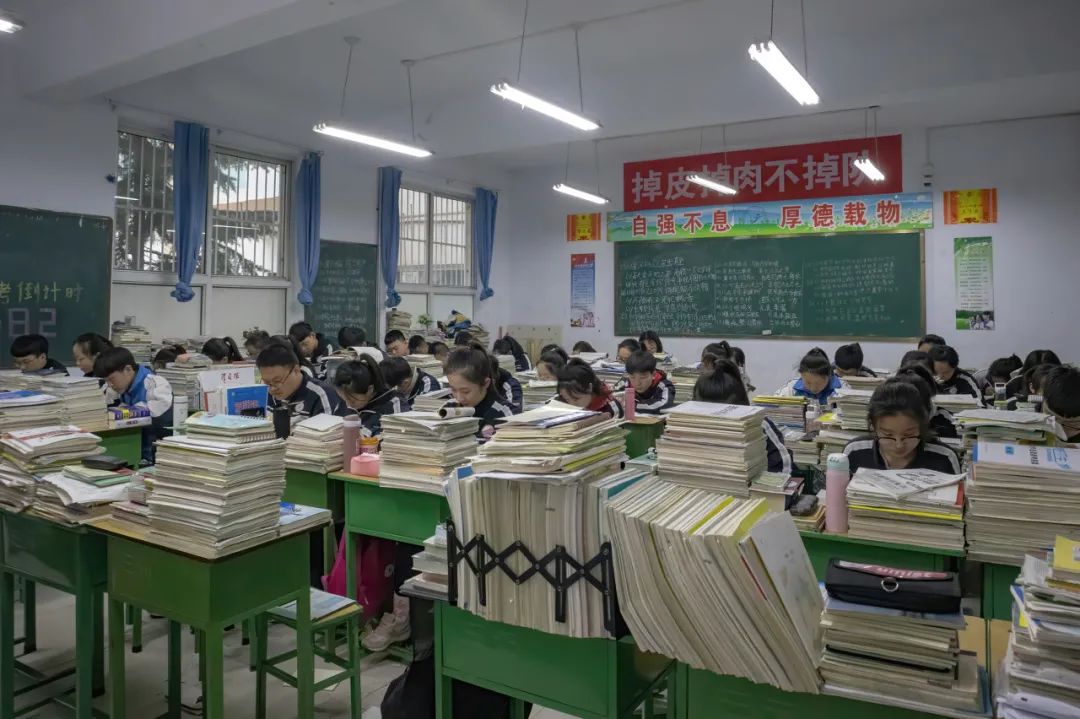
In three days, 13.42 million candidates across China will enter the examination hall to face an exam that may be the “most difficult” college entrance examination in history.
You may not know that since the resumption of the college entrance examination in 1977, this is the first time the number of college entrance examination participants in China has exceeded 13 million. There are about 4.13 million repeaters alone.
And the undergraduate enrollment places they are competing for are only about 4.5 million.
A 33% undergraduate admission rate is not the most difficult.
What’s even more difficult is that the focus of the college entrance examination questions has undergone a fundamental change, shifting from “testing knowledge” to “testing ability and literacy”, and paying more attention to critical thinking.
Seven provinces, including Heilongjiang, Gansu, Jilin, Anhui, Jiangxi, Guizhou, and Guangxi, will also face the new college entrance examination model of “3+1+2” for the first time, regardless of liberal arts or science, and compete for the top spot.
As the “volume king” country in the East, China’s college entrance examination focuses on fairness, with the core goal of selecting talents, and has always been regarded as a key link in social mobility.
This year, the high school graduates who can stand out from the crowd are definitely extraordinary.
01
Among the vast number of candidates, the candidates from Henan, Sichuan, and Guangdong are still the three most difficult teams.
This is because the admission rates of candidates in the three provinces have always been of “hell” difficulty in the country.
Last year, Henan’s “first-tier” admission rate ranked second to last in the country, and the “985” admission rate ranked last in the country with 0.9%. Sichuan’s undergraduate admission rate also ranked last in the country, and Guangdong was also in the bottom ranks.
And this year, these three “hard-hit” population provinces are once again “sharing the hardship”:
Henan welcomes 1.36 million candidates, 50,000 more than last year, once again breaking the record!
Sichuan also added 16,300;
Guangdong added 30,000.
In this way, there are more candidates this year, and the admission rate may be even lower.
And what’s even more shocking is that this year, before the exam even started, the “most difficult college entrance examination in history” has already been a foregone conclusion for the whole country!
First, it is “difficult” in terms of the number of people, and the competitors have reached a new historical high.
According to CCTV.com information, the number of national college entrance examination applicants in 2024 is 13.42 million, an increase of 510,000 compared to last year.

What is the concept of 13.42 million people?
In 2023, the permanent population of Xi’an, Zhengzhou, Hangzhou, Suzhou and other cities with a GDP of over 1 trillion did not have this number!
In other words, last year, the entire population of Xi’an participated in the college entrance examination, and the degree of competition was not as intense as this.
This is the eighth consecutive year of continuous growth in the number of college entrance examination applicants since 2016, and the growth rate has a fluctuating upward trend.
For example, the population growth rate from 2017 to 2020 was 3.7%, 5.7%, 3.9%, and 0.6%.
And since 2021, the growth rates have reached 10.7%, 8.2%, and 3.9% respectively.
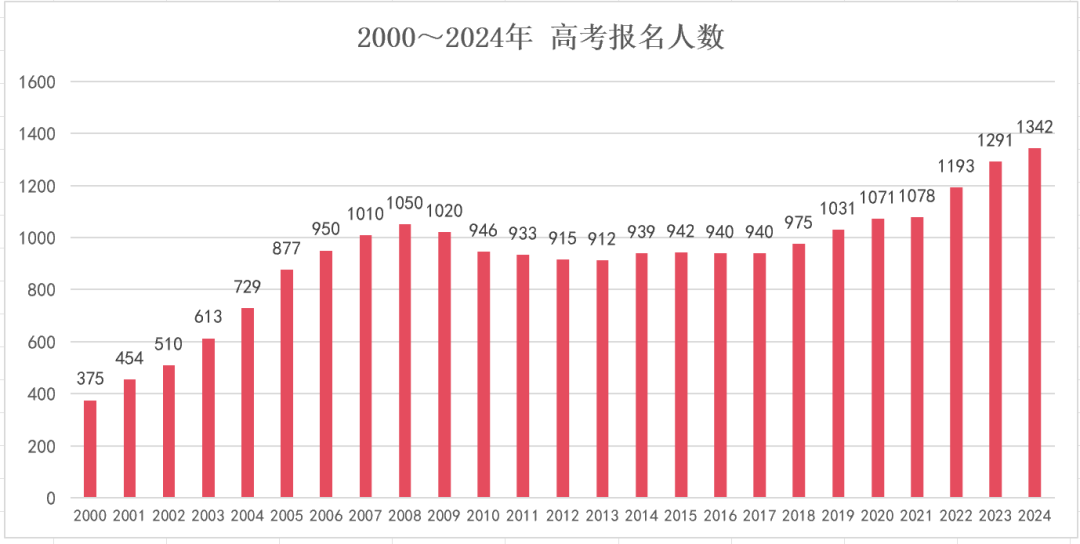
▲ Recent college entrance examination enrollment numbers, unit: 10,000 (Picture/Network)
What’s even more terrifying is that there is no most difficult, only more difficult.
This situation of more and more applicants may continue for 10 years!
Although in 2023, the national birth population was only 9.02 million, a continuous decline for 7 consecutive years, but the current population change trend is far from being able to affect the present.
Looking at the number of candidates today, we have to go back 18 years.
In 2006, the number of births in China was 15.84 million.
Although the actual number of births in this year showed a downward trend, judging from the performance of the repeated record highs in the number of college entrance examination participants in recent years, it has already shown that thanks to the promotion of compulsory education in our country, the number of school-age students receiving education is constantly growing.
And from a time perspective, 2006 was actually the year with the fewest births in the following ten years.
From the birth peak from 2006 to 2016, the number of births in our country rose in a wave-like manner to 15.94 million, 16.08 million, 16.15 million, 15.88 million, 16.04 million, 16.35 million, 16.40 million, 16.87 million, 16.55 million, and 18.83 million.
In other words, as the “most number of participants in history” in 2024, this record is very likely to be broken every year in the next ten years.
If we rate the stars according to the number of competitors, 2024 will only record three stars.
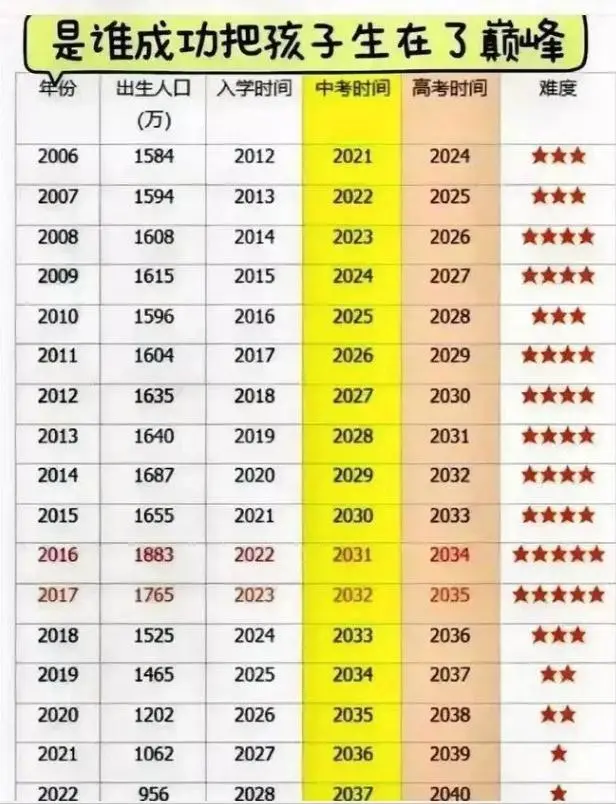
Picture/Network
The high school graduates of 2034 and 2035 are the real “five-star” difficulty.
These flowers of the motherland born in 2015 and 2016, who are still in elementary school, are probably not aware that in ten years, they will face the truly “most difficult college entrance examination”.
But parents born after 2016 should not be in a hurry to be happy, the number of births in 2017 and 2018 has declined, but it has also maintained a high level.
It will take 12 years to return to today’s level, which is until 2036.
02
Second, it is “difficult” in the questions.
On the one hand, this year, candidates from 7 provinces will usher in the new college entrance examination model of “3+1+2” for the first time!
In 2021, the seven places of Heilongjiang, Gansu, Jilin, Anhui, Jiangxi, Guizhou, and Guangxi successively issued college entrance examination reform implementation plans, announcing that the new college entrance examination model of “3+1+2” will be implemented from the first-year students who entered school in the autumn of 2021.
The so-called “3+1+2” means that the three major subjects of Chinese, mathematics, and English remain unchanged; “1” refers to choosing one subject from physics and history as an optional subject; “2” refers to choosing two subjects from biology, chemistry, geography, and politics as optional subjects. The combination method alone has:
12 kinds!
That is to say, starting from this year, the candidates in these 7 regions will officially not be divided into liberal arts and science, and will face new questions.
Without the experience summary of their predecessors, the psychological pressure faced by the candidates in the 7 regions who are facing the new college entrance examination for the first time can be imagined.
Next year, candidates from Henan, Shaanxi, Shanxi, Sichuan, Yunnan, Ningxia, Qinghai, and Inner Mongolia will also usher in their first new college entrance examination.
At that time, this new college entrance examination reform, which began in September 2014, marked by the State Council’s issuance of the “Implementation Opinions on Deepening the Reform of the Examination and Enrollment System”, except for Tibet and Xinjiang, the remaining 29 provinces (autonomous regions, municipalities) across the country will gradually enter the new college entrance examination in five batches, and the comprehensive reform of the college entrance examination will be fully implemented.
On the other hand, the questions themselves have become “difficult”.
Every time the college entrance examination ends, the voices of “I’ve never seen this type of question!” and “This year’s college entrance examination is the most difficult!” are endless.
In 2022, after the new college entrance examination I volume mathematics college entrance examination questions were leaked, a mathematics professor from the University of Science and Technology of China who claimed to be a third-level professor spent 90 minutes answering the questions, and finally only scored 118 points.
You read that right, a mathematics professor from a top domestic university was still 32 points away from the full score of 150.
Let the professor begin to self-reflect: the poor performance is also due to the long-term disconnection from basic mathematics.
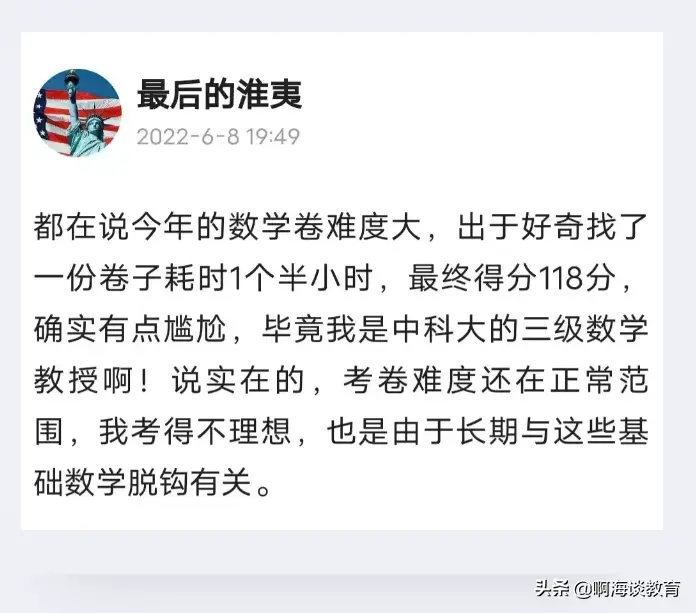
That year, a Chengdu high school teacher who was admitted to Fudan University by guaranteeing a first prize in a mathematics competition also issued a challenge. According to China.com, the teacher finally scored 135 points after answering the questions for 2 hours.

This is not a “survivor bias”.
In the landmark document of the new college entrance examination reform, “Implementation Opinions on Deepening the Reform of the Examination and Enrollment System”, it has already been clearly stated:
The direction of the reform is to “design the content of the questions scientifically based on the requirements of university talent selection and national curriculum standards, enhance the foundation and comprehensiveness, and focus on examining students’ ability to think independently and use the knowledge they have learned to analyze problems and solve problems”.
In other words, no matter how the high school teachers cultivate students, the questioners mainly consider: they must select talents according to the needs of universities.
And the questions of the college entrance examination mainly come from university professors or are reviewed by them.
Therefore, this is not a consideration of the same dimension.
The 2024 college entrance examination blue book “China College Entrance Examination Report (2024)” compiled by the editorial board of the “China College Entrance Examination Report” more clearly shows this tendency:
The college entrance examination questions focus on examining five key abilities represented by critical thinking, increasing the examination of thinking quality, especially the visualization, process, and standardization of thinking, and realizing the transformation from “testing knowledge” to “testing ability and literacy”.
This requires candidates to be more flexible in their thinking, more daring to question, and more able to solve practical problems.
This year’s candidates must face the new requirements of the times.
03
Another point worth noting about the record high number of applicants this time is that the number of repeaters has also remained high.
According to the report of Dazhong Daily, there are about 4.13 million repeaters among the 2024 college entrance examination applicants, which is nearly 1/3 of the applicants.
Although the education department has not officially announced this data, the proportion of repeaters has indeed been gradually increasing in recent years.
Do you remember Tang Shangjun? This young man from a rural area in Guangxi, who was once admitted by well-known universities such as Southwest University of Political Science and Law, Jilin University, China University of Political Science and Law, and Guangxi University, has undergone 15 college entrance examinations and is still in “senior three”.
His Weibo personal profile reads: “Tang Shangjun, a candidate who has been repeating for 13 years to attend Tsinghua University”.
This year, he will usher in his 16th college entrance examination. After deciding to participate in the 2024 college entrance examination, he wrote on Weibo: “Not every ball will go in, and not every wish is so easy to realize.”
Such a college entrance examination “nail house” is, after all, an individual case, but repeaters are already a huge group.
According to the information of the Illustrated Education, 17.5% of the undergraduate college students have repeated their studies. The data reasoning comes from the “China University Students’ Learning and Development Tracking Research” of Tsinghua University, which shows that from 2011 to 2018, the first generation of undergraduate students has been maintained at more than 70%, and the number of students who have participated in multiple college entrance examinations, that is, repeaters, has reached 19.91%, and the non-first generation of undergraduate students is 11.76%.
And according to the difference between the number of college entrance examination applicants and the number of high school graduates in previous years, it will also be found that the proportion of non-freshman college entrance examination students is increasing year by year. The main body of which is the college entrance examination repeaters.
In 2019, the number of non-freshman college entrance examination students was 2.4175 million, and then it increased year by year to 2.8447 million, 2.9777 million, 3.689 million, and 4.1456 million.
In this way, the 4.13 million repeaters rumored this year are not very exaggerated, and even a little conservative.
Since 2019, the growth rate of the number of non-freshman college entrance examination students has been 17.75, 4.6%, 23.9%, and 12.4% respectively, which are basically higher than the overall growth rate of the college entrance examination students in the same period.
More and more repeaters who have experienced one or more college entrance examinations will compete with new candidates at the same starting point and at the same time.
In this way, under the background of the country accelerating the promotion of the modern vocational education system, the number of college entrance examination repeaters is increasing year by year, and Chinese parents still have a strong obsession with the traditional education promotion system.
Among them, the “obsession” with repeating studies is not the “four provinces of mountains and rivers” in the traditional impression, and Shandong, the “province of civil servants”, cannot even be ranked in the top five.
According to NetEase Shudu, among the repeaters in 2021, the repeat rates in Jiangxi, Anhui, Sichuan, Guangxi, and Shaanxi provinces all exceeded 10%, and Henan ranked sixth.
And if the time period is extended, it will be found that Jiangxi, Anhui, and Henan have long been at a high level of repeat rate.
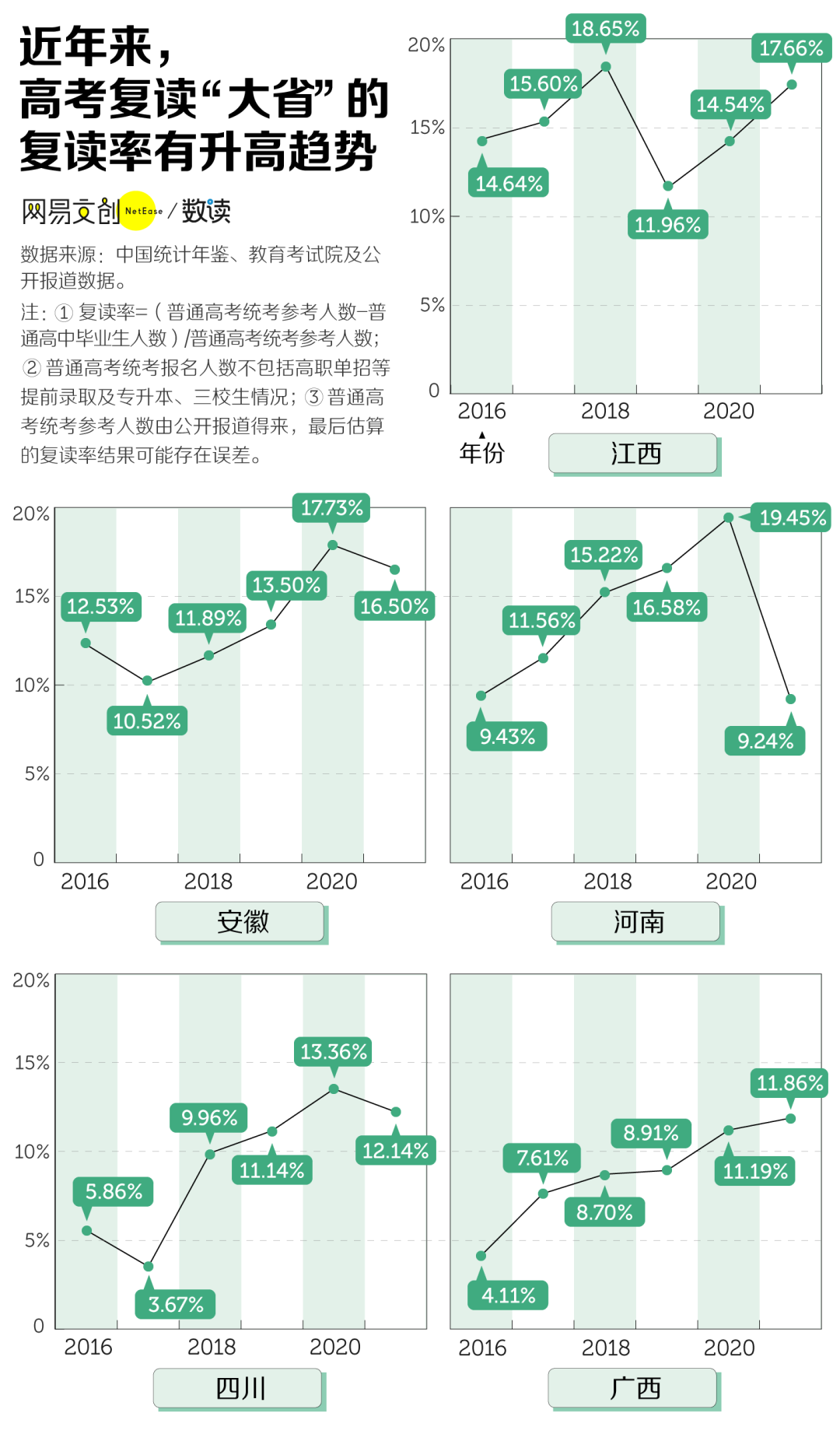
Picture/NetEase Shudu
From this level, the candidates from Jiangxi, Anhui, and Henan may be the ones with the greatest psychological pressure.
For them, in the situation where the number of college entrance examination participants will remain high in the next ten years, stopping “involution” will be at least ten years later.
04
In a certain sense, going to university is no longer a single-plank bridge, and in 2023, the admission rates in Shanghai and Beijing even approached 80%.
But if you look closely at the admission rates of “first-tier”, “985”, and “211” in the traditional sense, you will find that the chances of going to a “good university” are getting smaller and smaller.
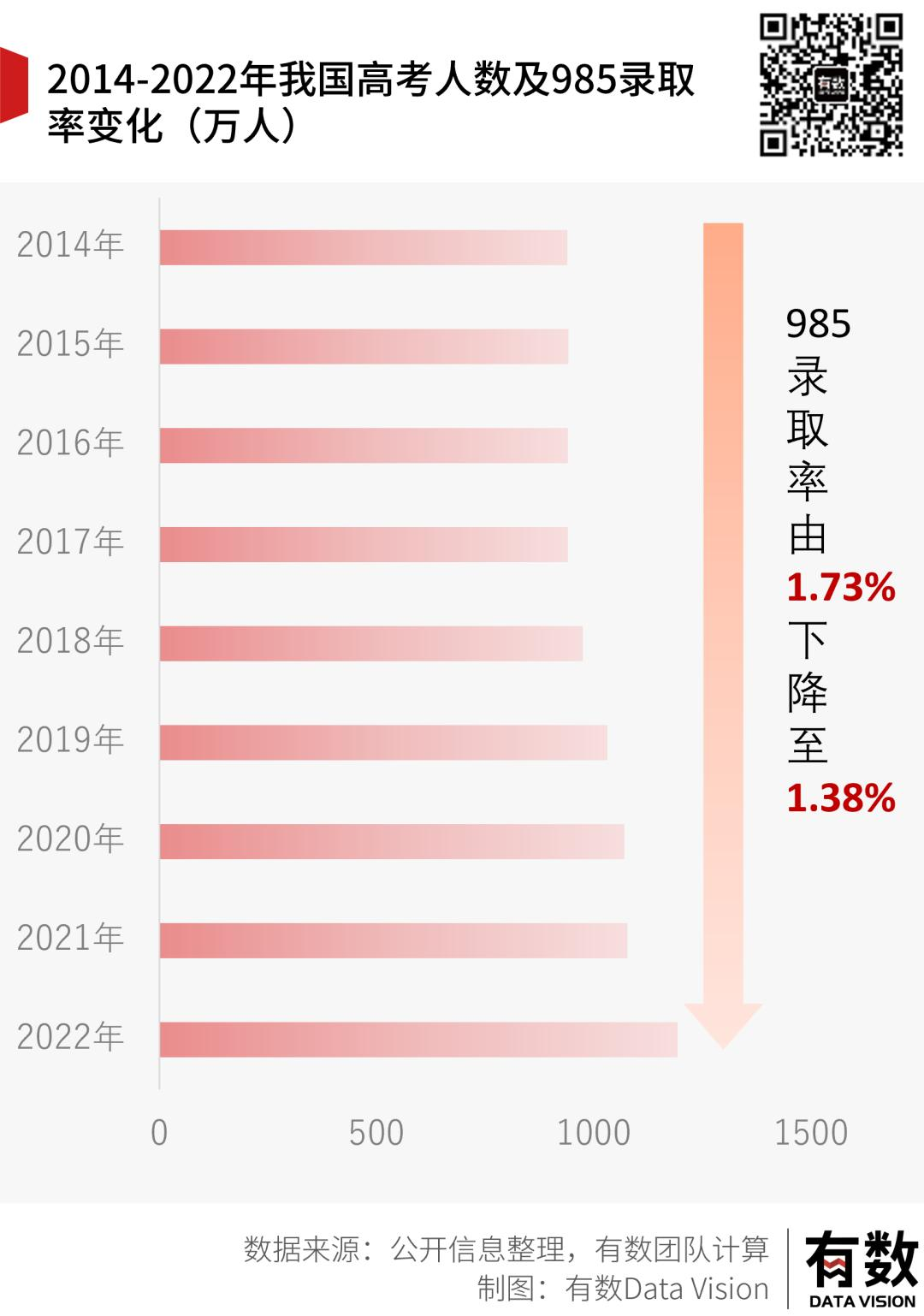
YouShu DataVision shows that from 2014 to 2022, the “985” admission rate decreased from 1.73% to 1.38%.
What’s more unexpected is that the entire proportion is actually pulled up by the high proportion of Beijing, Shanghai, and Tianjin.
For example, in 2023, the “985% admission rates in the three places were 7.1%, 5.3%, and 6.9% respectively, while many places across the country maintained between 1.2% and 2.5%.
The most “difficult” Henan, the “985” admission rate in 2023 was only 0.9%, ranking last in the country.
No wonder netizens are so vocal about “Shanhe University”.
However, parents do not need to be so anxious, after all, the era of “only academic qualifications” is passing, and there are several obvious signals:
First, the country is in a hurry, desperately developing vocational undergraduates, “gilding” blue-collar workers, and increasing the attractiveness of talents.
China is currently facing an unprecedented “shortage of blue-collar workers”, and the income of blue-collar workers is rising step by step, with a 225% increase in ten years, far exceeding the 30% of white-collar workers in the same period.
Second, in the past two years, in order to have a skill, it has become a trend for undergraduates to “return to the furnace” to study vocational schools.
This kind of study that is not bound by traditional concepts and chooses a more practical path can also be regarded as a new way for college students to seek jobs.
Thirdly, in the era of globalization, education and talent can also have an “external cycle”, and the demand for studying abroad shows a trend of younger age.
New Oriental data shows that the number of students studying abroad at the high school stage (18-21 years old) has rebounded for the first time in nearly four years, with a rebound of up to 50%. More and more parents are looking globally to allow their children to experience diversified education.
All roads lead to Rome.
Let go of your attachments, and everyone can find a path that suits them.
Discover more from 自由档案馆
Subscribe to get the latest posts sent to your email.