According to a press conference held in Meizhou on May 2, it was stated that as of 2 p.m. on the 2nd, a total of 23 vehicles were found to have fallen into the collapse area of the Meida Expressway, resulting in 48 deaths, with another 3 people requiring further DNA comparison for confirmation. In addition, 30 people were injured and sent to the Meizhou People’s Hospital (Huangtang Hospital) and Dabu County People’s Hospital, with no life-threatening conditions.
The Meida Expressway was built during the high tide of highway infrastructure construction from 2010 to 2014, and it is an important transportation link connecting Meizhou with Longyan, Guangdong, and Fujian. In the interview with this magazine, most of the victims of the Meida Expressway collapse accident came from villages under the jurisdiction of Longyan City, Fujian Province. Longyan was once the most important mining area in Fujian Province at the beginning of this century, but after years of large-scale mining, the “mountains are bare, and the fields are thin”. With the economic transformation, a large number of mining enterprises closed down, and villagers could only seek new sources of income. Working in electronic factories and machinery factories in Guangdong became the main theme in the past decade. After the Meida Expressway was built, it quickly became a necessary road for migrant workers from Longyan to return home.
In the interview with this magazine, several victims in this collapse accident worked in a car parts city in Guangzhou. They did not have weekends off and could only go home on national holidays. For these villagers who are busy with survival and only go home two or three times a year, it is the most convenient and cost-effective way to take a carpool home overnight during the May Day holiday. Their original plan was to depart from the car parts city on the evening of April 30 and arrive home at 3 a.m. on May 1. “Leaving early will avoid traffic jams, and after arriving home, we can sleep and spend the next day with our family.”
—————— The following is a text backup ——————
Collapse in the Darkness
Rao Zhen may be the last driver to “leap” to escape before the collapse of the Meida Expressway.
This was a long-awaited reunion trip. Rao Zhen was originally from Qingxi Town, Dabu County, Meizhou. He, his mother, wife, two children, and parents-in-law lived in Shenzhen for a long time and would only return to his hometown to see his father occasionally during holidays. Rao Zhen recalled that after his daughter finished school on the afternoon of April 30, the family of seven finished dinner slowly. Around 7:30 p.m., Rao Zhen drove a seven-seater business car from Longgang, Shenzhen.
They encountered a little rain and thin fog on the way. When they came out of the Dabu toll station in Meizhou and went towards Chayang, the night sky was clear and the visibility was relatively clear.
Around 2 a.m. on May 1, when the car drove to the exit direction of Chayang section 2 kilometers (K11+900m in the Dabu to Fujian direction of the Meida Expressway), Rao Zhen saw a black shadow about 60 to 70 centimeters wide between the right-side slow lane and the emergency lane. His first reaction was that there was water on the road, or that the newly patched asphalt was not dry. Out of instinct, he turned the steering wheel to the left and tried to go around it, but there were two muffled sounds of “bang bang”, and he felt that the front wheels hit something, and the rear wheels “jumped”. He gripped the steering wheel and turned to the right, trying to park the car in the emergency lane, but the brakes had failed, and the car slid forward for another 300 meters before stopping, stopping between the emergency lane and the slow lane. What he didn’t know was that his car had just leaped over the Meida Expressway, which was in the process of breaking.
Everyone sleeping in the car was awakened by the huge bump. “Are you dozing off and hitting something?” Rao Zhen’s mother asked. “It’s okay, Mom.” Rao Zhen comforted his family while preparing to get out of the car to check the car’s condition. Just as he opened the car door, he saw the headlights of a car disappearing in the night in the rearview mirror, accompanied by a crisp metallic impact sound. This unusual situation also made Rao Zhen’s mother on the car feel puzzled, “Get out and see if someone else’s car is broken?” she said, and got out of the car, along with Rao Zhen’s parents-in-law and wife. There were no street lights on the highway. They turned on their mobile phone flashlights and walked along the emergency lane towards the back of the car. Rao Zhen saw that the wheel hub of his car had cracked and the tires were scrapped, knowing that the car would not be able to move for a while.
At this moment, the second car coming from behind also suddenly disappeared. “There’s a big hole!” Rao Zhen’s mother, who was walking in front, first noticed, “Will the car fall down? Come and help!” Rao Zhen realized the seriousness of the situation and asked his wife to call the police. He also took his mobile phone flashlight and walked towards the back of the car. After walking two steps, he started running, “We kept running forward, waving our hands.” However, while running, he saw that many cars coming from behind kept falling into the hole, and water vapor was coming out of the hole. When he ran to about 50 meters away from the hole, Rao Zhen was so anxious that he climbed onto the guardrail in the middle of the two-way lane and waved his flashlight desperately, shouting “Stop! Stop!”. He, who is 1.73 meters tall, felt that standing tall might be conspicuous enough, but the cars that were coming still couldn’t stop. “It can be seen that it slowed down, as if stepping on the brakes and then releasing them, maybe wanting to see clearly what was going on in front, but when he understood, it was too late to step on the brakes.”
In Rao Zhen’s memory, when about the ninth car fell down, a very high pillar of fire burst out of the hole, and a car exploded. “Step back a little!” Rao Zhen reminded his family. He found that with the impact and explosion of the car, the road continued to collapse, and the deep hole became wider and wider. At this time, his father-in-law, Huang Jiandu, had already anxiously climbed over the guardrail and crossed the opposite side of the hole from the adjacent highway lane, kneeling directly in the middle of the highway, and the oncoming car finally braked sharply. Huang Jiandu shouted at the car owner. “The front has collapsed!”
Fire Rescue
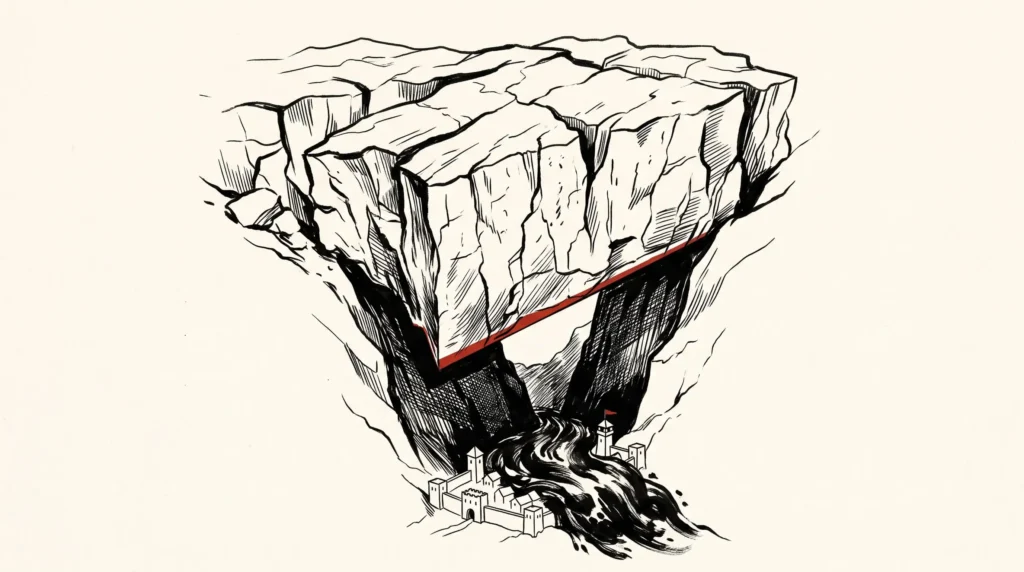
Rao Zhen saw that the oncoming cars gradually stopped and decided to retreat to the back to rescue people. At this time, the collapse had evolved from the initial crack in the road surface of 60 to 70 centimeters to a huge crack. According to the statistics of the local relevant departments later, the length of the collapsed road surface reached 17.9 meters, and the total collapsed area of the road surface and the mountain body below the roadbed was about 184.3 square meters.
Rao Zhen saw a man in his thirties climbing up from the hole, covered in blood, walking unsteadily. “Are you okay?” Rao Zhen asked. The man was incoherent and asked Rao Zhen, “How did I get up?” Then, another man climbed up from the hole, holding a three-year-old child in his arms. “Please call the police to save my mother. I could have held her, but a car fell down and caught fire next to it.” Rao Zhen comforted him that he had already called the police. Seeing that the child was not crying or making a fuss, and there was blood on his mouth and head, Rao Zhen, who had studied in a health school, felt that the child might have internal injuries. He ran back to the car and took his daughter’s school uniform jacket and spread it on the ground, letting the child lie down and rest. The man borrowed Rao Zhen’s mobile phone, made a call, gasped, and choked in Hakka, “Aba, Ama molei (Dad, Mom is gone).”
Cai Xuanda is one of the survivors. He is 23 years old this year and is from Zhangzhou, Fujian. At 6 p.m. on April 30, he set off from Guangzhou and arrived at the accident section just after 2 a.m. on the 1st, and was stopped by Huang Jiandu. Cai Xuanda and another car owner, Liu Yongjin, were going to go down to save people.
Liu Yongjin is from Yongding, Longyan. He remembers that around 2:30 a.m., when he drove to the vicinity of the accident site, there were already cars driving in the opposite direction. Driving forward, he saw more than a dozen cars piled up at the bottom of the hole, with flames rising, and people were climbing out of the cars, shouting “Is there anyone! Help us!” Liu Yongjin shouted twice at the bottom, “The car is on fire and is about to explode, run quickly”!
There were 6 injured people on a small mound, near the drainage ditch in the deep pit, about ten meters away from the burning vehicles. After the fall, the 6 people climbed from their own vehicles to this temporary “safe area”. Liu Yongjin first climbed over the guardrail and went down along the drainage ditch of the slope, but it was too slippery in the ditch, so he could only return. He and Cai Xuanda walked down the slope. “The slope is steep and slippery, and we can only hold on to the cogongrass on the slope to maintain balance,” Liu Yongjin said. To prevent falling, they walked a “Z” shaped route. When they reached the nearest injured person, it had been five or six minutes.
The two first rescued a three or four-year-old girl. Liu Yongjin carried the little girl on his shoulder, and the girl kept crying and vomited blood on his shoulder. Next was a boy in his teens. When Liu Yongjin held him, his legs and upper body were very painful, and he could only hold his armpits. Because there was no place to borrow force, Liu Yongjin and Cai Xuanda could only take turns going up, “passing one to the other” to bring the boy up. “The boy kept crying and saying that his mother was still under the car and asked us to save her,” Cai Xuanda recalled. Following them was a man in his thirties, who said that all his ribs were broken. Liu Yongjin could only support his buttocks from behind and push him up. As soon as the man climbed to the road surface, he lay on the ground.
From the time they started rescuing people, Cai Xuanda could feel that the fire was getting bigger and bigger, and the heat was surging on him. The scariest thing was that the car started to explode. Cai Xuanda remembered, “There was the sound of tires exploding, ‘Peng’ and the sound was very loud, and some explosions were very long, ‘Jiu ——’ kind of”.
After that, Liu Yongjin went down again to rescue the remaining 3 people. A boy of fifteen or sixteen, “his face was pale and looked very weak, and he couldn’t climb the last 40 centimeters”, and a woman of about fifty years old and a man of about thirty years old, the man’s right foot was bleeding. When rescuing people, Liu Yongjin noticed that there were more than a dozen people standing about four or five meters away from them, all of whom had climbed out of the car. “They would shout once the explosion sounded.” But Liu Yongjin couldn’t go over, and what separated them was a tree that was taller than Liu Yongjin, who was 1.8 meters tall.
When Liu Yongjin rescued the 6th person and returned to the road surface, it was already around 3:20 a.m. More than a dozen fire trucks arrived at the scene, and the other passing vehicles had basically retreated in the opposite direction. There were not many people standing outside. There were two men next to Liu Yongjin who were nervously turning around. They told Liu Yongjin that a car that was traveling with them had fallen down, and they could still make a phone call at first, but now they couldn’t get through. “I comforted them that they probably didn’t bring their mobile phones, but at that time, they could still hear the explosions, and the fire was also getting bigger, and the chance of survival might not be great.”
Migrant Workers Returning Home
Meida Expressway is the “Meizhou-Dabu” Expressway, which is the first expressway built in Dabu County. It starts from Meixian, passes through Dabu County, and ends at the junction of Dabu and Longyan, Fujian. It was started in 2010 and completed in 2014. The total length is 61.2 kilometers, and the total investment is nearly 5.6 billion yuan. The expressway passes through the Nanling Lianhua Mountain Range, and most of the area along the way is mountainous and hilly, with dense gullies. It is a typical eroded hilly landform, and the proportion of bridges and tunnels is 51%. The Meida Expressway was the most difficult to build among the mountainous expressways in Guangdong Province at that time. During the construction period, there were many high-risk situations such as roof collapse, collapse, and water penetration.
After the Meida Expressway was built, the time from Dabu to Meizhou was reduced from 1.5 hours to 50 minutes. This road also connects with the expressway from Putian, Fujian to Yongding, becoming an important link between Guangdong and Fujian provinces – the journey from Meizhou to Xiamen is about 3 hours, and to Zhangzhou is about 2.5 hours. For the people of Longyan, Fujian, it is also more convenient for them to go to Guangxi and Guangdong in the southwest. Compared with the original Changshen Expressway, it is nearly an hour faster. Therefore, the Meida Expressway has become a major transportation route for the people of Longyan to work outside.
A villager from Longyan told this magazine that they could also take the national road to enter Guangdong, “but the national road goes around from the mountains, with many uphill and downhill slopes, and it is a single lane, which is relatively narrow, and the distance is also tens of kilometers longer than the Meilong Expressway. Most people will take the expressway.”
In the interview with this magazine, most of the victims came from villages under the jurisdiction of Longyan City, Fujian Province, and they were killed on their way back to their hometowns from Guangzhou, Shenzhen and other places. Longyan is mainly mountainous. Because of its rich coal, iron and other mineral resources, it was once prosperous because of mining at the beginning of this century, and it is the most important mining area in Fujian Province. However, years of large-scale mining destroyed the vegetation, making Longyan one of the most serious areas of soil erosion in the south. “The mountains are bare, and the fields are thin.” It was not until recent years that the government invested funds to manage it, and the ecology has improved. With the economic transformation, many mining enterprises closed down, and villagers could only seek new sources of income. Working in electronic factories and machinery factories in Guangdong became the main theme in the past decade.
Chen Han is 41 years old this year and is from Yanjiang Village, Yongding District, Longyan City. A couple of his neighbors and their son were killed in this accident. Chen Han said that the accident section was only about ten kilometers away from the village. He told this magazine that the deceased father, Yu Hai, was 42 years old, and his son was 14 years old. This time, they came back to visit the elderly in the family. Yu Hai worked in a bottled water factory in Heyuan City, Guangdong Province, and he also had a pair of twin daughters who were preparing for the college entrance examination. His wife stayed to take care of them, so he only brought his son back this time. Yu Hai has been working outside for more than 20 years, and his parents are in their 60s. They have more than 2 acres of farmland at home. In Chen Han’s impression, Yu Hai was very filial. “He would come back whenever he had a vacation. Others might play mahjong, but he never did. He would help with the farm work as soon as he came back.” This year, during the Chinese New Year, Yu Hai and Chen Han chatted and said that his two daughters were taking art specialty classes together, and the training fee for one person was 100,000 yuan, and he had to bear a lot. After the accident, Yu Hai’s wife could not accept it. Villager Yu Meiling said: “(She) wants to see the whole body, but it was blown up and couldn’t be found. It is said that only a little bit of teeth were found.”
There are also two elderly people in Yanjiang Village who died in the collapse accident. One is in his 50s, and the other is about 60 years old. They worked together in a factory in Dongguan. “This (working outside) is very common here,” Chen Han said. There are a total of 1,200 people in the village, and most of them work in Guangzhou, Shenzhen, Guangxi and other places. Those who stay at home are elderly people in their sixties and seventies. The village is surrounded by mountains, with less farmland, with an average of five or six points of land per person, used to grow watermelons, corn and other crops. “It may only be possible to earn two or three thousand yuan a year by farming, and you can only work outside.”
Wang Wenlin from Jinfeng Village, Yongding District, Longyan City, also suffered misfortune. His friend recalled that after her husband, Wang Wenlin, graduated from junior high school, he worked in an auto repair shop in Longyan. Three years ago, the company’s business was not good and closed down, so he went to Guangzhou. “There is nothing good to do in the village, it’s all farming, or doing transportation and cement.” In this already poor village, Wang Wenlin’s family was also in a relatively poor economic situation. Wang Wenlin’s mother lost a foot in a car accident more than ten years ago and could not work. His father retired from the coal mine a few years ago, with a monthly pension of more than a thousand yuan. The family had three children to raise, mainly relying on Wang Wenlin’s salary, “The pressure of life has always been relatively high.” “Because of the family’s difficulties, the children in the family have been sensible since childhood, knowing how to do housework and take care of their grandmother, and they also did well in school, ranking among the top few.” Wang Wenlin’s friend said.
In Wang Wenlin’s car, there were his wife, his wife’s nephew, and a fellow villager who was carpooling home, “who went to Guangzhou to study hairdressing”. Huang Rui is from Sanfeng Village, Yongding District, Longyan City. He told this magazine that he had 5 friends who knew each other who died in this accident, including Wang Wenlin and his wife. The youngest of the deceased friends was only 24 years old, and the oldest was over 60 years old. Everyone knew each other because they worked in the same car parts city in Guangzhou, and their homes were not far away. In Huang Rui and his friends’ options, carpooling home was the most convenient and cost-effective way. He calculated an account. It takes more than 4 hours to take the bullet train from Guangzhou to Longyan, plus taking the subway to the station, which is time-consuming and troublesome, and sometimes you need to transfer. The bullet train ticket costs more than 300 yuan per person, and the highway toll is only more than 200 yuan. Adding the fuel cost, dividing it equally, there is not much.
In the car parts city, many people do not have weekends off and can only go home on national holidays. Huang Rui said that this May Day, they only had 3 days off. For these villagers who are busy with survival and only go home two or three times a year, it is even more important to be able to get home earlier. Huang Rui told this magazine that 7 people took two cars and set off from the car parts city on the evening of April 30. They were expected to arrive home at 3 a.m. on May 1. “Leaving early will avoid traffic jams, and after arriving home, we can sleep and spend the next day with our family.”
The Dangerous Meida Expressway
Peng Lin, a senior engineer who has been engaged in geotechnical engineering surveying and mapping for decades, told this magazine that although the area where the Meizhou Expressway is located is generally densely covered with gullies and many hills, the terrain is not particularly complex and steep, just for the accident section – from the satellite map, the original elevation of the road is about 126m~120m, and the natural slope is about 1:4 (H:V), which is a relatively gentle slope of about 25 degrees.
“In such a hillside, the usual practice of building expressways is to excavate the inner part and backfill the outer part, thus forming a plane. The photos of the accident scene show that the collapse started from the middle of the road, which is the so-called ‘interface of filling and excavation’.” A professor in the field of roadbed engineering and geotechnical engineering, and an expert committee member of the China Highway Construction Industry Association, analyzed to this magazine that granite residual soil is widely distributed in Guangdong, which is prone to cracking when encountering drought, and it will become deeper and deeper over time. If it encounters extreme rainfall again, it will immediately soften and expand.
A resident of Dabu County, Meizhou, said that in the past few years, the local area was somewhat dry and short of water, and he, who lived on a high floor, “couldn’t get water from the water heater”. This magazine found that Meizhou experienced a severe drought of “once in 60 years” in 2021-2022, and experienced heavy rainfall many times from the summer of 2023 to the spring of 2024.
The rain in April this year was very unusual. According to official meteorological data, the accumulated rainfall in Dabu County, Meizhou in April this year was 628.2 mm, which is 2.75 times the average level of previous years, and it is the most rainfall in April in history since meteorological records. Chen Han, a resident of Yanjiang Village, which is about ten kilometers away, recalled that it had been raining almost every day since the beginning of the month, “Sometimes it was heavy rain, sometimes it was light rain, but it never stopped, and it only stopped for a few days in the middle”. There were seven or eight sections of roads in Yanjiang Village that were blocked by mudslides, but fortunately, there were no casualties. In Anqian Village, Chayang Town, which is not far from the accident site, villager Tian Cheng contracted a mountain pond to raise ducks. The duck shed collapsed in April due to excessive rain, and thousands of ducks were lost.
The design flood control level requirements of the Meilong Expressway are that, except for extra-large bridges, the rest of the bridges, culverts and roadbeds are once in 100 years. “Perhaps due to the drought in the previous two years, cracks appeared at the interface of filling and excavation, and the extreme heavy rainfall this year led to serious wetting of the interface of filling and excavation, the roadbed structure was damaged, and finally caused a serious accident.” The above-mentioned professor in the field of geotechnical engineering analyzed.
Peng Lin has participated in the construction of many expressways in China and has also studied many collapse and landslide cases at home and abroad. He believes that the roadbed damage depth of the Meizhou Expressway is very rare. In addition to rainfall and drought, there may be more complex causes, “For example, during the early survey, whether the underlying layer or structural surface (fault) that was not noticed under the roadbed was missed, and whether the design drainage ditch considered extreme weather, and whether anti-slip steps were installed inside the roadbed. In addition, the construction quality of roadbed backfilling and subsequent operation and maintenance also need to be tested.”
The Meida Expressway was built from 2010 to 2014, which is in the golden age of the leapfrog development of expressways in China. In 2010, China’s investment in road construction historically exceeded the 1 trillion yuan mark. In 2012, the total mileage of expressways reached 96,000 kilometers, surpassing the United States for the first time and ranking first in the world. During the “Twelfth Five-Year Plan” period, the cumulative investment in roads reached 7.1 trillion yuan, which is 1.74 times that of the “Eleventh Five-Year Plan” period. By the end of 2015, the total mileage of expressways reached 124,000 kilometers, covering 97.6% of the cities with a population of more than 200,000 in the country.
After this concentrated construction period, the construction quality and later maintenance of expressways have always been an issue that cannot be ignored. Dabu County has a broken terrain, with a wide distribution of strongly weathered intrusive rocks and metamorphic rocks, and it is located on the Zhenghe-Dabu fault zone, which often triggers disasters such as collapse, landslides, and mudslides. Chen Han, the villager, was not surprised when he learned of the collapse accident. After the expressway was opened, he often took this road. In his impression, this section of the road has always had the problem of roadbed subsidence. “Driving is very bumpy, up and down, especially the four or five kilometers before and after the accident section.” Two years ago, a local slope reinforcement was carried out on the section where the accident occurred. Last April, the operating management of the Meida Expressway also issued an “Announcement on the Traffic Interruption of S12 Meilong Expressway in Both Directions”, stating that due to the impact of continuous heavy rain, the slope at K55+690 of S12 Meilong Expressway towards Dabu had a dangerous situation, which seriously affected driving safety, and announced that the traffic control of the Xiyang to Dama section of S12 Meilong Expressway would be implemented for 3 days.
The above-mentioned university professor told this magazine that in fact, many areas in China are distributed with soil that is not conducive to the construction of expressways, such as red clay in the Yunnan-Guizhou area, and permafrost in the Tibet, Heilongjiang, and Jilin areas, all of which have the characteristics of expansion when encountering water. In the future, extreme weather will increase, and more later reinforcement and frequent monitoring are needed. “In fact, more reinforcement should be done on the roadbed slopes in advance, such as laying steel mesh, making anchor rod support, or spraying high-pressure concrete hard shells on the slopes. The frequency of patrols and the installation of inclinometers should also be increased to monitor the displacement of the roadbed in a timely manner.”
Whether such maintenance and patrols can be achieved involves high maintenance and monitoring costs, but the revenue situation of expressways in China is not optimistic. According to the “2022 National Toll Road Statistics Bulletin”, the total debt of national toll roads is close to 8 trillion yuan. According to the annual report of Guangdong Expressway Development Co., Ltd., as of 2022, the company’s total debt reached 8.905 billion yuan.
Although this accident has passed for several days, and the family is safe and sound, Rao Zhen is still immersed in sadness and regret, and has been unable to sleep for days. The scene of the car disappearing one after another always appears in his mind. Although his family’s actions to stop the car have saved many people, he still repeatedly asks himself: “If we had gone to the opposite side of the pit a little faster, wouldn’t we have been able to stop other cars earlier?”




Discover more from 自由档案馆
Subscribe to get the latest posts sent to your email.