A tragic traffic accident has pushed Huawei’s AITO to the forefront of public attention.
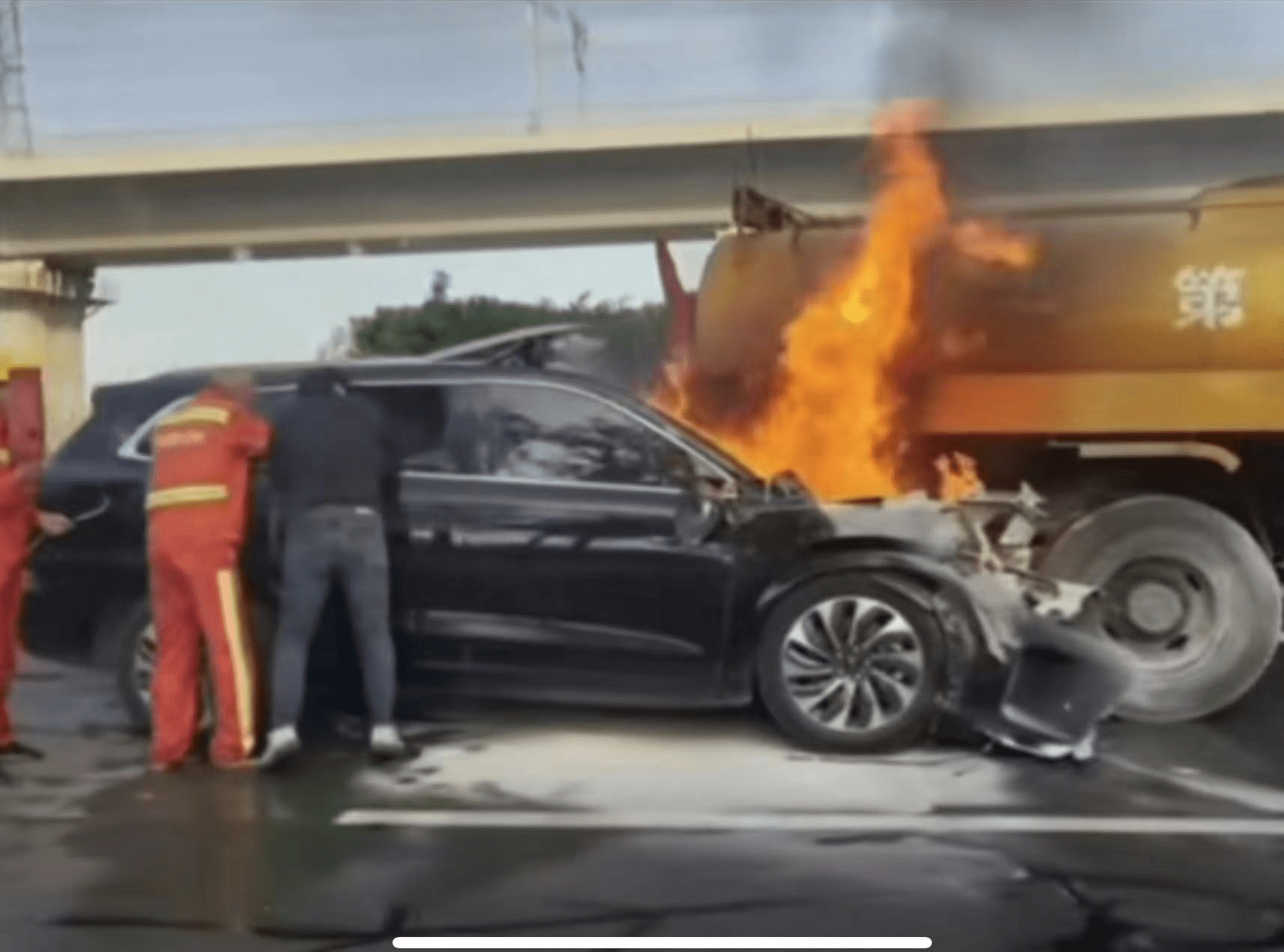
On April 26, a Huawei AITO M7 was involved in a rear-end collision on a highway in Shanxi, resulting in the tragic deaths of three people, including the driver, in the AITO M7.
The accident is still under investigation, and the responsibility for the accident has not yet been determined, nor is it possible to determine whether there are any safety hazards in the vehicle itself.
Although, from a certain perspective, on a highway, any private car rear-ending a large vehicle at a high speed is inherently a very dangerous thing, a matter of “living by the skin of your teeth”.
However, there are still many issues worth reflecting on in this accident. First, does Huawei AITO exaggerate its claims?
It is worth noting that Huawei AITO once released a test video at the new car launch, showing that the “A-pillar, B-pillar, and C-pillar” of the vehicle did not deform after being sandwiched between large trucks. Huawei executive Yu Chengdong has also repeatedly promoted the AEB function of Huawei AITO as being far ahead, claiming to be “the first in all tests, with no second place.”
Under the endorsement of Huawei and the promotional efforts of Yu Chengdong, models like the AITO new M7 have been highly sought after in the market. In March of this year, AITO’s deliveries exceeded 30,000 units for the first time, and it has been at the top of the new car brand list for three consecutive months.
Second, does Huawei AITO itself have safety hazards?
In the two accident statements before and after Huawei AITO, three main points were mentioned: 1. The vehicle speed at the time of the accident was 115km/h, and the accident model was a non-intelligent driving version, using Bosch’s AEB solution; 2. The battery pack did not self-ignite; 3. The airbags opened normally.
Some opinions question whether AITO is putting Bosch forward to distance itself from the Huawei AEB solution that Yu Chengdong has emphasized.
However, Bosch China quickly issued a statement pointing out that the vehicle involved did not have the Bosch intelligent driving system (including AEB).
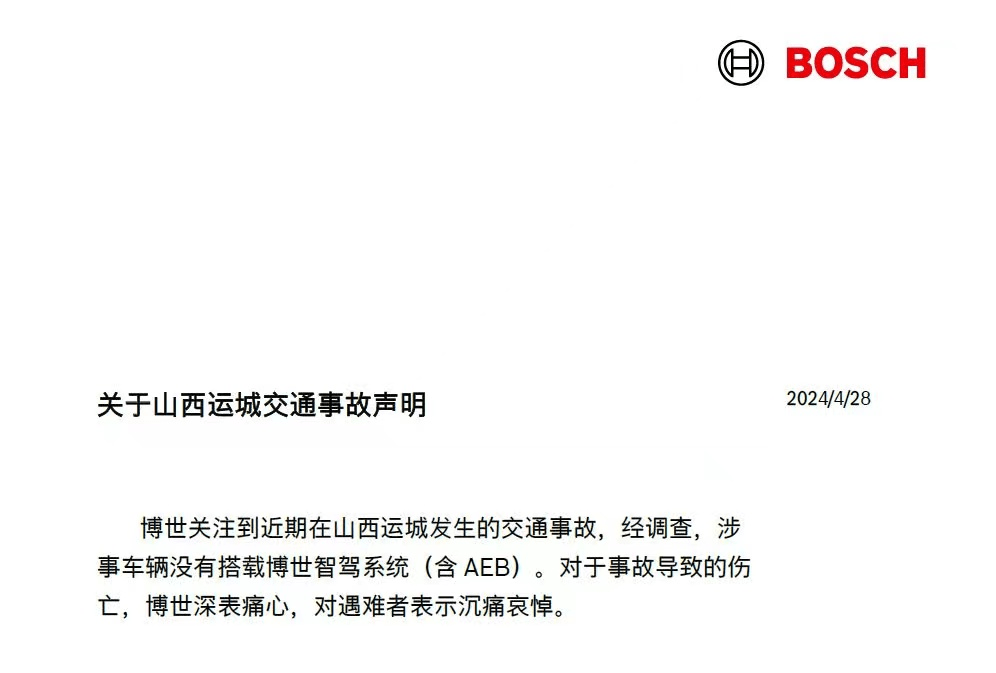
This means that the official statement from AITO is questionable and may be “making false claims”.
In addition, AITO has not mentioned why the hidden door handles did not pop out after the accident. In fact, after any major traffic accident, the most important thing is to get the people inside the car out safely and in a timely manner. However, the rear door of the AITO M7 involved in the accident could not be opened after the collision, which had a certain impact on the rescue.
Why didn’t the rear door handle of the AITO M7 pop out after the serious accident, and whether there is a safety redundancy design defect when using the hidden door handle?
After this accident, it can be seen that through marketing and promotion, Huawei AITO has gained market and profits. But at the same time, once an accident occurs, it will also pay a price for the backlash.
In fact, with the entry of internet companies such as Huawei and Xiaomi into the automotive industry, the automotive industry is becoming increasingly intense in terms of traffic, marketing, and promotion. Under Yu Chengdong’s slogan of “leading the way”, many car companies are forced to follow suit and get involved in the “trap” of over-promotion.
“Under the competition of electrification, intelligent driving, and price, many basic safety bottom lines are ignored, misleading and even treating human life as grass. Face the problem and solve the problem,” an automotive industry expert told a reporter from 21st Century Business Herald.
Indeed, in the process of continuous technological development and intelligent driving, it is impossible to be smooth sailing. However, car companies need to always maintain a balance between pursuing technological progress and safety.
Of course, Huawei AITO has once again sounded the alarm for the industry. Irresponsible over-promotion will not only harm users but also backfire on itself.
Is AITO’s response credible?
Huawei AITO’s handling of the incident has sparked intense public discussion.
This serious traffic accident occurred around 3 p.m. on April 26.
The victim’s family spoke out on social platforms such as Weibo and Douyin on April 27. After they released the relevant content, they received considerable public attention.
Combining the revelations of the netizen and the subsequent accident videos circulating online, the vehicle rear-ended the right rear of the water truck in front on the left front side. The front cabin and A-pillar of the accident vehicle AITO M7 were severely deformed, and the vehicle caught fire from the front, eventually spreading throughout the car.
In addition, judging from the videos circulating online, the hidden door handles in the rear of the car did not pop out, and the rescue personnel tried to break the window to save people, but the three people on the car unfortunately died.
However, the victim’s family had previously told the media that after the accident, Huawei, AITO, and Seres had not contacted her. She also said that she was still very confident that the matter could be handled at first, but after many things happened, she felt that (the car company) might suppress the matter.
Some netizens questioned that Huawei AITO’s act of “deleting posts” was inappropriate. Huawei AITO should respect the deceased and their families, and what it should do more is to assist the victim’s family in dealing with the accident itself and finding out the cause of the accident.
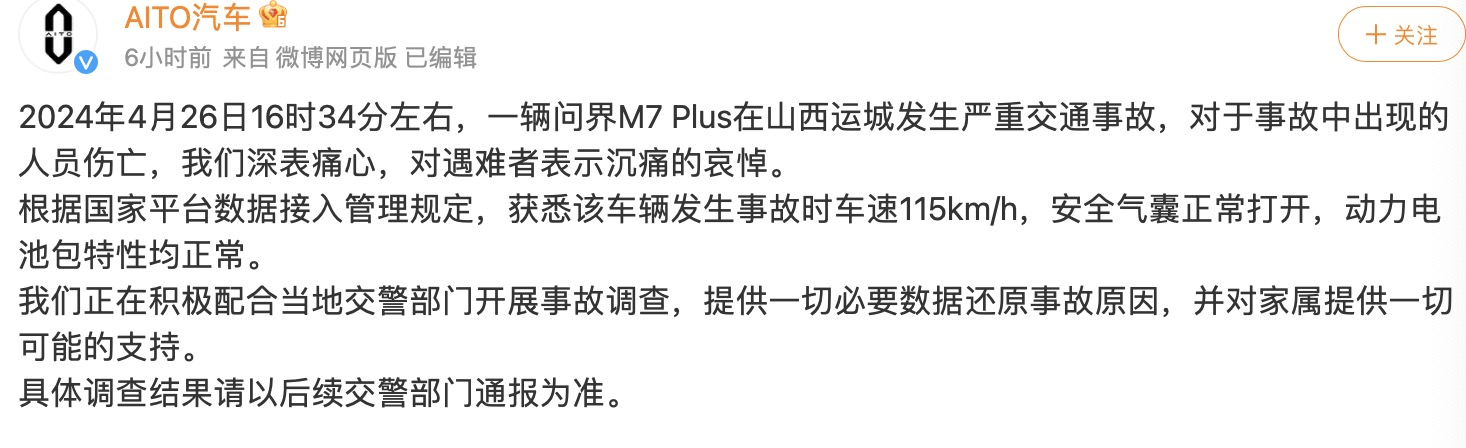
On April 28, due to the continuous fermentation of the accident online, AITO finally released its first statement on its official Weibo at noon.
The statement said that according to the national platform data access management regulations, it was learned that the vehicle speed at the time of the accident was 115km/h, the airbags opened normally, and the characteristics of the power battery pack were normal.
“We are actively cooperating with the local traffic police department to conduct an accident investigation, providing all necessary data to restore the cause of the accident, and providing all possible support to the families. The specific investigation results shall be subject to the subsequent notification of the traffic police department,” AITO said.
The victim’s family had previously raised multiple questions about the vehicle safety of the Huawei AITO M7, including whether the AEB emergency braking and GAEB abnormal obstacle automatic emergency braking functions responded, whether the airbags played a role, and why the hidden door handles did not pop out and affected the rescue.
On the afternoon of the 28th, AITO spoke out again. AITO said that it would provide all possible support to the families!
AITO reiterated three points: 1. The accident model is the entry-level non-intelligent driving version and does not have the Huawei high-level intelligent driving assistance system. Instead, it uses the Bosch solution, and the Bosch solution AEB’s working range is 4-85km/h. The speed of 115km/h at the time of the collision has far exceeded the Bosch AEB trigger range; 2. The characteristics of the accident car’s power battery pack are normal, indicating that there was no battery self-ignition. The specific cause of the fire still needs to wait for the investigation results of the traffic police department; 3. At the time of the accident, the accident car’s airbags opened normally, and there was no situation where the airbags did not work.
AITO, in addressing a serious traffic accident involving its own vehicle, clearly mentioned that it did not use the Huawei solution but used the solution of its supplier Bosch, which is considered to be intentionally shifting the blame.
However, as the world’s largest automotive parts supplier, Bosch did not remain silent after being mentioned by AITO.
On the afternoon of April 28, Bosch stated that it had noticed the recent traffic accident in Yuncheng, Shanxi. After investigation, the vehicle involved did not have the Bosch intelligent driving system (including AEB). Bosch expressed deep sorrow for the casualties caused by the accident and expressed its deep condolences to the victims.
AEB is one of the driving safety technologies that Huawei has emphasized.
At the AITO new M7 launch in September 2023, Huawei launched the “omnidirectional collision avoidance system”, claiming that the Huawei ADS 2.0 intelligent driving system can achieve forward, lateral, and rear active safety, and can achieve AEB automatic emergency braking at a speed of 90 kilometers per hour. Among them, lateral active safety can achieve active correction to avoid risks and avoid changing lanes; rear active safety can actively brake when pedestrians, guardrails, and cones are found during reversing, and Yu Chengdong said, “Reversing is safer, it’s hard to hit.”
AEB is an automotive active safety technology that can measure the distance between the vehicle and the vehicle or obstacle in front through radar, and use the data analysis module to compare the measured distance with the warning distance and safety distance. When it is less than the safety distance, it will automatically brake or slow down the vehicle, thereby ensuring safe travel and reducing accidents.
In November 2023, Yu Chengdong responded to the AEB controversy that caused a lot of discussion at the Huawei Smart Travel Solution launch: “The AEB capability is just a small case for Huawei, a ‘piece of cake’ thing. Huawei GOD (General Obstacle Detection Capability) far surpasses the capabilities of ordinary AEB. Huawei still has many capabilities in intelligent driving that have not been released, and it is only the tip of the iceberg.”
The AEB function has also become a reason for many users to choose the AITO new M7.
From the information released by the victim’s family on social platforms, the first point of their questioning about the accident is why the AEB function did not work, which also reflects from the side that Huawei AITO had used the AEB function to generate a certain consumer perception when promoting it before.
In addition, from AITO’s two responses to the accident, the emphasis on AEB can be seen that AITO hopes to release a clear signal to the outside world: this accident has nothing to do with Huawei’s highly confident AEB function.
Beware of the “trap” of over-promotion of intelligent driving
Seres was previously a third-tier domestic car company, and it was not until it joined hands with Huawei in 2021 to create the new energy brand AITO that it gradually received more attention.
Although Huawei does not build cars itself, as Huawei’s “own son” in the new energy vehicle layout, Huawei provides AITO with a large amount of resource support and dominates the direction of the AITO brand.
More importantly, Yu Chengdong has repeatedly used a relatively “exaggerated” way to market products at AITO’s launch events.
For example, “the best SUV within 10 million”, “the best AEB in all cars”, “AITO’s cars, not a single car has been burned, many cars are burning every day”, “leading the way”, etc.
As one of the most well-known companies in China, many users choose to believe in Huawei’s cars and intelligent driving based on their trust in the word “Huawei”, referring to its official promotional statements. They even misunderstand that Huawei’s related products are indeed leading, safe, and without defects.
However, excessive promotion will make consumers fall into the safety “trap” of ignoring intelligent driving.
Blindly advocating the leading nature of technology to attract consumers, while not making too many warnings about the hidden risks, may pay a heavy price.
Although Huawei AITO and Yu Chengdong’s “leading the way” style of many promotional remarks have achieved certain success in business, some remarks are inappropriate, too exaggerated, and seem irresponsible to consumers. As a brand with a very high national reputation, Huawei should weigh the impact of its promotional rhetoric on consumer perception and not mislead consumers.
In fact, the current competition in intelligent electric vehicles is becoming increasingly fierce, and under the leadership of Yu Chengdong, it has made many companies confidently introduce their own intelligent driving functions.
But this has also brought about huge controversy. Under the current regulatory restrictions, the intelligent driving promoted by current car companies generally uses L2+, L2.99999, and other different statements. Although car companies promote that everyone is using higher-level intelligent driving functions, the accident responsibility is still on the driver under L2-level intelligent driving, and car companies can still easily evade responsibility.
Behind the technological questioning and controversy, it highlights that under the increasingly fierce competition of new energy vehicles, the competition of domestic leading manufacturers in intelligent driving solutions is accelerating and upgrading, which also makes the importance and safety of intelligent driving be re-evaluated, and at the same time, it also makes the accident risks and responsibility determination problems existing in the actual operation of intelligent driving come to the fore.
Although the accident involved an AITO M7 non-intelligent driving version model, it does not involve more difficult intelligent driving scenarios such as NOA.
In fact, from Tesla, new car manufacturers, to Huawei, incidents of traffic accidents caused by users due to autonomous driving occur from time to time.
Although AITO’s current market share is not high, there have been many related accidents before.
On November 13, 2023, a video of a Huawei AITO M5 intelligent driving version car hitting the rear car and riding on the roof of the other car went viral online. The video shows that the vehicle that was hit stopped temporarily at the intersection, and the AITO M5 in front suddenly accelerated when reversing, circled a half arc, and quickly hit the left side of the rear car, causing the side door of the rear car to be dented to a certain extent. Due to the excessive speed, the rear wheels of the AITO M5 directly rode on the roof of the rear car.
Subsequently, the official statement said that after analyzing the background data and confirming with the test drive users, the user mistakenly used the accelerator pedal as the brake pedal, resulting in the accident. Fortunately, the accident did not cause any casualties.
In December 2023, an AITO M9 had a rear-end collision. From the pictures circulating online, the front engine compartment cover of the AITO M9 that rear-ended the bus was warped and deformed, and the headlights were suspected to be hit, and the rear of the bus was not severely damaged. Some car bloggers said that the accident vehicle was a test drive car provided by AITO to the media. Before the collision, the vehicle had enabled AEB deceleration and steering avoidance, but due to the driver’s unfamiliarity with the vehicle, he chose to actively intervene, resulting in the collision.
Seres said that the vehicle was in intelligent driving mode before the collision, and the driver’s intervention during driving led to the withdrawal of intelligent driving, resulting in the vehicle rear-ending. The accident did not cause any casualties, and the driver has cooperated with the traffic police to complete the handling work. Seres said that under driving conditions, the human driving authority is always higher than the intelligent driving system, and urged users to pay attention to driving safety.
Of course, in the actual process, it is also inevitable that such a situation will occur: when users use the automatic assisted driving function many times and gain a lot of experience, this may make the car owner relax their vigilance. However, it is obvious that under the condition that the technology is not fully mature, it is risky to overly rely on automatic driving.
An industry insider told a reporter from 21st Century Business Herald that intelligent driving is not a child’s play. Many consumers will be “fully focused” when they use it for the first time, and then become more and more “relaxed” until the unfortunate happens.
Safety is always the first priority, and the price of excessive promotion of technology by enterprises should not be the lives of users.
Discover more from 自由档案馆
Subscribe to get the latest posts sent to your email.