Guide: When the reporter from Yicai followed the footsteps of the interviewee and arrived at the intersection of Zhengxin Road and Yutong Road in Zhengzhou City, Henan Province, they found that the area was already crowded with people, and many people were wearing safety helmets.
Author | Yicai Ma Jichao
It wasn’t even 4 a.m. when Zhang Zhong got out of bed.
“I have to hurry, or I won’t have any work later.” Zhang Zhong muttered as he hurried outside.
The place he was going to is called the “Liuwan Labor Market”, which is the largest labor market for temporary workers in Zhengzhou.
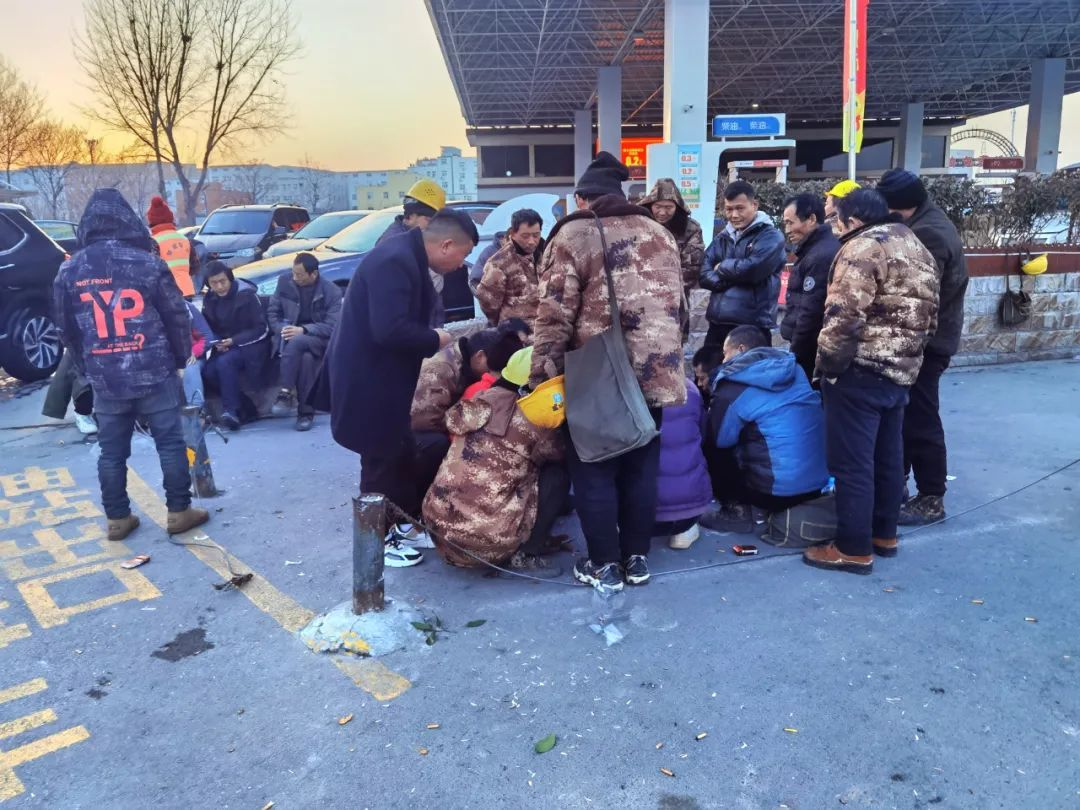
Going out to wait for work in the early morning
When the reporter from Yicai followed Zhang Zhong’s footsteps and arrived at the intersection of Zhengxin Road and Yutong Road in Zhengzhou City, Henan Province, they found that the area was already crowded with people, and many people were wearing safety helmets.
In the local people’s mouths, this area, which is crowded with migrant workers at four or five in the morning, is called the “Liuwan Labor Market” because Liuwan Village is across the road.
Liuwan Village is a village under the jurisdiction of the Shibalili River Office in Zhengzhou City. Most of the people living in the village are migrant workers like Zhang Zhong, who have poured into Zhengzhou from all over the country to find work.
Taking Zhang Zhong as an example, in order to save money, he and several other fellow villagers live together in a large standard room. The monthly rent for the room is more than 500 yuan. After several people share it, Zhang Zhong only needs to pay more than 100 yuan in rent each month.
There are also some construction labor subcontracting companies that have simply registered new companies and set up offices in the village in order to facilitate the recruitment of migrant workers.
On the one hand, there is cheap accommodation, and on the other hand, there is daily wage settlement. More and more migrant workers are beginning to regard the Liuwan Labor Market as their first choice for earning money through labor.
According to the villagers of Liuwan Village, the so-called Liuwan Labor Market was first formed in 1983 because of its convenient transportation, which facilitated the contractors to pick up and drop off migrant workers. Later, with the increasing popularity of the market, it eventually became the largest labor market for temporary workers in Zhengzhou, with construction temporary workers as the main force.
A traffic police officer on duty told reporters that the real “Liuwan Labor Market” has been relocated to the Henan Construction Workers Labor Market (hereinafter referred to as “New Market”) further south, but although the “New Market” covers an area of more than 100 acres, many migrant workers are still unwilling to go to the “New Market” and are still waiting for work on the side of the road.
There are many large vehicles coming and going at the intersection, and there are also many migrant workers gathering at the intersection to find work. The Fourth Traffic Police Brigade of Zhengzhou City is worried about traffic accidents, so they have to arrange traffic police to be on duty every morning.
Zhang Zhong also said that it is cold now, and many construction sites have stopped work, which is considered the off-season for migrant workers to find work. Even so, there are still five or six thousand people coming and going to this market every day to find work.
“Compared with previous years, the number of people this year (at this time) is considered to be less.” Zhang Zhong, who has been looking for work in the Liuwan Labor Market for more than ten years, said that in previous years, during the peak season for employment in the construction industry, more than 20,000 migrant workers would come here every day to find work.
The Fourth Traffic Police Brigade of Zhengzhou City has calculated, based on the traffic data of the traffic lights at the intersection, that there are about three or four thousand pedestrians passing through the intersection every day at four or five o’clock, and sometimes even more than ten thousand people.
A van drove over, and a foreman wearing a down jacket got out of the car. He waved his hand and shouted to the crowd: “7 people, laborers, 130 (yuan) a day.”
Zhang Zhong quickly squeezed into the car, but after sitting for less than three minutes, the reporter saw him dejected again.
When asked why, Zhang Zhong said that he only knew after getting in the car that today’s job was to go to a building under construction to do exterior wall insulation. The 33-story building required workers to stand in a basket and hand the rock wool boards used for exterior wall insulation to the workers. “It’s so cold, and it’s so high, if you don’t do it well, you’ll fall down, and you’ll either die or be disabled.” Zhang Zhong has two children at home, the older one is only in junior high school, and the younger one is still in kindergarten. He doesn’t dare to take this risk.
But the van was soon filled with migrant workers, and then it drove away.
Another car came, and after a few shouts from the foreman on the car, accompanied by a burst of noise, several more migrant workers got on the car, which was considered a verbal transaction for the day’s labor cooperation.
The migrant workers who got on the bus work for nine hours a day. After working for nine hours, they can get their wages settled for the day. Then, the foreman will send a car to take these migrant workers who have finished their work back to this intersection.
Feeling the warmth and coldness of real estate
Why not go to the construction site to find a long-term job, but rather endure the cold and heat every day, and go to this dangerous intersection to take on temporary jobs?
The fear of being owed wages is an important reason. The reporter’s random interviews found that many migrant workers who take on jobs in the Liuwan Labor Market have experienced being owed wages by the construction party and the sub-contracting party.
Including Zhang Zhong himself.
A year ago, because he trusted a foreman, he followed the other party to work on the construction site of the new campus of the Second Affiliated Hospital of Zhengzhou University for half a year, but was eventually owed more than 20,000 yuan in wages, which has not been recovered to this day.
This made him no longer dare to trust the foreman, and he returned to the Liuwan Labor Market, which settles wages on a daily basis.
More migrant workers, including Zhang Zhong, stand on the side of the road to take on jobs in the harsh cold and heat, precisely because they value the daily wage settlement of the Liuwan Labor Market, and they can get their wages after finishing their work every day, without having to wait until the end of the year to settle, or even face the risk of being owed wages, like some construction sites.
In the labor market, these migrant workers who require daily settlement of wages call themselves the “shock troops”, who can take on urgent jobs and go wherever they are needed.
But on January 2nd, Zhang Zhong, who got up at more than 4 o’clock in the morning to wait for work, stood in the cold wind on the side of the road until 6 o’clock in the afternoon, and failed to “sell” his labor.
At more than 6 o’clock in the afternoon, his familiar migrant worker friend, Lao Li, came down from a van with his tools.
“Hey, why are you still here?” the other party asked in surprise.
“I’ve been standing here all day, and I haven’t found a job.” Zhang Zhong told Lao Li very dejectedly, and tried to ask if the other party could take him to the construction site the next day. Unfortunately, Lao Li said that even if his daily wage was only 130 yuan, the construction site was unwilling to add more people.
“130 (yuan) a day, it sounds ridiculous.” Lao Li was a little self-deprecating. In previous years, he would definitely not accept such a low wage, but this year, even this 130 (yuan) is not easy to earn, and it has to be under 60 years old to be willing to take it. If you are over 60 years old, people are only willing to pay 80 or 100 (yuan) a day, and if you don’t do it, then don’t.
Zhang Zhong also said to the reporter from Yicai that Lao Li was not lying this time. In previous years, skilled workers such as steelworkers, welders, and carpenters were willing to pay 350 yuan/day on the construction site. Now, the wage of a similar skilled worker has fallen to 180 yuan/day.
Lao Li also quickly explained that this “previous year” refers to the years when the real estate market was booming a few years ago.
As one of the industries that accommodates the most migrant workers, China’s construction industry has provided job opportunities for tens of millions of migrant workers in the past 20 years of real estate and infrastructure dividends.
The “2022 Migrant Worker Monitoring and Survey Report” released by the National Bureau of Statistics shows that the total number of migrant workers in the country in 2022 was 295.62 million, of which the proportion engaged in the construction industry was 17.7%. This means that at least 52 million migrant workers rely on the construction industry to support their families.
However, with the adjustment of the real estate situation, some real estate companies that used to have sales of tens of billions of yuan are now facing difficulties in survival.
When the operating rate and sales of upstream real estate companies plummeted, the construction workers at the bottom of the industrial chain also began to suffer.
Lack of money in hand
Zhang Zhong said that he has been in Zhengzhou for more than 20 years, and he has found a wife and had children by working on construction sites. He originally wanted to give them a better life, but now, even his own life is difficult to sustain.
“Look, this is all my money, a total of 87.12 (yuan).” Zhang Zhong said to the reporter while opening his WeChat on his phone. If he can’t find a job tomorrow, he won’t even be able to eat.
Where did the money earned in these years go? One is the betrothal gifts for marrying a wife, buying a house, and buying a car, and the other is the expenses for the two children.
As for the money earned in 2023, Zhang Zhong said that in the first half of the year, he also saved more than 30,000 yuan. He originally wanted to go back to his hometown to do a small business after the Chinese New Year. As a result, in August 2023, his old father was hospitalized with a cerebral infarction, and all these tens of thousands of yuan became medical expenses.
In the second half of the year, the jobs became fewer and fewer, but as long as there was some income, he would quickly transfer it to his wife as household expenses. In a chat record with his wife that Zhang Zhong showed to the reporter, there were records of transferring and receiving red envelopes, ranging from 100 yuan to three or five hundred yuan each time.
In fact, it is not only Zhang Zhong who feels that it is difficult to find a job this year. In a row of simple prefabricated houses in the new market, the reporter happened to meet Lao Zhao, who was carrying a bag and preparing to go out. He came from Shangqiu and had been living in this cold prefabricated house for more than a week at a rent of 10 yuan/day. He had not found a job, and he was preparing to go out at 5 pm to work the night shift at a nearby express delivery sorting point, and he could earn 130 yuan after working all night.
“It’s so cold, and in previous years, I would have gone home for the New Year.” Zhang Zhong pointed to the fellow workers who were also waiting for work on the side of the road and said, “Look, not only am I not leaving now, but they are also not leaving, because they are still short of money.”
The night gradually deepened. The migrant workers who found jobs in the early morning were sent back by the foremen one after another, while the migrant workers who did not find jobs were still reluctant to leave. Some bored people simply gathered in groups of three or five, playing cards while continuing to look for jobs. These migrant workers who missed the day shift put their hope on the night shift.
But Zhang Zhong couldn’t hold on anymore. He said that he was hungry and his body hurt, and he really couldn’t work the night shift.
He has been doing physical work on construction sites for decades, and now, when he bends over, he feels like his whole body is about to fall apart. He is a little hunched over, a little staggering, and in the night, he returned step by step to the room he shared with his fellow workers.
He is unwilling to talk about the topic of going home for the New Year. He is looking forward to being able to find a job as soon as possible and earn more money during the Spring Festival, and he is also thinking about his wife and children at home, who have not been reunited for a long time.
(Zhang Zhong in the text is a pseudonym)
Discover more from 自由档案馆
Subscribe to get the latest posts sent to your email.