Restoring Mao Zedong to a Human Being
——Reading “The Fall of the Red Sun”
Mao Yushi
Mao Zedong was originally a god, but now, with the exposure of more and more information, he is slowly being restored to a person, a person of flesh and blood. However, some people still regard him as a god, and any comment on him is disrespectful. If he also made mistakes, it is absolutely not allowed. In the eyes of these people, Mao Zedong is a god who can never be analyzed, cannot be looked at squarely, and cannot be commented on. They will never see Mao Zedong drooling uncontrollably, unable to speak clearly, unable to get into a car and having to be lifted up, and his legs being thin and weak from long-term bed rest. Fortunately, with the publication of more materials, we can look at Mao Zedong from the perspective of ordinary people and get many new impressions. He is nothing more than a person, although his intelligence is outstanding, but he cannot avoid falling into the laws that everyone will encounter. He cannot break through the laws, but is limited by the universal laws. He is not a god at all, and all the superstitions about him will gradually fade away.
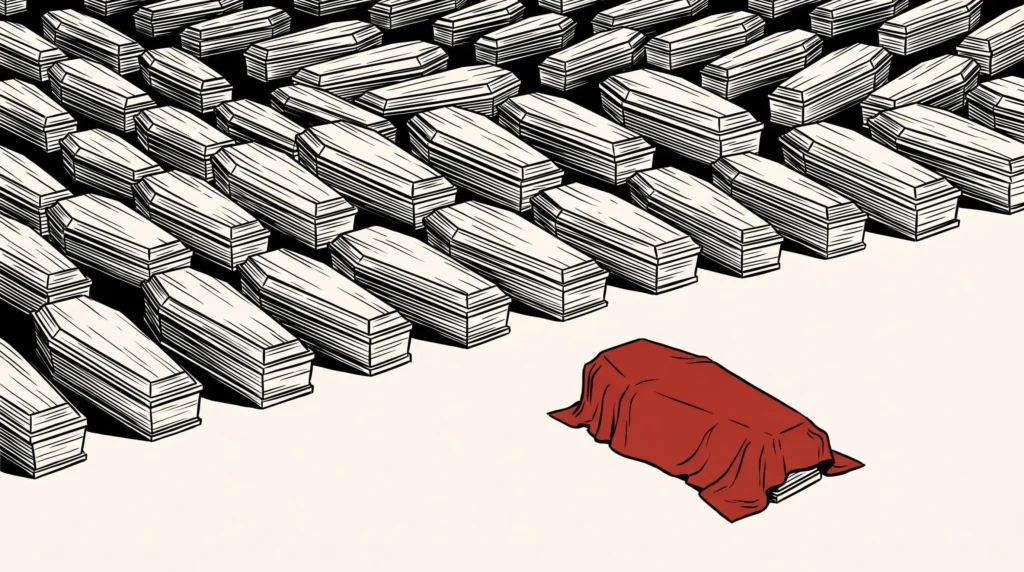
One major thing he did was the Cultural Revolution. This was his reaction to the fear of responsibility for the three-year famine. More than 30 million people in China died of starvation, exceeding the highest record of starvation in peacetime or wartime in Chinese and foreign history. In peacetime, there is no other reason to shirk responsibility. Whose responsibility is this? Undoubtedly, it is Mao Zedong’s responsibility. He unreasonably opposed Peng Dehuai’s criticism, fearing that Peng Dehuai would seize his power, disregarding the already exposed harm of the left-leaning, and continued to deviate more severely to the left, not allowing people to tell the truth, and carrying out the Great Leap Forward and the smelting of steel, the so-called “three red flags” of the people’s communes, which were completely divorced from reality. This led to the great famine. In order to escape this responsibility, he launched the Cultural Revolution, forcing Liu Shaoqi, who had criticized him for the three-year famine, to death. He wanted to eliminate all political opponents, expand his power infinitely, and also planned to hand over his power to his most reliable person, Jiang Qing, after his death. In his eyes, the people were just a mass of flesh, a tool for shouting slogans of “Long live”. The desire for power controlled his life, and he was completely crazy for it, pursuing power at the greatest cost, to the point that his power itself was weakened as a result.
His method of pursuing power was class struggle. The original meaning of class struggle was the struggle between the bourgeoisie and the proletariat. But Mao Zedong’s class struggle had nothing to do with the bourgeoisie or the proletariat. The so-called bourgeoisie was actually the people he didn’t like, and most of them were actually the proletariat. This unprincipled struggle eventually destroyed him. From the 1950s, he became obsessed with class struggle. Anti-Hu Feng, anti-rightists, anti-right-leaning, the Four Cleanups, and the Cultural Revolution were all centered on class struggle. He purged Peng Dehuai, He Long, Chen Yi, Liu Bocheng, and Tao Zhu. He also used Lin Biao to overthrow Liu Shaoqi. Later, he didn’t trust Lin Biao either and wanted to get rid of Lin Biao. Finally, he even wanted to oppose Zhou Enlai, leaving himself alone with a few relatives, Jiang Qing, Mao Yuanxin, Wang Hairong, and a very few retainers, like Zhang Yufeng. If Mao Zedong didn’t believe in class struggle so much, but instead valued harmony and unity, he would not have been so lonely when he died. Although he was responsible for the three-year famine, as a founding father, he could still be respected by most people. It can be seen that Mao Zedong was destroyed by his own class struggle. After the Lin Biao incident, Mao Zedong repeatedly admonished Jiang Qing to unite. He only saw how terrible Jiang Qing was in fighting people everywhere, but Jiang Qing was just his dog, and she would bite whoever he told her to bite. He himself did not give up class struggle in the end.
Mao Zedong engaged in class struggle, and countless people died, regardless of the cost. Every time a movement was launched, people committed suicide (not to mention those who were murdered). Especially during the Cultural Revolution, the people who committed suicide were not ordinary people, but mostly well-known figures in society who had made great contributions to society, and many of them were Mao Zedong’s friends. Mao Zedong knew all about these suicides, but he showed no sympathy. More than 30 million people died of starvation during the three-year famine, most of whom were poor and lower-middle peasants who helped him build the country. But he didn’t feel any pain. Sun Weishi, Shangguan Yunzhu, and others who were close to him were also forced to commit suicide. He showed no pity. Now it has been revealed that Mao Zedong had raped countless women. Originally, on the altar, no one dared to talk about his bestial desires. After he came down from the altar, these things were exposed one by one. His cold-bloodedness was unparalleled. His psychological darkness was truly shocking. Everyone says that Mao Zedong had super high wisdom, and no one could learn it. But even fewer people could learn his cold-bloodedness and ruthlessness, and his lack of basic humanity.
From the details revealed now, Mao Zedong’s class struggle made everyone in the party feel insecure, and interpersonal relationships were extremely abnormal. All affairs revolved around the word “power”. The unity of the country, the interests of the people, were all put behind him. The leaders of the country thought every day about one thing: who would benefit, especially how it would benefit Mao Zedong’s power. No one dared to offend Mao Zedong, and the affairs of a country completely became the private affairs of the Mao family. The various situations that many people could not understand at the time are now clear one by one. How Nie Yuanzi’s big-character poster became a revolutionary big-character poster, how the rebel students of several universities were called around and used, the background of Wang Li being beaten in Wuhan, and the subsequent Tiananmen Square rally to defend the Central Cultural Revolution, who were the 516 elements, why 516 was to be rectified, why Lin Biao, Confucius, and Zhou Enlai were to be criticized, all these things that outsiders could not understand, were actually Mao Zedong’s strategy to eliminate political opponents. He knew it very well in his heart, but it was not convenient for him to say it clearly. During the Cultural Revolution, he was always ambiguous when asked about many important things, and asked others to guess. Because his real purpose was not to be seen, his psychology was very dark. It is not surprising that a country was led by such a leader with boundless power and ulterior motives, and it went to the brink of economic and political collapse. Many people originally thought that Mao Zedong launched the Cultural Revolution in order to seize the power of the bourgeoisie in the state apparatus and to benefit the proletariat. Now this deception has been completely exposed.
In the last few years of Mao Zedong’s life, although his body was completely failing, his mind was still very clear. He knew that he was dying. Who would he hand over the leadership of the country to? In his mind, only Jiang Qing was the most reliable. So he decided to let Jiang Qing take over. But he also understood that Jiang Qing had made too many enemies and could not get the consent of most people, so he asked Hua Guofeng to assist Jiang Qing. Mao Zedong said to Hua Guofeng: “I am at ease with you doing things.” But he also said: “Consult Jiang Qing on matters.” His arrangements for the country’s leaders after his death a year before his death were: Party Chairman, Jiang Qing; Premier, Hua Guofeng; Chairman of the NPC Standing Committee: Wang Hongwen or Mao Yuanxin; Chairman of the Military Commission: Chen Xilian. Later, it was changed to Mao Yuanxin as the Party Chairman. In short, it did not exceed his own few close relatives. What virtues and abilities did Jiang Qing or Mao Yuanxin have to be able to serve as the President of the State? Jiang Qing’s performance in the Cultural Revolution was completely that of a shrew, without any vision or insight, self-inflated, and ignorant of the world. The trial of Jiang Qing after the smashing of the Gang of Four, which defined her as a counter-revolutionary who usurped the party and seized power, and sentenced her to a suspended death sentence, was extremely fair. Mao Zedong actually wanted to hand over the state power to a counter-revolutionary. The only thing he thought about was how to maintain Mao Zedong’s family’s world. It had nothing to do with the bourgeoisie and the proletariat.
After the Lin Biao incident in 1971, the people of the whole country breathed a sigh of relief, believing that Lin Biao had misled the great leader to carry out the Cultural Revolution in order to seize power. Now that Lin Biao was dead, this unreasonable Cultural Revolution should stop. Everywhere, policies were being implemented, and those who had been against Lin Biao and the Cultural Revolution were being liberated. Of course, those who had been executed for opposing Lin Biao could not be resurrected. But Mao Zedong was extremely depressed because of the Lin Biao incident, and he fell seriously ill, and his health never recovered. The leader of a country had extreme opposite feelings from the people. Facing the same thing, the people were jubilant, and the leader was unhappy, which was a great misfortune for the people. In 1975, after Deng Xiaoping’s second comeback, he first rectified the clogged national railway system, enabling it to operate normally. Then he rectified the factionalism in governments at all levels, eliminated the emotions of mutual opposition, and liberated a group of cadres who had been overthrown, and arrested a group of bad leaders, so that the government work gradually went on the right track, production was obviously restored, various indicators turned to rise, and the people of the whole country felt that with Deng Xiaoping, the situation was improving, and the broken country might return to normal. But Mao Zedong’s thoughts had nothing to do with the interests of the people, he only thought about whether his own power could be preserved, and whether Jiang Qing could take over. Deng Xiaoping had several direct conflicts with Jiang Qing, and Mao Zedong decided to get rid of Deng Xiaoping. This was the movement to criticize Deng before Mao Zedong’s death in 1976. Deng Xiaoping was overthrown again. Mao Zedong fell from a politician to a public enemy of the people who was everywhere opposed to the people, because he was controlled by the superstition of power and lost his basic rationality.
The desire for power completely destroyed Mao Zedong, causing him to completely lose his normal thinking, and he regarded the affairs of the country as his own family’s affairs. Although he knew that Jiang Qing was unpopular, he said, “There will be a bloodbath in three to five years.” But he could not escape this situation. He was already crazy, driven crazy by class struggle. Letting Jiang Qing take over was his only best choice. The reason why he wanted to put Zhou Enlai to death was because he did not believe that Zhou would submit to Jiang Qing. His original ideal was to let Zhou Enlai assist Jiang Qing in taking power. But Zhou Enlai could not cooperate with Jiang Qing. Jiang Qing was not a politician at all. There were countless heroes who emerged during the founding of the Communist Party, but none of them could compare to a shrew. The combination of Mao Zedong’s foolishness and his extremely high intelligence turned China into a “country” that was not a country. His ability to destroy the country was brought to the extreme, and no one could match even one percent of his ability.
With more and more information being declassified, the ins and outs of the Cultural Revolution farce are becoming clearer and clearer. Mao Zedong was remarkable, able to overthrow and eliminate so many heroes one by one. Mao Zedong was different from Stalin. Stalin’s purpose was to eliminate dissidents, and killing was the purpose. Mao Zedong’s purpose was not to kill people, but to make them suffer extreme humiliation and pain. First, he isolated them, and no one dared to sympathize with them, making them enemies of the people, then depriving them of their basic human rights, allowing anyone to insult them at will, to beat them at will, to make them drink the dirty water from the spittoon, and not allowing them to be treated in the hospital if they were injured. Finally, he made them feel that life was worse than death, and they should commit suicide. And when they committed suicide, they had to shout “Long live Chairman Mao.” If they dared to show the slightest disrespect to Mao Zedong, all their relatives would suffer a more tragic fate after their death. Mao’s treatment of Liu Shaoqi was an example. When Liu Shaoqi was dying, Mao Zedong ordered a rescue, and he had to wait for the party congress to pass a resolution to permanently expel the traitor, special agent, worker thief, and internal spy Liu Shaoqi from the party, and choose to read it to Liu Shaoqi on the day of his 70th birthday, and then let him die slowly in helpless pain. The high-ranking officials who were purged by Mao were not formally executed after a trial (even if it was a formality), but were allowed to die slowly in a state of extreme isolation and isolation, after suffering all the pain. Mao Zedong hated Zhou Enlai extremely, because the people supported Zhou far more than they supported Mao. But Mao could not get rid of Zhou Enlai, because this country could not do without Zhou Enlai, both internally and externally. In the last few days of Zhou’s life, he was extremely tormented by illness. Mao Zedong took this opportunity to dig out articles criticizing Zhou Enlai written decades ago, using all kinds of ridicule, sarcasm, and harsh language, and asked people to read them to Zhou Enlai in person to increase Zhou’s pain. This process needed to be carefully designed and was time-consuming. Most of Mao’s energy was spent on this.
Comparing Stalin and Mao Zedong, Stalin killed more people than Mao Zedong. Before the liberation, more than 100,000 people were killed in the Jinggangshan purges. I can’t say whose responsibility this should be. After the liberation, 700,000 counter-revolutionaries were killed. This was mainly Mao Zedong’s idea. Later, during the Cultural Revolution, the class ranks were cleaned up, and the Three-Anti and Five-Anti campaigns killed a large number of people. The specific number has never been announced, and it is estimated to be no more than two million. In addition, there were no large-scale executions. The more than 30 million people who died of starvation were not directly killed; those who were purged, committed suicide, and died in armed struggles were not directly killed by Mao Zedong. But Stalin actually executed millions of people. But Stalin led the Great Patriotic War, resisted the German army and won, which no one can deny. In contrast, Mao Zedong, except for a few battles fought by the Communist Party’s army against the Japanese army in the first two years of the war of resistance, did not fight a single slightly larger battle after 1939. The Communist Party’s main energy was focused on expanding the liberated areas and cultivating its own armed forces. At this time, it was a critical moment for the survival of the Chinese nation. Mao Zedong did not fight the Japanese, but played his own little tricks, preparing to reap the fruits after victory. He did indeed do it. But liberation did not bring happiness to the Chinese people, but instead, it brought thirty years of suffering. The number of deaths due to political reasons reached 50 million, exceeding the total number of deaths in World War II. The end of World War II brought peace to the world. The defeated countries, Germany and Japan, have become democratic, civilized, prosperous, and happy countries. Only China, the victorious country, fell into endless internal class struggle, causing unprecedented loss of life in human history.
What Mao brought to China was to make people suffer and then die. Not only did he use all means to make people suffer, but he also mobilized the people of the whole country to fight each other and create suffering for each other. For ordinary small people, it was not simply to execute them, but also to make them suffer extreme pain before killing them, like Zhang Zhixin, Yu Luoke, Lin Zhao, and Wang Peiying, all of whom were killed after suffering all kinds of crimes before their execution. Mao Zedong also destroyed everything beautiful in the world. The culture, ideals, morality, and art accumulated in China for thousands of years were all negated. The movable antiques, paintings, and sculptures were all burned and smashed. The immovable buildings were demolished, and the beautiful movie stars were shaved bald, and the ignorant masses were allowed to insult them in every way. The intellectuals who were most useful to society were overthrown one by one, and even forced to commit suicide. The religious leaders who advocated good were imprisoned, and even simply killed. Mao Zedong’s purpose was for the whole world to suffer because of him. If the suffering of each person could be added up, Mao Zedong’s purpose was the maximization of the suffering of the whole society. He did achieve this goal through the Cultural Revolution. The maximization of suffering is the most essential thing of the Cultural Revolution. This is the gift given to the people by the “Great Savior of the People”.
Mao Zedong not only maximized the creation of suffering in China, but also exported his theory, so that the whole world would have to engage in brutal struggle. He encouraged armed revolution in Southeast Asia, creating death. There were armed rebellions in Malaysia, India, Thailand, the Philippines, Myanmar, Indonesia, Nepal, and Sri Lanka. There are still a lot of problems left over from more than thirty years after his death. The Maoists in India have independent armed forces and have the support of two hundred million poor people, but the poverty problem has not improved at all in the past thirty years. Thousands of people die every year due to armed struggle. The central government of India can’t do anything about them. The worst situation is in Cambodia. Mao’s good student, Pol Pot, followed Mao Zedong’s teachings and killed countless people, becoming the person with the highest proportion of killings in modern human history. This is Mao Zedong’s feat that surpasses all others. This series of deeds also illustrates a problem. His theory is very deceptive, so many people will be deceived. There are still people who are holding up his banner to do things. Is his theory right or wrong? The reason is simple. Improving people’s lives depends on developing production, and how can people become rich by fighting each other? All those who follow Mao Zedong’s theory may be very happy in the struggle (those who are fought are unlucky), but they cannot escape poverty. Without exception.
But Mao Zedong was also naive. He never expected that he would eventually become a lonely man, without a truly like-minded politician by his side, leaving behind a group of sycophants. In the end, the people he trusted were only the Gang of Four, who were later sentenced. Everyone praised Mao’s foresight, but in fact, Mao was short-sighted. How could he have imagined that he would become a lonely man when he launched the Cultural Revolution? The close comrades-in-arms who had fought with him at the beginning were all purged and alienated. Mao Zedong was very clear-headed until his death, but he died in a state of extreme loneliness, disappointment, no future, no comrades, and no friends. He never expected that his glorious life would end in such a way. Mao did not have the slightest self-reproach or regret until his death. After Mao’s death, Hua Guofeng and Ye Jianying arrested the Gang of Four, and the Supreme People’s Court tried the Gang of Four and sentenced them. But the leader of the Gang of Four, the chief backstage who brought disaster to the country and the people, is still hanging on Tiananmen Square, and is printed on the banknotes that everyone uses every day. This farce in China has not really ended yet. But Mao Zedong is a person, not a god, and he will eventually completely step down from the altar and become an ordinary person, accepting a fair judgment under the conditions of stripping away all the outer garments of the gods and eliminating all superstitions.
Discover more from 自由档案馆
Subscribe to get the latest posts sent to your email.