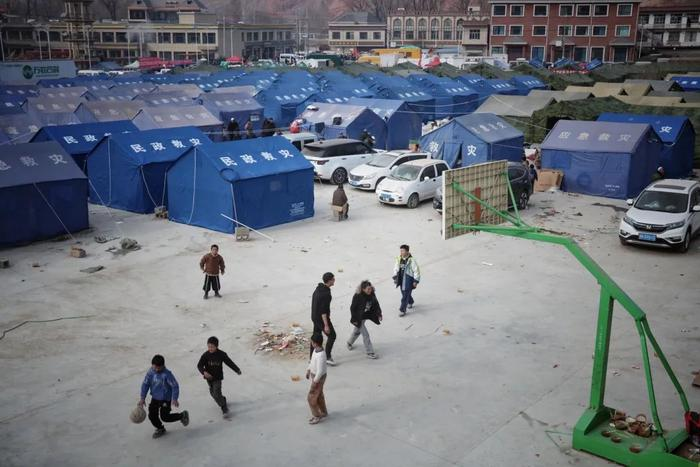
An安置点 in Dahejia Town, Jishishan County
After the earthquake, those migrant workers, like migratory birds, rushed back to Chenjia Village, Jishishan County, Gansu Province. Thousands of kilometers from south to north, from warmth and prosperity to desolation.
For this area, which only shook off poverty four years ago, a sudden strong earthquake seemed so “unfair.” Facing the rescuers and interviewers from outside, the people of Chenjia Village frankly told about their past poverty and current difficulties.
Their former livelihood was farming and raising cattle and sheep, and many people didn’t finish primary school or even know how to read. Life improved because of working outside, and the villagers have been going further and further in recent years, all the way to the electronics factories in the southeastern coastal areas. The county has also introduced policies to encourage migrant workers, providing transportation subsidies and awarding bonuses to representatives of stable employment. In a less economically developed area, seeking change, “going out” is one of the few choices from top to bottom.
When most of the people in Chenjia Village went out to work, an earthquake reminded the young people of the importance of this place. From transporting materials, burying the dead, to the future damage assessment and reconstruction, it is inseparable from the young and middle-aged people who rushed back. What to do in the future? It’s a dilemma. In the courtyards of houses with “dangerous house” signs, the savings of tens of thousands of yuan earned from working outside have collapsed. “We have no money at home,” they still have to go out.
After an earthquake, this place is still a place that needs more attention and help.
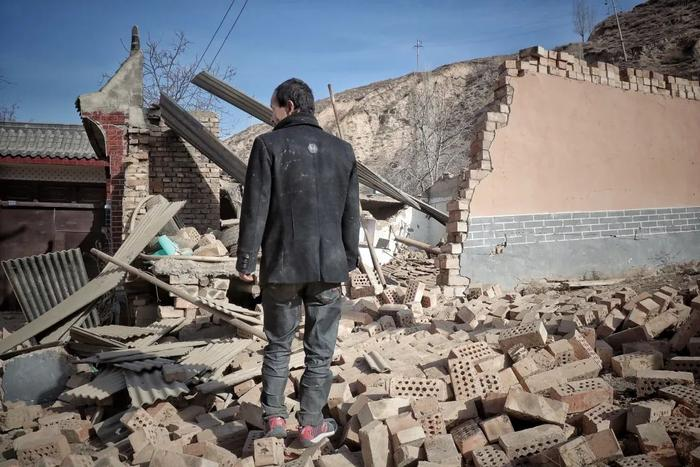
A migrant worker who rushed back stood in front of his house, and his two children died in the earthquake
“I want to go back”
In September of this year, 29-year-old Zhan Yujuan went out for the first time. She and her husband left Chenjia Village, Dahejia Town, and went to Xiamen, 2,500 kilometers away, and finally stood in front of a machine “as big as a wheat harvester.” The couple were a little scared, “How can I do this?”
They work in a factory that produces children’s twist cars and roller skates. Zhan Yujuan’s job is to install buttons on the twist cars, and then send them for inspection and fill out reports. The old employee explained for half an hour and let her do it herself. She had never filled out a report before, and when she encountered something she didn’t know, she would run to grab someone else’s sleeve and ask for advice. By the third day, she was already like a skilled worker and could also help her husband, who hadn’t learned much.
Three months later, she had adapted to this job, working 11 hours a day and earning more than 4,000 yuan a month. On December 19th, it was Zhan Yujuan’s night shift. After midnight, as soon as she put down her work, she saw a message from her husband: a house in the village collapsed. A few minutes later, another fellow worker from the same village called and said that there was an earthquake at home.
She immediately called home, and her daughter told her that everyone was safe, but her 40-year-old nephew was buried under the house, and her family was helping with the rescue.
Chenjia Village was experiencing a chaotic night. When the earthquake struck, some villagers were awakened in their sleep and ran out without time to put on their clothes; some elderly people and children hadn’t reacted yet and were buried under the collapsed walls and roofs.
The people who ran out gathered in the square. In the Chenjia Village WeChat notification group, messages kept popping up: whose house collapsed, whose people were buried underneath… The villagers helped each other, searching for their relatives or neighbors among the piles of bricks and wood.
When the rescue forces arrived, the bodies of most of the victims in the village had been taken out and placed in the open space. A villager from the Fourth Society said that Chenjia Village had a total of seven societies, and more than 20 people died, of which eight died in the Fourth Society.
Zhan Yujuan’s mother-in-law told her that after everyone ran out, they had nowhere to go, so they lit corn stalks in the village square and sat around them all night. All night long, Zhan Yujuan and her relatives and friends in Xiamen watched the live broadcast online, discussing whether to go home. Some people said that they couldn’t help even if they went back. “I want to go back,” she said to her husband, “It’s good to hold the children in my arms and sleep and play with them for a while.”
That day, as far as she knew, at least 14 fellow villagers working in Xiamen were going to rush back. Among them, a friend of Zhan Yujuan’s from the same village was told that his mother was trapped in the house and had been confirmed dead. He hurriedly took the earliest flight.
Zhan Yujuan and four others went back together. On the way, they discussed the rescue situation in the village and the possible economic compensation, and no one mentioned anything about death. At more than eight o’clock in the evening, on the way from Lanzhou Airport to Chenjia Village, Zhan Yujuan received a video from her friend. The children and their grandmother were sitting in a tent, and there were no obvious injuries on their bodies.
Zhan Yujuan and the other five people arrived at the Chenjia Village resettlement site at one o’clock in the morning on the 20th. The villagers rested in the temporary tents. The temperature dropped to minus 16 degrees Celsius at night. The five people stood outside the tent and warmed themselves by the fire. Because they came back in such a hurry, they were only wearing single clothes. Zhan Yujuan was eager to see the children, but the phone couldn’t get through.
It was late at night, and the tents slowly became quiet. Only the rescuers were still busy arranging the people who had just returned and finding cotton coats for the villagers who didn’t have thick clothes. After being arranged to settle in a tent, Zhan Yujuan stared at a sleeping girl for a long time, walked to the girl’s feet and asked, “What is this?” The child lifted the quilt and revealed her whole face, and she was a little disappointed – it wasn’t her eldest daughter.
On the second night after the earthquake, she didn’t sleep again. At 7:30 in the morning, the couple lifted the tent curtains one by one and called out the children’s names. In the innermost tent in the same row, someone finally answered. When the youngest son saw Zhan Yujuan, he hugged her and kissed her non-stop.
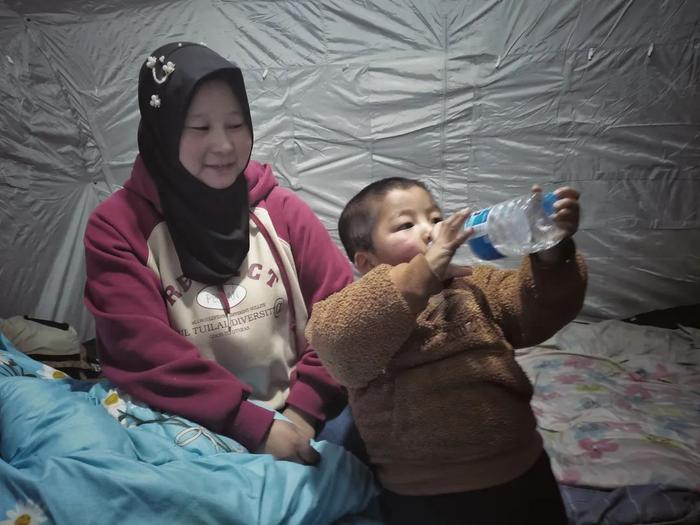
Zhan Yujuan finally saw her children
“Don’t let winter be idle”
Around 0:30 on the 19th, Ma Muhaimai, who had already fallen asleep, received a call from his cousin, “Come quickly,” his cousin’s tone was urgent, “Two children were crushed, they’re gone,” and then he hung up the phone in a hurry.
On the way home, Ma Muhaimai’s mind was in a mess. A month ago, he went to work in Guangzhou through a labor agency. This was the first time he had gone out to work in nearly twenty years. In the past, he always thought that the children were still young and didn’t want to leave home. Now, among the four children, the eldest daughter and the second son have already married, and the youngest, the fourth, is already nine years old. He thought he should go out and earn some money.
The day before the earthquake, he made a video call with his family, and his daughter-in-law said that the two younger brothers were too naughty. He told the two children, “Dad is gone, you have to listen to your sister-in-law.” In the video, the children asked him when he would go home with a smile, “Two to three months, Dad will be back,” he said. At that time, spring would come, and Linxia would be warmer, so he would do some odd jobs near home and be able to spend more time with his family.
At more than 2 p.m. on the 19th, Ma Muhaimai rushed to Chenjia Village and saw his two sons lying in the open space, “There’s no way, let’s send (bury) them.”
In this earthquake, another migrant worker from the same village, She Mansu, also lost his children. He originally planned that when he went home in March of the coming year, he would buy a small bicycle from Huizhou. That was what he promised his daughter when he made a video call on the evening of the 19th. A few hours after making the promise, he received the news that his daughter had died and his mother and wife were injured.
For 365 days a year, She Mansu, like a migratory bird, shuttles back and forth in the north and south, going wherever there is work. The winter in the northwest is too cold, and the construction site cannot start work. In order not to let the winter be idle, most of the migrant workers in the village will go to the southern cities – the factories there recruit people all year round, and the assembly line work does not require too high a degree of education.
In the summer, She Mansu does odd jobs on the construction site in Xinjiang. At the end of October, he returned to Jishishan and stayed for more than ten days, and then went to Huizhou, Guangdong with two people from the same village to work in a TV factory.
His task is to screw the screws on the TV parts. He works about 10 hours a day, and his hourly wage is 19 yuan. This is the price after several labor companies “layered deductions.” She Mansu only went to the first grade of elementary school, which is considered a good treatment for him, much easier than carrying bricks on the construction site. He said that if he had a higher level of education, he could find a job with an hourly wage of 30 yuan.
Although he has been working outside for many years, She Mansu still cannot get used to life without his children. Whenever he has a rest time, he will watch his wife and children on the other side of the screen through video, and often chat for more than an hour. This year, his 18-year-old son went out for the first time and started the working life of another generation in the family.
Going out is a choice they have to make. She Mansu calculated an account for the reporter: In Chenjia Village, the period without work starts from November and lasts until the end of February of the coming year. If they don’t go out, the income for four months is zero; taking a monthly salary of 5,000 yuan in the factory as an example, they can earn 20,000 yuan more by going out for a winter.
For the same reason, Zhan Yujuan and her husband left home in September of this year and took the train to Xiamen. Before that, her husband did odd jobs on construction sites around Jishishan, earning 120 to 180 yuan a day. During the three years of the epidemic, he might only have work for more than ten days a month. Zhan Yujuan’s family of 7 people, “can’t support at all.”
“Is it like this all year round here?” When she first arrived in Xiamen, Zhan Yujuan was full of curiosity about this southern city: she could also see flowers and plants on the road in winter, and the climate was not as dry and cold as in the northwest. In her spare time, she could take a bus for two or three stops to the beach, and the sand was soft under her feet.
In the 24 hours of a day, she will think of her children countless times, and she is most worried about her three-year-old son: “I don’t know if he is crying or making a fuss at this time?”
After work, she walks in the park and sees other parents taking their children to play on the beach. Zhan Yujuan always feels envious, “If I bring my children here and play here, it should be very good.” She remembered the previous summers, when their family often took snacks to the Yellow River to play and watch people swimming in the river.
When she went to the beach for the first time, Zhan Yujuan made a video call to her children, but her daughter was not as excited as she imagined, but rather complained, “Where did you go to play, and you didn’t bring me.” This made her feel sorry, and when she went to the scenic spot again, she only dared to take a photo and send it, with a sentence: Study hard, and I’ll take you here when you have a winter vacation.
She likes the life in Xiamen, free and humid. In contrast, Chenjia Village represents closed, backward and boring. Except for going back to her mother’s house and visiting relatives, she rarely goes out of the village. In winter, she has nothing to do and no money to earn.
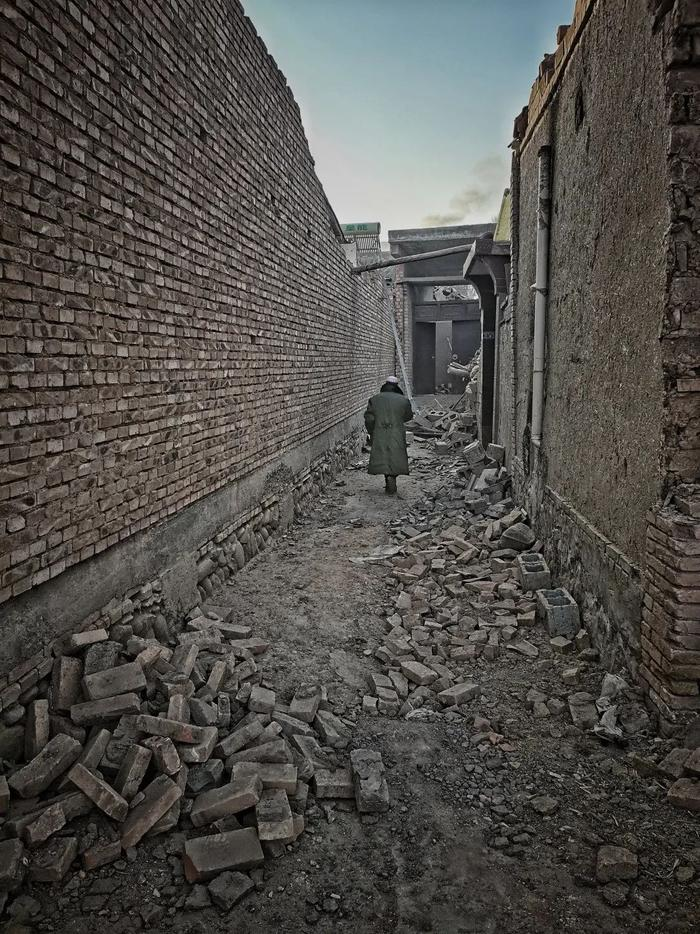
A villager walks on the streets of Chenjia Village after the earthquake
The helplessness of “being forced to leave”
A 77-year-old low-income household said, “If it weren’t for this (earthquake), no one would know how poor we are here.” The cement brick house without exterior walls where he lives with his wife and granddaughter was a resettlement house built by the government for low-income households four years ago. Compared with the old earthen houses in the village, it is not bad.
Jishishan County was once a key county for poverty alleviation and development listed by the state and province, and it is also one of the 23 deeply impoverished counties in Gansu Province. In 2019, 2,989 households and 13,546 people in the county were lifted out of poverty, 53 poverty-stricken villages withdrew, and the poverty incidence rate dropped to 1.15%, achieving the goal of removing the poverty-stricken county.
The 2020 government work report shows that all the remaining 630 households and 2,821 people in the county who were not lifted out of poverty have been lifted out of poverty, and the risk of returning to poverty and becoming impoverished for 1,389 households and 5,989 people on the edge of poverty has been eliminated, and the problem of absolute poverty has been historically solved.
In 2014, Haicang District of Xiamen City established a pairing relationship with Jishishan County, and Xiamen has also become one of the first choices for local migrant workers. Most of the villagers interviewed by the reporter only have a primary school education, and their jobs are concentrated in the processing of electronic products, fitness equipment, and catering services.
The morning when she found her youngest son, her youngest son asked Zhan Yujuan, “Do you still want to go?”
“I want to go,” she said.
“Can you not go?”
“If I don’t go, I have no money at home.”
The eldest daughter didn’t speak and stood aside, shedding tears.
Three months ago, when she and her husband went to Xiamen, her daughter also cried like this, and her youngest son hugged her tightly and wouldn’t let her leave.
Ma Yuan, who has been engaged in labor brokerage in Jishishan County for many years, has a deep understanding of this kind of “forced to go out” helplessness. Starting from August every year, more and more people come to him to inquire about recruitment. He said that most people who are looking for work are more willing to work near their homes, “Even if we can only earn three thousand a month, we are willing to stay at home.”
In recent years, in order to encourage everyone to go out to work, the county has introduced many employment subsidy policies, such as issuing transportation subsidies and providing subsidies of 3,000-10,000 yuan to representatives of stable employment for more than 3 months.
Public information shows that as of the end of October 2022, the county has transferred a total of 81,240 surplus rural labor forces. Since 2023, the county’s labor department has connected with more than 30 external employment enterprises in Xiamen, Jinan, Zhongshan, Nanjing and other provinces, and mobilized labor forces with employment intentions to go out to work.
A villager from Chenjia Village told his own working history. At the age of 13, he first went to Hualong County, Qinghai Province, and at the age of 15, he went to Shanghai from the northwest. He worked in an electronics factory for 14 months. Because he was an “illegal worker” who had not reached the legal age, his wages were always deducted. In the second half of his nearly 20 years of working career, his final destination has been as far as Huizhou, Guangdong, but he still misses the time when he started in Hualong the most: “They are all people from my hometown, and their words and food are the same.”
In the memory of Han Zhigang, the village head of the Fourth Society of Chenjia Village, the wave of migrant workers began in the 1990s. The villagers first went to Xinjiang and Qinghai to engage in construction, road construction and other work. Around 2018, the young and middle-aged people in the village began to go to Guangdong, Xiamen and Nanchang to work. “Before, it was all men who went, and later there were more opportunities to enter electronics factories, and many women also went.”
The Fourth Society has a total of 97 households, and now nearly 80% of the people are in other places. The advantage of working outside is that the economic situation has finally improved. In the past, every household relied on planting corn and raising cattle and sheep to make a living, and they couldn’t earn 10,000 yuan a year. Now, young people can earn three or four thousand a month in the factory.
With more and more people going out to work, the overall economic situation in the village has improved. Han Zhigang clearly felt that in the past two years, there was more money, and more children went to high school and university. “Like people in the village who are fifty or sixty years old, many of them are illiterate,” Han Zhigang said. He himself only went to the second grade of elementary school. Now his children have to spend at least four or five thousand yuan a year in elementary school.
What makes him feel difficult is that the village also needs young people. Just like when the earthquake happened this time, many families only had the elderly and children. “If the young people were there, maybe they could escape with them.” Even now, transporting materials and burying the victims, these things also need the young people who rushed back from other places to take care of them.
A villager who left home to work at the age of 19 and took his parents to settle in Hubei, drove back to Chenjia Village these days. He said that he just hoped to help his relatives and neighbors.
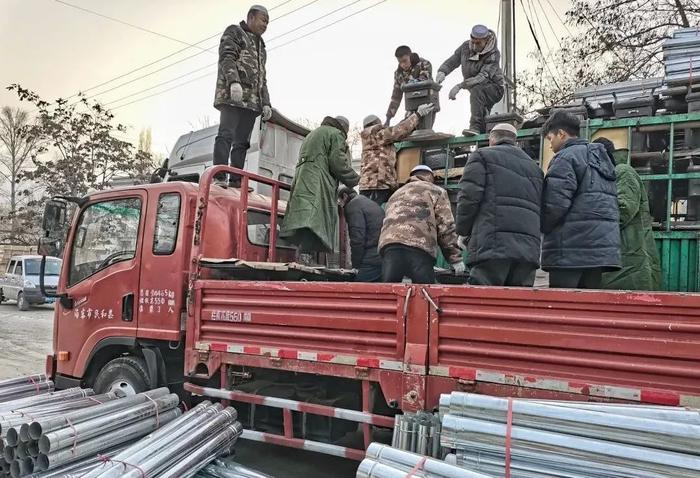
The young and middle-aged people in the village are transporting disaster relief materials
Money, houses, and livelihood
Along the road of Chenjia Village, you can see fallen bricks, tiles and wood everywhere, and even the big iron doors that were shaken off. The courtyard doors on both sides of the road are pasted with the words “can be inhabited” or “cannot be inhabited.” The structure of the courtyards in the village is roughly similar, with three main houses facing the gate, and two side houses on the left and right.
Among the scattered bricks on the ground, many are hollow bricks. Ma Wenxiang, who came back from Xiamen with Zhan Yujuan, said that a hollow brick costs 60 cents, and a solid red brick costs more than one yuan. In order to save costs, some villagers will mix hollow bricks and solid bricks when building houses.
Among the collapsed houses, the most severely damaged are the earthen houses and wooden houses. A villager introduced that compared with cement houses, wooden houses are not only low in cost, but also have better thermal insulation and air permeability. Houses with a lifespan of more than ten years mostly use a structure of brick and wood. The newly built houses in recent years are mainly cement brick houses.
Last year, Ma Wenxiang and his wife used the money they saved from working outside to build a more stable and reliable new cement house in the position of the main house next to the old wooden house. The foundation was padded very high, and you had to step on four cement steps to walk from the courtyard to the house. In resisting natural disasters, such a house is obviously more advantageous. Except for the cracks in the steps and walls, there is no serious damage.
The construction and decoration of these three main houses cost about 180,000 yuan. The couple worked hard for more than a year, and the government can subsidize 25,000 yuan, but the payment has not yet come down. In September of this year, the new house was completed and decorated, but the two had not yet moved in, and they went to Xiamen to work again. “If we don’t go out to work, we have no money to sit at home,” he said.
Like Ma Wenxiang and his wife, most of the income of migrant workers is used for building and decorating houses.
On the 21st afternoon, Zhan Yujuan opened the door of her own courtyard. Three months after leaving home, she carefully looked at the house. The floor tiles had cracked a meter-long crack, the wardrobe that was originally standing against the wall had moved, and it was ten centimeters away from the wall. The cabinet doors were all open and “spitting out” clothes, and the bottles and cans on the dressing table fell on the ground.
The main house and side houses of the family were renovated three years ago, and they were just renovated this year, with a total cost of more than 300,000 yuan, including the “sponsorship” of her in-laws and more than 100,000 yuan borrowed from others. The couple plan to pay back the money while working. While feeling sorry for the loss, Zhan Yujuan was also a little fortunate that the newly built house was strong. If it was the previous earthen house, it would probably not escape the fate of collapse. “If the family is gone, no matter how much money you earn, it’s useless.”
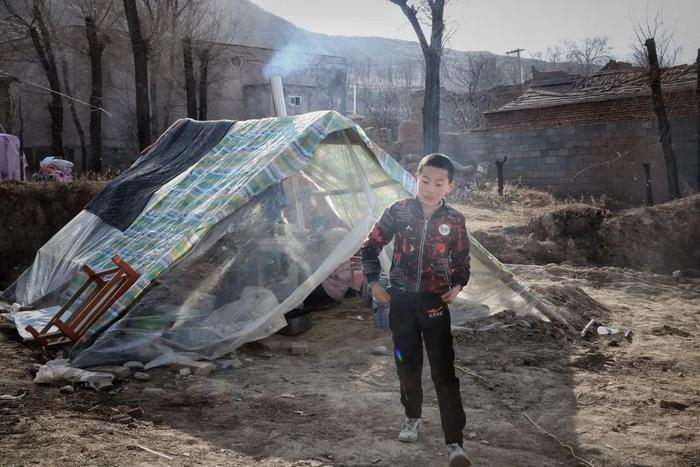
A young man walks out of the tent he set up
Because she didn’t know how to start comforting, Zhan Yujuan didn’t dare to go to Ma Hailin’s house in the same village to see. Ma Hailin is her mother-in-law’s own nephew, in his 40s, and died in the earthquake.
Ma Hailin’s house has a similar structure of three main houses and three side houses. The walls are made of homemade mud and earth bricks, and the roof is made of wooden sticks and wooden boards, and then covered with a layer of tiles, which is almost the “cheapest” house in the area. The main house was built seventeen or eighteen years ago, and the walls were tiled with tiles, and the side houses were built earlier. According to local customs, the in-laws live in the relatively new main house, and Ma Hailin and his wife live in two side houses respectively. His family’s life is not well-off. Ma Hailin works in the township, and his wife takes care of the elderly and two junior high school children at home. The whole family of six relies on his salary of more than 5,000 yuan.
During the earthquake, the wooden boards of the roof collapsed and hit Ma Hailin’s wife. Fortunately, the wall collapsed towards the outside of the house. She opened the wooden boards and climbed out from the position near the door of the house. The main house was not seriously damaged, and the in-laws also ran out. But outside the side house where Ma Hailin lived, there was a row of corn stalks, which pressed the wall to collapse into the house, and the bricks and wood fell together. His wife called his name several times, but no one answered. The neighbors came to help dig people, and after half an hour, Ma Hailin was taken out, and he was no longer breathing.
A few days after the earthquake, rescue materials from the outside were delivered to the Chenjia Village resettlement site in batches, but tents were still in short supply. Several families lived together in a tent. In a blue tent of 12 square meters, there were at most eight or nine people at the same time, and it was difficult to turn over.
To stay or to leave has become a problem that the migrant workers in Chenjia Village have to consider. Under the low temperature, the reconstruction of the houses cannot be carried out, and the villagers may have to spend this winter in tents or activity board houses.
Zhan Yujuan still decided to go, “Staying at home like this, there is nothing to do,” she asked her boss for ten days off, and she may be deducted from her salary if she doesn’t go back.
“This job can’t be done within a year,” Ma Wenxiang and his wife discussed, and his wife went out to work first, and he stayed at home. Because they were worried about the subsequent matters such as house damage assessment and reconstruction, someone had to stay at home to take charge. Ma Wenxiang couldn’t sleep until three o’clock in the morning that day. He wrote in his Moments of Friends: Many familiar faces (holes) have been isolated for two lifetimes.
(At the request of the interviewees, Ma Yuan in the text is a pseudonym.)
Discover more from 自由档案馆
Subscribe to get the latest posts sent to your email.