
文 | 清和社长
In 1368, Zhu Yuanzhang established the Ming Dynasty and established the Eight-legged Essay; Dante’s Divine Comedy was born 60 years ago, and Boccaccio finished The Decameron, and Western Europeans began to awaken.
In 1380, Emperor Taizu of the Ming Dynasty executed Hu Weiyong and abolished the prime minister’s power; the Magna Carta of England was issued more than 170 years ago, and the principle of inviolability of private property and personal freedom had been established, and the forces of the aristocracy rose.
In 1587, the fifteenth year of Wanli, eunuchs were favored and their power was at its peak; Shakespeare began his acting and creative career, and 8 years later wrote Romeo and Juliet.
In 1643, the Shunzhi Emperor of the Qing Dynasty ascended the throne, and Dorgon was regent; Newton was born. “If Newton was not born, the world would be like a long night.” In 1666, Newton returned to his hometown to avoid the plague and created calculus, classical mechanics, optics and astronomical theory, which was the Newton Miracle Year. At this time, the first major literary inquisition of the Qing Dynasty, the “Ming History” case, had just been concluded.
In 1689, the eighth year of Kangxi, Kangxi captured Obai and personally handled the government; Locke published “Two Treatises of Government”, criticizing the divine right of kings and hereditary succession of the throne, and proposed a civil government. At the same time, the British Parliament passed the Bill of Rights, restricting the power of the king.
In 1776, Qianlong instructed the government to delete books on a large scale; in the same year, Adam Smith published “The Wealth of Nations”, North America issued the “Declaration of Independence”, and Watt’s steam engine was put into production, which can be called a miracle year for mankind.
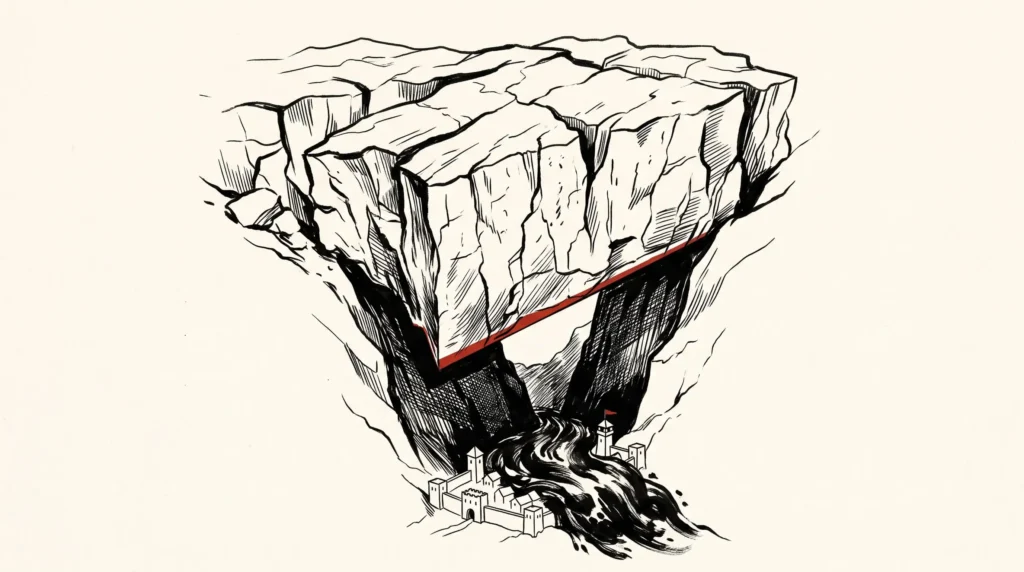
In the 14th-15th centuries, at the critical crossroads of human history, the Ming Dynasty established by Zhu Yuanzhang pushed China into the “garbage time of history”. From then on, the East entered the era of great divergence.
What is “the garbage time of history”? Is the garbage time of history a long vacation for culture, or a cultural sea market? How to spend “the garbage time of history”?
This article takes “the garbage time of history” as the starting point to think about the predicament of national modernization.
本文逻辑
一、历史的垃圾时间
二、文化的罗刹海市
三、个人的临终关怀
01
历史的垃圾时间
Many historians believe that the collapse of the Soviet Union began with the invasion of Afghanistan in 1979. Senior media person Hu Wenhui defined the period from 1979 to 1991 as “the garbage time of history”, saying that Gorbachev just let this garbage time end earlier [1].
Hu Wenhui also believes that the garbage time of history is not only applicable to the history of Russia, and is not only applicable to contemporary history. For example, the Western Zhou Dynasty collapsed in 770 BC, and the garbage time of the Zhou Dynasty after King Ping moved east to Luoyang; the garbage time of the Cao Wei Dynasty after the Gaoping Tomb Incident in 249 AD; the garbage time of the Tang Dynasty after the Huang Chao Rebellion in 878 AD, the garbage time of the Ming Dynasty after the death of Yuan Chonghuan in 1630, and the garbage time of the Toyotomi regime after the Battle of Sekigahara in 1600.
The garbage time of history feels like an empirical statement, this concept is not rigorous, and it is suspected of being a post-event Zhuge Liang.
“The Tang Dynasty perished in Huang Chao, and was harmed in Guilin.” Chen Yinke borrowed the view of Song Qi in “Xin Tang Shu·Nanzhao Biography”, believing that the Huang Chao Rebellion destroyed the wealth of the southeastern provinces and cut off the Bian Road of north-south transportation, and the Tang Dynasty therefore lost the economic power of the south. If we want to trace back further, it was the Pang Xun Rebellion caused by the invasion of Nanzhao – in 868 AD, Pang Xun led 800 Xu state soldiers to launch a mutiny in Guilin.
When did the garbage time of the Ming Dynasty start? Huang Renyu believes that it was “the fifteenth year of Wanli”: “In 1587, it was the fifteenth year of Wanli, the year of Dinghai, and on the surface it seemed that the world was peaceful and nothing could be recorded, but in fact, our Ming Empire had already reached the end of its development”.
However, Hu Wenhui opposes Huang Renyu’s “great historical view”. He believes that if the Ming Dynasty perished in the fifteenth year of Wanli, then Chinese history would also end. The three hundred years of the Qing Dynasty were all garbage time in history. Hu Wenhui defined the 14 years from 1630, when Chongzhen destroyed the Great Wall by himself, to his suicide in Meishan as the garbage time of the Ming Dynasty.
According to the historical experience methodology, there are many differences and disputes in the garbage time of history. It implies historical inevitability, which is itself a controversial view. If we use the results to determine historical inevitability, it is easy to fall into circular reasoning.
Usually, when we say “the game enters garbage time”, it at least contains two meanings: one is a definite countdown; the other is that the outcome of failure is a high-probability event. If we were in that era, how would we know when this period of history would end and where the next period of history would begin? More importantly, “garbage time” is for the relatively high-probability losers, and for the potential winners, it is “the beginning of everything”.
However, the garbage time of history is still an interesting and valuable statement. Moreover, from a logical point of view – non-historical empiricism, it is still a reliable concept. We can deduce the garbage time of history from the logic of economics and the logic of political science.
As early as 1920, Mises published an article entitled “Economic Calculation in the Socialist Commonwealth” [2], in which he denied the possibility of Pareto’s socialist planned economy and the centralized allocation of resources from the perspective of economic calculation, and the Soviet Union had not yet been established at this time. In other words, before the Soviet Union was born, Mises predicted through logical reasoning that this economic entity would inevitably fail. According to Mises’ logic, the Soviet Union entered garbage time from its birth in 1922.
Therefore, from the logic of economics, when a certain period of history is in a stage that violates economic laws, individuals are powerless to change it, and it is bound to fail, we define it as “the garbage time of history”.
The collapse of the Soviet Union was the failure of Mises’ planned economic system, and it was also the failure of the highly centralized nation-state system of the Soviet Union. There are many failures of nation-states, and their common reason for failure is that they have not become democratic countries, that is, the power within the nation-state has not been legalized and has not been implemented in the hands of the people.
“The king is under the law.” The state power transitions from the ruler to the people, and is constrained by the constitution. This is the change of ancient and modern times, and it is also the key problem of national modernization. This is the logic of political science.
Philip Kuhn, based on the experience of the British Glorious Revolution, constructed a set of logic of “political participation, political competition and political control” [3]. He believes that the extent to which the elite class, which has expanded with economic progress, participates in politics is related to the process and risks of national modernization. Just after the Ming Dynasty of the Zhu family perished, the British aristocracy highly participated in politics, checked and balanced the imperial power, and went to modern civilization through a peaceful reform path. During the same period, Louis XIV of France greatly strengthened the imperial power, weakened the power of the aristocracy, and the power was over-concentrated, and finally the political structure lost its balance, and Louis XVI was sent to the guillotine.
Qian Mu, in his book “Political Gains and Losses in Chinese History”, counted the changes in the political power structure of successive dynasties. He believes that it is not accurate to define the ancient Chinese dynasties as centralized autocracy. In fact, there are many changes between the dynasties. “If we say that Chinese traditional politics is autocratic, and the government is ruled by an emperor, this statement can be used to explain the Ming and Qing dynasties. If we talk about the Han, Tang, and Song dynasties, the organization of the central government, the imperial power and the prime minister’s power are divided, and although the proportions are different, we cannot say that everything is controlled by the emperor’s autocracy. [4]”
Qian Mu analyzed the relationship between imperial power and prime minister’s power from the two dimensions of personnel and system, and believed that Emperor Taizu of the Ming Dynasty abolished the prime minister’s power and concentrated imperial power, leading to a high concentration of political power. Emperor Taizu of the Ming Dynasty executed Hu Weiyong and abolished the prime minister, requiring his descendants to never establish a prime minister again. Not only that, the Zhu family of the Ming Dynasty abolished the Zhongshu Province and the Menxia Province, and only retained the Shangshu Province; and the Shangshu Province had no chief officer, and was in charge of the six ministries, called the six ministries Shangshu, with the official rank of second grade. The six ministries Shangshu, the nine qing, and the military officer Grand Governor were listed side by side and managed by the emperor. The emperor set up a private secretariat and appointed cabinet university scholars to help him manage everything. Some people say that the university scholars actually acted as prime ministers, but the power structure has undergone fundamental changes, and the administrative power controlled by the university scholars is responsible to the imperial power.
Later, the Aisin Gioro family of the Qing Dynasty basically followed this political system. In the view of Philip Kuhn, Wei Yuan put forward this fundamental question: How should the state strengthen its authoritarian rule by allowing the literati to take on more responsibility and participate more widely in politics? Wei Yuan’s successor, Feng Guifen, went further, and he advocated expanding political participation through official elections in “Public Dismissal and Promotion Discussion”. He quoted Confucius’ words, “If you raise the straight and put it in the wrong, the people will obey”, “If you ask for a promotion, use the one who is recommended the most” [5].
In the changing times, whether the political power structure is a power law or an olive-shaped trend determines the future of the country – whether the road to national modernization is peaceful and reformist, or violent and tortuous. In the Ming Dynasty, it was the era when modern world civilization began, and the abolition of the prime minister’s power closed the door to national modernization. Thus, it entered the garbage time of history.

02
文化的罗刹海市
History has garbage time, but individuals do not.
How should individuals spend the garbage time of history?
Hu Wenhui believes that the greatness of history is one thing, and the smallness of individuals is another thing. In the garbage time of history, individuals are of course helpless politically, but in life and culture, they can continue to let themselves go [1].
The so-called “the world has the way, then it appears, and if there is no way, then it hides”, hiding can be understood as lying flat, which is a rejection and avoidance of the garbage time of history. Hu Wenhui suggested that once you encounter the garbage time of history, treat it as a long vacation for culture.
“In the garbage time of the Tang Dynasty, there were the frustrated Pi Rixiu, the unsuccessful Lu Guimeng, Luo Yin who went to western Sichuan, and Han Wo who escaped the Later Liang, all of whom had their own long vacations and exuded a different cultural brilliance [1]”. In Hu Wenhui’s view, when entering the garbage time of history, another parallel universe of history will split, that is, the darkest world politically and the most beautiful world culturally.
In the garbage time of the Ming and Qing Dynasties, talented scholars and beautiful women indulged in Qinhuai, Kong Shangren wrote the joys and sorrows of Hou Fangyu and Li Xiangjun, and wrote “The Peach Blossom Fan”, Mao Xiang wrote his entanglement with Dong Xiaowan, and wrote “Memoirs of Yingmei An”. There was also Wu Weiye who created “Pipa Xing”, “Yu Lake Song”, and “Qinhe Ganjiu”.
“Let the wind and rain come, and be a person who watches the show.” Perhaps, what Hu Wenhui wants to express is not open-mindedness and romanticism, but helplessness and drunkenness.
The garbage time of history is not necessarily a long vacation for culture, but more likely a cultural sea market.
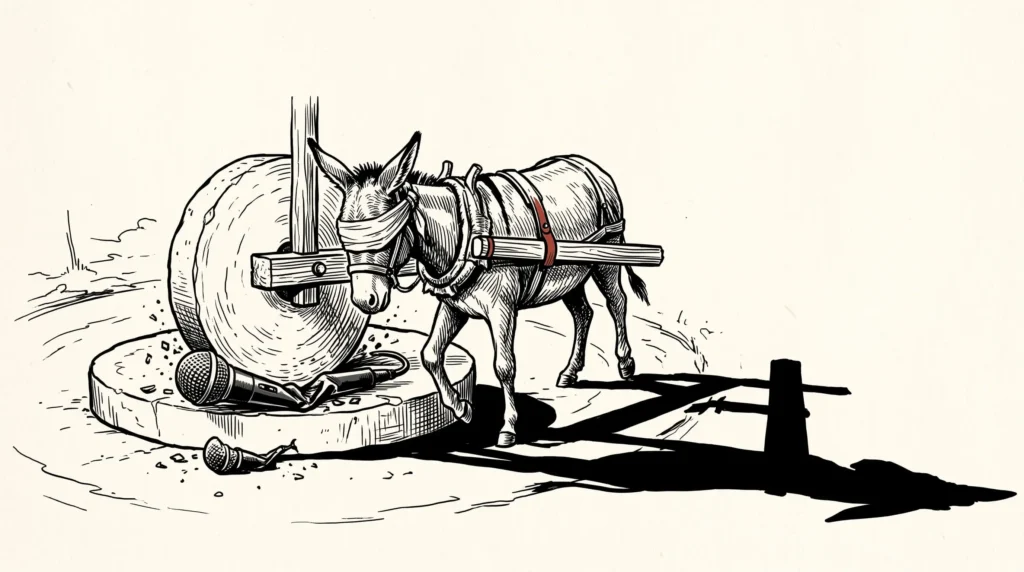
In the garbage time of history, there are never stars, only ghosts and monsters. In the cultural sea market, Goebbels-style mouthpieces, beautiful-looking families, flatterers, yes-men, demons dancing wildly, frantic ignoramuses, free riders, the silent majority, and a group of accomplices who pretend to be harmless – Hannah Arendt called them “the banality of evil” [7], which is thoughtless, without personality, and without responsibility, and they are all dyed, jointly performing a mirage of “that horse doesn’t know he’s a donkey, that bird doesn’t know he’s a chicken”. Pu Songling called it “Liaozhai”.
Under the big tree, no grass grows; the imperial power is concentrated, and all horses are silent. From Mises to Philip Kuhn and Qian Mu, we found that the concentration of economic and political power created the garbage time of history, and autocracy is the natural enemy of culture.
Whenever history enters garbage time, the first to fall are always cultural people and thinkers. Each round of cultural catastrophe is like a historical repeater: from the disappearance of sharp criticism, to silence being considered malicious, then not praising enough is also a crime, and finally only one voice remains: lies.
Moreover, the more concentrated the imperial power, the more crazy the control of ideology, and the more extreme the打击 of dissidents.
After the Qing Dynasty entered the pass, it was suspicious of Han intellectuals, and launched a large-scale literary inquisition, with about 160-170 cases, which was more than the total number of literary inquisitions in other dynasties. Hu Qiguang pointed out in his “History of Chinese Literary Disasters”: “(The Qing Dynasty’s literary inquisition) lasted for a long time, the network of literature was dense, the number of cases was large, the scope of打击 was wide, the charges were fabricated and insidious, and the means were cruel, all of which surpassed the previous dynasties. [6]”
The “Ming History” case in the eighteenth year of Shunzhi was the first major case of the Qing Dynasty’s literary inquisition. At that time, Zhuang Tinglong, a wealthy household in Huzhou, Zhejiang, purchased the unfinished “Ming History” of Zhu Guozhen, the first assistant of the Ming Dynasty, and then recruited famous scholars to donate and delete, and supplemented the history of the Chongzhen Dynasty and the Southern Ming Dynasty, and compiled “Ming History Compilation”. As a result, he was reported by Wu Zhirong, the magistrate of Gui’an, and caused a great disaster. Although Zhuang Tinglong was dead at this time, he was still exhumed and decapitated, and his body was hung on the city wall of the north gate of Hangzhou for three months. 221 people, including editors, printers, and buyers, were convicted, more than 70 people were severely punished, and 18 people were subjected to Lingchi.
Why is the imperial power obsessed with ideological control?
We can use Zhao Dingxin’s theory of political legitimacy to explain. Zhao Dingxin believes that the legitimacy of political power comes from three aspects: ideological legitimacy, procedural legitimacy, and performance legitimacy, which correspond to value rationality, formal rationality, and instrumental rationality [8]. According to the standards of modern states, the procedural legitimacy of successive dynasties’ imperial power is insufficient, and the monarch has to resort to ideological legitimacy, and the control of ideology reaches an unprecedented level.
The secular thought of ancient China was “overly” mature during the Spring and Autumn and Warring States periods, overwhelming the natural religious thought. The ruling class advocated the divine right of kings to maintain the legitimacy of its source of imperial power, but tried to use secular thought to maintain the eternal stability of its imperial power.
The so-called era of a hundred flowers blooming was nothing more than an era of the ruling thought of a hundred schools of thought competing and elites vying to be imperial teachers. In the Qin Dynasty, the Legalists gained power and burned books and buried Confucian scholars. In the Han Dynasty, the Confucianists rose and dismissed the hundred schools. Confucius talked about self-discipline and the restoration of rituals, Mencius also said that the people are more important than the king, Dong Zhongshu listed the three cardinal guides and five constant virtues, and Zhu Xi integrated the great achievements, “exhausting the principles of heaven, clarifying human relations, speaking of the saints’ words, and understanding the past”, and the imperial teachers and great Confucian scholars of the Ming and Qing Dynasties reached the peak.
However, secular thought cannot solve the problem of the soul’s destination like religion, and make the people absolutely obey the imperial power. Why did God grant the imperial power to the Ying surname Zhao family? Why has my family been slaves for generations? “Are the kings, marquises, and generals born with a kind?” unveiled the emperor’s new clothes wrapped in ideology, so for two thousand years, the revolution has never stopped, and the dynasties have changed.
The ideological legitimacy of the imperial power of the ancient European kings came from the divine right, not secular thought. The “Book of Romans” in the Bible writes: “Let every soul be subject unto the higher powers. For there is no power but of God: the powers that be are ordained of God. Whosoever therefore resisteth the power, resisteth the ordinance of God”. The three major religions all have a set of ideologies to persuade believers to submit to the rule of the imperial power, that is, the eternal life of believers. God said that people are born with sin, and Jesus came and was crucified in order to wash away the sins of the world. Believers do not seek this life but seek eternal life – “Except a man be born again, he cannot see the kingdom of God”, “Verily, verily, I say unto you, He that believeth on me hath everlasting life”.
European monarchs used God to solve the problem of ideological legitimacy, and their imperial power has been passed down for thousands of years without revolution, and the ideology is firmly in control.
Why did modern thought originate in Europe?
The divine right and the imperial power colluded, but they also checked and balanced each other, and Europe never had an absolute power. Moreover, the divine right and the imperial power often fought and killed each other. This instead left some space for the people.
The Black Death, which swept through most of Europe in the mid-14th century, defeated the rule of the Middle Ages. People began to awaken, began to question God, and then Martin Luther’s religious reform, and mastered the interpretation of the Bible. Weber believes that Protestantism provided a psychological driving force and moral energy for capitalism, “This situation becomes more and more obvious as capitalism becomes more and more free [9].”
When the divine right declined, the imperial power tried to dominate. Starting from the end of the 15th century, the Austrian Habsburg royal family and the French Valois royal family fought each other for the numerous city-states in Italy, and many European royal families, including England, Spain, and the Holy Roman Empire, were involved, which is known as the Italian War. This war lasted for more than 60 years, and as a result, not only did the imperial power not increase, but it also activated the power of the people.
North, in his “The Rise of the Western World”, talked about this war [10]. The kings and city-states at that time had no sufficient financial resources and the ability to collect taxes, and could only borrow money from local merchants, which directly gave rise to modern finance – government bonds. North emphasized that those Spain, who did not repay their debts, and France, who had a strong ability to collect taxes, became failed countries, and the rise of the commercial forces of the people became the historical pointer of the country.
The Medici family, a local gentry, participated in the Italian War, and the Medici helped the Holy Roman Empire against France to gain its ruling position in Florence. In the following 200 years, this banking family became the uncrowned king of Florence.
The Medici family greatly funded Leonardo da Vinci, Raphael, Michelangelo and other pioneers of the Renaissance. Without the Medici family, the Renaissance would definitely not be like this. The Renaissance advocated humanism, and the Enlightenment advocated human rights, and from then on Europe emerged from the dark ages.
In the 15th century, during the Ming Dynasty, the East and the West began to enter the era of great divergence as Pomeranz said.
During the Kangxi and Qianlong periods, the Aisin Gioro royal family compiled a large number of “Comprehensive Examination of the Imperial Dynasty Literature”, “Qing Dynasty Regulations”, and “Complete Library of the Four Libraries”. During the same period, Montesquieu published “The Spirit of the Laws”, proposing the separation of powers; Rousseau published “The Social Contract”, proposing the sovereignty of the people; Kant published “Critique of Pure Reason”; and Diderot compiled the Encyclopedia. They solved the key problems in national modernization.
Although in the garbage time of history, there were also progressive thinkers such as Wang Shouren, Li Zhi, Wang Fuzhi, Huang Zongxi, and Gu Yanwu, they could not be compared with the starry sea of the Enlightenment era.
That was another era.

03
个人的临终关怀
Reviewing the history of mankind for thousands of years gives people the feeling that after the 15th century, the top of the human head suddenly opened. In Kant’s words, it is “to remove the mental shackles that mankind has put on itself”.
Madison, in his “World Economic History”, found through calculation that the per capita GDP of Western Europe basically did not increase in the first thousand years AD, below 450 international dollars; it only improved from 1000 to 1500, and it soared after the 18th century. China’s per capita GDP in the first thousand years was slightly higher than that of Western Europe, but it also stagnated for a thousand years; the same was true for the second thousand years before 900, and it has only caught up in the last hundred years [11].
If we follow the great historical view, mankind has been in the “garbage time of history” for thousands of years, the productivity has not improved at all, the assets have not increased in value, and it has experienced a long winter, just like the ancient ice age of the earth. The efforts of each person and each generation seem to be “in vain”, and the situation remains unchanged for thousands of years, sometimes even worse, falling into a trap. This trap is called the Malthusian trap.
In the Malthusian trap, the more people work hard and the more they are involved, the deeper they fall. Because the key problems have not been solved, the technical level is extremely low, and there is almost no increase. The more people work hard, the more children they have, the more food they lack, and eventually they fall into famine and plague. In order to escape famine and plague, they migrate, reclaim wasteland, and plunder, competing for the existing amount, and fighting each other. The four pale horses of the “Book of Revelation” – plague, war, famine, and death, broke into the world and plundered life.
In the garbage time of history, because the direction is wrong, efforts will only accelerate the end.
Qian Mu, in his “Political Gains and Losses in Chinese History”, talked about why the descendants of the Zhu family in the Ming Dynasty did not go to court [4]. He said that after Emperor Taizu abolished the prime minister, all the administrative power, affairs and pressure fell on the emperor, and the descendants of the Zhu family were raised in the deep palace, and did not have the energy of Emperor Taizu to deal with such a huge government, and could only let the secretaries, that is, the university scholars, take their place. Not going to court for a day, not asking about politics for three days, naturally can’t keep up and don’t want to follow, and finally they are in office but not in court, and they don’t go to court generation after generation.
When Chongzhen took over, the country was already in ruins, the people’s livelihood was declining, and the border defense was in crisis. However, Chongzhen was not as muddle-headed as his ancestors, but was diligent in government affairs, working hard day and night, in order to revive the country, and he was still in court two days before his suicide. However, Chongzhen’s diligence instead accelerated the end of the Ming Dynasty. Chongzhen executed Yuan Chonghuan, the general who guarded the border of Liaodong, as a result, he abolished his martial arts, and internal and external troubles arose.
Speaking of diligence, no dynasty can compare with the Aisin Gioro family of the Qing Dynasty. The emperors of the Aisin Gioro family were all diligent in government affairs, both civil and military. However, the emperor was most afraid of ambition. The emperor conquered the south and the north, and would inevitably extort and plunder; the killing and decision would inevitably lead to bloodshed; and the mouth would be blocked like a river, and naturally all horses would be silent.
The emperor was open and closed, and the officials, bureaucrats, landlords, farmers, merchants, and slaves were involved deeper and deeper, and all the efforts were only to intensify the mutual fighting, the refugees fled, the adults killed infants, and the elderly entered the forest. The only valuable words were the elegy of the souls of the dead.
When Chongzhen committed suicide in Meishan, only the eunuch Wang Chengen accompanied him. Before his death, he wrote on his clothes: “I am of little virtue and I am in trouble with the heavens, but all the ministers have wronged me. I have no face to see my ancestors after my death, so I will take off my crown and cover my face with my hair. Let the thieves split me, without harming a single person of the people.” Wang Chengen also provided emotional value in the last moment of Chongzhen’s life, and the words of shirking responsibility on his clothes were more like a farewell to himself.
The historical evolution of mankind is dramatic and jumping. After the 15th century, the dark haze of mankind suddenly disappeared, and this terrible thousand-year night seemed never to have appeared. Even the people at the bottom can get great improvement in their situation as long as they work hard.
Zweig, in his memoir “The World of Yesterday”, described this exciting change in Europe: “I am surprised and delighted every time I go to cities like Vienna, Milan, Paris, London, and Amsterdam. The streets there are getting wider and more beautiful, the public buildings are getting more imposing, and the shops are getting more luxurious and beautiful. People can feel the wealth growing and expanding from all kinds of food… Whoever dares to do it can succeed [12].”
On the road to national modernization, Europe opened the mountains and forests, and the Americas and Asia followed suit. The United States followed the path of Fukuzawa Yukichi, and South Korea and most of the countries in transition followed the path of Friedman, that is, economic freedom promotes political freedom. However, there are not many countries that have successfully transitioned, and the reason is how to cross Greenwich time politically. Once the political side is not crossed, the economic side is prone to regress, and history enters another period of garbage time.
In fact, opportunities often lie in the hands of one or two generations.
North, in “The Rise of the Western World”, said that the success of Britain and the Netherlands lies in the fact that the royal family, whose right to tax was restricted, had to encourage trade and the market, and promoted the growth of property owners [10]. And with the increase of private wealth, property owners began to participate in political power, and through the establishment of a constitutional system to protect private wealth, they finally completed national modernization.
In other words, the one or two generations who rose from trade and the market are lucky people, and they are also the key figures in national modernization. They have property, knowledge, and influence, and some people even serve as officials, members of parliament, and lawyers. Most importantly, they are the economic force on which the royal family relies for survival, and they are the only force that can compete with the imperial power and promote the country to enter modernization in a peaceful way. In fact, these one or two generations of social elites are the backbone of political participation that Philip Kuhn desires.
In 1979, Park Chung-hee, the ruler of South Korea, was assassinated by his subordinates. The post-40s and post-50s who rose in the “Miracle on the Han River” began to challenge the military government, and the military government suppressed them with bloodshed. These two generations fought bravely, and finally helped South Korea cross Greenwich time with the help of the 1988 Seoul Olympic Games. If those one or two generations missed the opportunity and failed in the end, then the political structure of South Korea would collapse into a power law form, the contradictions would be sharp, and the revolution would never stop.
Therefore, the Miracle on the Han River, that is, the Han River window period. For this country, once missed, it will be a hundred years.
The dilemma of collective action is that when the degree of the national market is very low, the opportunistic motivation is very strong, and the two generations of the “Miracle on the Han River” may not be willing to act as drivers. Olson pointed out in “The Logic of Collective Action” that the more people in collective action, the more free riders [13]. They are like Mao Buyi wrote in “Xiao Chou”: “Acting as if they are right, pretending, dancing, and being tired”.
Wang Jisi said: “In an uncertain era, be a ‘good ordinary person'”. Well, this is a bottom line and a good statement. “Life is short, why bother to remember, a glass of wine to freedom, a glass of wine to death”, drunkenness creates the greatest emotional value, and after dawn, they leave in a hasty manner, “the soberest people are the most absurd” [15].
Hu Wenhui used the words given by his friend and Zhang Yuangan’s “Ruizhu Ge·Peng Deqi shows Hu Bangheng’s new sentence and rhymes” in the article to express his feelings about the garbage time of history:
White clothes and gray dogs change into floating clouds,
Thousands of years of fame and fortune are gathered in a pile of dust.
It is good to sing a sad song and drink wine,
It is also good to share the remaining spring.
The scenery is all like the days of the Central Plains,
The stench must be our people.
After the rain, the number of fallen flowers is known,
Drunk, win freedom.
Isn’t this Zhang Yuangan’s farewell to the remaining elders of the Northern Song Dynasty?

参考文献
【1】The garbage time of history, the long vacation of culture, Hu Wenhui, personal library, September 2023;
【2】Socialism, written by Ludwig von Mises, translated by Wang Jianmin, Feng Keli, and Cui Shuyi, China Social Sciences Press, May 2008;
【3】The Origins of the Modern Chinese State, by Philip A. Kuhn, translated by Chen Jian and Chen Zhihong, Life · Reading · New Knowledge Sanlian Bookstore, October 2013;
【4】Gains and Losses in Chinese Political History, by Qian Mu, Life · Reading · New Knowledge Sanlian Bookstore, July 2012;
【5】Protests from the School of Binyu, by Feng Guifen, Shanghai Bookstore Publishing House, January 2002;
【6】History of Literary Disasters in China, by Hu Qiguang, Shanghai People’s Publishing House, October 2006;
【7】Against the “Banality of Evil”, by Hannah Arendt, translated by Chen Lianying, Shanghai People’s Publishing House, April 2014;
【8】Politics of Legitimacy, Zhao Dingxin, NTU Press, 2017.12;
【9】The Protestant Ethic and the Spirit of Capitalism, by Max Weber, translated by Jian Huimei and Kang Le, Guangxi Normal University Press, September 2010;
【10】The Rise of the Western World, by Douglass North and Robert Thomas, translated by Li Yiping and Cai Lei, Huaxia Publishing House, June 2009;
【11】The World Economy: A Millennial Perspective, by Maddison, translated by Wu Xiaoying and Xu Xianchun, Peking University Press, November 2003;
【12】The World of Yesterday, by Stefan Zweig, translated by Shu Changshan, Life · Reading · New Knowledge Sanlian Bookstore, June 2018;
【13】The Logic of Collective Action, by Mancur Olson, translated by Chen Yu, Guo Yufeng, and Li Chongxin, Gezhi Publishing House, August 2017;
【14】In Uncertain Times, Be a “Good Ordinary Person”, Ji Si, Kan Lixiang, November 2023;
【15】Xiao Chou (Eliminate Sorrow), Mao Buyi, A Common Day, May 2018.
Discover more from 自由档案馆
Subscribe to get the latest posts sent to your email.