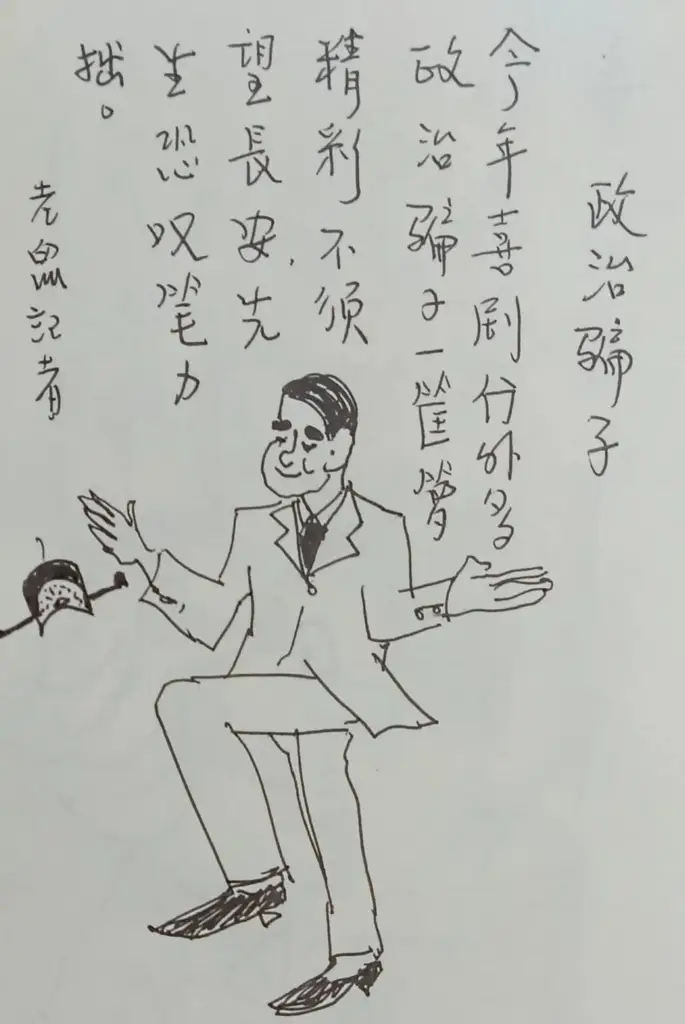
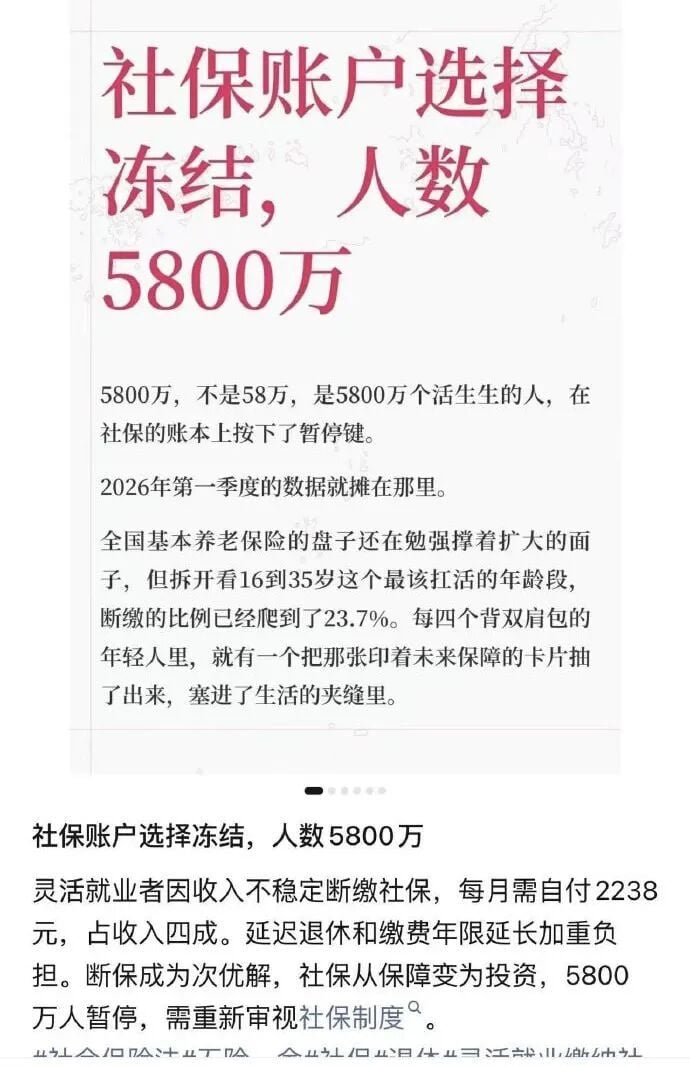
Recently, a piece of data quietly climbed the hot search list: in the first quarter, the number of people with suspended social security payments nationwide exceeded 58 million, with young people aged 20 to 35 accounting for more than 60%.
Widely spread
The first thing to say is that the Ministry of Human Resources and Social Security has never directly released the figure of 58 million. The actual source data chain is:
Ministry of Human Resources and Social Security data for March 2025: The number of people with suspended employee pension payments nationwide exceeded 42 million, accounting for nearly 18% of the total insured population. Among them, the suspension rate for 20-35 year olds was 31.7%, and the suspension rate for flexible employment was 38%. This is the original data from the Ministry of Human Resources and Social Security.
By the first quarter of 2026, the Ministry of Human Resources and Social Security mentioned in a press conference on April 28 that the proportion of “suspended payments” was about 23.7%, but it was not clearly specified in the official text which scope it referred to (employee pension? all social security?).
58 million was calculated by self-media by multiplying 23.7% by the total insured population aged 16-35, and it was not directly released by the Ministry of Human Resources and Social Security. After it climbed the hot search on July 13, various self-media cited each other, but now it is impossible to find the words “58 million” in the official documents of the Ministry of Human Resources and Social Security.
Why did it cause such a big reaction again in July?
Because July is also the graduation season, and another figure is that this year there are 12.7 million college graduates.
12.7 million. The number of college graduates in 2026 has reached a new historical high.
Coupled with the 320 million flexible employment population, which also reached a new high before. 58 million suspended social security payments, 320 million flexible employment, and 12.7 million college graduates, these three figures together tell the same story.
The scam of the word “flexible”
320 million. This is the projected number of flexible employed people in China in 2026, accounting for over 44% of the urban employed population. At the end of 2025, it was 280 million, an increase of 40 million in one year.
When the term flexible employment first appeared, it was intended as a “supplement”. Odd jobs, part-time work, temporary transitions – that was its original position. Now? The supplement has become the main force, and temporary has become the norm.
But the word “flexible” itself is a form of rhetoric.
It packages structural problems into a narrative of personal choice. As if most of these 320 million people actively chose freedom, pursued flexible work, and didn’t want to be bound by the nine-to-five. There are indeed such people, but they are definitely a minority.
More people are “forced to be flexible”. Formal positions are gone, contracts are not signed, employment is outsourced, social security is not paid – companies transfer labor costs to individuals, and then tell these individuals: Congratulations, you are free.
Free, but without security. Flexible, but without stability.
320 million is not the dream of 320 million freelancers, but the collection of 320 million people without choices. When flexible employment changes from a supplement to the main force, it is not a testament to economic vitality, but a signal of the institutional collapse of the job market.
The coldest arithmetic problem
58 million suspended payments sounds like a huge sociological problem. Broken down, it’s actually a very simple arithmetic problem.
What is the average monthly income of flexible employed people? The data for the second quarter of 2025 is 6179 yuan. And how much is the individual’s self-paid social security? 2238 yuan.
What is the proportion of income? 36%, nearly 40%.
Let’s do a more detailed calculation. A young person in flexible employment earns 6,000 yuan per month:
Social security self-payment: 2238 yuan
Rent: 2000 yuan (this is already very restrained)
Food: 1500 yuan (can’t even order expensive takeout)
Remaining: 262 yuan
262 yuan needs to cover transportation, communication, daily necessities, social activities, medical expenses, and save something for the future.
At this point, some people will say: young people are short-sighted and don’t plan for the future.
But short-sightedness is sometimes the result of rational calculation. When “securing the future” and “surviving this month” are placed on the same scale, choosing the latter is not foolish, it is a survival instinct. Social security is not “security” for many people, it is a “monthly payment” – a monthly payment that, if paid, may make it difficult to live in the present, and if not paid, allows them to breathe.
Moreover, the delayed retirement policy will be implemented from January 1, 2025, extending the retirement age of male employees from 60 to 63 and female employees from 50/55 to 55/58 within 15 years. For young people, this signal is very clear: pay for 5 more years, receive benefits for 5 fewer years. This calculation makes it even less worthwhile.
When the system design leads “rational people” to choose to suspend payments, the problem is not with rational people, but with the system.
The number of campus recruitment positions for graduates is limited, what is the estimated gap?
9.3 million. Where did these 9.3 million people go? They won’t disappear. The majority of them will join the ranks of the 320 million flexible employed people. From the campus gate to the flexible employment pool, there is no need to turn, it is a direct pipeline.
Some people will say that urban new employment reached 12.67 million in 2025, isn’t employment quite stable?
But this figure needs to be broken down. Every year, 20-27 million jobs are released due to retirement. How many of the new jobs are positions vacated by retirees? The core contradiction has never been the total amount, but the structure.
Graduates want positions that allow for growth, provide security, and offer upward mobility. However, the market is releasing a large number of positions such as food delivery, ride-hailing, temporary work, and outsourcing. Jobs are increasing, but good jobs are decreasing. Employment is growing, but the quality of employment is declining.
The most ironic thing is that the 12.7 million graduates are “products” meticulously cultivated by this system. Primary school, junior high school, high school, university – sixteen years of education, family investment, social resources, personal time, all bet on one expectation: after graduation, a formal position will be waiting for you.
Then the system tells them: Sorry, there are not enough positions. You should be more flexible.
This is not a job market, this is a flexible employment pool. Graduates are not here to seek jobs, they are here to fill the gaps.
Now, let’s put the three numbers together, and the loop appears.
Graduates cannot find formal positions -> forced into flexible employment -> flexible employment cannot afford social security -> suspended social security payments -> no future security -> the next generation continues to be forced into flexible employment.
This is not a failure of personal choice, but the system design does not allow you to choose.
Some people say, you can get certifications, improve your skills, start a business. These words sound right, but in the face of concrete survival pressure, they are light and hollow. When a person earning 6,000 yuan per month is left with only 262 yuan after paying social security, how can they improve their skills? How can they start a business?
The pie is expanding, but the bottom is leaking.
The number of participants in pension insurance is indeed still increasing, but what is driving the increase? It’s fiscal subsidies, passive continued payments due to delayed retirement, and inertia from the middle-aged and elderly population. It’s not young people actively joining, it’s the very people who should be injecting water who are pulling out the plug.
Once a generational cycle is formed, it cannot be broken by individual effort. A young person suspending payments is their own choice. 58 million young people suspending payments is the system telling them: this set of rules is not worth your participation.
As I write this, as usual, some suggestions should be given. For example, calling for policy improvement, suggesting that young people plan rationally, and expecting economic recovery.
But not this time.
Because when three numbers form a loop, when 320 million flexible employment, 58 million suspended payments, and 12.7 million graduates become three faces of the same problem, cheap solutions are an insult to the problem.
When young people with backpacks stuff their security cards into the cracks of their lives, they are not unaware of the importance of the future. They just know too well how difficult the present is.
One out of every four young people has suspended payments. The next one could be you, it could be me, it could be our children.
The pie is still being held up, and appearances are still being maintained. But only those who are injecting water know whether the bottom is leaking.
Discover more from 自由档案馆
Subscribe to get the latest posts sent to your email.