By Li Yuchen
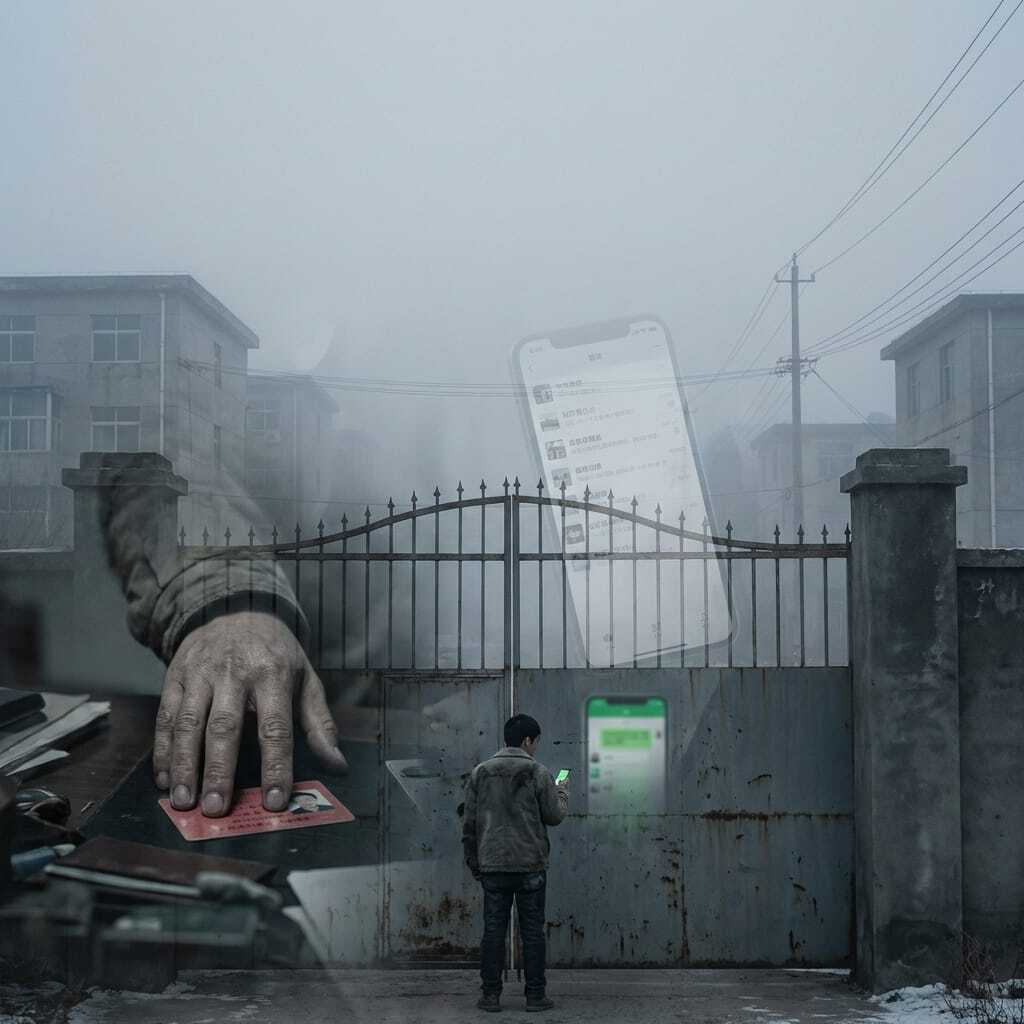
February 12, 2026, in Taihe County, Jiangxi Province, a young worker, due to wage arrears, prepared to complain to the labor department. The factory manager immediately called him, and calmly told him:
“Don’t be so impulsive, kid. I have your ID information here.”
This was not the whole threat. The manager continued, if he dared to complain, he would send his ID information to the labor group in Taihe County, “blacklist you, and you will never be able to enter the factories in Taihe County”. Finally, he dropped a sentence, like announcing a local regulation that was more effective than the “Labor Law”:
“Don’t talk to me about the state’s regulations.”
The state does have regulations. Article 50 of the “Labor Law” stipulates that wages should be paid to the worker himself on a monthly basis, and no deductions or arrears are allowed. Article 30 of the “Regulations on Labor Security Supervision” stipulates that those who retaliate against whistleblowers shall be ordered to make corrections by the labor security administrative department; those who constitute a violation of public security administration shall be given administrative penalties by the public security organ in accordance with the law. Article 276 of the “Criminal Law” stipulates that those who refuse to pay relatively large amounts of labor remuneration shall be sentenced to imprisonment of not more than three years or criminal detention.
The articles are written clearly. But the factory manager in Taihe County obviously understands the grassroots operation logic better than the legislators—in a county, a blacklist from a labor WeChat group is more effective than three laws combined.
This is not an isolated case. This is a set of precise, bottom-up growing local order.
In counties and towns, labor intermediaries and factory owners operate an invisible network. This network does not rely on laws to operate, but on WeChat groups. What circulates in the group is not recruitment information, but a list of informal blacklists—who is “disobedient”, who “likes to complain”, who is “difficult to manage”. Once a worker is on this list, it is like being marked with a certain invisible symbol, and it is difficult to move an inch in the employment market of the entire county.
The factory manager in Taihe County said “every summer and winter vacation”, revealing another detail: this threatened worker is likely a student. Student workers who work in factories during the summer and winter vacations are even more ambiguous in legal terms than formal workers. They often do not have labor contracts, no social security, no work injury insurance, only a copy of their ID card—left in the boss’s drawer.
This ID card is the chip in the boss’s hand.
Don’t think this is just a small boss’s personal arrogance. In 2020, the People’s Court of the South Taihu New Area of Huzhou, Zhejiang Province, jointly with the labor supervision department, released the country’s first “List of Abnormal Rights Protection for Workers”—the official statement is to crack down on “workplace scams”. According to the report of The Paper, the standards of the list include: applying for arbitration in the same arbitration court for more than five cases in three consecutive years. The following year, Jiaxing followed up, and the standards included applying for wage arrears to claim project funds more than three times within a year, and the two places intended to network.
Translate: You are owed wages, you went to sue, you sued several times—you became “abnormal”. It’s not the person who owes you money who is abnormal, it’s you who are too diligent in asking for money, you are abnormal.
The boss in Taihe County just used the WeChat group to do what the government’s list did. The difference is that the boss is more direct and honest. He did not package his behavior with a “maintaining the harmonious and stable labor relations” purpose, he directly said:
“Don’t talk to me about the state’s regulations.”
According to public statistics from a certain institution, from 2023 to 2025, more than 1,700 wage arrears incidents were publicly reported by the media. In addition, data from labor research institutions are even more shocking: at least 1,600 wage arrears incidents of migrant workers and 1,000 wage-seeking incidents occurred during the same period. And these are only the parts that have surfaced.
What does the story look like under the surface?
It looks like this: Liu Yueteng, a 28-year-old employee of a state-owned enterprise, was owed wages for seven months, and his pension insurance was not paid for two years. He worked in the unit during the day, and went out to sell barbecue from 6 pm to 2 am, and got up at 5 am to go to the vegetable market to buy meat. He once stood on the roof of the company building and shouted “I don’t want to live” to 110 and 120. The next afternoon, the wages owed for three months were made up. According to media reports, the state-owned enterprise of urban construction where he worked “had no money, and some money was borrowed by the superior government”.
It looks like this: Nurse Li Qingqing, was owed wages for four months, and her social security was cut off. Dozens of medical staff went to the hospital to ask for wages, and the hospital’s reply was—”just don’t give it, just say the unit has no money”. She called the mayor’s hotline, but there was no follow-up. She went to the Labor Bureau, but it was not filed. Also according to low-level reports, she finally said: “Where were you when I had no money to pay the rent and had to ask my family for money for the New Year?”
It looks like this: Migrant worker Wang Guiyou, was owed 22,000 yuan by the contractor. The county labor supervision team said it was a “personal dispute”. He went to the Municipal Human Resources and Social Security Bureau, and went to the Provincial Human Resources and Social Security Department, but was stopped outside the door by security guards. He posted on social media, and government staff called him to delete the post. According to the interview records of low-level reports, five minutes after the interview, the reporter received a call from the local government department to inquire.
It looks like this: Bus drivers in Baiyin, Gansu Province, have been owed wages since June, and the buses stopped operating in October. According to Qilu Evening News, at 6:30 pm on the day of the suspension, a driver named Mr. Wang received three months’ wages. If the operation is not stopped, it will not be issued, and it will be issued in seconds once the operation is stopped—this cycle is repeated all over the country. Three bus companies in Lipu City, Guilin, Guangxi, also announced the suspension of operations in September 2025, because of long-term losses and inability to pay social security.
According to statistics from the Ministry of Transport, the passenger volume of urban public electric vehicles in the country decreased from 69.176 billion passengers in 2019 to 38.67 billion passengers in 2024, nearly halved. The passenger volume was cut in half, but the wages that should have been paid were not owed at all.
These stories are pieced together to paint a complete picture: the law is written on paper, and power grows in the soil.
The “Labor Law” stipulates that wages must be paid monthly. But in Taihe County, the boss said not to talk to him about the state’s regulations. The “Regulations on Labor Security Supervision” stipulates that retaliation should be “ordered to be corrected”. But in Zhejiang, workers who have sought wages several times are included in the “abnormal list”. The “Criminal Law” stipulates that refusing to pay labor remuneration can be sentenced. But all over the country, migrant workers can only get their hard-earned money by standing on the roof, and bus drivers can only receive the wages owed on the day of the suspension.
The factory manager in Taihe County may not know that his sentence “Don’t talk to me about the state’s regulations” is actually the most accurate description of the current situation of workers. He did not lie. In his territory, the state’s regulations are indeed not valid. What counts is the county’s group.
We don’t know if the young worker finally went to complain. But we can help him deduce:
If he went to the Labor Supervision Brigade, the brigade would say it was a “personal dispute”. If he refused to accept it and continued to complain, after a few times his name would appear on the “List of Abnormal Rights Protection”—Congratulations, he has been upgraded from a person who is owed wages to an abnormal person. If he posts online, he will receive a call to delete the post. If he does nothing and obediently admits it—then his ID information is still lying in the boss’s phone, and can be sent to the group at any time.
You see, all the roads have been thought out for him. Every one is a dead end, but every one is unobstructed.
I carefully studied this system and found that it is actually very advanced. The “Labor Law” has been in place for so many years, and the supporting arbitration, supervision, and court three-level system, a lot of institutions have been set up, but the effect is limited. But the bosses in Taihe County only need a WeChat group to complete the comprehensive control of the labor market—who can be used, who cannot be used, who should be blacklisted, a message can solve it. No need to file a case, no need to go to court, no need to wait for scheduling.
In 2026, there are more than 300 million migrant workers in this land. Each of them has an ID card, and the national emblem is printed on each person’s ID card.
The state has regulations, but the county has a group. The National People’s Congress needs to go through three readings for legislation, the “Labor Law” has been written for thirty years, and the “Criminal Law” has been amended nine times, but in Taihe County, Jiangxi Province, the boss sends a message in the group, and a worker can disappear from the employment market of the entire county.
Li Yuchen’s article stands in the dust
Written on March 6, 2026
This article has been enabled for quick reprint, and you are welcome to reprint it to your public account
Archive to prevent deletion, relay and spread
Please include the reward picture at the end of the article when reprinting, and respect the fruits of labor
Friends who are willing to lend me their public account to help me publish articles, please read this article
Solicit public accounts, insist on writing and speaking out
Recommended reading:
Li Yuchen |Why I shouldn’t forgive Zhao Kongliang again
Li Yuchen|When Zhou Ze’s public defense becomes a public criticism
The essence of Zhou Ze’s lawyer “case source fee” is a big brother’s self-cultivation
What’s the crime for a lawyer colleague to introduce a case to Zhou Ze?
The full chat record of “Qian Qian Fayan” bullying the family members of the wronged


Discover more from 自由档案馆
Subscribe to get the latest posts sent to your email.