For more than forty days since September, Henan has been shrouded in continuous rain. According to monitoring data from the Henan Meteorological Observatory, the average precipitation in the province reached 349.6 mm, which is 2.6 times more than the same period in normal years, and the highest value in the same period since meteorological records began in 1961.
It is the season for the harvest of crops such as corn and peanuts. Farmers braved the rain and tried their best to manually harvest the crops. However, in many cases, they could only watch the crops they had painstakingly preserved from the summer drought being flooded in the fields and becoming moldy and sprouting.
Extreme weather events occur frequently, and the past experiences of farmers are gradually failing, leaving them vulnerable and helpless. Zhang Xiu, a farmer in Nanyang who planted more than 70 acres of land, still dares not calculate the specific financial losses from this crop, but she can be sure that “the losses are unbearable.”
Reporter: Wei Zhaoyang Intern Reporter: He Xinyue, An Yueyang
Harvesting
The rain is still falling. On October 17, Zhang Xiu, a villager from Haozhai Town, Sheqi County, Nanyang City, Henan Province, looked out from her home and saw a “gully full of water and the river is level.” Starting from the night before, heavy rain poured down continuously, and deep ditches in the fields were filled with water and overflowed. “It was so full that you couldn’t tell which was the road and which was the ditch.” Zhang Xiu was worried. She was concerned about the 29 acres of corn fields in her home that had not yet been harvested, but the rain was so heavy that she dared not go out.
Since entering September, the autumn rain in Henan has lasted for more than forty days. Many farmers interviewed by this magazine did not expect that the rain would last so long. In fact, for the initial few showers, the farmers were somewhat happy, thinking that it could alleviate the drought that lasted throughout the summer. But by mid-September, the corn was ripe and ready to be harvested, but the rain was still falling. Watching the corn stalks soaked in water, the leaves turning yellow, and the corn cobs exposed after peeling the outer skin had become moldy and hairy, Zhang Xiu began to worry. She couldn’t wait for the weather to clear up, so she braved the rain and, with her husband and mother-in-law, harvested more than an acre of corn by hand. The rainy weather continued, and Zhang Xiu’s family had not yet harvested the remaining 29 acres of corn. Then, peanuts also ripened in late September. In order to prevent the peanuts from rotting in the field, they had to harvest the more valuable peanuts first.
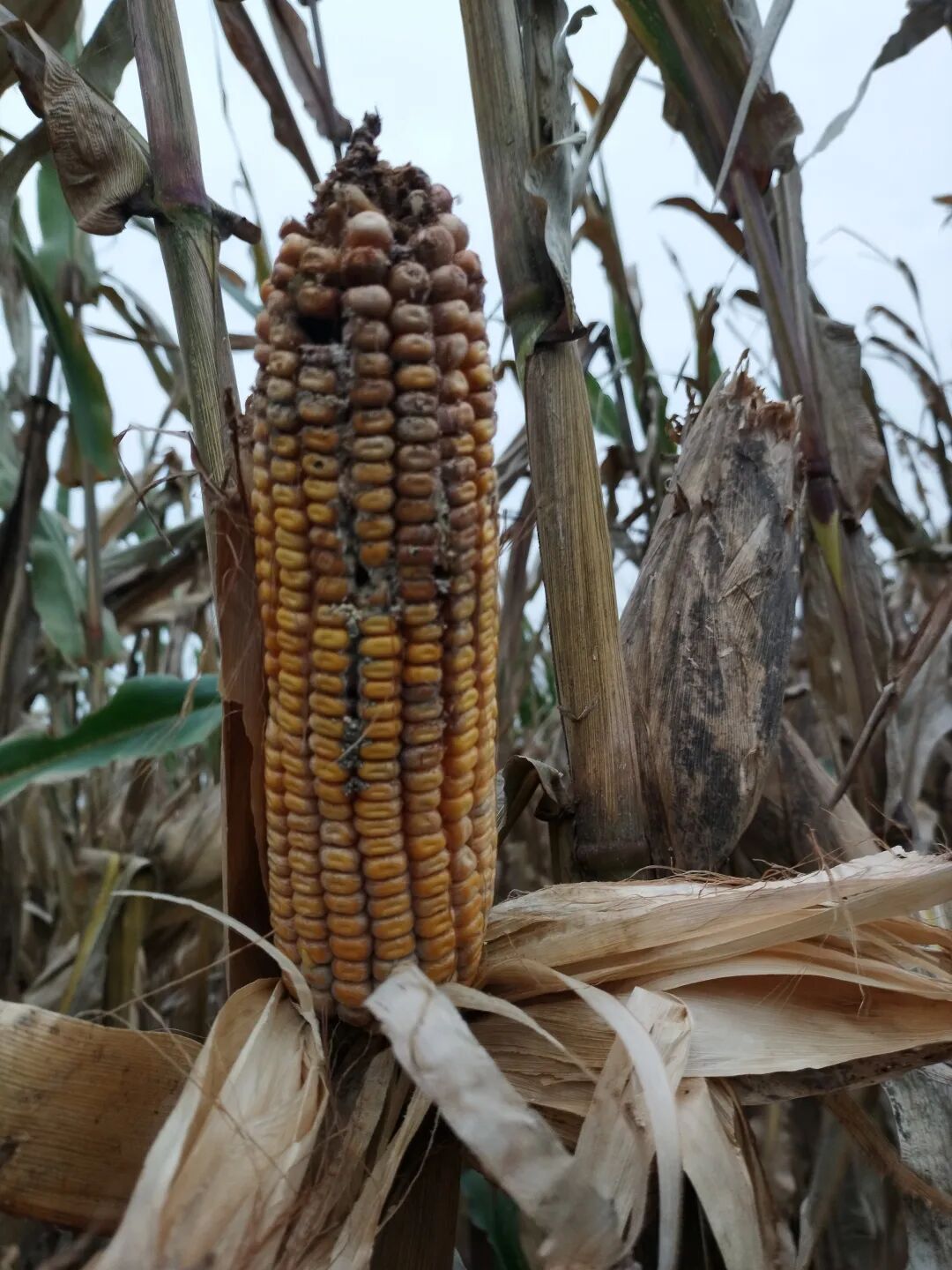
Corn rotting in the field (provided by the interviewee)
The soil is too wet, and the tires of the wheeled combine harvester will sink into the ground. The usual mechanized operations are not feasible at this time, and many farmers can only harvest by hand. Zhang Xiu wore rubber shoes and stepped into the peanut field, and the mud that was half a leg deep immediately poured into her shoes, feeling that one foot weighed four or five kilograms. She couldn’t walk, so she had to take off her shoes and walk barefoot. She couldn’t squat either, so Zhang Xiu could only bend over and painstakingly pull out the peanuts covered with mud clods one by one, and her nails were worn off. After a day, her waist hurt more than a muscle strain, and she had to maintain a fixed posture when sleeping at night, not daring to move.
Harvesters have become one of the busiest roles during the autumn harvest. Chen Li and her husband from Zhumadian City, Henan Province, own a crawler-type combine harvester that can operate in wet fields. They have been running around for more than a month, sleeping in the car every day. “It’s either all-night work or overtime.” They can harvest fifty or sixty acres of land a day. The ground is too wet, and the load of harvesting is heavy, and the wear and tear of the tracks and other accessories has increased by three or four times. In Henan Province, Chen Li and her husband basically help harvest corn, and much of it has become moldy and sprouted. She couldn’t help but sigh, “It’s really not easy this year. The corn harvested is like sheep dung.”
In northern Henan, Feng’e from Langzhong Township, Puyang, has been unable to sleep well since the corn ripened. She gets up three or four times every night to see if the rain has stopped. She and her husband have contracted more than a hundred acres of land to grow corn, and they are the largest grain growers in the village. Her daughter, who works in Changzhou, and her son, who is in college, have both come back to help with the harvest. They get up at five in the morning and go to the fields as soon as the rain gets smaller, breaking corn and bagging it. Her son buried his head and carried a 40-kilogram corn bag, wading through more than a hundred meters of muddy ground, which took ten minutes. During this time, he had to hold the corn stalks on his side, otherwise he would fall. In order to facilitate work, they didn’t wear raincoats. Feng’e watched her son’s wet clothes and felt a pang of sadness. “No matter how hard I work, I don’t feel anything, and I don’t feel苦, but when I see my child like that, my tears just flow.”
Farmers who are working hard and racing against time mostly have the same simple idea: not to let the grain rot in the field. Zhang Xiu’s mother-in-law is 62 years old this year. She has been farming all her life. Recently, as long as she sees a peanut left in the field, she will feel distressed and quickly pick it up and put it in her pocket. “She says that picking up a peanut is like picking up a piece of gold.” Thinking about the dozens of acres of crops that haven’t been harvested in the field, the mother-in-law is both worried and anxious, and sometimes she cries while pulling peanuts. She gets up early every morning before dawn, cuts open two plastic bags and sews them into large bags to make it easier to carry peanuts. Even if she has to take painkillers to go to the field, she has to work in the field until dark, and she is reluctant to go home.
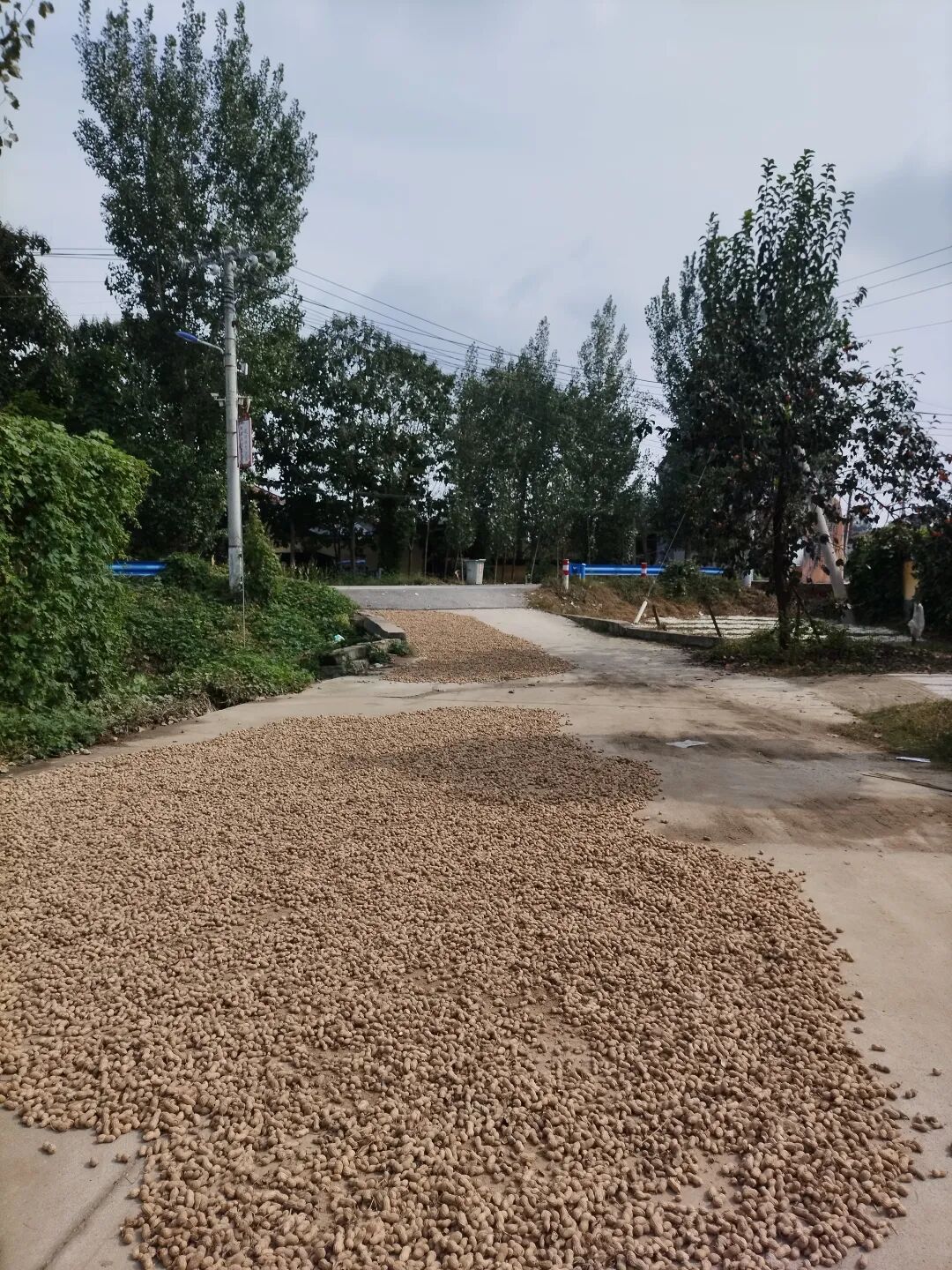
Peanuts drying in the sun (provided by the interviewee)
Harvesting is so urgent, and there are also economic considerations. Li Wei is a farmer from Liudi Town, Sui County, Shangqiu City. He rented 5 acres of land to grow corn. He gave this magazine a detailed calculation of the cost per acre of corn land: the land rent is 800 yuan per year, and he has to buy seeds, fertilizers, insecticide, and dwarfing agents, plus the electricity bill for watering, and the machine fees for sowing and harvesting. The cost per acre is about 1,200 yuan. Under normal circumstances, each acre of corn can yield 1,500-1,700 catties, and one catty sells for 1.1 yuan. However, if the corn is wet, the price is halved, so an acre of land will lose several hundred yuan.
Many farmers who cannot finish harvesting can only watch their crops “rot in the field.” Feng’e has a contracted land in a low-lying area in the south of the village. More than 30 acres of corn could not be harvested in time, so it could only be left in the field. After the rain completely stops, a small water pump will be used to slowly drain the water. In Xinyang City, the main rice-growing area in Henan, Xue Lian’s 61-year-old parents only made an appointment with a harvester once in early September and harvested more than a dozen acres of rice. After that, they could no longer make an appointment. During the National Day, Xue Lian went home to the fields and broke open the rice grains, and they were all dark gray or black mold spots. Regarding the remaining 20 acres of rice that had not been harvested, Xue Lian said, “I have no hope anymore.”
The autumn rain that occurs once in 60 years
Li Wei is 52 years old this year. This is the first time in his memory that he has encountered such continuous rainy days, “like the plum rain season in the Jiangnan area.” Usually, the clothes washed in the morning can be dried at noon, but now they are still damp after being dried for two days. According to monitoring data from the Henan Meteorological Observatory, since entering September, Henan has experienced 10 rounds of large-scale precipitation, with an average precipitation of 349.6 mm in the province, which is 2.6 times more than the same period in normal years, and the highest value in the same period since meteorological records began in 1961. In terms of time, the average number of rainy days in Henan is 25.3 days, which is 14 days more than normal.
Qiao Jiangfang is the director of the Corn Cultivation and Cultivation Office of the Henan Academy of Agricultural Sciences’ Grain Crop Research Institute and a member of the Henan Autumn Grain Production Expert Group. He told this magazine that in normal years, the autumn weather is relatively sunny, and even if it rains, it usually only lasts for two or three days. And in the past more than forty days, he only saw the sun 6 or 7 times in his memory. Continuous rain will undoubtedly have an adverse impact on crops that are in the harvest season. Taking corn as an example, Qiao Jiangfang said that one is insufficient sunlight, which will hinder the grain filling in the later stages of corn, thereby reducing yield. The second is that the surface of the corn is wet for a long time, which is prone to mold, and the toxin content increases, affecting the quality.
This autumn rain, which occurs once in 60 years, has largely exceeded people’s past coping experiences. Qiao Jiangfang participated in two pre-judgment meetings organized by the provincial meteorological department in August. At that time, it was predicted that the rainfall in September would be greater than in previous years, “but I didn’t know it would be so much more, and it would last so long.” Starting in mid-September, Qiao Jiangfang went to the rural front line to guide how to harvest in continuous rainy weather, “basically running all over Henan.” All parties are also taking action. According to Henan Daily, Henan has established 742 agricultural machinery emergency operation service teams, introduced 3,080 crawler-type corn harvesters across provinces, and announced the location and contact information of 4,963 drying machines in the province to farmers. It has also arranged 50 million yuan in disaster relief funds for drying machine subsidies, autumn grain harvest subsidies, and the scheduling of agricultural machinery.
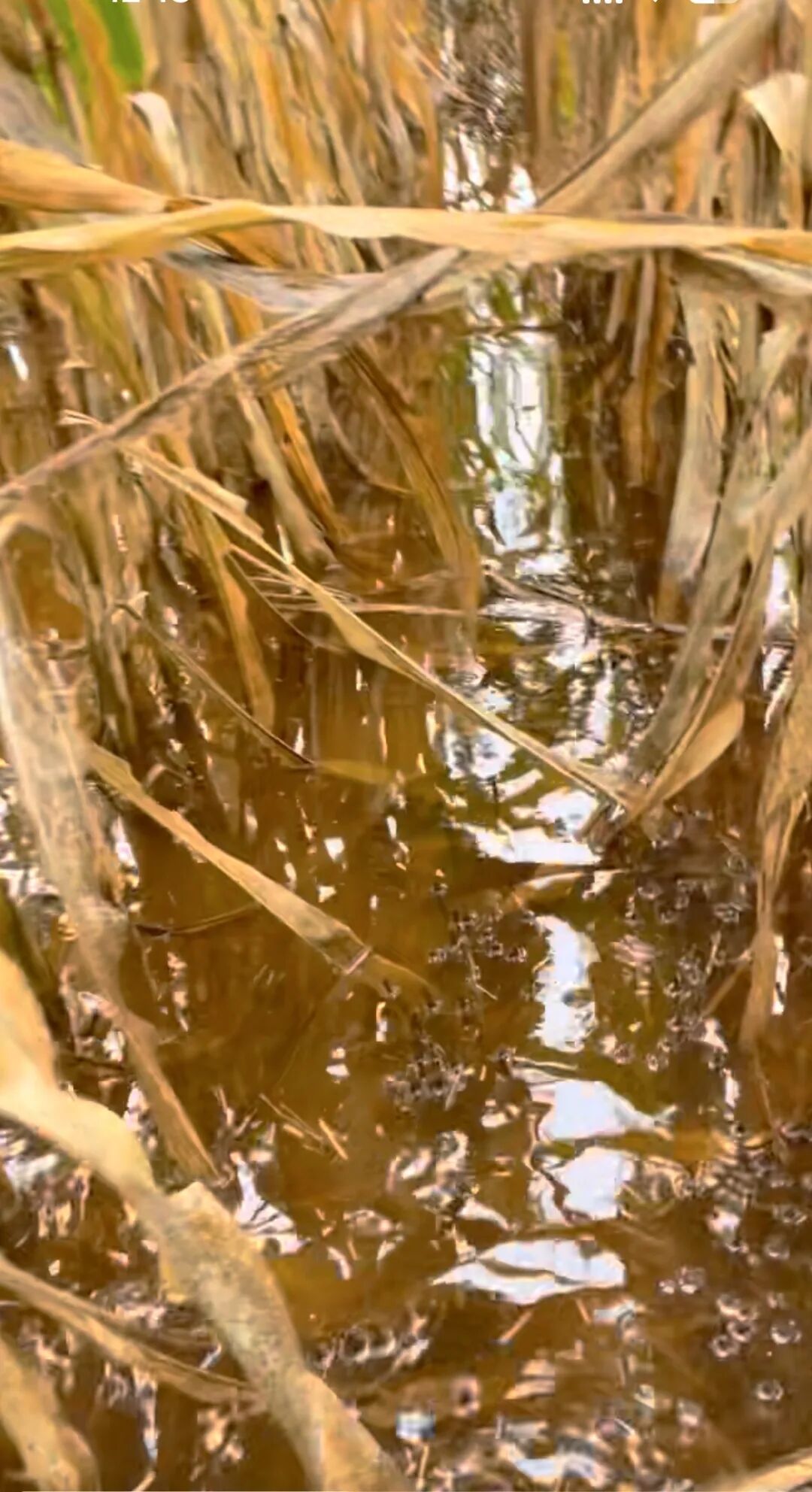
Corn fields soaked in water (provided by the interviewee)
More abnormally, before the “autumn flood,” Henan first experienced a severe “summer drought.” Li Fang, a senior engineer at the Henan Climate Center, pointed out in a previous interview that since 1961, Henan has only experienced a similar “summer drought and autumn flood” situation in 2014, but the precipitation from June to August that year was 40% less, and from September to October it was 1.1 times more. However, this year’s precipitation from September to October was more than 2.6 times more, and the abnormality was even more prominent.
For farmers, these crops soaked in the fields are what they have preserved from the drought. Watering this action runs through Feng’e’s entire summer. It takes half a month to water a round. Today, as soon as she finishes watering, she sees the corn leaves curling up, and it’s dry again. She watered a total of 3 rounds. Since June, when she planted corn, Feng’e has been guarding the well. Sometimes she has to move the water pipe every ten minutes. Only when she waters the 300-meter-long field can she have four hours of continuous rest. It’s too hot in the dog days, and Feng’e has to drink seven or eight bottles of water a day, wet the towel and put it on her head, and then wear a wide-brimmed hat to cool down. Drought resistance also has economic costs. Li Wei said that a roll of 60-meter “Little White Dragon plastic bag” (long plastic pipe) costs more than a hundred yuan, and a piece of land needs to use several rolls. “It’s more painful, and I don’t want to water it unless there’s no way.” Zhang Xiu slept in the field in order to water, “Watering day and night, I always think that I can have a good harvest when I finish watering, and I have always held this hope.”
Even if the crops are harvested, many farmers do not have sufficient ventilation and drying conditions, and the crops will still become moldy and sprout. Qiao Jiangfang said that the normal water content of corn harvested is below 20%. This autumn rain has caused the water content of corn to be above 35%, which is prone to heat accumulation and accelerates mold. The effective method is drying. Qiao Zhenqun operates a drying point in Tanghe County, Nanyang. The two dryers run 24 hours a day and have dried four or five thousand tons of corn in a month, charging 150 yuan per ton. Qiao Zhenqun told this magazine that there are a dozen drying plants in the suburbs and townships with 80,000 acres of land. Even if his dryer utilization rate has doubled, farmers still have to queue for three days before they can dry it. Most of those who come to him are large households who plant hundreds or thousands of acres of land.
And in the eyes of many individual small farmers, drying is not the most convenient and cost-effective choice. In fact, Li Wei also wants to go to drying, but the drying tower built by the government needs to dry more than ten or twenty tons per bin. Many neighbors, including himself, plant three or four acres of land and harvest five thousand catties of corn. The amount is too small, and the quality and dryness of each family’s corn are also different. It is difficult to get together to dry it. If he goes to a privately operated drying point, Li Wei feels that the cost is a bit high. Xue Lian, who grows rice at home, recalled that in previous years, she hardly used a dryer, and only used it in an emergency when it rained during the drying of grain. Zhang Xiu also did not go to drying, but vacated her newly built two-story house for drying, mainly worrying about the price of drying, “That should be very expensive.”
The autumn rain affects not only the autumn harvest, but also the sowing of the next crop. Zhang Xiu judged that this year’s wheat may not be planted because the peanuts have not yet been harvested, and the land is wet and cannot be plowed. Li Wei said that in previous years, he had planted garlic two weeks ago, but now he doesn’t dare to sow it, fearing that the roots will be damaged. He is a little worried about the yield. “If the planting time is late, the temperature will be low, and the garlic may reduce production next year.”
Affected farmers
32-year-old Zhang Xiu still dares not calculate the specific financial losses from this crop, but she can be sure that “the losses are unbearable.” There are more than 20 acres of corn and peanuts that have not been harvested. More than half of the harvested peanuts are wet and damaged. After drying and selling, the grain merchants also refused to accept them due to quality problems.
Because she is concerned about her parents and children, Zhang Xiu and her husband work outside for half a year every year and go home to farm from May to November. Zhang Xiu and her husband, Zheng Nan, were high school classmates. After they got married, they went to work in Zhongshan, Guangdong together. Zhang Xiu worked in a textile factory, making underwear shoulder straps, working 12 hours a day, running between more than 30 machines, and earning four or five thousand yuan a month. Zheng Nan worked in a hardware factory, earning five or six thousand yuan a month. In order to save more money, the couple can save as much as possible. They eat in the factory canteen and only spend three or four hundred yuan to rent a single room of 10 square meters in the urban village. They take a bus for more than ten hours to travel between Henan and Guangdong.
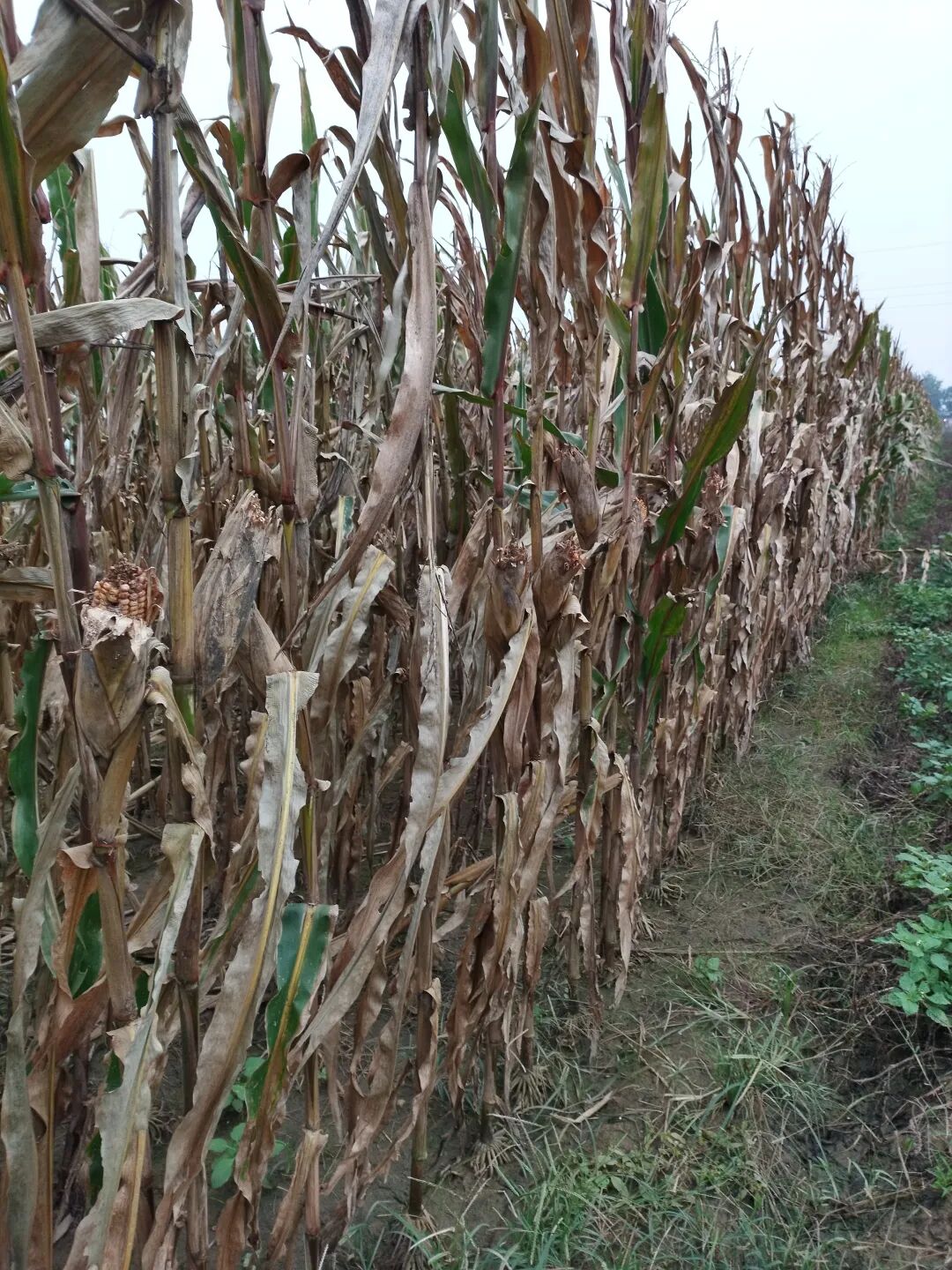
Wilted corn stalks (provided by the interviewee)
For this family with four children, farming is a very important part of their income. The four children are 13, 12, 7, and 6 years old, respectively, and they are all of school age. The parents’ health is not very good, and they have been taking medicine, including painkillers and blood pressure-lowering drugs, which cost more than a thousand yuan a month. It costs more than 100,000 yuan a year to support the family. Zhang Xiu and her husband earn 50,000 to 60,000 yuan by working for half a year. The rest depends on more than 70 acres of land. Under normal circumstances, an acre of land can earn 600 yuan, which is barely enough to balance income and expenditure. Zhang Xiu said that with the elderly above and the young below, the family cannot save money, and they cannot consider more long-term things like saving money for the children. All efforts are first to solve the current livelihood problems.
Zhang Xiu said that farming is more difficult and more unstable than working, but the children are gradually growing up, and she needs to stay at home more. When the couple didn’t come back, the eldest daughter, who was in junior high school in the countryside, was always unhappy. After eating, she would shut herself in her room and hide everything in her heart. When Zhang Xiu called and asked, her daughter would only shake her head and would not tell her grandparents. After Zhang Xiu came home, her eldest daughter became obviously lively. “She tells me what happened at school, what she ate, and what she learned when she came back.” The 12-year-old son has also changed a lot. In the past, he would easily get angry and quarrel when his grandparents said a few words, “like a rebellious period.” After his parents came back, he became very obedient and immediately went to do housework.
Similar to Zhang Xiu, 48-year-old Feng’e also cannot leave home. Five or six years ago, she would go out to work during the slack season, and she had been to food factories and toy factories in Guangdong, Hangzhou, and Shandong. Until her daughter gave birth to two children, the young couple went to Changzhou to work, and the children were taken care of by the grandmother at her husband’s home in the neighboring village. Feng’e felt that she should also help her daughter take care of her grandchildren, so she stopped going out.
Feng’e’s income mainly depends on these more than a hundred acres of land. Under normal circumstances, the annual income is 70,000 to 80,000 yuan, and the cost is 30,000 yuan. Farming doesn’t make much money, and there are also economic pressures in the family. Her husband is a village cadre, and his salary is more than a thousand yuan a month. Her 20-year-old son is in college, and his living expenses are 2,000 yuan a month. The family built a two-story new house a few years ago, and Feng’e was very careful with the decoration, laying marble floor tiles and installing wooden handrails on the stairs. The debt for building the house also has to be paid slowly. At present, the money earned is enough to live on, but Feng’e thinks that if her father-in-law and mother-in-law need money for hospitalization for minor illnesses in the future, and the bigger expense is her son’s wedding, “it will cost at least four or five hundred thousand yuan.” So Feng’e is reluctant to sell the wet grain at half price. Fortunately, she has a grain depot with a capacity of more than 100,000 catties. Feng’e puts the corn in a four-sided ventilated wire cage and turns it over and checks it every half day. If there is mold, she spreads it out and re-dries it, hoping that it will eventually be dried corn cobs and then sold.
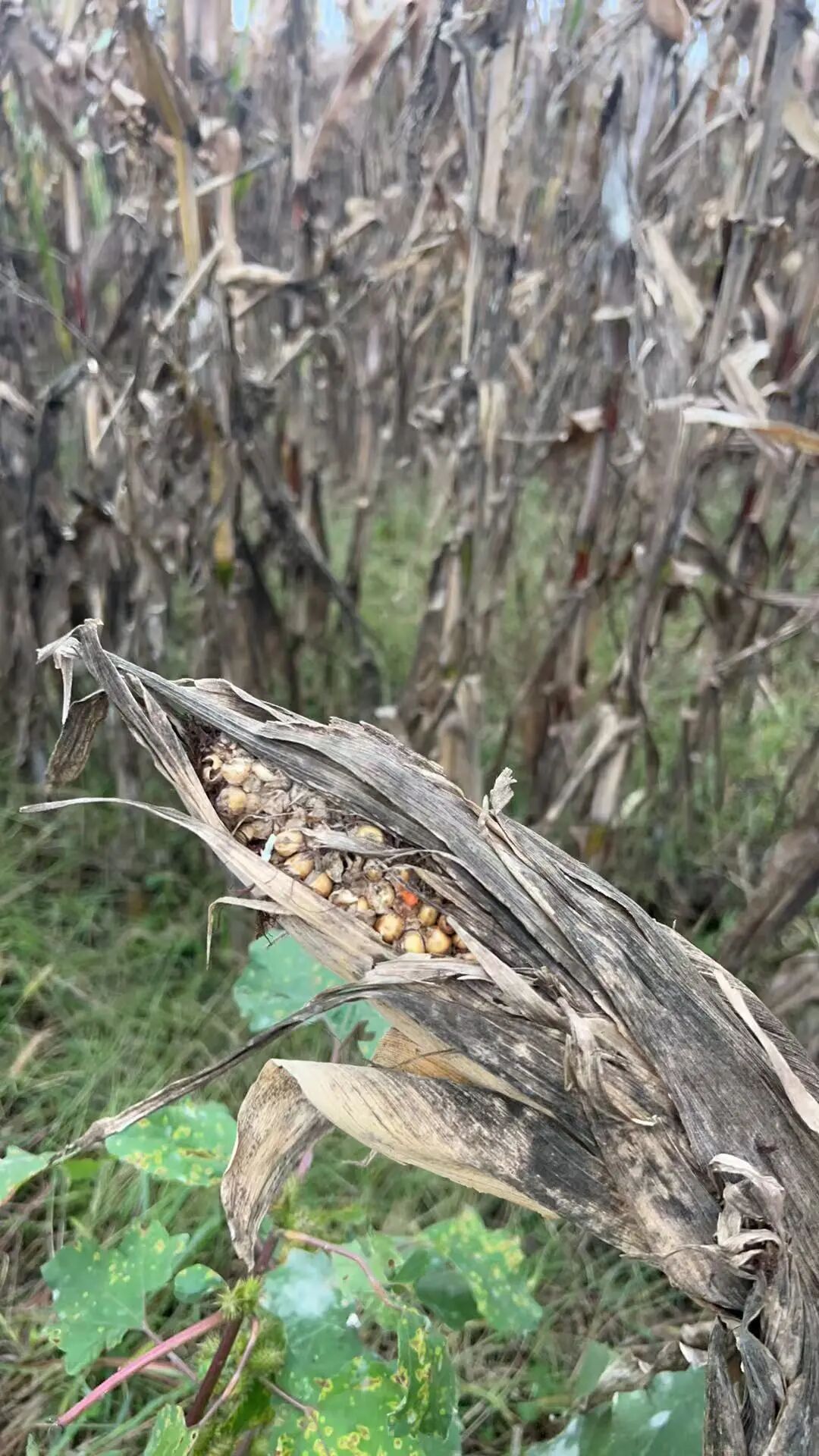
Corn rotting in the field (provided by the interviewee)
Li Wei, 52, is one of the few “70s” who stayed at home to do farm work in the village. More villagers chose to go out to work. He was a soldier when he was young. After he was discharged from the army, he also worked on construction sites. In recent years, his two children were studying in the county, and he needed to pick them up and drop them off. In addition, in 2016, the village built a greenhouse under the poverty alleviation policy, so he earned money by the greenhouse, planting sweet melons and watermelons in the spring, vegetables in the summer, and then planting a few acres of corn. Li Wei said that now that he is getting older and has no skills, it is difficult to make a living by going out to work. “I can only rely on this land.”
“My wife and I are now doing everything for the children.” Li Wei’s two children are both in college. His daughter is interning in Sui County, and his son is a sophomore in Zhengzhou, with a living allowance of 1,500 yuan per month. Li Wei and his wife are reluctant to spend money on themselves. His clothes are 7 yuan each, and the vegetables are grown in the greenhouse, choosing cheap potatoes, mung bean sprouts, and cabbage. Chili peppers are expensive, so they don’t eat them. After supporting the two children to go to college, Li Wei didn’t save any savings. Now he only hopes that his children can find jobs after graduation and can support themselves. “It’s okay if they don’t come back to farm.”
On October 18, Feng’e sent a video. The corn she carefully cared for after harvesting in the granary still had many sprouts, and it looked like a cluster of tender green grass from a distance. She didn’t complain about anything, but instead shared something about putting the corn into the granary: One night last week, after Feng’e finished washing the dishes, she saw three or four neighbors in the granary yard, who took the initiative to move stools and sat silently in front of the corn pile to help her peel the corn. The big brother across the street had a serious lumbar disc herniation, but he also wanted to lend a hand, so he held a solar lamp to help with the lighting. The neighbors didn’t say anything, just smiled at her. So Feng’e thought that natural disasters are beyond human control. No matter what the harvest is, what she can do is to plant the corn well and harvest it, “just do what you can do now.”
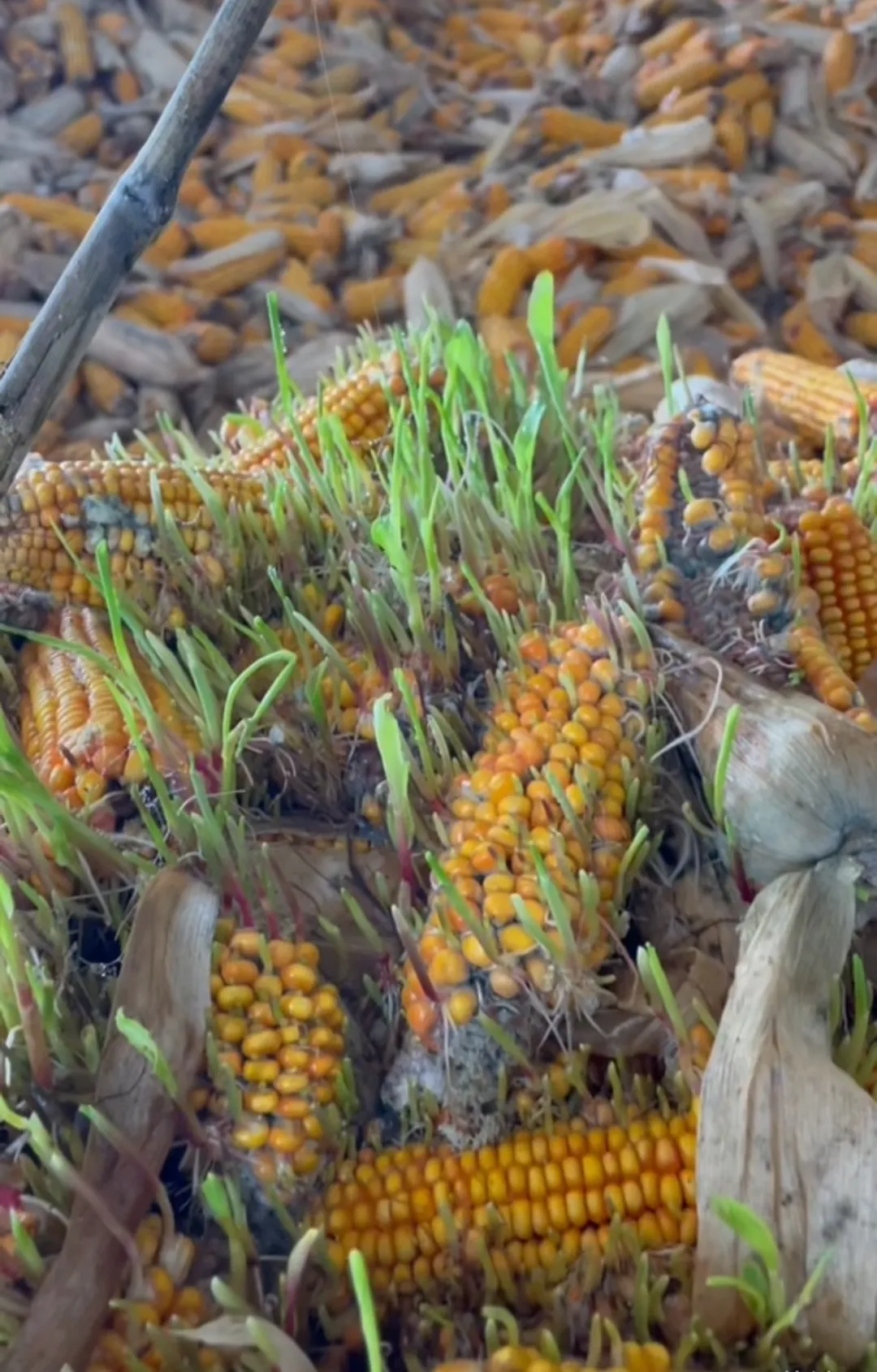
Corn sprouting in Feng’e’s granary (provided by the interviewee)
(At the request of the interviewees, Zhang Xiu, Chen Li, and Zheng Nan are pseudonyms)
Discover more from 自由档案馆
Subscribe to get the latest posts sent to your email.