
A recent media report put the Frog Princess, Gu Ailing, in the spotlight. The report showed that the training expenses of Gu Ailing and Zhu Yi were included in the Beijing municipal budget, with Gu’s training expenses alone reaching over 47 million yuan per year. Given such high training costs, in addition to achieving the competitive goals of the Milan Winter Olympics, should Gu’s commercial income also be partially returned to the state? How much should be returned?
Since Gu’s naturalization, there have been no clear official reports on whether Gu has signed relevant agreements with the state. However, the inclusion of her training expenses in the financial budget indicates a clear cooperative relationship with the state, including confirming her participation in competitions representing the country, obtaining logistical resource support, and the distribution of possible commercial development rights to ensure that the state can receive returns on its training and investment.
We might as well speculate on Gu’s income distribution model based on previous cases of well-known domestic athletes.
Yao Ming: When he first entered the NBA, he was required by the Chinese Basketball Association to deduct 50% of his income, based on the State Sports Commission’s “Interim Measures for the Management of Prizes and Prizes for Domestic and Foreign Award-Winning Competitions.” After negotiations, the amount Yao Ming paid to the Basketball Association each year (during a specific period) was reduced to about 5% of his after-tax income.
Li Na: After going solo, according to the agreement with the Chinese Tennis Association, she needed to pay 8% of her commercial income and 12% of her competition prize money to the state. Before going solo, this proportion was as high as 65%;
Zhu Ting: 28% of her annual income is paid to the Henan Provincial Sports Bureau and the Volleyball Association, and another 10% is given to her agent team, with about 60% going to herself.
Based on the above cases, the proportion of Gu Ailing’s commercial income returned to the state could be between 5% and 50%. Taking 2024 as an example, Gu’s commercial income is $22 million, equivalent to 158 million yuan. Ignoring the prize money, 99% of the income comes mainly from off-field endorsements, then the portion paid to the state would be 7.5 million to 79 million yuan. However, if calculated based on after-tax income, especially after-tax income in the United States (as a naturalized athlete, Gu is very likely to have de facto dual citizenship, although China does not recognize dual citizenship, this does not affect the global taxation of its citizens by the lighthouse country), Gu needs to deduct a considerable amount of taxes.
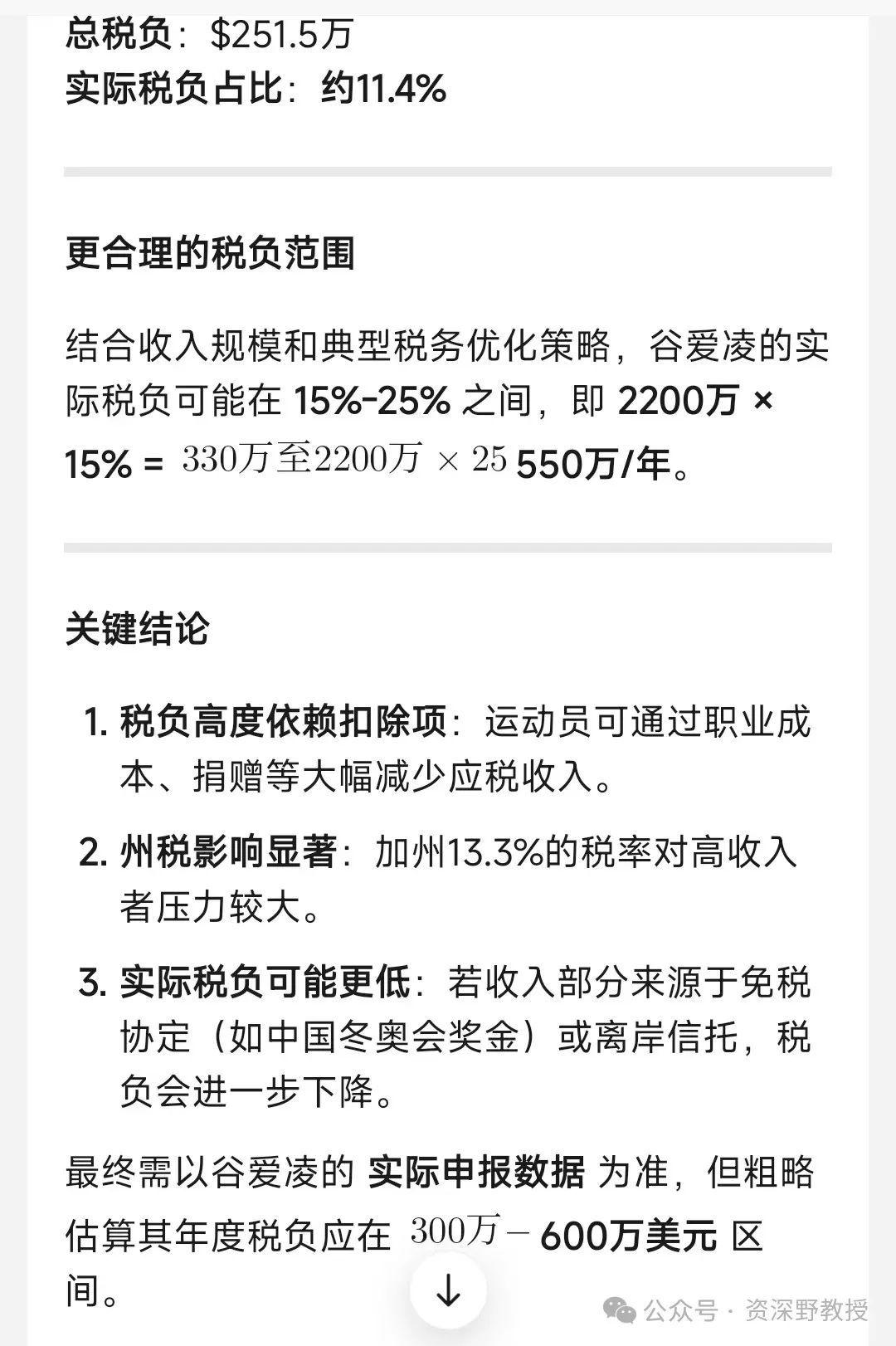
According to Deepseek, based on federal and state tax (California) policies, Gu’s personal rough calculation needs to deduct about 15%-25% of taxes, with an annual tax burden in the range of $3 million to $6 million. We take the higher figure of $6 million, then Gu’s personal after-tax income is around $16 million, which is 114.4 million yuan.
Based on this, Gu’s income returned to the relevant Chinese regulatory authorities should be between 5.72 million (5%) and 57.2 million (50%) yuan of her after-tax (US) income. The latter is sufficient to cover the financial investment in her personal training guarantee.
In short, although the financial budget cost for personal training guarantee is high, with Gu’s competitive level and commercial value, high risks may also bring high returns. It depends on whether the relevant agreement stipulates that this return value is purely measured by commercial development income distribution.
Of course, if the competitive goals can be achieved smoothly or exceeded, it is not ruled out that Gu’s income payment ratio will be correspondingly reduced (conversely, Gu should return, similar to a gambling nature). After all, the national honor and sports promotion contribution she brings cannot be measured by money.
※ The above information is all from public reports and does not constitute any malicious speculation. If there is any infringement, please delete it.
Discover more from 自由档案馆
Subscribe to get the latest posts sent to your email.