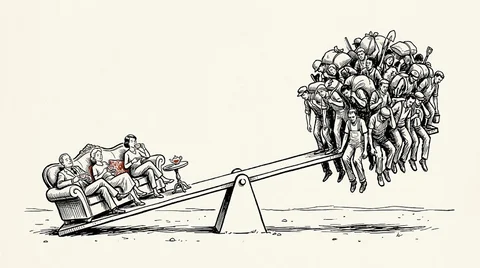


When discussing national fortune, many people are easily attracted by grand narratives, such as "national rejuvenation", "technological leap", and "world power", etc.
Just like recently, not only DeepSeek, but also the movie Nezha has become a symbol of national fortune.
However, a country's true national fortune is not reflected in the loudness of slogans, the growth rate of GDP, or even the brilliance of certain industries, but in whether the income of the common people can continue to grow and whether their lives are truly improved.
If the citizens' wallets are empty and life is under great pressure, then the so-called "national prosperity" is only prosperity on paper.
From the perspective of modern world history, the countries that have truly achieved national strength and wealth for the people have all increased the income of their people at the same time as economic growth, rather than relying solely on the wealth of a few people to build prosperity.
The United States became a world power from the beginning of the 20th century, and its national fortune's rise is not only due to industrial expansion, but also inseparable from the improvement of people's income.
Many people judge national strength only by focusing on the level of national power, such as saying that the United States benefited from World War II, but they only see the macro, but not the improvement of Americans' lives. After World War II, the United States quickly established an economic model characterized by high wages, high consumption, and high welfare.

From 1950 to 1973, the US economy grew by about 4%, and at the same time, the real wages of ordinary workers also nearly doubled. The rise of the American middle class enabled a large number of ordinary families to own their own homes, cars, and higher education opportunities. This wealth distribution model not only made society more stable, but also provided strong impetus for the consumer market, further promoting economic prosperity.
In contrast, the Soviet people lived much worse than the Americans, which is also an important reason for the Soviet Union's lack of follow-up development. On paper, the Soviet Union's GDP was long second only to the United States, but the degree of wealth of the people was far behind.
However, in the past two decades, income growth in the United States has begun to stagnate, the middle class has been squeezed, and the gap between rich and poor has widened, leading to frequent social problems. This shows that the sustained prosperity of national fortune must be built on the basis of the continuous improvement of the people's income, otherwise economic imbalance will eventually affect the overall development of the country.
Germany has always been considered a manufacturing powerhouse, but in fact, one of the important reasons for its economic success is high-quality labor protection and stable wage growth.
The German government, through cooperation with trade unions and enterprises, ensures that workers' wages can increase with economic development. For example, Germany's "Co-determination Act" requires employees of large enterprises to participate in corporate governance and protect the right of workers to speak in corporate decision-making.
In addition, Germany's skilled worker education system ensures that ordinary workers have a high level of skills, thus earning higher incomes.
According to data from the German Federal Statistical Office, real wages in Germany increased by nearly 20% from 2000 to 2020. This means that although Germany has experienced economic crises and globalization challenges, the purchasing power of ordinary workers is still improving.

Japan is even more a model for East Asian countries to improve people's income.
Japan's post-war economic take-off, becoming the world's second largest economy, is one of the important factors in its success is to rapidly increase the income of ordinary people. From the 1950s to the 1980s, while the Japanese economy grew, workers' wages increased by an average of about 8%-10% per year.
This is mainly because Japan launched the "National Income Doubling Plan". In other words, the Japanese government used a national-level strategy to "forcefully raise" the average income of the Japanese people, avoiding Japan becoming a country that only produces products for the world, but its own people are very poor.
The stable growth of ordinary workers' income has improved the overall consumption level, and sufficient family wealth has also allowed Japan to maintain its status as a developed country after the collapse of the bubble economy.
In contrast, countries whose income has stagnated will inevitably suffer damage to their national fortune.
Brazil and Mexico are examples. From the 1960s to the 1980s, these two countries had experienced rapid economic growth, but due to the widening gap between rich and poor, the income of ordinary people grew slowly, social conflicts intensified, and they eventually fell into the "middle-income trap".
As can be seen from the picture below, Brazil's shocking gap between rich and poor:

Today, although these two countries are still emerging economies, their economic vitality is far less than it was then.
In addition, the Russian economy recovered to some extent after the collapse of the Soviet Union, but the real income growth of ordinary people was slow. Especially in recent years, constrained by international sanctions and fluctuations in the energy economy, the living standards of the Russian people have not significantly improved, which has also affected the overall development prospects of the country.
So, how should a country ensure that its national fortune is truly prosperous? The core lies in whether the formulation of policies truly benefits the majority of people, rather than just benefiting a few elites who have power and are close to power.
Specifically, it can be approached from the following aspects:
First, increase wage levels. Economic growth cannot rely solely on capital accumulation, but should allow workers to share the dividends. The government can ensure that the income of ordinary people grows in sync with economic development through minimum wage standards, labor law protection, and other means.
Then, encourage the development of small and medium-sized enterprises. State-owned enterprises and central enterprises are certainly important, but it is small and medium-sized enterprises that truly create a large number of employment opportunities. The government should encourage the development of small and medium-sized enterprises through tax incentives, financing support, and other means, so that more ordinary people can benefit.
In fact, there is another point that is rarely mentioned, which is to strengthen education and vocational training.
We can observe that the ordinary people in developed countries generally have a higher ability to earn money and a higher quality than the people in developing countries. This is because of their developed education and vocational training systems. The key to modern economic competitiveness lies in the quality of people. The government needs to invest resources to improve the skill level of the people, so that ordinary people themselves have a higher income capacity.

The government also needs to help people reduce the cost of living. If the wages of the people increase, but the costs of medical care, education, and housing soar, the actual income will still not increase. Therefore, the government needs to strengthen investment in public services and reduce basic living expenses.
Finally, it is also necessary to improve social welfare. A reasonable social security system can reduce the uncertainty of residents' lives, improve consumer confidence, and thus promote economic growth.
True national fortune is not the growth of GDP figures, not the dazzling performance of certain industries, but whether the wallets of ordinary people are getting fuller and their lives are getting better.
If a country's economic growth is only a victory for national power, rather than an increase in the various rights and interests of ordinary workers, then history proves that this growth is unsustainable, and national fortune is also difficult to truly prosper.
On the contrary, a country that can make most people rich is the most respectable country and the country that can continue to be strong.
Therefore, true national fortune is not applause and slogans, nor is it forcing people to get excited with a movie, but the life that the people truly feel.