We heard that we were blocked for half a month, and we were unblocked this evening. Thank you for your continued attention to this account.
On this day 38 years ago—October 9, 1986, the Taiwan News Bureau confirmed that Chiang Ching-kuo had accepted an interview the previous day with the chairman of The Washington Post and two editors from The Washington Post and Newsweek, stating that the Kuomintang authorities would propose to lift the “Martial Law” that had been implemented in Taiwan for 37 years.
This decision was extraordinary. On July 21, 2007, Mr. Fu Guoyong wrote in an article published in Southern People Weekly that at a critical moment in historical development, Chiang Ching-kuo seized the initiative of political change and grasped the initiative of history, and a new era began.
“We heard that we were blocked” hereby reprints the article, originally titled “Chiang Ching-kuo and Taiwan’s ‘Lifting of Martial Law'”. Due to understandable reasons, some editing was done during the reprint.
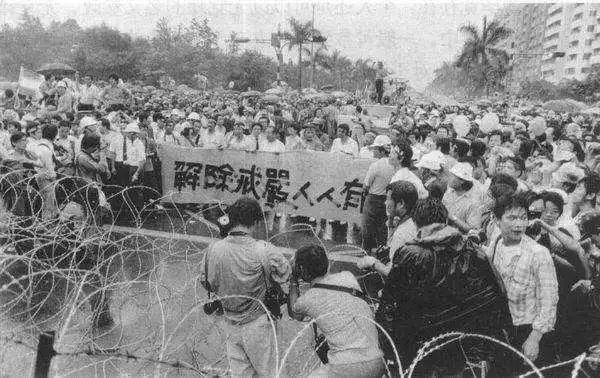
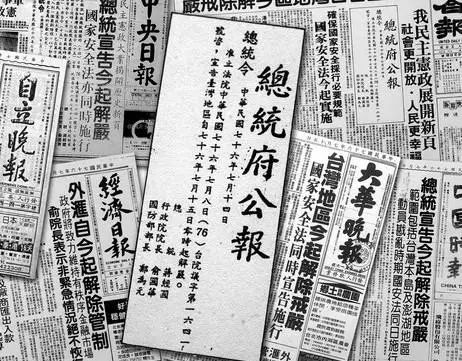
20 years ago (this article was published in 2007, the same below—note by “We heard that we were blocked”), Chiang Ching-kuo, who was in his twilight years but held absolute authority on the island, announced that starting from 0:00 on July 15, 1987, Taiwan would lift “Martial Law”, thus ending the 38-year “Martial Law” era.
Under the “Martial Law” system, the “Garrison Command” could enter citizens’ homes at any time to check household registration, review and punish newspapers and magazines, prevent and disband citizens’ demonstrations and gatherings, prohibit citizens from striking and forming associations, strictly restrict citizens’ freedom of entry and exit, arbitrarily open, detain or confiscate citizens’ private mail and telegrams, and even use military law to try ordinary citizens who are not military personnel, and so on. In a word, most of the basic rights granted to citizens by the “Constitution” were almost ruthlessly deprived.
Living in this “tiger” system for 38 years with trepidation, the people on the island finally ushered in the day of “lifting martial law”. Unexpectedly, their reaction was very calm, even a little indifferent, and there was no scene of people rushing into the streets to celebrate wildly.
The arrival of this day was not abrupt. Before this, on September 28, 1986, the Democratic Progressive Party was born in the Grand Hotel in Taipei, which was undoubtedly a direct challenge to the “Martial Law” system and the authority of the Kuomintang. According to their ruling logic and thinking inertia, that would definitely not be allowed.
At that time, it was less than 7 years away from the “Kaohsiung Incident” in 1979, and the civilian opposition elites who were tried by military law were still struggling in prison, and the sky over Taipei was overcast for a while. What was unexpected was that Chiang Ching-kuo, who was in his twilight years, weighed it again and again, and believed that the Kuomintang could no longer stick to the old ways and respond to changes with the same, but should respond to changes with changes, and decided to adopt a “tolerant” policy towards the newly born Democratic Progressive Party, “not recognizing, not suppressing”, actually tacitly approving or tolerating the objective existence of the Democratic Progressive Party.
Chiang Ching-kuo said at a high-level meeting within the party:
“Times are changing, the environment is changing, and the trend is also changing. In response to these changes, the ruling party must adopt new concepts and new methods, and promote reform measures on the basis of democratic constitutionalism. Only in this way can we combine with the trend of the times and be with the people forever.”
More than 20 years later, we might as well regard these words as his “Declaration of Reform”. Doing so is actually more beneficial than harmful, winning the hearts of the people internally, easing social conflicts, turning passive into active, and conforming to the trend externally, improving the external image. Therefore, he seized the initiative of political change and grasped the initiative of history, and a new era began.
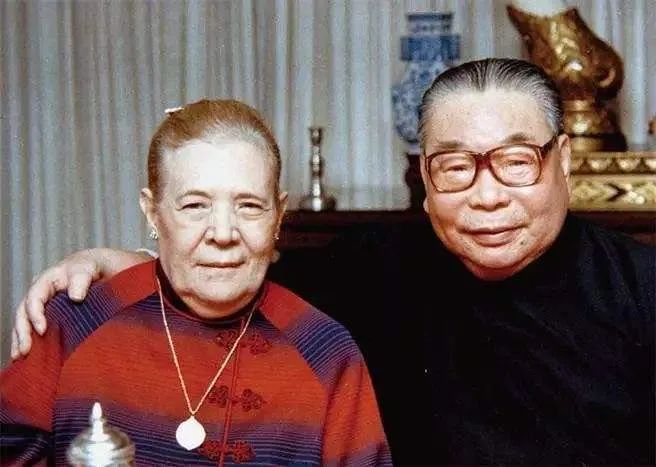
Chiang Ching-kuo and his wife in their later years
For the Democratic Progressive Party, this is not a pie falling from the sky, but the result of long-term and unremitting pursuit.
Before the official formation of the party, the efforts of the non-party to criticize current affairs, call for democracy, and run for local public office and people’s representatives have been persistently sustained, and thus formed political organizations such as the “Non-Party Editors and Writers Association” and the “Non-Party Public Officials Public Policy Research Association”. If we go back to the era when Lei Zhen and others advocated the formation of a party, they had been pursuing it for thirty years.
This history that happened 20 years ago can be regarded as a benign interaction between a political leader and the forces of the people, and the result is a win-win situation.
Some people say that Chiang Ching-kuo responded to the birth of the Democratic Progressive Party with a moderate attitude because he considered that the cost of suppression might be greater than tolerance. This statement is certainly reasonable. In those years, his rule fell into a predicament because of frequent scandals.
In 1984, the author of “The Biography of Chiang Ching-kuo”, Jiang Nan, was assassinated by the Taiwan intelligence department in the United States. In 1985, the “Ten Trust Case” occurred in Taipei, involving collusion between officials and businessmen and harming thousands of depositors. The exposure of these incidents greatly damaged Taiwan’s external image. At the same time, the momentum released by economic reforms across the strait attracted international attention. Under pressure, Chiang Ching-kuo was also seeking new countermeasures to accelerate the pace of political reform.
However, carefully searching for the trajectory of history, Chiang Ching-kuo’s move from tacitly approving the Democratic Progressive Party to lifting “Martial Law”, opening up the press and party bans, was not entirely a passive and helpless choice, nor was it a whim, but rather a considerable period of brewing.
As early as before the “Kaohsiung Incident” in 1979, he had arranged for communication with the non-party political forces. In 1983, when he accepted an interview with a West German reporter, he affirmed the role of the non-party movement for the first time, and publicly admitted that the non-party opposition movement was helpful to social progress. In May 1986, with Tao Baichuan, Hu Fo and other four intellectuals as intermediaries, representatives from the Kuomintang side had two face-to-face communications with representatives from the non-party.
In early September 1986, Chiang Ching-kuo told American reporters that the Kuomintang was studying the opening of party bans. In other words, he had sent out multiple signals of goodwill before the official birth of the Democratic Progressive Party.
There is no doubt that the reason why Chiang Ching-kuo came to this step was due to the international background, especially the influence of the United States, the continuous struggle of the domestic non-party opposition movement, the will of the people could not be violated, and various complex objective factors. But one thing cannot be denied, that is, his personal subjective sincerity and efforts.
Chiang Ching-kuo, who was plagued by illness, knew that he did not have much time left, and he wanted to give an account to history and leave a space for peaceful transition on the island. This was his wisdom and his pragmatism. His great achievements in the last moments of his life made him a political figure of great fame and fulfilled the land that had suffered so much.
Sometimes, especially at critical moments, the orientation and choices of a political figure in a key position often determine the direction of history. Chiang Ching-kuo is precisely known in history for his actions in his twilight years.
20 years ago, he lifted “Martial Law”, enabling Taiwan to smoothly complete the transfer of power behind him with the least cost and without a drop of blood, enabling the people of Taiwan to not only enjoy a prosperous economy and a rich life, but also enjoy freedom from fear, freedom of expression, and freedom of election.
Regardless of the unsatisfactory aspects of Taiwan, and regardless of the different evaluations of Taiwan’s democratization today, we have to admit that it is a vibrant and open society, a pluralistic and democratic society.
All this is of course the result of the struggle and sacrifice of several generations, including Lei Zhen and Yin Haiguang, for more than half a century, but it is also inseparable from Chiang Ching-kuo’s foresight and determination 20 years ago. Without him, the democratic process on the island might have been completely different, and history is indeed created by specific individuals.

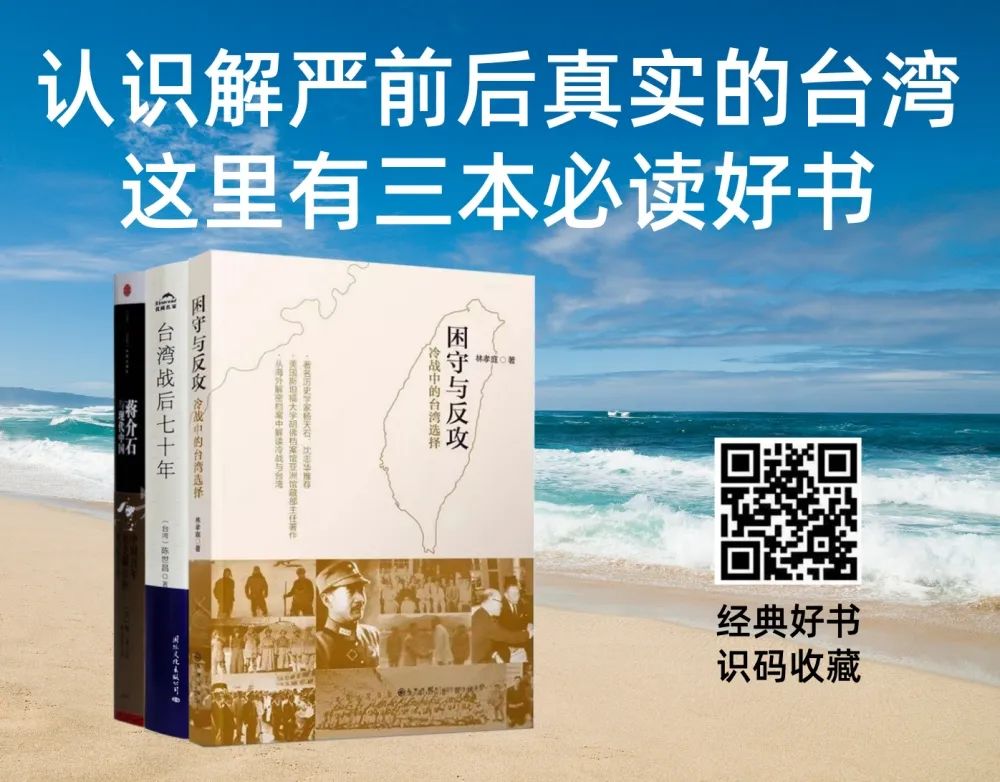
It has been 38 years since the lifting of martial law in Taiwan. Without the lifting of martial law, there would be no Taiwan today; so, from the most realistic perspective possible, what exactly was Taiwan like before and after the lifting of martial law? Today, we recommend three related books from the Xianzhi Bookstore:
First, “Imprisonment and Counterattack: Taiwan’s Choice in the Cold War”, written by Lin Xiaoting, tells the story of Taiwan’s stance and choices against the backdrop of the Cold War.
This book is compiled from the archives collected by the author over the past ten years from academic and historical archives in the United States, Britain, and Taiwan. The book contains valuable materials that are very rare for mainland readers, covering the early Cold War China’s borders, the relationship between Chiang Kai-shek and the Korean War, Chiang Kai-shek’s “underground work” and “third force” in the early Cold War, the Taiwan Strait crisis and the secret envoys between the two sides, the Tibetan issue during the Cold War peak, Chiang Kai-shek on the Southeast Asian battlefield, the Cold War and the controversy over Taiwan’s development of nuclear weapons, and so on.
Mr. Shen Zhihua highly recommends this book, saying: To fully and truly understand the US-Taiwan relations, the Kuomintang-Communist relations during the Cold War, especially the goals, connotations, and results of Chiang Kai-shek’s foreign policy after he retreated to Taiwan, this book is a must-read.
The author of this book, Lin Xiaoting, is a Ph.D. from the Faculty of Oriental Studies at the University of Oxford, a Fellow of the Royal Asiatic Society, the youngest researcher in the history of the Hoover Institution at Stanford University, and the director of the Asian Collection Department of the Hoover Archives. He specializes in modern Chinese politics, diplomacy, military affairs, border and ethnic minority issues, Sino-British diplomatic history, Sino-US relations during the War of Resistance Against Japanese Aggression, and US-Taiwan relations during the Cold War.
Second, “Seventy Years After the War in Taiwan”, written by Chen Shichang, a post-war history of Taiwan from a personal perspective.
This book fully narrates the truth of the 70-year history of Taiwan after the war. The author analyzes the causes and consequences of the ten major political events during the martial law period (such as the Sun Liren case and the Lei Zhen case), the beginning and end of Taiwan’s political party rotation, and so on.
The author comments on the merits and demerits of figures such as Chiang Kai-shek, Chiang Ching-kuo, Lee Teng-hui, Ma Ying-jeou, and Chen Shui-bian, as well as the triangular relationship between the mainland, Taiwan, and the United States, and so on. The writing style is concise, easy to understand, and to the point (for example, how the Korean War saved the Kuomintang, which is thought-provoking).
Third, “Chiang Kai-shek and Modern China”, written by Jay Taylor, translated by Lin Tiangui, comprehensively shows the humanity and human feelings of a generation of politicians.
Objective: The author, Jay Taylor, was a former US diplomat in China and a Harvard scholar. He is above Chinese history with an outsider’s perspective, and his restoration of the historical context is unmatched.
In-depth: Taylor consulted a large number of classified archives, visited Chiang’s old friends, colleagues, and subordinates, and US military and political figures, and his understanding of the complex Sino-US and US-Taiwan relations during that period is unprecedented.
Detailed: Did the Xi’an Incident really change history? How did Chiang Kai-shek and Soong Mei-ling choose when their political views were different? What choices did Chiang Kai-shek make after being betrayed by Nixon? The author uses warm words to reproduce the unknown historical details.
Subversive: This book comprehensively presents the complex and contradictory Chiang Kai-shek, shows his humanity and human feelings as a politician, and restores a most authentic Chiang Kai-shek.
This era today is hard to describe. Truly good books are becoming increasingly difficult to find, and it is not easy to come across them. Friends who are interested in the above three books from the Xianzhi Bookstore, please press and hold the picture below to identify the QR code in the picture and own them with one click.
Discover more from 自由档案馆
Subscribe to get the latest posts sent to your email.