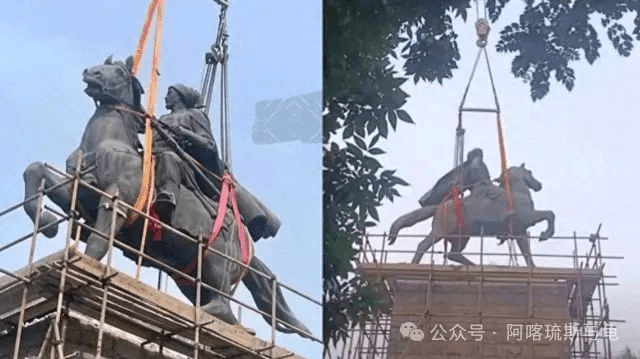
Recently, a rather funny thing happened: the statue of Li Zicheng in Changping District, Beijing, was moved back to Li Zicheng’s hometown, Mizhi County, Shaanxi Province.
The reasons are not yet clear. Some say it’s due to urban planning needs, while others say it was agreed upon with the scenic area in Shaanxi. However, neither seems very convincing. I’ve heard that the housing prices in some areas of Changping have already fallen back to what they were 9 years ago…
Of course, I think it’s not very appropriate to erect a statue of a bandit leader in Beijing, right?
Because this thing is too symbolic and easily leads to associations. When people see the statue of Li Zicheng, their minds will naturally wander. It’s like publicly reading a seditious article, and it was deleted.
I don’t know why this statue was erected in the first place, but objectively speaking, it does have a progressive side. Let’s imagine, if someone dared to erect a statue of Li Zicheng in the capital during the Qing Dynasty, how many people would lose their heads? Even just raising a hand to suggest it would lead to the extermination of their entire family?
Therefore, from the perspective of social tolerance, I think it’s a sign of the times to erect a statue of a rebel in the capital. Moreover, aside from Li Zicheng’s special identity, this statue also has other cautionary meanings. It at least tells the world that harsh government is more ferocious than a tiger.
Now, when people talk about Li Zicheng, the most talked about is a story about a grassroots civil servant being fired, which led to a tragic event of the century. In fact, this view is largely misleading and not true.
Li was indeed a postman, but after he was optimized, he didn’t become a bandit. Instead, he went to the border to be a soldier. If we consider postmen as proper civil servants, then it’s equivalent to crossing from the political world to the military world, still within the system.
However, Li Zicheng’s iron rice bowl was ultimately unstable. Originally, the court wanted them to go north to fight the Qing Dynasty, but halfway there, the officers began to embezzle military pay. This led to a mutiny, and everyone joined in, killing the adjutant and the county magistrate. Thus, Li Zicheng’s dream of being in the system was completely shattered, and he joined the peasant uprising.
From this, we can also see that the optimization of the postal station was not accidental, but a systemic corruption of the Ming Dynasty, which completely festered and broke out in the late period. The court’s finances were tight, and even the postmen couldn’t be supported. The military was corrupt, and military pay was arbitrarily deducted. Then, a famine broke out in Shaanxi, and local officials still collected taxes as usual, forcing the peasants to rise up in revolt.
At that time, Li Zicheng was only in his early twenties, an age when he had just started a family and needed to establish a career. But he had no way out. He couldn’t be a small postman, and he was shortchanged on his military pay as a soldier. Even if he became a farmer, he couldn’t support himself and was still urged for grain by the government. This was the collapse of a great era, not a random layoff, and he became a rebel out of anger.
Many people criticize the Ming Dynasty for having many incompetent emperors, including Chongzhen, who seemed diligent but ended up making things worse and becoming an accelerator of the times. In fact, incompetent emperors are just a facade. The Qing Dynasty’s imperial family education was considered successful, and almost no incompetent emperors emerged, but they still made the people suffer, and uprisings occurred everywhere.
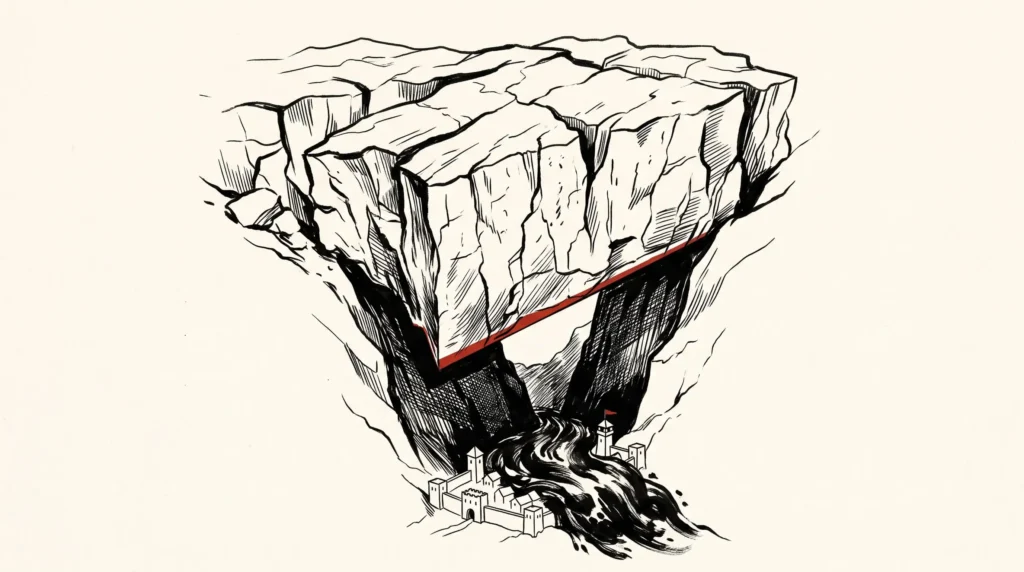
This is a kind of fate of a dynasty. I once used the setting of ‘The Matrix’ to interpret this fate. The artificial intelligence Matrix ruled the world. It was almost omnipotent, possessing the technology to use human bodies to obtain a constant supply of energy, and it was smart enough to control everyone’s thoughts, making them unable to distinguish between reality and illusion, and powerful enough to drill into Zion, which was several miles underground, at any time, and zero out the awakened humans.
But it couldn’t overcome a small bug in itself, which was the mutation of the antivirus software (Smith), which turned into a virus that attacked the system itself, until it collapsed.
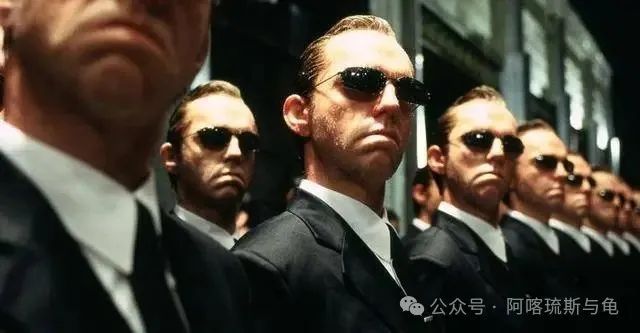
This was the situation at the end of the Ming Dynasty. It wasn’t Li Zicheng’s uprising that destroyed the Ming Dynasty, but the Zhu family’s inability to clean up its antivirus software. They could only watch their own antivirus software, which they had installed themselves, gradually drain the country’s foundation and exhaust the people’s resources. It reached a point where even military pay was deducted, and the disaster victims were to be exploited, almost reaching a state of system failure and paralysis.
And the only thing Chongzhen could do was to fight tigers but not flies. He killed Wei Zhongxian and Yuan Chonghuan, which not only did nothing to improve the people’s livelihood at the bottom but also disrupted the factional balance of the elite class, making the system even more unstable.
Of course, it’s not that Chongzhen didn’t want to swat flies, but that he was powerless. This is the fate of the family-controlled model. When a country is controlled by a single family, then he becomes a lonely person. Outsiders are nothing more than the difference between those who benefit and those who lose. If those who benefit cannot benefit, then they are in the same class as those who lose. Therefore, corruption cannot be avoided. When corruption reaches a certain level, then those who benefit become the biggest killers of the system.
In ‘The Matrix’, the Matrix came up with a solution, which was to design a ‘savior’ program. It allowed some of the humans in the battery cells to awaken, and then let them and the antivirus software consume each other, which is equivalent to a purification mechanism of basic corruption.
If the antivirus software fails, then they manually eliminate the awakened humans. If the awakened humans fail, then they re-launch a savior. This is repeated, allowing the system to maintain a sufficiently healthy environment to continue operating.
Of course, this is not a cure for the ‘Matrix problem’, but rather a delay. Then, it’s just a plot in a movie. The fate of the dynasty in real society is unsolvable. However, the setting of the ‘savior’ program is very realistic. The Western society’s transition from darkness to civilization is essentially the process of the savior program defeating the system.
Looking at Li Zicheng again, he is actually a program corresponding to this. ‘When the King of the Rebels comes, no grain is collected’, and it was made into a song for children to sing. It also wears the guise of a savior, but in essence, Li Zicheng is no different from Zhu Yuanzhang and Liu Bang. He is just using the name of a savior to try to replace them and become the new ruler.
Before Li Zicheng’s uprising, he killed a creditor, and then because his wife had an affair, he also killed her, and then killed his superior, and finally had no way out and became a rebel. This is also the reason why China lost to the West, because when they began to have the idealistic idea of a savior, wanting to create a fair and just society where everyone is free and equal, the Chinese were full of the barbaric thinking of ‘the winner takes all’ and replacing others.
Of course, the Li Zichengs of today have already withdrawn from the stage of history. But how far are we from a free and equal society?
Discover more from 自由档案馆
Subscribe to get the latest posts sent to your email.