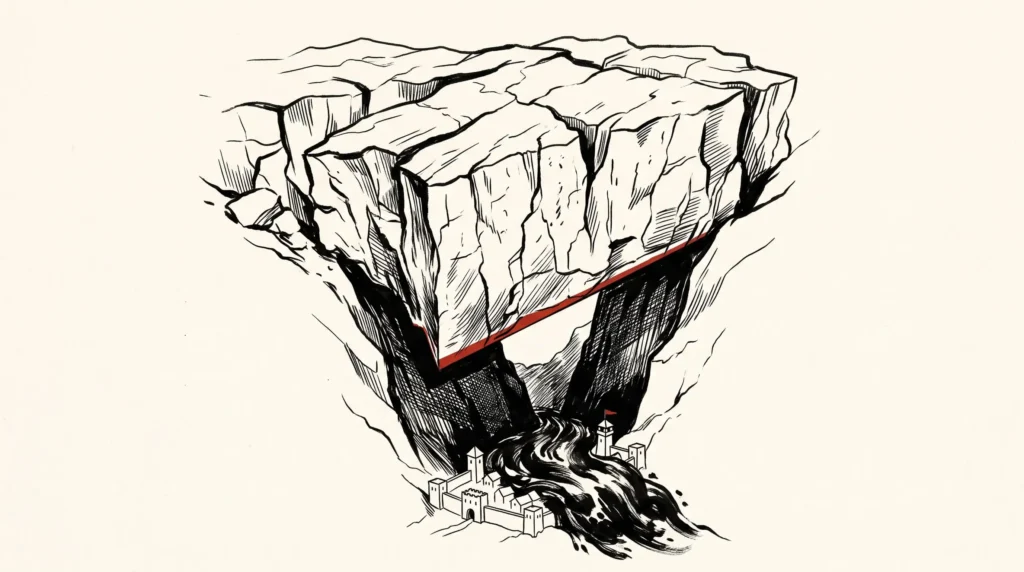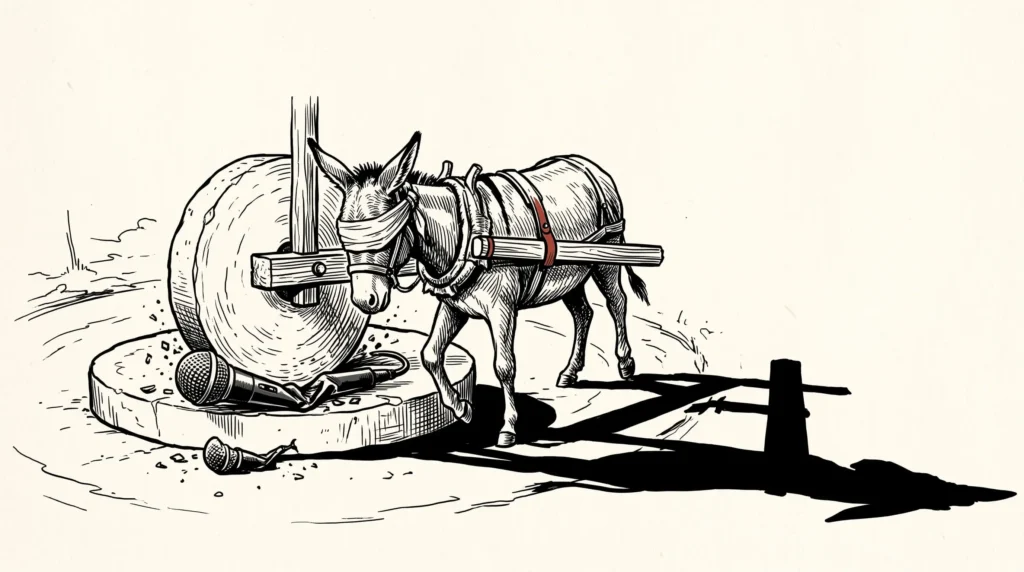
In fact, various economic systems in the world are competing with each other on one thing, which is the ability to correct errors. Which system is error-free?
Capitalism is remarkable. The “Communist Manifesto” says that it has created revolutionary economic achievements that surpass all previous eras, but why does it always have economic crises? Isn’t it because that system makes mistakes?
In the past, it was thought that by implementing a planned economy, crises could be eliminated. In fact, whether in the Soviet Union or China, economic decisions would also make mistakes. Otherwise, why would there be an “adjustment” every few years?
Experience has proven that mistakes are inevitable, the question is whether the ability to correct errors is strong. A highly centralized power system can concentrate resources to accomplish great things, which is an advantage, but the premise is that the decisions must be correct. If the decisions are wrong and concentrated, then the errors are also large, and it is difficult to correct them.
Reform is nothing more than systematically correcting errors. There is a paradox here: the planned system itself needs reform because its ability to correct errors is not strong enough, and it has accumulated many problems. But with the banner of reform, can our system’s ability to correct errors automatically become stronger?
In practice, a new bias has emerged. It is extremely difficult, and reform has finally made some progress, and thus achieved some economic achievements. There is an opinion that our system is the most brilliant system in the world and no longer needs to be reformed.
Since reform is so difficult, can we simply not reform? Can we simply announce that China has built a new system and no longer needs reform?
After thinking about it, the answer is “no.” Because if you only reform halfway and stop, big troubles will follow. There are roughly three levels.
●The first level, if we do not continue to promote reforms in some key areas, do not continue to promote reforms in the direction of a socialist market economy, and do not promote reforms to improve socialist democracy and the rule of law, many social contradictions will show a chain reaction.
In connection with the current economic situation, the overall characteristic is a high-level decline. As the old saying goes, “It’s easy to go up the mountain, but hard to go down,” which means it’s easy to have problems when going downhill. Many contradictions are covered up during rapid growth, but when going downhill, the difficulty of balancing increases.
●The second level, younger people become the main body of society. They have a new frame of reference for evaluating the system, policies, and their own environment, which is different from the previous generation, and they also have higher expectations for an ideal society.
For example, for those who experienced the Great Famine of 1959-1961, the people’s communes, and the “Cultural Revolution,” no matter what, they feel that the changes after China’s reform and opening up are huge progress.
However, for the “post-80s” and “post-90s,” their frame of reference is different from birth. They live in a more open China, have more understanding of the world, and believe that the world should be like this and that. If it doesn’t meet the standards, they are not satisfied.
Now, what is the frame of reference for the main body of the population, that is, the most active population in the industrial structure, the most active population in the consumption structure, and the most active population in cultural activities? What are their expected values? Are their standards for social justice and modern civilization a little higher than in the past? Do they feel more intolerable about the negative phenomena brought about by the lack of reform?
We must see that China’s total economic output is already the second largest in the world. And because of this, people’s expectations for their own country are higher than in the past. We cannot always talk about how things were before the reform, and we cannot talk about how things were before the founding of New China. We cannot always rely on “remembering the bitterness and thinking about the sweetness” to maintain people’s satisfaction.
A country has hope, it must be that generation after generation has higher expectations for their own society. Therefore, reform must also match the expectations of the mainstream population.
If the reform is too slow and cannot keep up with the expectations of the younger generation for society, problems will also arise, and disappointment may spread, and then it will be impossible to mobilize generations of people to face and solve problems.
●The third level, many systemic variables are now changing too slowly and are always not in place, which is stimulating more and more extra-legal behaviors and phenomena.
Now, in many things, the law says one thing, the book says another thing, and people actually do another thing. Many people are not within the framework of the law, but are living in the world outside the law.
Seeing these phenomena, people are accustomed to criticizing mainland China for not abiding by the law and not having the good habit of observing the law. This problem exists, but in some cases, it is really because many of our laws or regulations are not reasonably set.
I gave a small example. When a civil aviation aircraft lands, the broadcast will definitely say, please do not turn on your mobile phone. But if you look around, almost everyone is turning on their mobile phones. And when you take a Cathay Pacific or Dragonair flight from Hong Kong, they will announce that you can turn on your mobile phones as soon as they land.
My question is, if there are no adverse consequences after turning on the mobile phone after landing, why not let everyone turn on their mobile phones? This is to say that in some cases, it is not difficult to make the law enforced by changing the law or regulations.
Now, many economic controls, or regulations or policies, are simply difficult to implement. In the end, everyone has to break the law to make a living.
Speaking of these phenomena, “small principles” prevail – this is not allowed, that is not allowed. But it seems to have forgotten a big principle, which is to allow the vast majority of people’s vast majority of behaviors to be carried out within a legal framework.
In a rapidly changing society, reform must enhance institutional capacity, that is, to resolve extra-legal behaviors and incorporate extra-legal activities that do not harm others and society into the legal framework as much as possible. Otherwise, more and more people will start from scratch, “not playing with you,” that is the biggest institutional failure.
Reform is difficult in the first place. Standing at this point in time, it is even more difficult to reform. But delaying reform is not a way out.
In the current situation, reform must not only race against corruption or collapse, but also race against the expectations of the increasingly younger main body of society, and have the ability to absorb a large number of extra-legal activities into the system. In these three directions, if you can’t win, big trouble is behind.
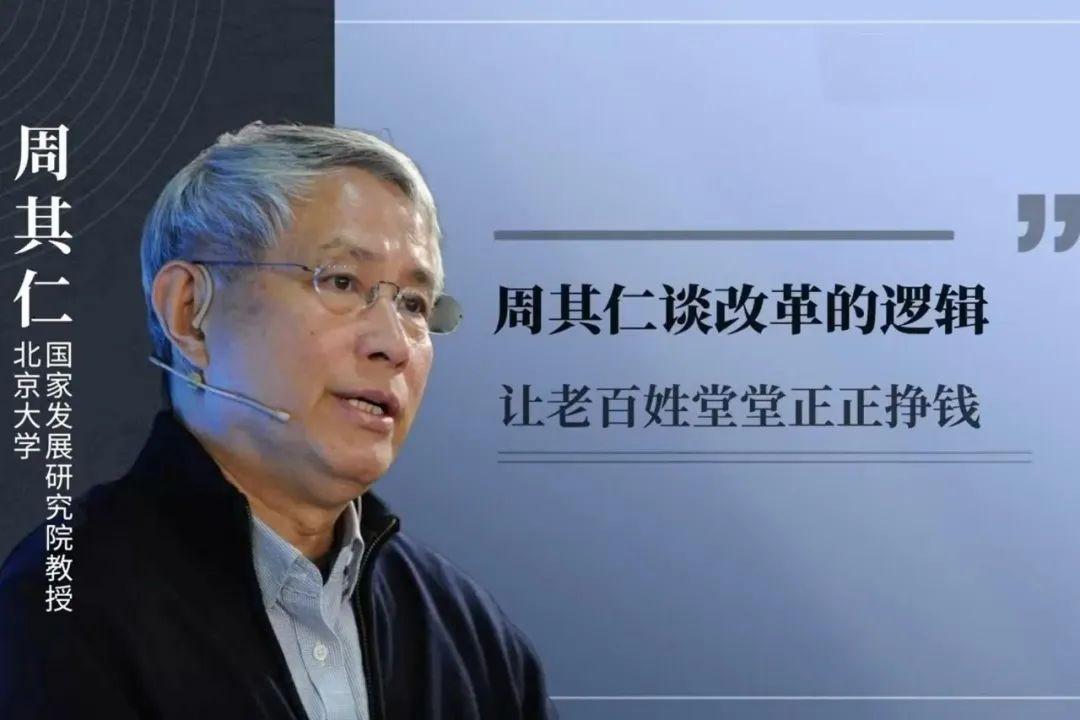
The above is selected from Professor Zhou Qiren’s “The Logic of Reform”. Professor Zhou Qiren’s in-depth insight into the essence of reform comes from his profound academic accomplishment and his practical wisdom of deeply participating in and studying reform. His insights are not only necessary for summarizing historical experience and lessons, but also for the present and the future, and are the common sense that should be returned to.
However, from understanding the essence of reform to understanding the reform logic and essence of various key areas in China, one article is not enough. Therefore, the Xianzhi Bookstore sincerely recommends the “Zhou Qiren Collection” including “The Logic of Reform”: This set is currently the most complete collection of Zhou Qiren’s works, involving the logic of political system reform, property rights reform, urbanization, land reform, and many other fields.
Zhou Qiren has many insights. He does not blindly follow the mainstream, nor does he cater to public opinion. In the circle of Chinese economists, he is considered a model of the academic world that “cannot be learned.” For decades, Professor Zhou has been running around and taking root in the front line of economic investigation and research, observing and understanding the problems and changes of Chinese society in the transition period with his feet, brains, and heart.
Wen Guanzhong: It is rare, whether in China or in the world, to have an economist who can use brilliant writing, use flesh-and-blood stories and characters as cases, rely on his extensive knowledge of both Chinese and Western cultures and his innate sharp vision, and use logic that is clear enough for passers-by to understand, to organize the in-depth observations from traveling through villages and villages into vivid texts. Zhou Qiren is one of them.
Discover more from 自由档案馆
Subscribe to get the latest posts sent to your email.