Those years of pursuit and interception: grabbing arms, snatching microphones, blocking toilets
Yesterday, I saw a video on WeChat of Ms. Zhao Qian, a teacher from Chengdu Business Daily, forwarding questions from reporters at the two sessions. The performance of Ms. Wang Chenyuan, a colleague of Ms. Zhao, was refreshing: exquisite makeup, elegant and decent, clear expression, calm and unhurried.
This state at the scene of the two sessions is really very different from ours back then. In those days, it was common for shoes to be stepped on and cameras to be knocked down.
In that era, reporters would pursue and intercept provincial and ministerial-level officials. In elevators, rooms, and meeting venues, as long as they encountered hot-topic provincial and ministerial-level officials, they would pull out their recorders and rush up to ask a few questions. Sometimes, some hot-topic officials would go to the toilet, and a large group of reporters would follow and even intercept them.
Around 2008, Gao Qiang, then Party Secretary and Deputy Minister of the Ministry of Health, went to the toilet in the middle of a meeting. When he came out, he was blocked by many reporters at the toilet door for interviews. Gao Qiang lamented: “I’ve been blocked by reporters here for several years.”
Wan Gang, who was once the Minister of Science and Technology, had a similar experience. The media once recorded: Wan Gang rushed to the toilet under the support of reporters. Wan Gang waved his hand, the door closed, and several female reporters retreated. The male reporters also tacitly waited at the door. After a minute or two, a reporter no longer hesitated, pushed the door and entered. Wan Gang was washing his hands at the sink. With a shout of ‘Minister Wan’, the interview began. The reporters outside also rushed in quickly, and the toilet was instantly filled with noise…
Many veteran reporters still remember that Ms. Zhao Qian was known in the Jianghu as “Sister Lanbu”, because she intercepted many ministers and persuaded them to accept interviews during the two sessions with her extraordinary physical strength and super patience. Compared with the current interviews of Ms. Wang Chenyuan, the scene of “Sister Lanbu”‘s interviews at the two sessions was more like a news phenomenon.
In March 2017, I specifically interviewed Ms. Zhao and asked her to describe her years of interview experience. She recalled that at that time, the ministers who attended the National People’s Congress in the Great Hall of the People all entered from the North Gate Hall of Peking University. The media reporters privately called this road, which was the only way for the ministers to enter the venue, the “Minister’s Passage”. “At that time, if a reporter stopped a minister, all the reporters would surround him, and the minister would be unable to escape from the crowd, and sometimes his clothes and hair would be messed up.”
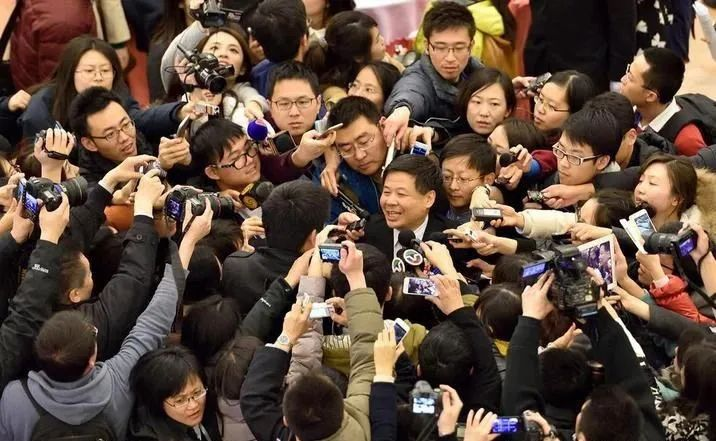
One year, Li Jixiang, the former director of the Civil Aviation Administration, was blocked by reporters in the “Minister’s Passage” and could not move an inch. He had to ask the reporters: “Can you let me speak while walking?” One year at the two sessions, Chen Zhu, then Minister of Health, was blocked at the toilet door to accept interviews.
Since 2013, the official has officially set up a “Minister’s Passage”, and the National People’s Congress has set up a temporary “Minister’s Press Conference Platform” in the North Hall, installed sound equipment, and set up a step platform for photography reporters.
But even so, not all ministers are willing to accept interviews. Therefore, reporters had to send representatives to the scene to pull people. The common trick is to spot a hot-topic minister, and the reporter will go forward to hold his arm and persuade him to accept the interview.
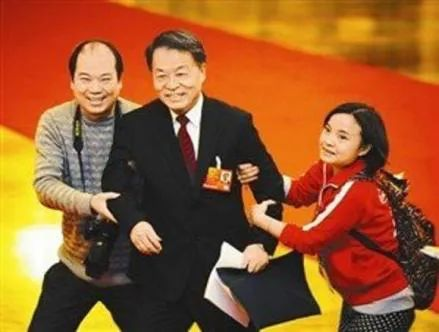
Ms. Zhao Qian on the right
One year, Zhao Qian intercepted Cai Wu, the former Minister of Culture. Cai was a little unwilling at first, but later Zhao Qian held Cai Wu’s arm and said: “Everyone entrusted me to persuade you to accept the interview, you have to let me complete the task.” Cai Wu, who was in a hurry to attend the meeting, had to agree with a smile to accept the interview in the “Minister’s Passage” after the meeting. After the meeting, Cai Wu kept his word and accepted the questions from the reporters in the “Minister’s Passage”.
In addition to the above-mentioned interview methods, snatching microphones is sometimes a last resort.
March 9, 2012, was the open day of the Chongqing delegation, but reporters were not allowed to enter. I went to the scene and asked, and was told that there were too many reporters, and the venue for the open day of the Chongqing delegation was too small, fearing a safety accident, so those who had not registered in advance were not allowed to enter. You can only enter the open day if you register in advance, but there was no such precedent at the time.
At that time, Wang Lijun’s treatment-style vacation shocked the world, and I had to find a way to get in.
I called two news officers from Chongqing one after another, but they wouldn’t let me in. I called another acquaintance, a news officer from the National People’s Congress, and he asked me on the phone: Where are you? I was overjoyed: I’m on the first floor. He said: Raise your hand and let me see.
I thought I had a chance, so I quickly raised my hand. As a result, he said: “Oh, I see you, well, you take the lead and go back first.” I almost vomited blood when I heard this sentence.
There was no way, so I called the secretary of Huang Qifan, the then mayor of Chongqing. On the evening of March 7 of that year, I had a nearly 3-hour exclusive interview with him in Huang Qifan’s room with two colleagues. The interview was not too ideal, but the atmosphere was still harmonious. The secretary agreed to coordinate, and after a while, he replied that it still wouldn’t work, and Chongqing couldn’t make the decision at the meeting held in the Great Hall of the People.
After negotiating for more than an hour, I finally got in. When I got in, the open day delegation meeting was over, and it was already the question-and-answer session. A CCTV reporter was asking questions, and I vaguely remembered that it was Lu Jian or someone, anyway, a well-known male host.
I raised my hand repeatedly, but it didn’t work. I noticed that three news officers were holding the microphones, and whoever they stood next to was pointed out by Chen Cungen, the director of the Chongqing Municipal People’s Congress. I, probably understood.
When the microphone was handed to a colleague next to me, I grabbed it. Later, I thought about it, and I actually snatched it. This colleague next to me had seen me raising my hand constantly before, and asked me what questions I wanted to ask, and he could help me ask, and he was very confident that he had the opportunity to ask questions. However, when I said my question, he said that he couldn’t help me ask such a question.
Although the person handing the microphone whispered, “It’s not you, it’s the reporter next to you”, I still firmly held the microphone and asked the question.
I only reported the name of the newspaper I worked for, and didn’t say my name. Then, I said: Secretary Bo, you just admitted that you were negligent in the use of Wang Lijun, so I want to ask, how many years did you use Wang Lijun, and did your colleagues, such as Mayor Qifan, Secretary Guanglei (then member of the Chongqing Municipal Party Committee Standing Committee, Secretary of the Political and Legal Committee, and also Wang Lijun’s predecessor as the Chongqing Municipal Public Security Bureau chief), and other members of the team, have any different opinions, and think that Wang Lijun should not be used.
The question is simple, and many people may not understand the meaning of asking it this way. A few days ago, I had successively visited three provincial and ministerial-level officials from Chongqing and received some shocking news. This question is to verify the news I received and explore Bo’s attitude, and also to stimulate certain information sources in Chongqing to continue to speak out, to facilitate later interviews.
Bo Xilai replied: Comrades, today’s meeting should not be turned into a cadre assessment meeting. The scene was filled with laughter, and Bo also laughed.
Then, he said a few words, the gist of which was: Since Wang Lijun was appointed as the director of the Chongqing Municipal Public Security Bureau, he has done a lot of work, his performance has been excellent, and the people’s satisfaction is very high, and the organization collectively decided to appoint him. Someone did reflect some problems of Wang Lijun to me, and I reminded Wang Lijun and also criticized Wang Lijun in person.
Unfortunately, I can’t find the video, it seems to have been deleted. That was my only public question to Bo Xilai about Wang Lijun, and I hope to provide a copy of the video. After the meeting, some people online cursed, saying that no media in the mainland asked about Wang Lijun’s affairs. Luqiu Luwei, who was at the scene, later explained on Weibo that in fact, reporters from the mainland media did ask. However, the question I asked at the time was not allowed to be reported and published publicly, so the outside world almost didn’t know.
The next day’s Chongqing Daily reported: 3 hours passed quickly, and many reporters who didn’t “snatch” the microphone still raised their hands to ask questions, and the atmosphere at the scene was very enthusiastic.
March 9, 2024
Discover more from 自由档案馆
Subscribe to get the latest posts sent to your email.