Four One Press: On February 16, the Federal Penitentiary Service (FSIN) announced the death of Alexei Navalny, the imprisoned leader of the Russian opposition and the most outspoken critic of the Kremlin. The prison administration stated that Navalny felt “unwell” after a walk and lost consciousness “almost immediately.” Russian authorities are currently conducting an “investigation” into his “sudden death.”
Navalny was long considered the most formidable opponent of Russian President Vladimir Putin. He exposed high-level corruption, opposed the ruling United Russia party, and organized the largest anti-government protests in recent years.
The independent Russian media outlet Meduza wrote an obituary for Navalny (see the image below).
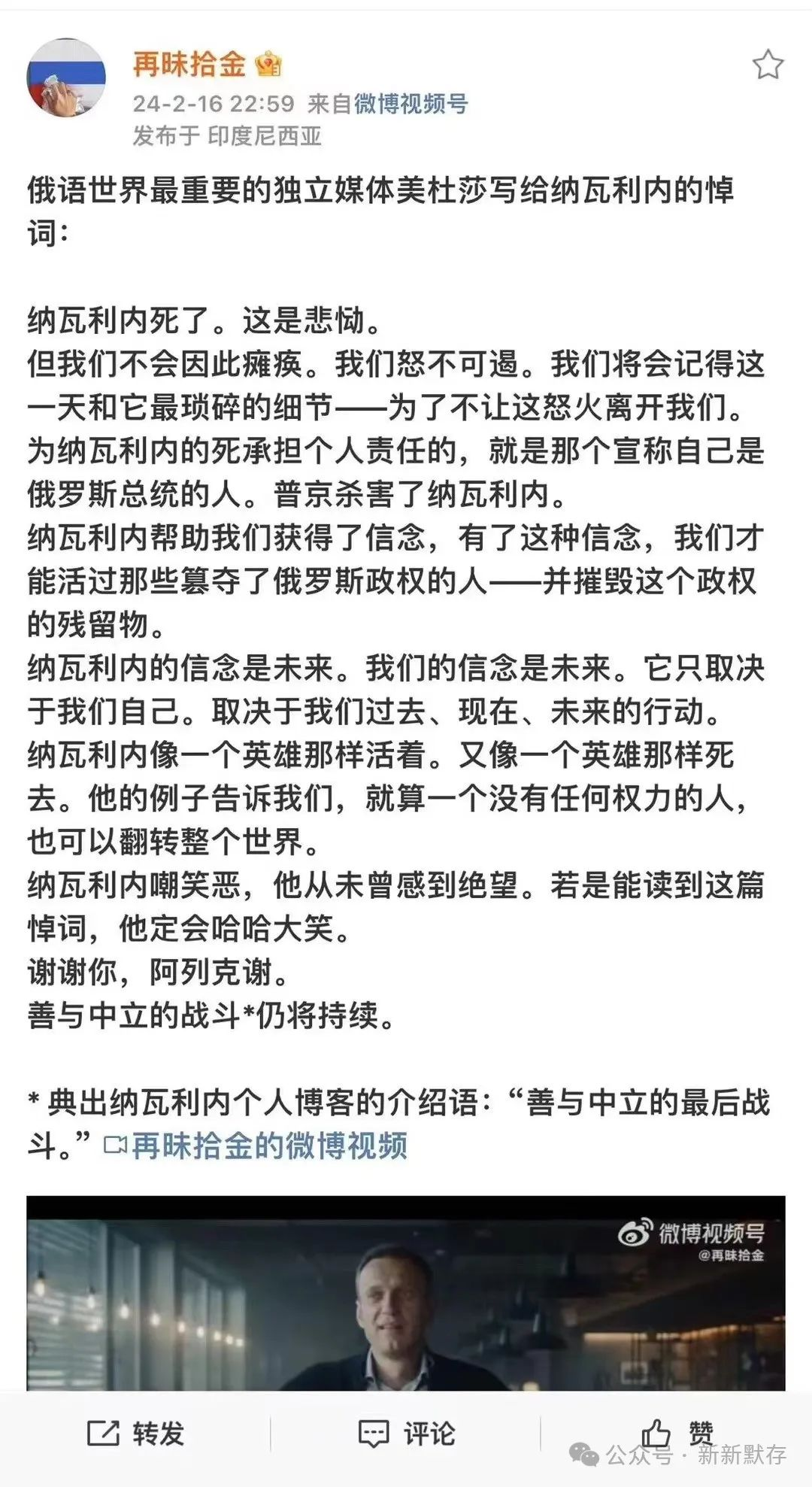
Why was the signature of Navalny’s blog in his lifetime “The Last Battle of Good and Neutrality” instead of “The Last Battle of Good and Evil”? I wrote a short article before, which may help to understand the words of this deceased hero.
Why is the hottest place in hell reserved for the neutral?
By/Song Shinan
Legend has it that Dante had a famous saying: The hottest depths of hell are reserved for those who remain neutral in the face of major moral crises.
Dante actually never said this, just as Lu Xun never said many of the things attributed to him. The reason for this misunderstanding may be because the American writer Dan Brown quoted this sentence many times in his novel “Inferno” and attributed it to Dante. And the reason why Dan Brown did this may have been influenced by former U.S. President Kennedy. Kennedy first mentioned this sentence in a speech and claimed it came from Dante.
Although Dante did not say this, his immortal masterpiece “The Divine Comedy” does express a similar meaning. In the third chapter of “Inferno,” Dante describes a group of people suffering on the edge of hell, who are not worthy of pity, not worthy of judgment, and not even allowed to seek death. In Dante’s view, these people are not even worthy of staying in the hottest depths of hell, which can be said to be the ultimate contempt.
What sins did these people commit that Dante despised them so much? They were all souls without clear stances, including the angels who neither joined Satan nor defended heaven during Satan’s rebellion, in other words, those who “remained neutral in the face of major moral crises.”
Remaining neutral in the face of major moral crises is, in fact, having no stance. Dante believed that the souls of those without a stance had never truly lived, and that they were no different from walking corpses in the world. They were neither favored by God nor welcomed by mortals, and even hell despised them. This attitude can be traced back to the Book of Revelation: “I know your deeds, that you are neither cold nor hot. I wish you were either one or the other! So, because you are lukewarm—neither hot nor cold—I am about to spit you out of my mouth.” Even hell despises you, and even death will not come upon you, which is exactly “I am about to spit you out of my mouth.”
This kind of contempt for the souls without a stance is rare throughout the entire “Divine Comedy,” and Dante did not even use such a heavy tone for some of the most heinous souls. Why did Dante hate those without a stance so much?
Dante himself valued moral stances very much, and his life was indeed spent in constant struggles between good and evil, right and wrong. Therefore, he extremely despised those who remained neutral in the face of major moral crises, thus losing their stance.
Dante was right, and he was not harsh. It is perfectly acceptable to remain neutral in ordinary times and ordinary events, but it is unforgivable to remain neutral in the face of major moral crises. Because when a major moral crisis arises, it means that evil is being presented and abused on a large scale. At this time, continuing to remain neutral is tantamount to standing on the side of evil. For example, when the Nazis were carrying out the large-scale slaughter of Jews, if you remained neutral, saying that the Nazis’ killing was not good, but the Jews also had problems, so you didn’t help either side, then you were actually standing on the side of the Nazis; when Stalin implemented the collective farms, if you remained neutral, saying that this was also an attempt by human society, but it was really not good to kill so many people, but I don’t have any opinions, then you were actually standing on the side of Stalin; the same was true when Pol Pot carried out the Great Evacuation Movement.
The German ethicist Paulsen said in his magnum opus “System of Ethics” that evil also has its meaning of existence, and the only meaning of evil’s existence is that it must be opposed and overcome, otherwise it has no meaning of existence. And the struggle against evil is precisely the eternal theme of good. In other words, not doing evil does not equal good, preventing evil is good, and not preventing evil is not doing good. From this, it can be inferred that the opposite of good is not only evil, but also remaining neutral in the struggle between good and evil, a cold neutrality.
You must know that the opposite of love is not hate, but indifference. A person who hates you may still love you in another way, but a completely indifferent person cannot have any love for you. The struggle between good and evil is also like this. A person who stands on the side of evil and shouts for it may make the appearance of evil clearer and thus attract more opposition. A cowardly and numb person who maintains so-called neutrality is, in a certain sense, more despicable than a person who shouts for evil, because his indifference may infect more people, causing evil to escape the fate of being presented more clearly and opposed more fiercely, and he also becomes an unconscious but powerful accomplice of evil.
In the 1960s, a sentence was popular in the Western civil rights movement: If you are not part of the answer, you are part of the problem. It probably means that when rights are persistently and massively deprived and violated, if you do not actively seek the answer to solve the problem, the problem will continue and even worsen, and you yourself will become part of the problem.
When right and wrong, good and evil must be decided, no one can truly be neutral. If you are not part of the answer, you are part of the problem. Remaining neutral between the wall and the egg is standing on the side of the wall. And the hottest depths of hell are reserved for those who remain neutral in the face of major moral crises.
Discover more from 自由档案馆
Subscribe to get the latest posts sent to your email.