For any industry, only stable and relaxed policies can create a “constant era” of stable expectations, stable growth, and stable employment.
Hello everyone, today is the Winter Solstice. The stocks of major internet companies seem to have entered a cold winter. The stocks of NetEase, Tencent, and Bilibili have all experienced sharp declines, with their Hong Kong stock prices falling by 21.08%, 11.90%, and 10.12% respectively. There are also nearly 10 concept stocks of domestic online games with a decline of over 10%.
The reason for such a heavy blow is that the National Press and Publication Administration has just released a new version of the “Measures for the Administration of Online Games (Draft for Public Comment)” today, soliciting public opinions.
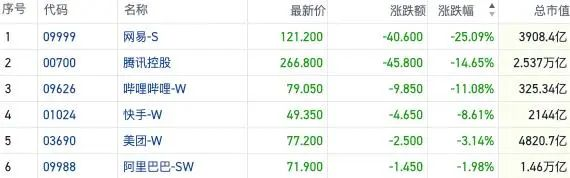
This draft, which was quickly called the “strictest game management measures in history”, mentions that online games shall not set up inducement rewards such as daily logins, first-time top-ups, and continuous top-ups.
The new measures also stipulate that online game publishing and operating units shall not provide or condone high-priced transactions of virtual props in the form of speculation or auction. All online games must set a user top-up limit and publicize it in their service rules. For users’ irrational consumption behavior, pop-up warning reminders should be given.
In addition, the new measures also include violation fines for the first time. Most violations will be fined six times the illegal income of the enterprise’s turnover, with a maximum of ten times.
Simply put, if this “Draft for Public Comment” is finally implemented, then the vast number of mobile game players may have to say goodbye to preferential activities like “recharge 6 yuan to get Zhao Yun” in King of Glory, and also say goodbye to “receiving wages” for daily logins. This will have a subversive impact on a netizen who is used to playing mobile games. And we know that for top internet platforms like NetEase, Tencent, and Bilibili, online game revenue currently accounts for a large portion of their revenue. Taking NetEase as an example, its net revenue for the first three quarters was 27.3 billion yuan, of which game revenue accounted for nearly 80%, or 21.8 billion yuan.
Online game revenue is so crucial to major internet head companies, so it’s no wonder that the stock market was in a state of mourning when this “Draft for Public Comment” came out. The full text of the newly released draft for public comment is about 23,000 words. Judging from the 500 billion market value evaporated by the relevant companies today, each word is worth about 20 million yuan – it can be said to be a textbook-level value.
Experts have also put forward many opinions on this draft for public comment.
Yu Guoming, Director of the Academic Committee of the School of Journalism and Communication of Beijing Normal University, Doctoral Supervisor, and Distinguished Professor of the Ministry of Education’s Changjiang Scholars Program, said:
The overall feeling is that this management measure has too much impact on the industry and undermines the confidence of the industry and the economy. Not only that, but it also completely disregards the huge potential and social value of games as the mainstream media in future social development, and blindly suppresses them, which is a short-sighted behavior without foresight. Furthermore, even if it is necessary to regulate certain game phenomena at present, policy design should be carried out from the perspective of benefiting digital consumption and the development of the game industry. At present, the management measures are too detailed, too much interference with the enterprise’s autonomy in operation, interference with the design details and market promotion of the game, and changing the industry rules, which to a large extent violates the laws of industrial development.
Chen Jingwei, Professor and Doctoral Supervisor of Communication University of China, and Deputy Dean of the School of Animation and Digital Arts, said:
We have always encouraged children in school to be innovative, make independent games, make functional games, make games of Chinese traditional culture, and make games that serve society. But games cannot be made with love alone. Creators need to survive, recover costs, and compete with commercial games for approval. The previous situation was not conducive to the survival of independent game teams, and now it is even completely hopeless. A graduate who was still insisting on independent games just sent me a message, saying how pessimistic he was. Commercial games don’t even have the strength to cry. The idea of Dayu’s water control can be applied to all walks of life. When encountering problems or difficulties, does proposing to prohibit 1234 articles really solve them? I don’t think so. It is better to dredge than to block. The purpose of the management measures is for social stability and the health of the people, and it should guide enterprises to develop well, not to be forcibly suppressed. Many problems cannot disappear just because the game takes the blame.
The experts said it very well, but they were also very implicit, for fear that everyone would not understand. I will try to say something more straightforward.
Yes, we believe that the original intention of the relevant departments to issue this draft for public comment is certainly well-intentioned. Nowadays, there are indeed many parents in society who tend to have negative views on online games. They feel that their children are not studying well, and it is all because of games, especially mobile games that also have daily logins and first-time top-up benefits, inducing children to spend money in the game, which is even more heinous. The relevant new regulations in the relevant departments’ draft for public comment are obviously to cater to this part of the “parental public opinion”.
However, in this part of public opinion, there is actually a loophole in thinking: whether it is really the game’s fault that children are not studying well. According to my observation, most children who are addicted to games and waste their studies are not because the game is too fun, but because they don’t want to study. A truth that parents are unwilling to accept is that even if the game is strictly controlled, or even banned altogether, this part of the children will probably not put their energy into studying. They will read novels, fall in love, or even skip classes to play football or cards. There will always be other entertainment activities that occupy their time that they are unwilling to spend on studying.
So, parents, may I ask, are these entertainment activities really healthier, less expensive, and safer for children than online games?
I think it’s really not necessarily.
Furthermore, the current version of the “Measures for the Administration of Online Games” already has quite strict regulations on preventing minors from being addicted and overspending. Major game platforms are also improving their relevant measures under the supervision of the measures to prevent minors from being addicted. In this environment, is it necessary to add more regulations to further prevent some minors from being addicted to games and strictly manage the entire game industry?
I think it is a matter that is very worthy of discussion.
In addition, there is a more important issue: it can be seen that the new measures obviously strengthen control over the game industry rather than loosen it.
A common sense is that enterprises in any industry need to have a certain space for independent operation in order to maintain a healthy revenue. However, the new draft for public comment extends the tentacles of management to very detailed places, so detailed that even whether there can be a first-time top-up and whether daily login rewards can be set is also restricted. But in reality, this kind of thinking that controls the most detailed details is seemingly clever but actually clumsy, because you can prohibit specific operation details, but you cannot guarantee that there will be no policies above and countermeasures below. As an industry with a huge amount of capital investment, the impulse of online games to pursue profits is irresistible. Restricting first-time top-ups and daily logins will not guarantee that online games will not come up with new methods to maintain user stickiness.
Perhaps it is precisely because of the prediction of this trend that the draft for public comment also has a follow-up move, which is to set a fine of up to ten times the “illegal income of the enterprise’s turnover”.

But this brings a new problem – how to judge and identify the violations of online game enterprises in operation, and then impose high fines on them?
Obviously, this right of judgment will eventually be handed over to the hands of officials at all levels.
However, when grassroots officials hold such a large power of punishment and can issue fines of tens of billions of yuan to severely punish the enterprises involved, it is difficult not to worry about whether someone will abuse this power. If the enterprises do not pay them to buy them off, they will use the new measures to investigate you to death, and fine you to bankruptcy.
Therefore, if the new draft for public comment is implemented, the space for power redemption left to the executors at all levels is very worrying. It is very likely to make internet companies feel terrified and reduce their enthusiasm for further investment and research and development.
And without the new investment and research and development funds of enterprises, may I ask how the new measures mentioned encouraging more high-quality original games to be produced and encouraging domestic games to go overseas to explore overseas markets can be mentioned?
So in the end, the expected effect is: it both increases the risk of corruption and is not conducive to boosting the confidence of enterprises and the market, and is not conducive to creating original, high-quality games, and allowing domestic games to go overseas to earn foreign exchange. May I ask why such management is necessary?
Not long ago, the recently concluded Central Economic Work Conference pointed out the direction for the current economic situation in China in a timely manner, and proposed to stabilize as the top priority, requiring all departments to introduce more policies that are conducive to stabilizing expectations, stabilizing growth, and stabilizing employment in the coming year, seeking progress while maintaining stability, promoting stability through progress, and establishing before breaking.
It should be said that this decision is very wise and timely. The current market does indeed expect to see more policies that are conducive to stabilizing market expectations, so that enterprises dare to increase investment, growth can be stable, and employment in all industries can be guaranteed.
However, if we look back at this draft for public comment, no matter what the original intention is, once it is released, it will objectively lead to another industry-wide panic, and the stock market, which has just shown a slight warming trend, will be poured with a basin of cold water. Therefore, its effect is not “stable”, but “chaotic” – it disrupts the relevant enterprises and also disrupts the management departments. I think this is contrary to the central government’s well-intentioned call for “stability as the top priority”.
The “Tao Te Ching” says, “Governing a large country is like cooking a small fish.” In fact, economic development is also the same – in many cases, although control is necessary, the introduction of each control measure actually carries a considerable “hidden cost”. This component is often reflected in the disturbance of policy stability and market expectations for development, and the reduction of the vitality of industry development.
Therefore, the change of control policies is not zero-cost. The formulation of new regulations cannot be completed by relying solely on “original intentions”. It requires more professional, more cautious consideration, repeated discussion and soliciting opinions before it can be made cautiously. Among them, the most crucial thing is to abide by the administrative “principle of proportionality”, and only when it is necessary to carry out control can the corresponding control measures be introduced. Minimize the hidden costs that society needs to pay for management. And this common sense is actually consistent with the spirit of the Central Economic Work Conference. We earnestly hope that all relevant departments at all levels should strengthen their understanding.
Since it is only a “draft for public comment” and encourages everyone to give opinions, I have also stated my own opinions as above. Please give the relevant industries and their massive number of practitioners, and also give the market confidence.
I believe that when everyone believes that each industry has a stable, healthy, bright, and not suddenly disrupted prospect. The “constant era” of the entire market will come. The days to come will be like the sunshine after the Winter Solstice, getting warmer day by day.
We are looking forward to this “constant era” of stability, peace, vitality, and the development of all things.
我们切望着这个稳定、和平、勃勃生机、万物竟发的“恒纪元”。

Discover more from 自由档案馆
Subscribe to get the latest posts sent to your email.