
“The right to offline rest” has become a trending topic, resonating with countless people in the workplace. At first glance, this seems like a new term, but in reality, it touches upon a situation that is all too familiar in our daily lives. The ding of the work group after work, the sudden voice calls late at night, and the smiles we have to put on during weekend team building.
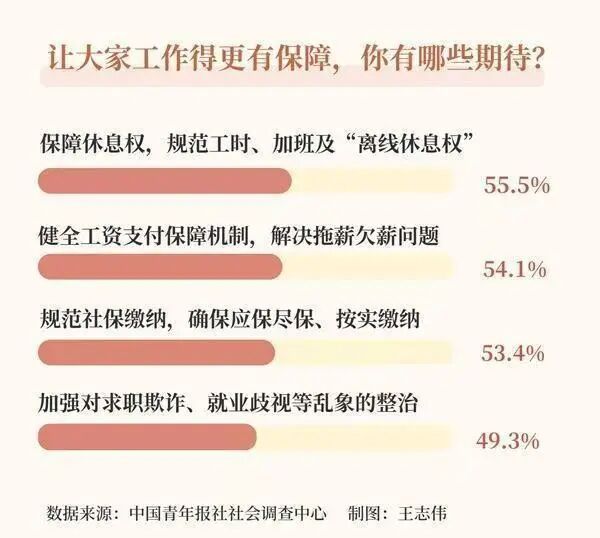
When National Committee of the Chinese People’s Political Consultative Conference (CPPCC) member and former director of the General Office of the All-China Federation of Trade Unions, Lü Guoquan, has been focusing on the issue of “invisible overtime” for the third consecutive year, and when “over half of the respondents suggest guaranteeing the right to offline rest” becomes a trending topic, we can’t help but ask, in this era of interconnectedness, why has “going offline” become a luxury?
In the days when mobile phones hadn’t “hijacked” our lives, getting off work meant truly “going offline.” When the factory broadcast sounded, after leaving the unit’s gate, the day’s fatigue was left behind, and the world switched back to the mode of daily life, with no unread messages and no to-do reminders, time truly belonged to oneself.
But nowadays, messages from WeChat groups @ everyone come at all hours, to-do items on DingTalk pop up to remind us at any time, video conferences can be held at the dining table, in the bedroom, or even outside the children’s tutoring class. We think we are enjoying the convenience brought by technology, but we don’t know that technology is also subtly changing the boundaries between work and rest.
“Mobile office, online communication, and remote collaboration are becoming increasingly popular,” sounds like progress of the times, but for every person in the workplace, it often means the pressure of being on call 24 hours a day.
The most terrifying thing about this “invisible overtime” is that it often wears a reasonable guise. The leader says, “Just ask a small question,” the colleague says, “It’s urgent, please take a look,” and the client says, “We need it tomorrow morning, please work hard tonight.” Every request sounds reasonable, and every response seems justifiable.
But when such “small questions,” “urgent matters,” and “working hard” accumulate over time, they become a mountain pressing down on people in the workplace. We dare not shut down our phones, dare not mute them, and dare not miss any message, for fear of missing important work and affecting our career development.
Gradually, our time is cut into countless fragments, and our minds are constantly being pulled, and the so-called “rest time” becomes a state of being on call that can be interrupted at any time.
If the speed of technological development determines how fast we run, then the ability to guarantee workers’ “offline” rights determines whether we can take a break with ease while running. CPPCC member Lü Guoquan calls for improving laws and regulations, legally establishing workers’ “right to offline rest,” and clarifying the boundaries between work and rest, which is a respect for workers’ basic rights and an exploration of humanized work methods.
Some people say that young people today can’t bear hardship and complain when they work overtime. This statement is actually a misunderstanding of the new generation of people in the workplace. Our parents sweated in the factories, which was a physical exertion; today, we are mentally tense in front of our phones, which is a mental consumption.
The two kinds of hardship are different, but both deserve respect. More importantly, endless “invisible overtime” cannot bring about real work efficiency. Psychological research shows that people’s attention and creativity need rest time to recover. A brain that is always online is like a bow that is always taut, and it will eventually lose its elasticity. From this perspective, guaranteeing the “right to offline rest” is not only a protection of workers’ rights, but also a guarantee of work quality.
Of course, we must also admit that it is not easy to implement the “right to offline rest” in reality. The nature of work varies greatly in different industries and positions, and the definition of emergencies is often unclear.
As CPPCC member Lü Guoquan said, “Except for special circumstances.” This sentence is both the necessary flexibility and may become a loophole to be exploited. How to both protect workers’ rights and take into account the actual needs of work in the system design tests the wisdom of the legislators.
But in any case, putting this issue on the table for discussion is progress in itself. It means that we are beginning to face the new labor relations of the digital age and begin to think about how to safeguard people’s basic dignity and quality of life while technology advances.
Looking back from the spring of 2026, we may find that the phenomenon of “the right to offline rest” trending on the hot search itself is a footnote to the times. It records our humanistic thinking in the rapid development of technology, and records workers’ simple yearning for a better quality of life.
When the boundaries between work and life become increasingly blurred, when “always online” becomes an invisible pressure, we need the protection of the law more than ever, we need social consensus more than ever, and we need understanding from each other more than ever.
In the final analysis, the “right to offline rest” is not just a question of whether we can turn off our phones, but whether we can regain control of our lives. Work is for a better life, not life for work.
In this era of information explosion, being able to “go offline” with peace of mind, and having complete time of your own outside of work, is a luxury in itself, and also a basic right. I hope that CPPCC member Lü Guoquan’s call can be answered, I hope that the relevant legislation can be improved as soon as possible, and I hope that one day, we can confidently say in the work group: “This issue, we’ll deal with it tomorrow at work.”
At that time, there may still be discussions about work on the hot search, but at least, we can put down our phones with peace of mind, have a good meal, have a good sleep, and spend time with the people around us. This is what life should be like.
Discover more from 自由档案馆
Subscribe to get the latest posts sent to your email.