By|Da He
Recently, Loudi City, Hunan Province, issued a document.
Starting from the autumn semester of this year, two middle schools in Loudi will launch a pilot program for “twelve-year consistent” integrated education.
Students enroll in the first grade of primary school, and after nine years of compulsory education, they are exempt from the high school entrance examination and directly admitted to regular high schools.
Each class will not exceed 45 students, and no selective examinations will be organized.
Students who cannot keep up can apply to withdraw before the end of the second semester of the second year of junior high school and transfer to regular classes.
Loudi is the first place in Hunan to take this step. But looking at the whole country, it is not the first.
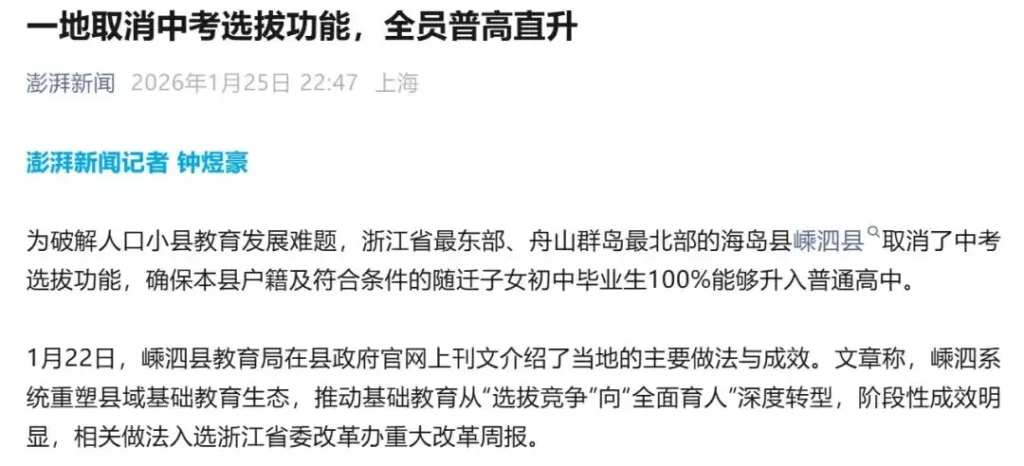
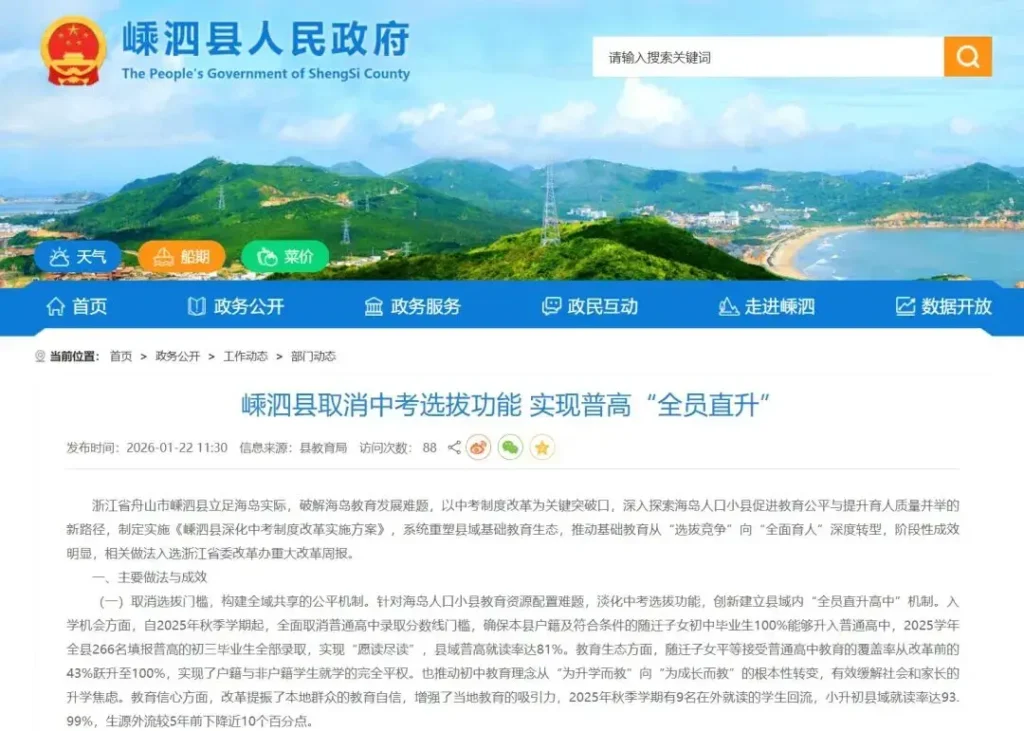
Shengsi County, Zhejiang Province, started earlier and took bigger steps.
In 2025, Shengsi will completely abolish the admission score line for regular high schools, and all 266 junior high school graduates who applied for regular high schools in the county will be admitted, achieving “read as you wish”.
Not a pilot, not a transition, but a direct one-step solution.
Two cities, one east and one west, are connected by a single thread: there are not enough students.
Shengsi’s data is very intuitive.
The permanent population of the county is 64,000, which is less than a town in the inland areas. The birth rate is a little over 2 per thousand, the death rate is a little over 8 per thousand, and the natural growth rate is negative.
The number of junior high school admissions has been declining for six consecutive years, and the ratio of junior high school graduates to high school admissions in 2023 has reached 99.21%. There is no room for selection, nor is there any need for selection.
Although Loudi’s figures are not as extreme as Shengsi’s, the trend is in the same direction.
The permanent population is 3.68 million, and the natural growth rate has been negative for many consecutive years. In Xinhua County, under its jurisdiction, due to the sharp decline in the birth population, the number of primary school admissions has decreased, and there is an oversupply of teachers, who can only be transferred to junior high schools, high schools, or other counties.
The decline in population is like a domino effect, starting from kindergartens, now reaching primary schools, then junior high schools, and later high schools.
2017 was the last peak in the birth population, with 17.23 million. These children are now in primary school and will enter high school seven years later.
But the birth population in 2025 has dropped to 7.92 million, less than half of that eight years ago.
By the time those children enter high school, a considerable portion of the existing middle schools may not have enough students to fill the classrooms.
Therefore, the actions of Loudi and Shengsi are less about educational reform and more about adapting in advance.
As the student population decreases, the selection mechanism naturally loosens.
In the past, the high school entrance examination was a gatekeeper because high schools could not accommodate so many people.
Now that there are more high school places than students, setting up a gate is meaningless.
This news can actually be linked with the “Action Plan for the Revitalization of County-Level Regular High Schools” jointly issued by six departments last September.
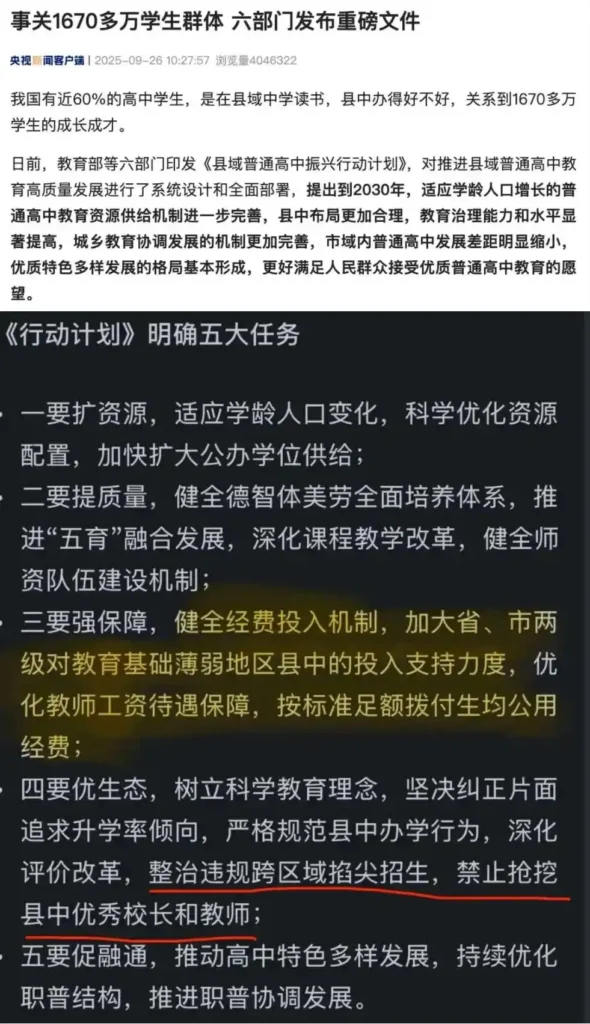
The first point in the action plan mentions: adapting to changes in the school-age population, scientifically optimizing resource allocation, and accelerating the expansion of public school places.
Translated, this means planning in advance and not waiting until the classrooms are empty to devise countermeasures.
But when these two matters are discussed together, many people will associate them with another term: “five-five” division.
Some people, seeing the actions of Shengsi and Loudi, first react with “Is the ‘five-five’ division going to be canceled?”
In fact, Shengsi has not canceled the division, but has postponed the division node from the high school entrance examination to the second year of high school.
Students will first study regular high school courses in the first year of high school, and then in the second year of high school, they will choose between the regular high school track or vocational education track based on their academic performance and personal wishes.
Loudi’s pilot program also includes an exit mechanism.
So it’s not that there’s no division, but rather “delayed division, slow division, and planned division”.
There are also preparations for “delayed division” at the policy level.
The “15th Five-Year Plan for Educational Development” issued by the State Council in June this year, regarding the reform of the high school entrance examination, states “orderly promotion”, “expansion of quota to schools”, “balanced allocation, and registration for admission”, shifting the positioning from “screening students” to “discovering students”.
The wording is gentle, and the direction is also gentle.
Frankly speaking, the division itself does not have major problems at the macro level.
With the country’s emphasis and promotion of high-tech industries, the demand for talents with professional skills is also increasing.
To cope with this challenge, the country has implemented the “five-five” division policy, which aims to direct some students to technical schools to cultivate them into technical talents who can fill the talent gap.
But the problem is, what is not a problem at the macro level is a problem at the micro level.
The policymakers envision it beautifully: divide half of the students into vocational education, alleviate the pressure of the college entrance examination, and cultivate technical talents, killing two birds with one stone.
But your vocational education itself is a mess, and if you don’t clean up this mess, and only rely on policies to force the issue, the bull naturally won’t drink water.
It’s not that parents are irrational, it’s that parents are too rational – who would watch their children being pushed into a fire pit?
I personally never oppose the concept of educational division itself.
Every child has different talents and interests, and teaching according to aptitude is the ideal state of education.
If the division is based on interest and talent, and a child likes hands-on work and is willing to learn a craft, this is an active choice that deserves respect and encouragement.
But our current division is essentially “division by grades”, which nakedly labels children as “superior” and “inferior”.
Under the general prejudice of society, which parent is willing to have their child become a “defective product” that is screened out?
Thus, the flames of involution have spread from children to parents, intensifying.
According to relevant statistical data, only 1% of the annual birth population can enter a 985 university, and the children suitable for the path of studying and taking exams account for only 10% at most.
Then how will the employment of the remaining 90% of children be allocated when they grow up?
Actually, jobs are all more or less the same.
If parents are not short of money and have some connections, they will sit in an office; if they are short of money, they will work hard and use their physical strength.
If you have seen the classrooms of ordinary public junior high schools in the second semester of the second year and the first semester of the third year, you will find that for students who are restless, feel like every day is a year, are bored, and sleepy, educational division is actually a relief.
We are all Chinese, and we have taken so many exams since childhood. We don’t need to wait until adulthood to know if our child is suited for studying.
The so-called educational division is to let parents who are unwilling to admit it accept reality earlier, and let parents and children suffer less from exams.
But what is the reality?
On the one hand, the current secondary vocational schools, both in terms of teaching quality and management level, make parents uneasy.
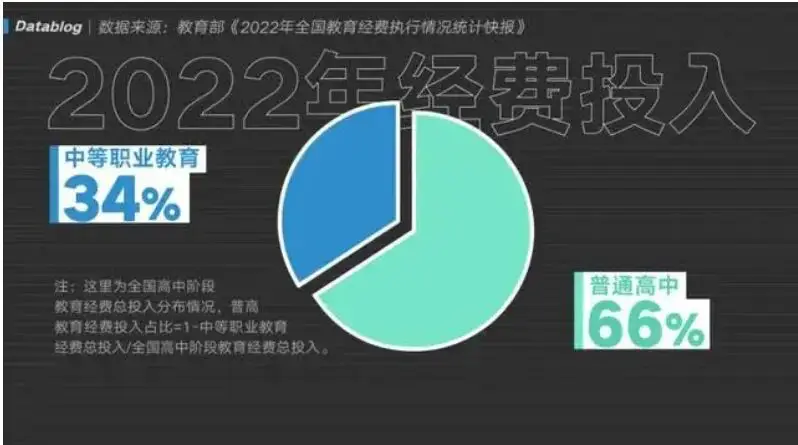
Data analysis shows that the investment in secondary vocational education is generally lower than that in regular high schools, which leads to secondary vocational schools being unable to attract excellent teachers and improve teaching facilities due to insufficient funds.
Teaching equipment may be old and damaged, practical opportunities are often scarce, and so-called school-enterprise cooperation often degenerates into sending students to factories to serve as cheap labor.
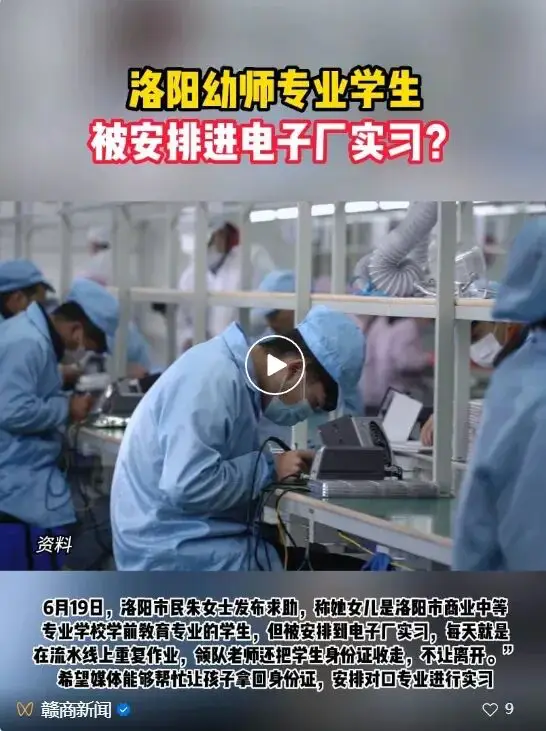
In June 2023, there was a news report about Ms. Zhu from Luoyang, Henan, who posted a plea for help. Her daughter was studying early childhood education in a secondary vocational school but was arranged by the school to intern at an electronics factory in Kunshan City, Jiangsu Province. The internship content was completely inconsistent with her major.
Students performed repetitive tasks on the assembly line, and their ID cards were confiscated by the supervising teacher, restricting their freedom.
During the internship, students worked night shifts from 8 PM to 8 AM the next day, with a wage of 14 yuan per hour and no overtime pay.
Ms. Zhu tried to communicate with the supervising teacher multiple times, but the teacher responded that students could leave, but would be disciplined upon returning to school.
Even worse, many such “school-enterprise cooperation” arrangements do not pay wages, and some even extort money from students, asking them to pay to work on the assembly line in factories, under the guise of “training fees”.
“If you don’t pay the training fee, you can’t start work and intern in the factory. If you don’t intern in the factory, you won’t get a diploma.”
This news was exposed by a CCTV reporter who went undercover several years ago.
In addition, the management capability of schools is also a big problem.
Compared with regular high schools, vocational schools and secondary vocational schools have a wider range of student sources, making them more prone to misconduct such as smoking, drinking, early dating, truancy, and campus violence, which are more common in vocational schools.
The schools appear to be lacking in management, and there have even been extreme management attitudes, such as a vocational school class teacher only requiring “boys don’t die, girls don’t give birth.”
Most of these students are only fourteen or fifteen years old, at a critical stage of value formation, and their self-discipline ability is relatively weak.
In such a lax management environment, children are more likely to go astray.
Many parents now know that learning a skill is better than going to a regular university, but they panic at the thought of their child being thrown into that “dye vat” and learning bad habits instead of skills.
There is also discrimination against secondary vocational graduates in the job market.
To put it bluntly, 80% of the jobs in this society are sufficient for secondary vocational graduates to handle, but now it’s still competitive, and if you don’t do it, there are plenty of others who will.
Don’t you see that the number of university graduates in recent years has reached tens of millions? With so many undergraduates applying for jobs, why should I hire a secondary vocational graduate? Even if they do the same work as an undergraduate, I have to offer them a lower salary.
Under this discrimination, these young children have not become the “blue-collar workers” they were expected to be, but have instead become the main force of the “demographic dividend” that supplements the current labor market gap….
Therefore, educational division is never an isolated educational policy issue; it is a concentrated manifestation of social resource allocation, class mobility, and value concepts.
The real crux of the problem lies not in whether to divide or not, nor in the ratio of division being five-five or four-six.
But rather, can we truly improve the social status and economic treatment of skilled workers, so that they can live a decent and dignified life with their skills?
Even if division is carried out, as long as the treatment of workers is improved, naturally some people will not compete for university degrees and will choose to become skilled workers.
Moreover, this division ratio will be more reasonable than “five-five”.
After all, those who truly love studying and taking exams from the bottom of their hearts have always been a minority.
End of full text, thank you for reading. If you found it useful, please like, share, and comment.
-end-
Written at the end: I have created a “Planet” community, which has been operating for 600 days. Friends with similar values are welcome to join.
Every day, I share some of my observations and thoughts in the community, and you can also ask me questions and progress together at a steady pace, enjoying the beauty of uniform progress~
Discover more from 自由档案馆
Subscribe to get the latest posts sent to your email.