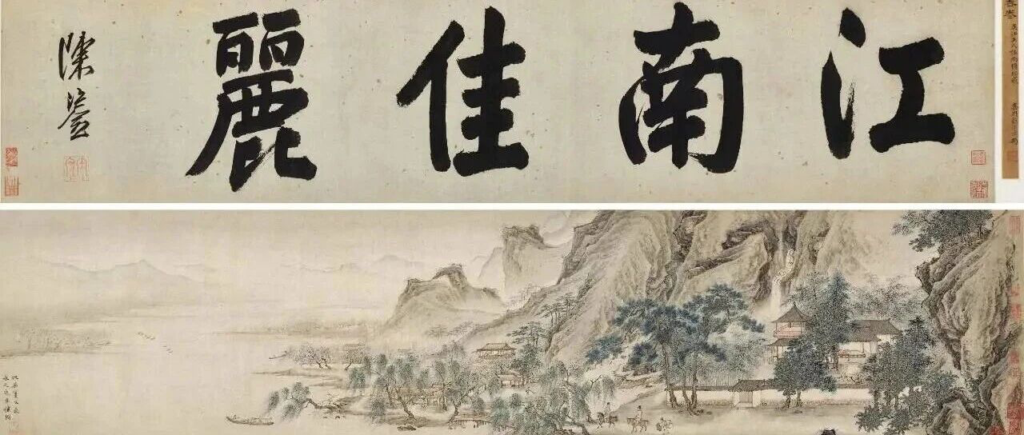
Sold for 2250 yuan
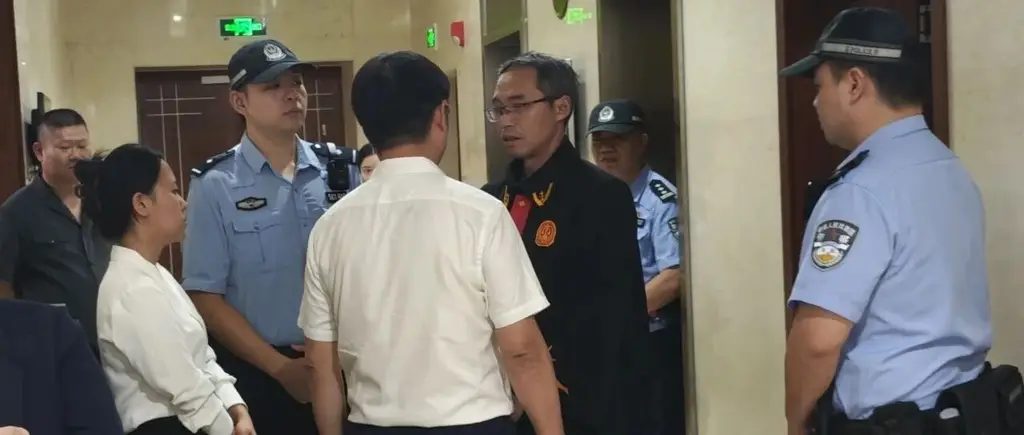
After months of investigation, the investigation into the Nanjing Museum’s illegal sale of the “Jiangnan Spring” scroll donated by the Pang family finally yielded results. According to the Jiangsu Provincial Investigation Team’s report:
In 1997, the then-Executive Vice President of the Nanjing Museum illegally approved the transfer of the “Jiangnan Spring” scroll and other precious cultural relics to the Jiangsu Provincial Cultural Relics General Store for sale, with a price tag of 25,000 yuan.
In the same year, Zhang, a staff member of the Cultural Relics General Store, took advantage of his position to change the price of the “Jiangnan Spring” scroll to 2,500 yuan, and entrusted a friend to purchase it at a 10% discount for 2,250 yuan. Later, the painting was sold to collector Lu for 120,000 yuan.
From 2016 onwards, Lu pledged the “Jiangnan Spring” scroll to the Shizhuzhai Company three times, and later failed to redeem it due to a broken capital chain.
In 2021, the calligraphy and painting merchant Zhu purchased the “Jiangnan Spring” scroll from the Shizhuzhai Company and entrusted it to the Jiade Auction in 2025, with an estimated value of 88 million yuan.
According to the report, Xu Huping, the person in charge, is suspected of serious violations of discipline and law and is under investigation by the Discipline Inspection and Supervision authorities. Zhang, a staff member of the Cultural Relics General Store, is suspected of serious violations of duty and is also under investigation. It can be foreseen that these people will have to go in and step on the sewing machine later.
Now, the “Jiangnan Spring” scroll and another 3 calligraphy and paintings that were illegally sold have been recovered (most likely using state-owned funds to fill the hole) and stored in the Nanbo Calligraphy and Painting Special Library, and another “Songfeng Xiaosi Tu Axis” is missing.
I personally believe that, given the serious management loopholes in the Nanjing Museum’s cultural relics management and the repeated lies in the handling of the incident, causing serious damage to the Pang family’s reputation, the donated paintings should no longer be stored in the Nanbo, but should be returned to the Pang family’s descendants as soon as possible.
The 500-year history of the “Jiangnan Spring” scroll shows that only private collectors who truly understand and respect calligraphy and painting art can protect such artistic treasures.
The creation of the “Jiangnan Spring” scroll itself took decades and is a culmination of the works of many calligraphers and painters of the Ming Dynasty.
Between 1507 and 1509, Shen Zhou and Ni Zan and others created a series of poems and calligraphy works “Jiangnan Spring Ci” at a gathering of literati.
Around 1522, collector Yuan Yi invited Qiu Ying to paint these poems, which is the main part of the painting of the “Jiangnan Spring” scroll;
Around 1530, Wen Zhengming, one of the Four Talents of Jiangnan, left his ink treasures on the “Jiangnan Spring” scroll. At this point, this artistic work, which combines poetry, calligraphy, and painting, has reached its peak.
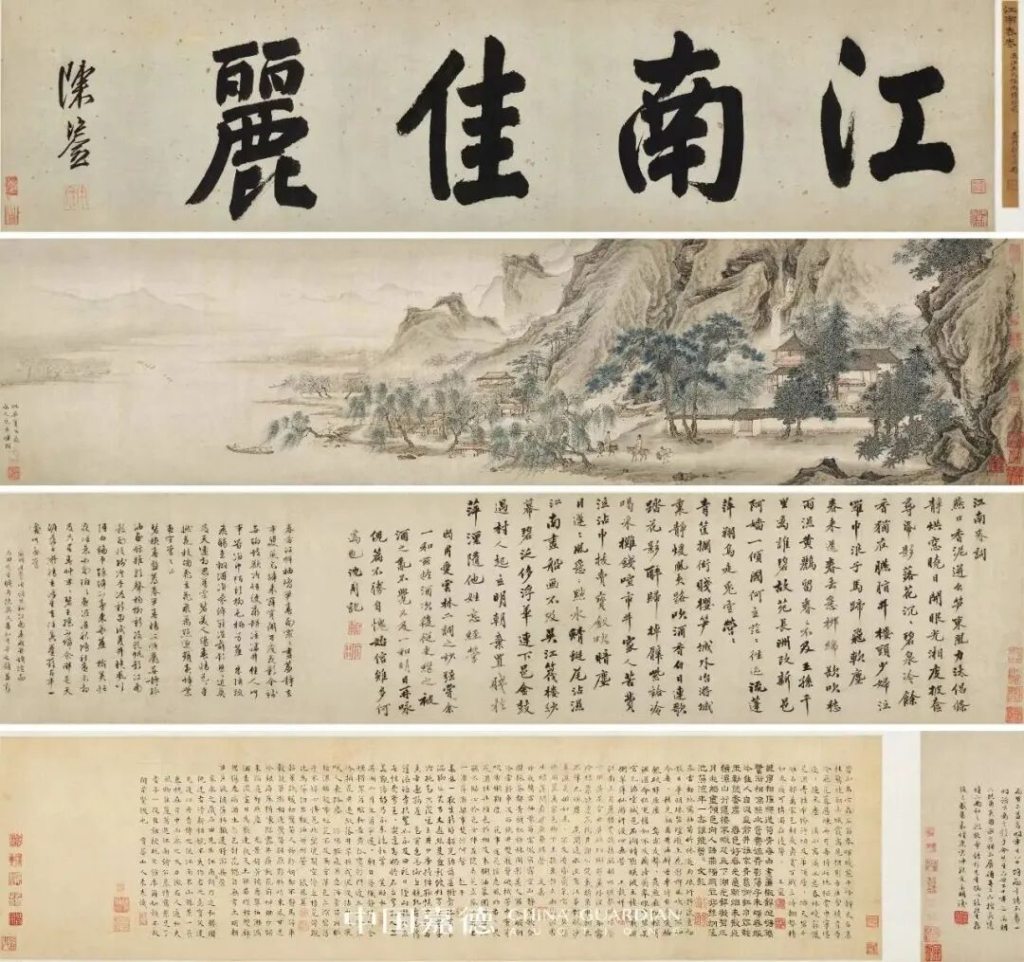
“Jiangnan Spring” scroll
More than a hundred years after the completion of the “Jiangnan Spring” scroll, it encountered its first major disaster in its artistic life – the war at the end of the Ming Dynasty.
In 1645, the Qing army captured the Jiangnan region and massacred the city. The Yangzhou Ten Days, the Jiading Three Massacres, and the Jiangyin Eighty-one Days all occurred during this period. The Qing army’s plunder and destruction of Han culture can be imagined.
During this period, the “Jiangnan Spring” scroll was collected by the Wang family of Wujiang (now Suzhou), and Wang Rentang left his collection seal on the scroll.
Despite the change of dynasty and foreign invasion, the “Jiangnan Spring” scroll is still in the hands of collectors who understand and love painting.
After another 200 years, the “Jiangnan Spring” scroll encountered its second major disaster in its artistic life – the Taiping Heavenly Kingdom War.
In September 1862, the Taiping Heavenly Kingdom army began to attack Suzhou, and by December 1863, it occupied Suzhou. Then, in May 1864, the Qing army reoccupied Suzhou. The nearly 2 years of brutal tug-of-war resulted in countless casualties of soldiers and civilians in Suzhou, and the loss of buildings and artworks was also incalculable.
During this period, the “Jiangnan Spring” scroll was collected by the Suzhou literati Gu Wenbin. Gu’s family was also a famous family in Wuzhong, with the Guyunlou, which collected ancient books and inscriptions and calligraphy and paintings, and enjoyed a high reputation in Jiangnan. During the Taiping Heavenly Kingdom War, the Gu family moved to Shanghai, preserving the “Jiangnan Spring” scroll and other precious artworks, avoiding being burned by the war or plundered by thieves.
After another 50 years, the “Jiangnan Spring” scroll encountered its third major disaster in its artistic life – the fall of the Qing Dynasty.
In 1912, the corrupt and incompetent Qing government collapsed. During the change of dynasty, the power and interest structure of Chinese society underwent earth-shaking changes, and many artistic treasures were also lost overseas or destroyed during this period.
During this period, the seal engraver Chu Deyu guarded the “Jiangnan Spring” scroll. Chu Deyu came from a scholarly family in Yuhang, and his family had been calligraphers and epigraphers for generations. He himself had written many monographs on epigraphy.
In the hands of collectors who truly protect artistic treasures, the change of dynasty will not ruin calligraphy and painting. This is the millennium cultural heritage of Chinese literati.
After that, the “Jiangnan Spring” scroll came to the Pang family in Nanxun, Zhejiang, and was collected and guarded by Pang Laichen.
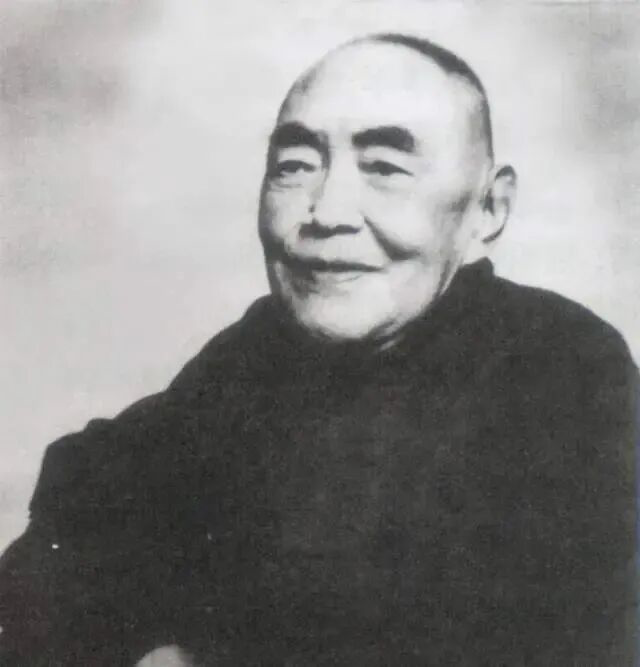
Collector Pang Laichen
In November 1937, the Japanese invaders invaded and Nanxun fell. During the occupation of Nanxun, the Japanese army wantonly destroyed and plundered, and countless cultural relics were lost and damaged during this period. This is the fourth historical disaster experienced by the “Jiangnan Spring” scroll.
It was the Pang family, it was Mr. Pang Laichen who guarded the “Jiangnan Spring” scroll, neither taken away by the Japanese invaders, nor damaged by the war, nor sold at a low price and lost.
Later, in 1949, the Kuomintang army retreated to Taiwan, taking away a large number of cultural scholars and cultural relics from the mainland, and the rich Jiangnan region was the first to bear the brunt. But the Pang family did not follow the Kuomintang to Taiwan, and the Xuzhai collection, which was the best in Jiangnan, was not taken away by the Kuomintang army.
For the protection and inheritance of the “Jiangnan Spring” scroll, the Pang family can be said to have made great contributions.
In 1959, Pang Zengho, the grandson of Pang Laichen, donated 137 Xuzhai collections to the Nanjing Museum, including the “Jiangnan Spring” scroll.
Later, in the late 1960s, the “Jiangnan Spring” scroll also experienced the “Four Olds Destruction” disaster during the Cultural Revolution. This time, it was the then-President of the Nanjing Museum, Yao Qian, who guarded it and prevented it from being burned.
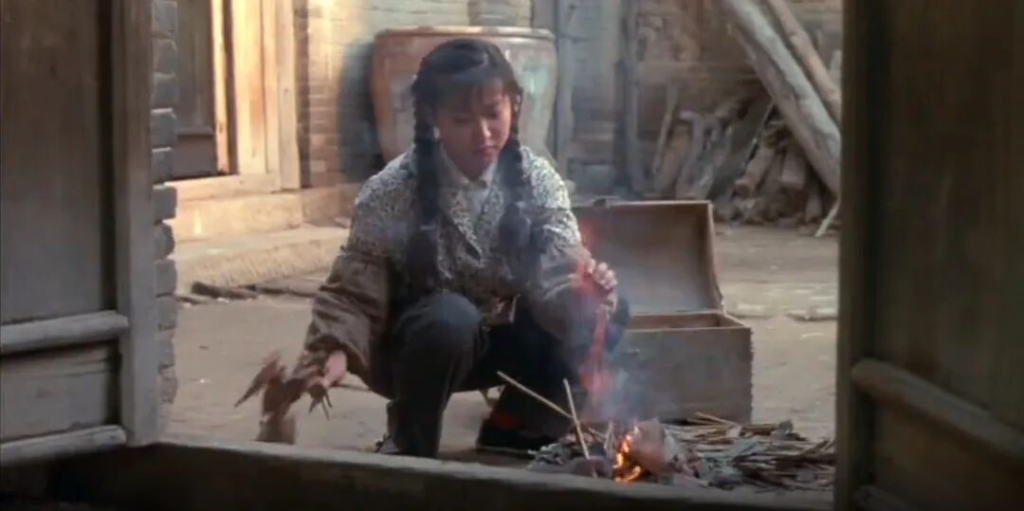
The scene of burning cultural relics in the movie “To Live” during the “Four Olds Destruction”
The “Jiangnan Spring” scroll, which has experienced 500 years of vicissitudes, has survived one disaster after another, including the Qing army, the Taiping army, the Japanese army, the Kuomintang, and the “Four Olds Destruction”, under the protection of generations of literati and righteous people, and it is not easy to pass it down to this day.
Until 1997, it was conspired by Xu Huping and a group of villains to be identified as a forgery and sold at a low price of 2250 yuan, and since then, the pearl has been covered in dust.
How sad, how lamentable, how shameful.
Dongliang’s note: This article was inspired by the WeChat public account “Not Mainstream Speech”, and has been authorized by the original author. I would like to express my gratitude here. The content of the article is original by Xiang Dongliang.
Discover more from 自由档案馆
Subscribe to get the latest posts sent to your email.