




By | Da He
Entering 2026, many places have successively announced the 2025 marriage registration data.
After years of continuous decline, a change has begun to be frequently mentioned—in many cities, the number of marriage registrations has shown a significant rebound.
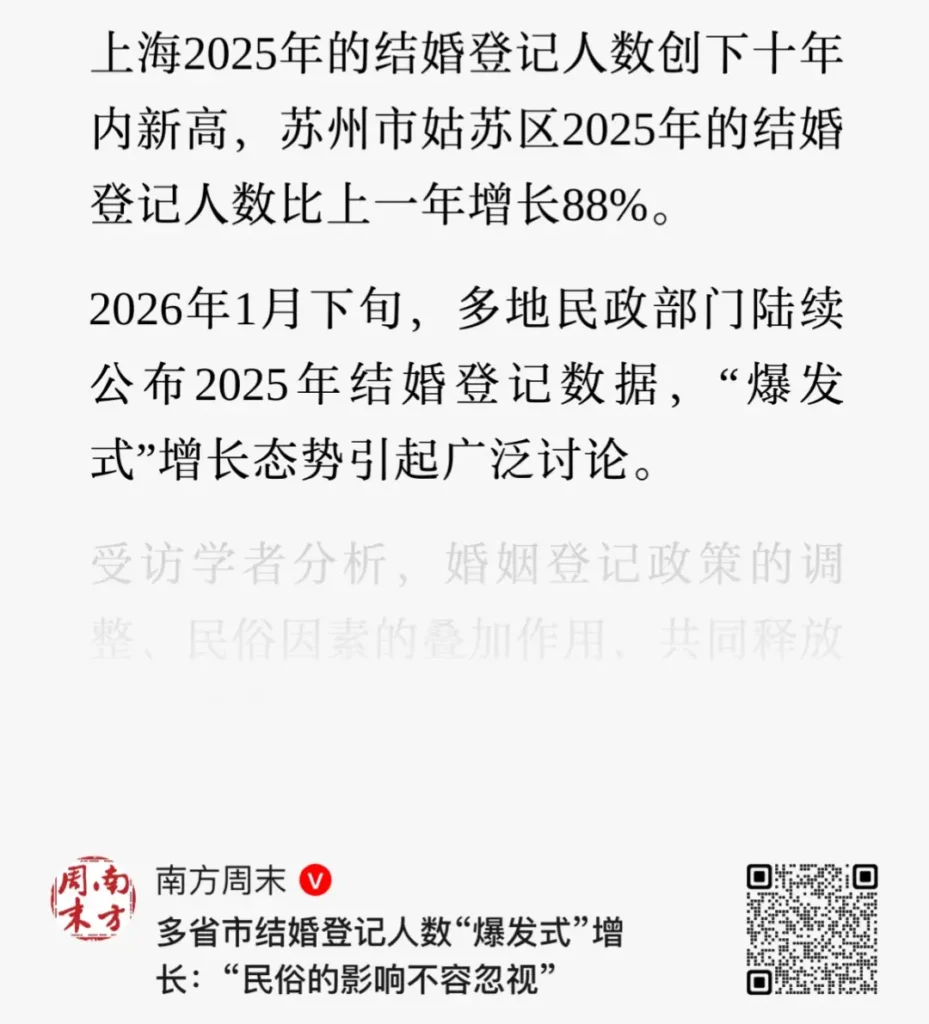
For example, in Shanghai, the total number of marriage registrations in 2025 increased by about 38.7% compared to 2024, reaching a new high in nearly nine years.
The number of marriage registrations in Shenzhen increased by 28.54% year-on-year, reaching a new high in nearly 5 years.
Statistics from the Fujian Provincial Department of Civil Affairs show that in 2025, the number of marriages in the province was 169,756, an increase of 12% year-on-year.
Looking at the national scope, the data for the fourth quarter has not yet been released. In the first three quarters, there were 5.152 million couples, an increase of 405,000 compared to last year, a year-on-year increase of 8.5%.
Many people online are singing the blues about marriage and childbearing, saying that not marrying or having children is a way to stay safe. As a result, when the statistical data came out, hey, the clown is actually me.
The titles of various media outlets are filled with joy, as if young people have finally figured things out and are starting to believe in love again.
However, I have to say another 'however', let's not be in a hurry to pop the champagne.
The good news is, of course, that the number of marriages last year has increased in the data,
The bad news is that the release of the last wave of people willing to marry can only last to this extent.
Let's assume the data is pure and without any embellishment.
This 'significant increase' in the number of marriages in many places refers to an increase of 405,000 in the number of marriage registrations in the first three quarters compared to last year.
I'll assume that the increase for the whole year is 700,000 (we'll count a little more at the end of the year), then the total for this year will be 6.8 million couples.
This is still 900,000 less than in 2023, and about the same as in 2022.
There's nothing else to it, it's just that the data for 2024 was too low, hitting a new low in nearly half a century. If it doesn't rise this year, it's really GG.
However, I see a more optimistic view, saying that 'no spring year, no marriage' in 2024 and 'double spring year, marriage' in 2025 will inevitably cause a difference in the marriage registration data between 2024 and 2025.
Damn it, don't underestimate the constraints of folk customs on young people!
But, in 2013, as a 'no spring year', the number of marriage registrations reached a peak in nearly 20 years, how do you explain this?
The battle reports may deceive people, but the front lines will not.
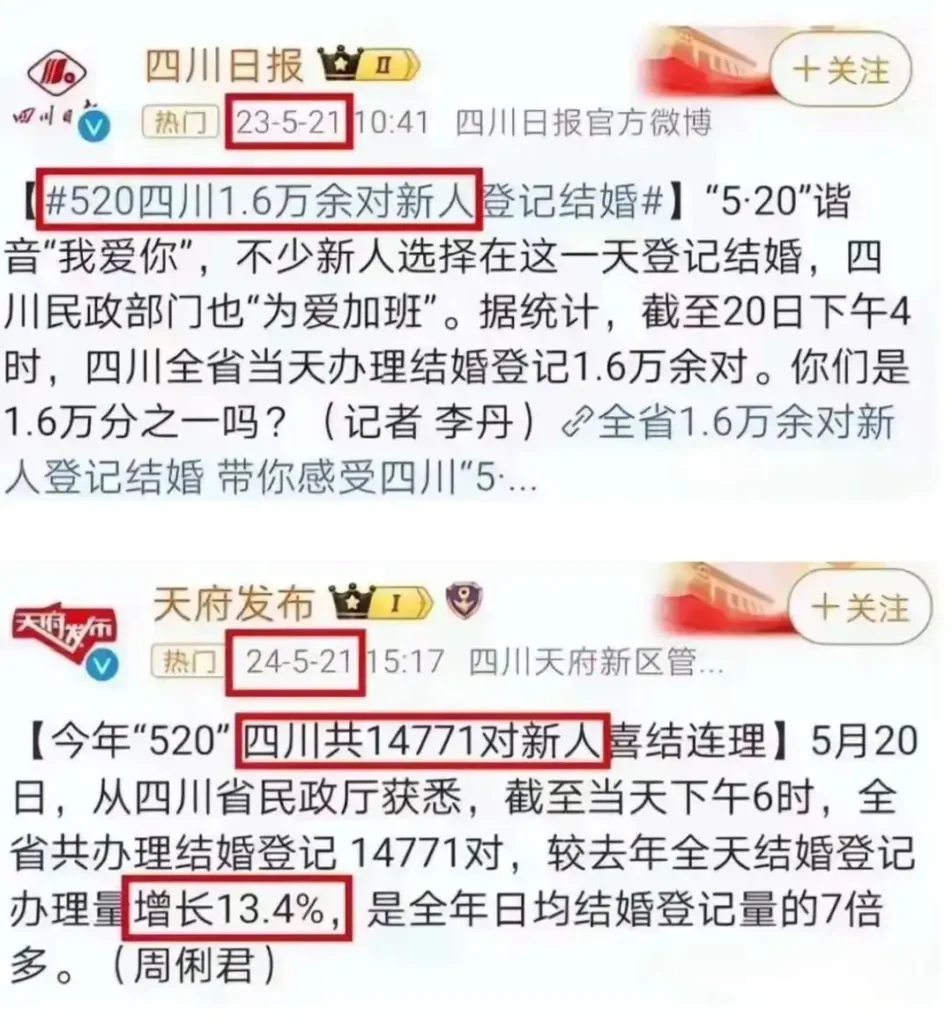
The battle reports of 520 and Qixi Festival every year are all booming, but the real front lines are retreating step by step.

Since reaching a peak of 13.46 million couples in 2013, the number of marriages has been declining year by year, with the data halved in 9 years;
The only rebound currently is in 2023, with 7.68 million couples, because the accumulated demand from the previous three years was released.
Then, once the release is complete, it will fall back. In 2024, the number of marriages was 6.1 million, nearly 1.6 million less than in 2023 and 700,000 less than in 2022.
Looking at the trend of the overall data, I don't think anyone will conclude that the number of marriages is warming up just because of an increase of about 8.5% in 2025.
To be honest, this kind of battle report that reports good news and not bad news may be a bad thing rather than a good thing. If the sense of urgency at the policy level is delayed because of this, then it's really a case of celebrating a funeral.
Many times, we all know what the facts are in our hearts, but we are emotionally unwilling to admit it.
But when the reality of the south wall hits us, we find that this wall was originally built on the edge of a cliff.
What is that most solid south wall?
It's the population structure.
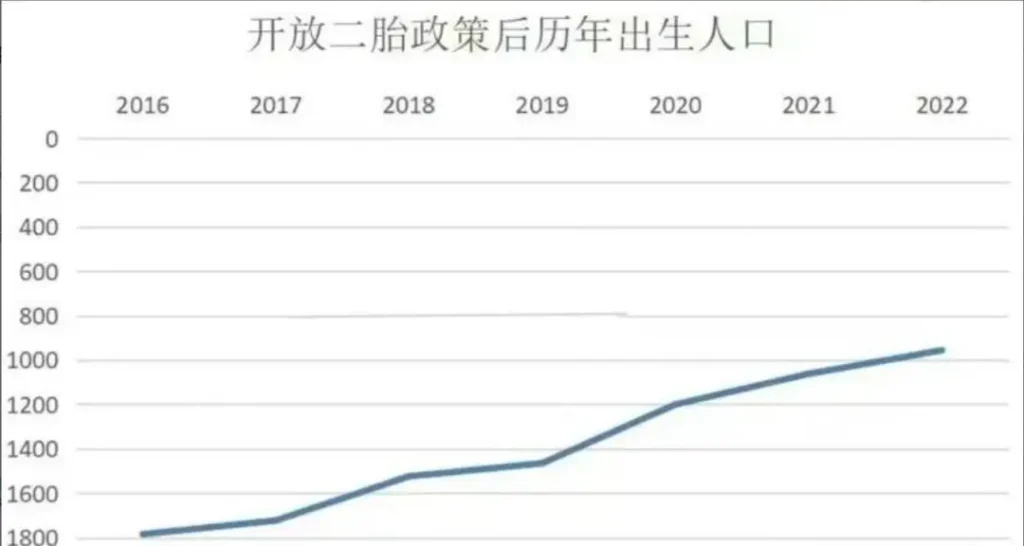
Currently, the average age of first marriage in our country is around 31 years old, which corresponds to the generation born around 1994.
In 1994, the number of births in our country was 20.98 million.
And after 1997, the birth rate began an irreversible rapid decline.
The post-00s have now reached the age of marriage, and the number of post-00s is 41 million less than that of the post-90s.
This means that in the next few years, the base of young people, who are the main force of marriage, will enter a channel of rapid shrinking.
So don't pay attention to the rebound in a certain year. In the face of the population structure, any explanation is pale.
When the denominator of the marriageable age population itself is shrinking rapidly, no matter what short-term policies we use to beautify the numerator, the long-term trend of this ratio is difficult to reverse.
We can't just rely on giving out eggs, can we?

Of course, some local civil affairs departments are racking their brains to find ways to urge marriage, and even opened marriage registration offices in nightclubs, concerts, and universities.
It can be said that as long as you want to get married, the Civil Affairs Bureau wants to move directly to your downstairs.
These efforts may bring a beautiful short-term report, but for the core goals of stabilizing marriage relationships and boosting the birth rate, the impact is minimal.
This exposes a pattern that we are very familiar with:
We are keen to talk about 'long-term mechanisms', but in action, we always prefer 'short-term attacks'.
This approach may release a batch of existing demand in the short term, creating a prosperous scene, but it cannot build a sustainable future.
Finally, let's talk about a more interesting angle.
They have been deducting from farmers' pensions for so many years, but they suddenly became so 'generous' and gave subsidies of 3,600 yuan a year to newborns.
If the data is really so good, and everyone really wants to get married and have children, why did they suddenly become so 'generous'?
The end of the article, thank you for reading. Since you've seen it here, if you think it's good, please like, forward, and watch.
-end-
Written at the end: I have built a planet community, which has been operating for more than a year. Friends with similar views are welcome to join. It is currently 99 yuan a year, which is only a few cents a day. I will consider increasing the price appropriately when there are more people.
I will share some of my insights and thoughts in the planet every day, and you can also ask me questions. Let's make progress together and enjoy the beauty of steady progress~
In addition, to prevent loss of contact, please follow Da He's backup account.