2025 marks the 80th anniversary of the end of the Sino-Japanese War. Against the backdrop of rising anti-Japanese sentiment and expressions of hatred towards Japan among many viewers following the recent release of the film “Nanjing Photo Studio” in China , we attempt to answer a question that has puzzled many Chinese people for years by examining the declassified, but little-known, 1972 Sino-Japanese diplomatic negotiation archives from the Japanese Ministry of Foreign Affairs: Why did the Chinese side take the initiative to waive war reparations back then? What exactly did China gain?
After reading these detailed meeting minutes and policy guidelines, a core feeling emerges: the Sino-Japanese negotiations at the time were guided by national interests and law on the Japanese side, demonstrating a high degree of professionalism; while the Chinese side was guided by ideology and political vanity, and its negotiating tactics appeared quite amateurish . This difference led the Chinese side to make huge concessions in terms of substantive interests while winning a formal “recognition” .
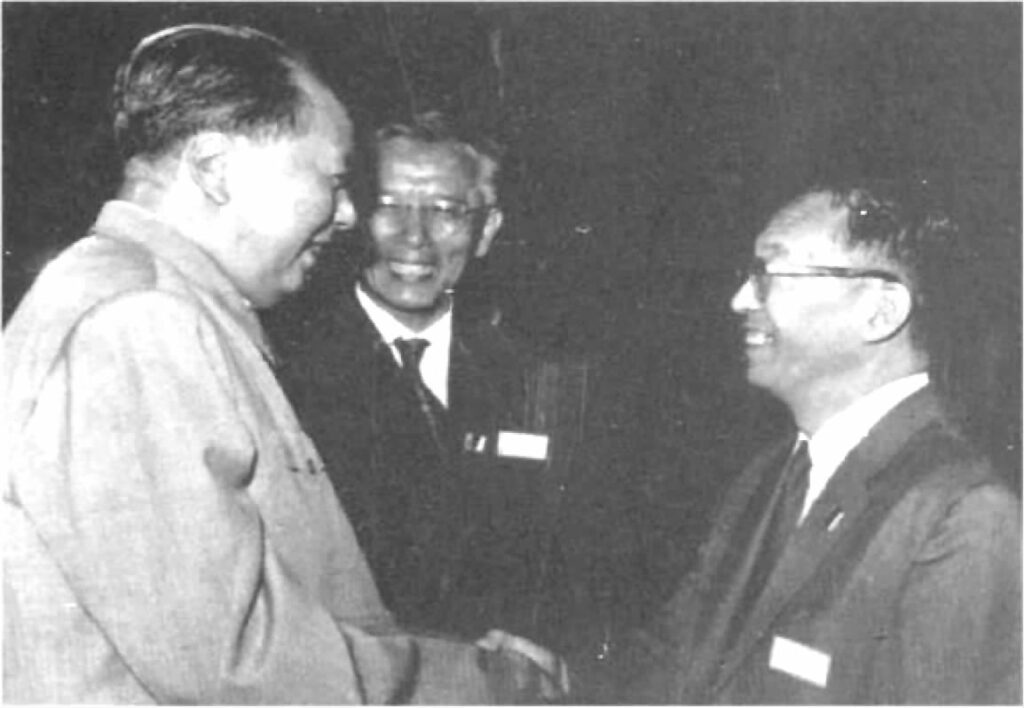
On August 23, 1964, Zhou Peiyuan (center) accompanied Mao Zedong in meeting with the head of the Japanese delegation, Masakazu Sakata (right)
Background of Diplomatic Relations: China’s Urgency to Break Isolation
In early 1972, Nixon’s visit to China shocked the world, and China and the United States shook hands to jointly deal with the Soviet Union . At this time, China urgently needed to break the blockade of the Western camp and gain international recognition. Japan, as an important member of the Western camp and an ally of the United States, and as a country that had fought a war with China for eight years, became the key target for China’s diplomatic breakthrough .
In July 1972, a dramatic change occurred in Japanese politics. Eisaku Sato, who was pro-Taiwan, stepped down, and Kakuei Tanaka defeated Takeo Fukuda to become Prime Minister . Tanaka Kakuei came from a grassroots background and had a relatively friendly attitude towards China. He released signals to promote the normalization of diplomatic relations at the beginning of his term .
At this time, Sun Pinghua (then head of the Shanghai Ballet Troupe), who was conducting “ballet diplomacy” in Japan, received an urgent instruction from China . Zhou Enlai conveyed a top-secret message through special envoy Chen Kang, requesting Sun Pinghua and Xiao Xiangqian, the economic and trade representative in Japan, to “spare no effort” to facilitate Tanaka Kakuei’s visit to China . To this end, Sun Pinghua and others, through Hashimoto Hiroshi, the head of the China Division of the Japanese Ministry of Foreign Affairs, secretly met with Japanese Foreign Minister Masayoshi Ohira on July 22 under the cover of a barber shop at the New Otani Hotel, and officially conveyed Zhou Enlai’s invitation .
Fatal Mistakes: Takeiri’s Notes and the Loss of All Cards
At the urgent invitation of the Chinese side, Yoshikatsu Takeiri, the chairman of the Japanese Komeito party, flew to Beijing on July 25 to act as a “pathfinder.” This visit became a major strategic mistake in China’s diplomatic negotiations.
From July 27 to 29, Zhou Enlai held three meetings with Takeiri. In order to show sincerity and win over Japan, Zhou Enlai revealed China’s negotiating bottom line:
- Waiver of reparations: Mao Zedong had decided to waive war reparations from Japan. This news shocked Takeiri.
- Defaulting on the Security Treaty: China no longer insisted on opposing the “Japan-U.S. Security Treaty”.
- Taiwan issue tacit understanding: The Chinese side acknowledged the difficulty in handling Taiwan and proposed to sign “secret clauses”, that is, not to mention the details of Taiwan in the joint statement, but the two sides reached a tacit understanding (recognizing the PRC as the only legitimate government, Taiwan as an internal affair, Japan withdrawing its embassy, etc.).
- Three Principles of Resumption of Relations: Adhere to the People’s Republic of China as the only legitimate government, Taiwan is a part of China, and abolish the Japan-Taiwan Treaty.
Zhou Enlai even said that compared with the Five Principles of Peaceful Coexistence, the Diaoyu Islands issue “is not important at all.” Yoshikatsu Takeiri compiled these contents into a 52-page “Takeiri Notes” and brought them back to Tokyo on August 4 to give to Kakuei Tanaka. Tanaka Kakuei initially did not believe that the Chinese side would make such a huge concession and even suspected that Takeiri had been deceived. After confirming that Zhou Enlai had indeed promised, Tanaka Kakuei immediately decided to visit China.
However, the Japanese Ministry of Foreign Affairs, which had mastered China’s bottom line, quickly established a response team composed of Masayoshi Ohira, Takashima (Director of the Treaty Bureau), and others, and formulated a tough negotiation strategy “based on existing legal provisions (such as the 1952 Japan-Taiwan Treaty)”, preparing to dismantle China’s offensive at the negotiating table.
Beijing Negotiations: Warm Reception and Cold Confrontation
On September 25, 1972, Kakuei Tanaka visited China. The Chinese side was meticulous in its reception, even specially airlifting miso and rich persimmons from Tanaka’s hometown, which greatly moved Tanaka. But in the subsequent negotiations, the Japanese side showed extremely high professional barriers.
1. The “Trouble” Incident At the welcome banquet, Tanaka Kakuei said in his speech that Japan’s invasion of China had “caused trouble” (Meiwaku) to the Chinese people. This word is very light in the Chinese context and caused strong dissatisfaction from Zhou Enlai and other Chinese leaders. In fact, this was a carefully chosen word by the Japanese Ministry of Foreign Affairs, which both took into account the sentiments of the anti-communist and pro-Taiwan forces in Japan and was the limit of apology acceptable to the Japanese political circles at that time.
2. The Duel of Legal Provisions In the subsequent foreign ministers’ negotiations, Takashima, the director of the Japanese Treaty Bureau, wielded legal weapons, catching the Chinese side off guard:
- Regarding the end of the state of war: The Japanese side insisted that the treaty signed with the Republic of China in 1952 had ended the state of war. If the Chinese side demanded to announce “the end of the state of war” in the joint statement, it would be equivalent to denying the legality of the 1952 treaty (that is, the Japanese parliament approved a fake treaty), which Japan could not accept.
- Regarding reparations: Takashima pointed out that since the Republic of China had already announced the waiver of reparations in the annex to the treaty in 1952, the right to reparations had already disappeared. Therefore, it was not that the Chinese side “waived” reparations (giving Japan face), but that the Chinese side could only accept the reality that “the right to reparations does not exist”.
- Regarding Taiwan: The Japanese side, citing the Potsdam Proclamation, claimed that it could not determine the ownership of the territory (Taiwan) that had been abandoned and refused to directly recognize that Taiwan belonged to China.
The Japanese side’s strong logic “stunned” the Chinese side. Zhou Enlai had to intervene, emphasizing that the negotiations should be “politically led” rather than “legally led”, and even accused Takashima of being a “law bandit”.
Mao Zedong’s Intervention and Final Compromise
The negotiations once reached an impasse. On the evening of September 27, Mao Zedong met with Kakuei Tanaka in his study, presented him with “Chu Ci Collection and Notes”, and did not dwell on specific clauses, but set the political tone of “the statement must be signed”. That night, the two sides stayed up late until two o’clock in the morning, and finally finalized the text.
Analyzing the finally signed “Sino-Japanese Joint Statement”, it is not difficult to find that the Chinese side made a comprehensive compromise on substantive content for the sake of the political goals of “face” and “establishing diplomatic relations”, while the core demands of the Japanese side were almost all realized:
- Regarding the state of war: The statement did not use the term “end the state of war”, but used the Japanese side’s proposal of “end the abnormal state between China and Japan”. This blurred the concept of time and actually defaulted to Japan’s legal interpretation of the validity of the 1952 treaty.
- Regarding war responsibility: The statement stated that “the Japanese side deeply feels… responsibility and expresses profound reflection”. It removed the “assume responsibility” required in the original draft of the Chinese side, characterized the responsibility as the past tense, and had no substantive legal obligation to compensate.
- Regarding the Taiwan issue: The Chinese side reiterated that Taiwan is an inalienable part, while the Japanese side only expressed “full understanding and respect” (not “accept” or “recognize”) and insisted on following Article 8 of the Potsdam Proclamation (that is, not to determine the ownership).
- Regarding reparations: The Chinese side officially announced that it “waives its claim for war reparations from Japan”.
Conclusion: Lessons of Face and Substance
Looking back at this history, the Chinese side revealed its bottom line too early before the negotiations, and sacrificed many “substantive” things in the negotiations for the “form” of the summit meeting. The so-called “anti-hegemony” and “peaceful coexistence” clauses insisted on by the Chinese side did not have much substantive binding force in the future, while the waiver of reparations, the ambiguous handling of the Taiwan issue, and the shelving of the Diaoyu Islands have become long-term regrets.
This kind of diplomacy that prioritizes ideology and politics and ignores international law and specific national interests ultimately allowed China to win face but lose substance. Today, 80 years later, re-examining this archive is not to perpetuate hatred, but to learn lessons: true diplomatic normalization should transcend ideology and focus on national interests.
Discover more from 自由档案馆
Subscribe to get the latest posts sent to your email.