


——Gender infringement, legal overreach, and historical echoes in the name of public health
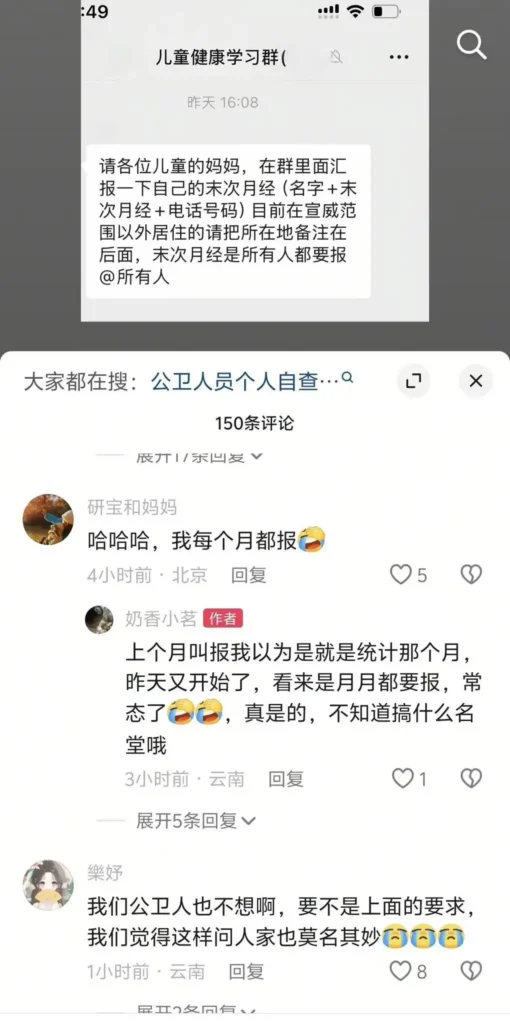
Recently, a shocking situation has emerged in parent groups in some areas of Beijing: public health departments are requiring parents of kindergarten or elementary school children to report "the mother's next menstrual period, name, and phone number," and even repeat the statistics every month. Screenshots show that the implementers are often grassroots public health personnel, while parents are generally dissatisfied but seem helpless.
This behavior quickly sparked heated discussions online in China, and was humorously dubbed by the public as "Menstrual Police". Although the authorities have not publicly acknowledged such policies, it can be confirmed from the specific implementation requirements of the parent groups that it is starting a pilot statistical approach under the name of "public health management".
1. Forcing the reporting of women's menstrual cycles, which laws in China are violated?
Regardless of the name, requiring women to disclose and regularly report their menstrual cycles is a fundamental infringement of personal privacy, bodily autonomy, and dignity. Within the current legal framework, this behavior violates multiple legal provisions.
1. "Civil Code"
Articles 1032 and 1033 of China's "Civil Code" clearly protect citizens' right to privacy and personal information rights.
- Menstrual cycles are highly sensitive personal health information
- Any organization or individual shall not collect, disclose, or compulsorily provide it without the explicit and free consent of the person concerned
The so-called "statistical public health data" cannot be a reason to override the law.
2. "Law on the Protection of Women's Rights and Interests"
Articles 24 and 38 of the revised "Law on the Protection of Women's Rights and Interests" in 2023 emphasize:
- No unit or individual shall infringe upon women's right to privacy
- Discrimination and humiliating management based on gender or physiological characteristics are not allowed
Forcing the reporting of menstrual cycles clearly constitutes institutionalized humiliating management of women's groups.
3. "Personal Information Protection Law"
The law lists health information as "sensitive personal information" and requires:
- It must "have a specific purpose and be fully necessary", and
- With "explicit consent of the individual in the knowledge of the situation"
Public health departments obviously cannot prove that the statistics of women's menstrual cycles are "necessary for public health work", and it is even less possible to meet the "principle of necessity".
4. "Public Security Administration Punishment Law"
Collecting women's private information without legal authorization constitutes "illegal acquisition of personal information" and can be held accountable.
In other words:
This is not administrative management, but illegal behavior. No public health, school, or community organization has the legal power to require women to report their menstruation.
2. Why would the CCP do this?
Everything starts with the population crisis and "body nationalization"
From a logical point of view, it is not surprising that the CCP is implementing such measures.
China's population has entered a historic collapse:
- Negative growth in 2023 and 2024
- The fertility rate has fallen to the lowest in the world (between 0.8 and 1.0)
- Women are generally unwilling to have children
- The number of births in major cities such as Beijing and Shanghai has been halved
Against this backdrop, the Chinese government is accelerating towards a model of "state control of women's wombs":
- Restrict abortions, rectify gynecology hospitals
- Advocate "eugenics and high-quality parenting"
- Plan "mandatory fertility registration system"
- Emphasize "childbirth is a citizen's obligation"
Forcing the statistics of menstrual cycles is an inevitable result after regarding women's bodies as "the state's reproductive resources".
Once the government has mastered women's menstrual cycles, it can:
- Infer whether pregnant
- Determine whether there has been a miscarriage or abortion
- Determine whether "not in accordance with policy childbirth"
- Implement intervention, pressure, tracking, and even punishment
Historically, only totalitarian states would manage women in this way.
3. The lessons of Romania: Ceaușescu's "menstrual monitoring system"
This reporting system is not the first time it has appeared.
In the 1960s–1980s, Ceaușescu's Romania, in order to increase the population, issued decrees banning abortion and contraception, and established the infamous:
"Menstrual Police System"
Its methods are highly similar to those of Beijing, China today:
- The state requires women to report to their units or clinics every month
- Doctors check whether they have their period
- If not, suspect pregnancy and be forced to undergo examination
- If abortion is found, they may be arrested
- If unmarried pregnancy, they are humiliated and forced to register
- If pregnant, they are forced to give birth
Public health personnel become tools for the state to control women's bodies.
The final result:
- A large number of women were forced to stay away from regular medical care and have abortions on their own, leading to a sharp increase in the number of deaths
- A large number of unwanted babies were born and eventually sent to orphanages, leading to the famous "Romanian Orphan Tragedy"
- Economic collapse and public resentment
- The 1989 revolution broke out, and Ceaușescu was overthrown and executed
- The "menstrual monitoring system" was regarded as one of the darkest symbols of totalitarianism and was severely condemned by the international community
Romanian history tells us:
Forcing the monitoring of women's menstrual cycles is a typical feature before the decline of totalitarian autocracy.
Is China moving towards a Romanian-style "body totalitarianism"?
According to the screenshots of the Beijing parent group and various recent policy signals, it can be judged that:
- The CCP is testing the bottom line of society
- If the pilot is not strongly opposed, the system may be quickly promoted nationwide
- In the future, it may be directly combined with "fertility registration", "fertility indicators", and "management of women of childbearing age"
- Women's bodies will be completely incorporated into the state governance system
This policy not only has no legal basis, but is also a comprehensive infringement of personal dignity, privacy, and bodily autonomy, which is a typical:
Gender oppression + state violence + totalitarian governance model
Romania has already proved in history:
A state that interferes with women's bodies will eventually be swallowed by the anger and tragedy it creates.