It lay on the desk of lawyer Guo Jianxin of Jiangsu Nuosheng Law Firm, marking the end of an information disclosure application.
Lawyer Guo wanted to see the accounts of the Shaolin Temple, an ancient temple, and the response from the Ethnic and Religious Affairs Bureau of Dengfeng City was concise and clear:
Abbot Shi Yongxin is suspected of criminal offenses, and the temple’s finances under his administration are now a state secret.
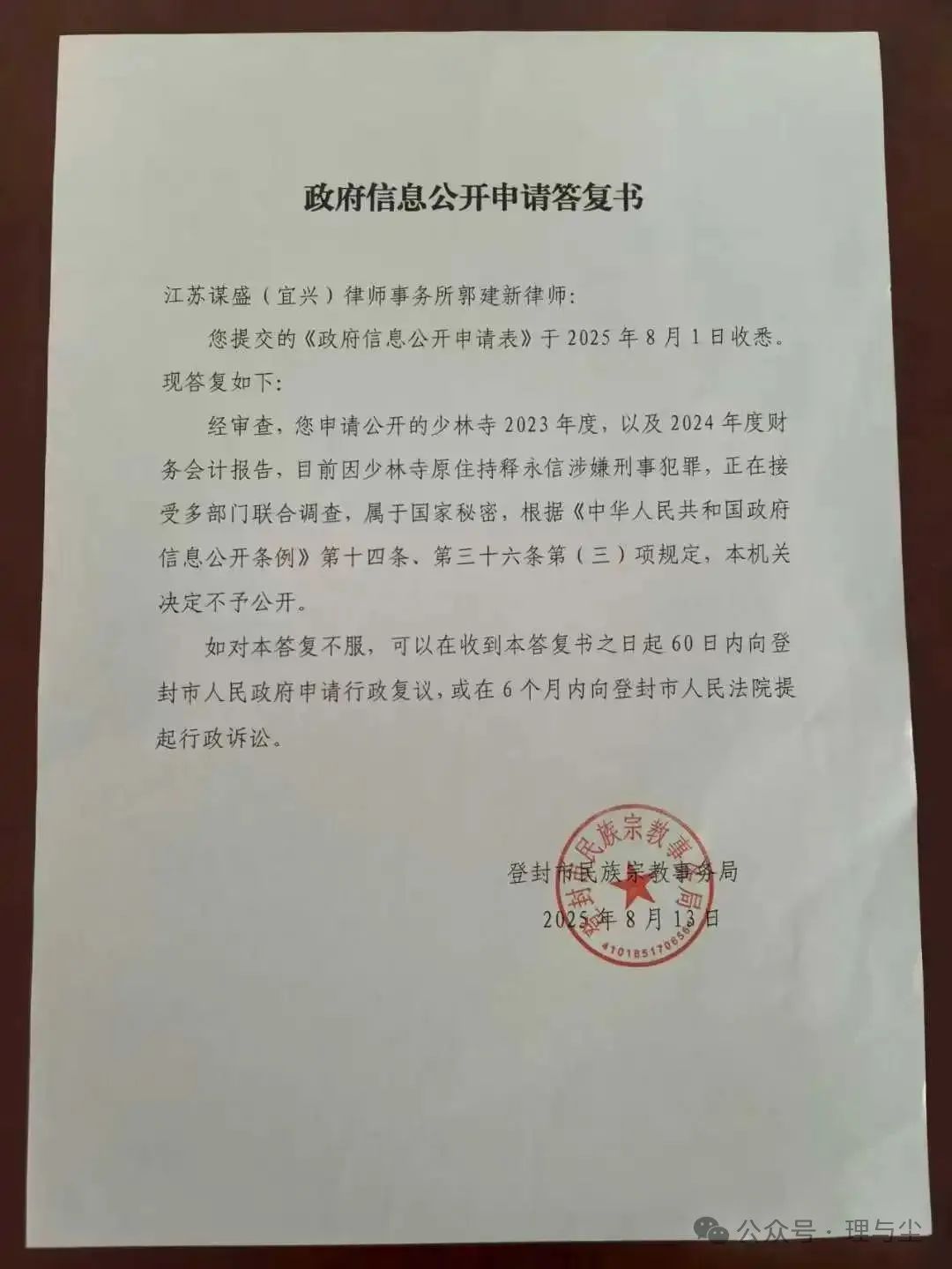
This “Reply to Government Information Disclosure Application” dated August 13, 2025, precisely welded two seemingly unrelated things together: the downfall of a famous monk and a ledger that refused to be opened.
From then on, the path to the core wealth of Shaolin Temple was no longer guarded by Bodhisattvas or monastic rules, but by Articles 14 and 36 of the “Regulations on Government Information Disclosure”.
The public’s curiosity collided with a high wall built of legal provisions.
Before Shi Yongxin fell, he was the most powerful abbot in China, a contradictory figure who moved between the Buddhist hall and the board of directors.
Since taking charge of Shaolin in 1999, he has transformed a dilapidated temple into a huge business empire.
According to public reports, his “Henan Shaolin Intangible Assets Management Co., Ltd.” has invested in many companies, with businesses spanning culture and tourism, food, and even medicine.
Hundreds of trademarks of Shaolin Temple have been registered, almost encompassing all conceivable categories.
In 2023, this company even spent 452 million yuan to buy a commercial land in Zhengzhou, preparing to build:
A real estate project.
Overseas, Shaolin Temple’s business map is equally spectacular.
According to media reports, its branches are located in more than forty places around the world, and it even plans to purchase land in Australia to build hotels and golf courses.
The abbot himself frequently attended social events, from the United Nations podium to the Meta headquarters, the figure in the cassock and the logic of modern business going hand in hand.
He was jokingly called the “Shaolin CEO” by the outside world, and a more popular title was:
Flower Monk, Big Businessman.
Rumors and controversies, like the smoke of incense, have never dissipated in the sky above Songshan.
Expensive cassocks, luxury cars worth millions, and accusations about his relationships with multiple women and having illegitimate children have been hot topics of discussion for many years.
These accusations reached their peak in 2015, when his disciple Shi Yanlu wrote a long article of tens of thousands of words, exposing his master’s “seven deadly sins”.
That storm ended with an official clarification.
A 2017 investigation report stated that the accusations against Shi Yongxin’s economic problems lacked evidence, and the most sensational rumors of illegitimate daughters were also defined as:
Not found.
History played a cruel joke here.
Ten years later, when Shi Yongxin was jointly investigated by multiple departments, the crimes in the official report were highly consistent with the content of the disciple’s report that year.
According to online news, this included misappropriation and embezzlement of temple funds, as well as long-term improper relationships with multiple women.
What was denied that year has now become the reason for the case. And the financial problems that were the focus that year have now gained a new identity.
According to the “Administrative Measures for the Financial Management of Religious Activity Venues” implemented since 2022, the temple’s finances should be “regularly disclosed in an appropriate manner” to believers and clergy.
This regulation aims to let the sunshine shine into the donation box.
However, when lawyer Guo Jianxin tried to take a look at this, he received a reply that, due to the abbot’s criminal case being investigated, these financial reports that should have been “appropriately disclosed” are now state secrets.
This logical chain is perfectly closed:
Because the abbot is suspected of embezzlement, the temple’s finances have become evidence in a criminal case; because it is evidence, it has become a state secret; because it is a state secret, it cannot be disclosed to you.
An investigation aimed at fighting corruption has objectively reinforced the most solid lock on the financial black box.
The public’s questions about the temple’s annual income and expenditure of hundreds of millions of yuan finally received a “no comment” with an official seal.
A legal procedure aimed at pursuing transparency ultimately led to more thorough secrecy.
For thousands of years, people have always thought that what separates the sacred from the secular is the high wall of the temple. Inside the wall are the morning bells and evening drums, the green lamps and ancient Buddhas, and outside the wall are the bustling world and the pursuit of profit. But they were wrong, what that wall really separates may only be the inside and outside of the accounts.
When faith can be quantified into tickets, incense, and investment returns, what supports it is no longer the scriptures, but the financial statements.
There is no more absurd drama in this world than this. People light incense and pray for the Buddha to show his spirit, but they do not know that behind the Buddha statue, another set of logic is already running.
Discover more from 自由档案馆
Subscribe to get the latest posts sent to your email.