First of all, I am from Hunan. Secondly, I studied environmental science in university. Although I have graduated for many years and have not been in this industry, I still have the basic knowledge. Benzene is very dangerous, very, very dangerous, and not easily detectable.
The impact of this stuff on the human body is long-term. To emphasize, benzene is a Group 1 carcinogen.
Currently, the official information only includes the following: 1) The overturned tanker truck was carrying 33.5 tons of crude benzene; 2) The leaked crude benzene has flowed into the nearby river, the Xiao River; 3) Rescue workers have constructed 7 dams to intercept the pollutants; 4) The tap water and the water quality of the Xiao River are fine, and the urban water supply can be safely consumed.
Then, there’s nothing else. Perhaps due to time constraints, I think the information released is too little. For example, where were the 7 dams constructed? Where is the area the polluted water is flowing through? These scopes should be announced.
The urban tap water is normal, but what about the surrounding villages? Can the groundwater still be drunk? If it can’t be drunk, what measures should ordinary people take to ensure their drinking water safety? Also, I saw pictures exposed online, and the on-site workers were wearing masks. This is a benzene leak. What’s the use of wearing a mask? To prevent this stuff, at least a gas mask is needed.
So far, no specific leakage data has been seen. The announcement only vaguely states that there was a leak. In fact, this number is easy to obtain. See how much is left in the truck. For example, if only 10 tons are left, then the leakage is at least over 20 tons, which is not a small amount.
According to the announcement, the tanker truck overturned at 4 pm, and the emergency response was issued at 8 pm. The staff probably arrived at 7 pm. The driver seems to have run away, which means the leak may have actually lasted for 3 hours (just for this, the driver deserves to be in jail).
The local weather is also bad, it’s raining… This means that groundwater and soil pollution are likely to occur.
With the current announcement content, the information is too little, too little, mainly lacking three aspects of information: first, the specific leakage situation and the possible pollution range; second, the location of the core data monitoring, so that people know the specific situation of which area; third, the response measures for ordinary people, but currently it seems to be just a sentence of reassurance, don’t believe rumors, don’t spread rumors, that’s it.
But the premise of not believing rumors and not spreading rumors is the disclosure and timely announcement of important data and information. Unfortunately, none of the above is present.
As for the air monitoring data, the announcement didn’t even mention it. We all know that crude benzene is a volatile substance. The truck overturned at 4 pm and the handling started at 7 pm. It’s absolutely impossible to say that the air was not affected. Therefore, air monitoring should be carried out immediately in the area near the leak point.
Of course, the most important thing is that the staff should wear protective equipment, but it’s too late to say this now.
I don’t mean to be sarcastic. In fact, I think the local area has done a great job. The incident happened on the 31st, and the 31st is the third day of the Lunar New Year. It’s during the New Year. They started mobilizing personnel at 7 am, and from 7 am to 9 am, they dispatched 40 vehicles in two hours, clearing pollutants and transferring personnel. The action has been very rapid.
But this is still not enough. If the leakage is large enough (currently, it’s unknown how large), provincial or national-level institutions should handle this matter. Benzene is very dangerous and difficult to handle. It will have an impact in groundwater or soil for ten or even decades.
I’ll tell you a news story so you’ll know. In 2014, a local benzene exceeding standard incident occurred in tap water in Lanzhou, which attracted high attention from the local area. The Ministry of Environmental Protection also sent people to investigate. The final result was that the water benzene exceeding standard was related to an oil accident that occurred in the local area 30 years ago.
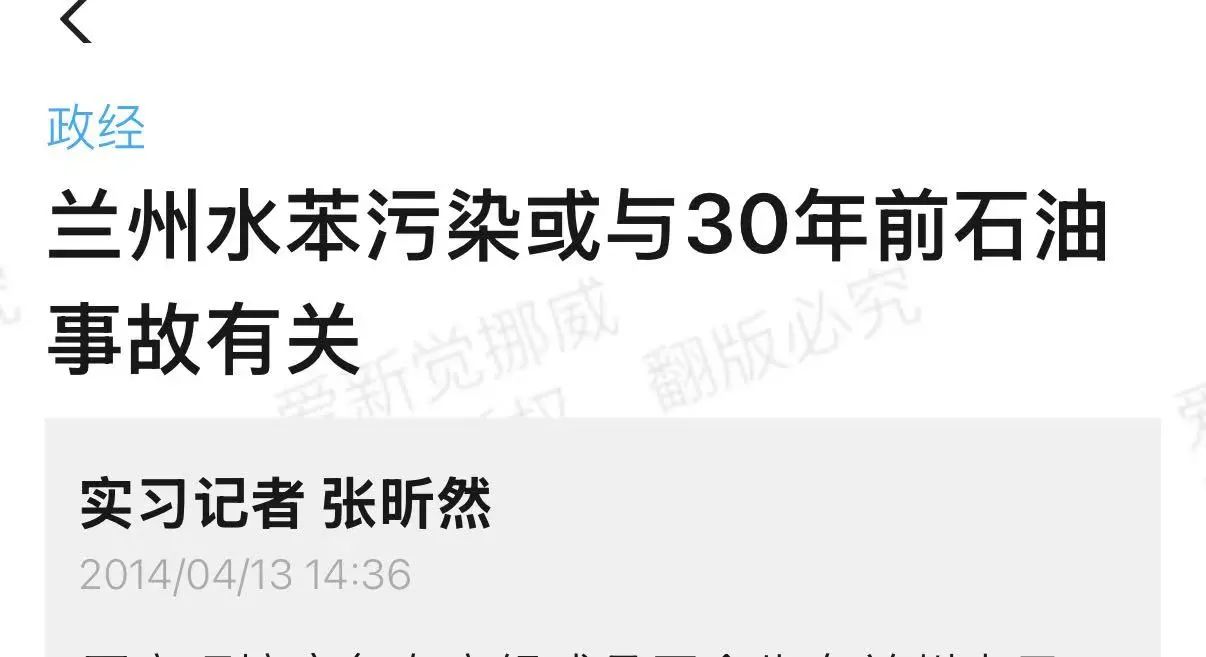
The process is a bit complicated, so I won’t go into too much detail. Simply put, a leakage accident occurred at Lanzhou Petrochemical in the 1980s, which polluted the groundwater. These pollutants moved with the groundwater and entered the self-flowing ditch, which had reached its design life, and then polluted the water quality.
The official report wrote very straightforwardly: “The historical accumulation of oily sewage from Lanzhou Petrochemical Company seeped into the self-flowing ditch, causing benzene pollution to the water body, resulting in local tap water benzene exceeding the standard.” So where did this oily sewage come from? The official report also wrote: “The oily groundwater that seeped into the self-flowing ditch was caused by the daily running, dripping, and leaking of Lanzhou Petrochemical Company and multiple safety accidents, which entered the soil…”
30 years have passed. Benzene that has penetrated into the groundwater and soil, as long as it has a gap, will still exceed the standard. In nature, the degradation cycle of benzene is actually very long, possibly several months or even years, depending on the environment. Anyway, it’s not that short, and artificial repair is also very difficult.
Then, it is said that after the tanker truck carrying crude benzene overturned in Yongzhou, the local area adopted the disposal measure of using water trucks and high-pressure water guns to flush the benzene into the sewer, which even caused an explosion.
I don’t doubt the announcement of the water quality safety by the tap water company, because it’s a centralized water supply, and it’s entirely possible to use artificial methods to degrade the benzene in the water. This is not difficult technically, both chemical and biological methods can be used. If they are willing to do it, they can definitely do it.
The key is that many villages may not use tap water, but their own well water, which is, in short, groundwater. If it’s near the leak point, then it’s very dangerous. The tap water company will at least monitor it. Will the villagers test it? Probably not. They will just drink it directly.
Again, there needs to be a more detailed announcement, as well as more intensive publicity. It can’t even get on the trending searches now. How can more people see it?
The announcement content should at least include the leakage amount, the approximate pollution range, various soil, water, and air data (especially the air data near the leak point), the specific data of the tap water rolling monitoring, the disposal methods, the response methods for ordinary people (such as reminding residents within the leakage range not to directly drink their own groundwater), and the response methods for the next few years (continuous soil, air, and water monitoring, building official tap water supply for residents within the leakage range, etc.).
That’s roughly it. However, I have graduated for a long time. If there are any professional errors, please point them out. This is at least a relatively large public safety incident.
Discover more from 自由档案馆
Subscribe to get the latest posts sent to your email.