


In early April 2026, the intensity of internet regulation in China showed a significant upgrade. According to internal documents circulating on social media, the Ministry of Industry and Information Technology and the Central Cyberspace Affairs Commission (CAC) convened telecommunications operators and relevant departments around the Qingming Festival to conduct special deployments on "Cyberpower" and cross-border access compliance. At the same time, an emergency notice, allegedly from Shaanxi Telecom, "banning overseas traffic," sparked heated discussions online. Although its authenticity is yet to be further verified, combined with the pressure faced by IDC service providers in general to clear up "circumventing the firewall" operations, it shows that China's network boundary control is evolving from precise interception to more large-scale suppression.
Intensive ministerial scheduling: From "cross-border dedicated lines" to "ideological theory"
According to leaked documents, the Information and Communication Administration of the Ministry of Industry and Information Technology organized a special meeting with China Telecom, China Mobile, and China Unicom on April 7, 2026. The core content of the meeting involved "strengthening the cleanup of illegal connections to the Internet through cross-border data dedicated lines."
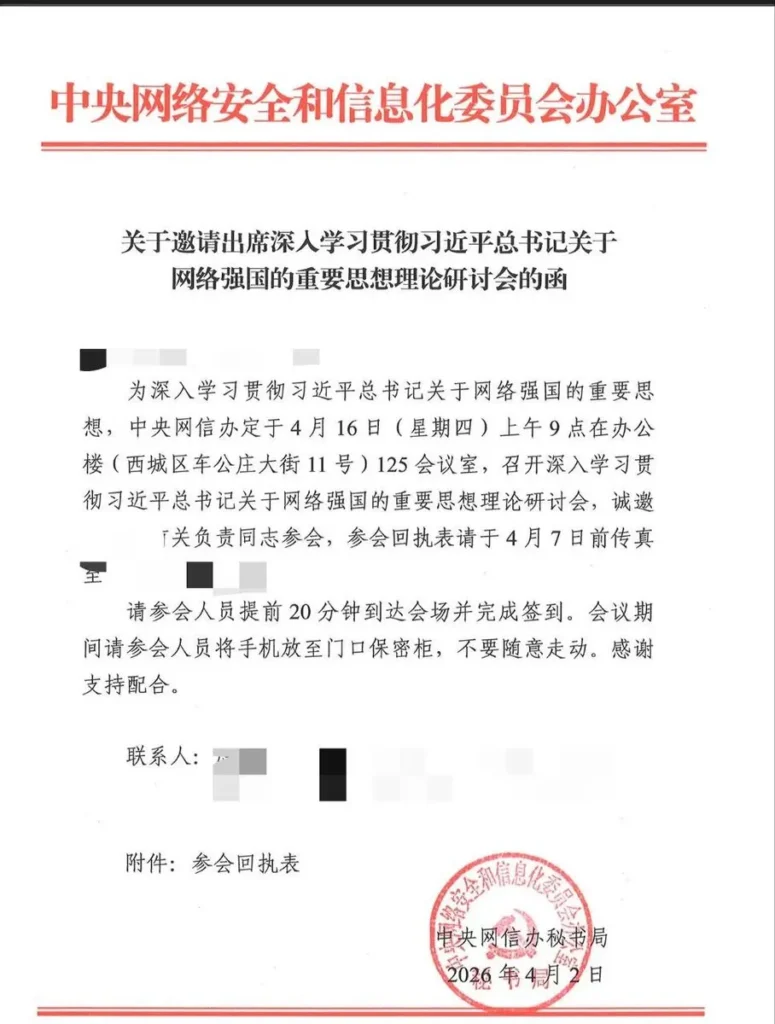
Following this, the Secretariat of the Central Cyberspace Affairs Commission also issued a letter, scheduled to hold a theoretical seminar on the important thought of "Cyberpower" on April 16. It is worth noting that the notice specifically required participants to place their mobile phones in a security cabinet at the entrance before entering the venue, indicating the highly sensitive nature of the meeting content. These two administrative actions initiated by industry regulatory agencies are regarded as the policy prelude to strengthening network boundary control in the second quarter of this year.
Shaanxi Telecom circulating document: Warning about "banning all outbound traffic to overseas"
On April 8, an "Emergency Notice on the Comprehensive Ban on Overseas Traffic and the Strict Prohibition of Circumventing the Firewall Business" from China Telecom Shaanxi Branch circulated online. The notice stated that from now on, all IP addresses must be completely prohibited from accessing addresses outside mainland China (including Hong Kong, Macau, and Taiwan), and any form of circumventing the firewall (VPN/proxy) related business is strictly prohibited.
Freedom Archives Note: This document is currently only found in online screenshots and has not been officially confirmed. The wording in the document, such as "banning all outbound traffic to overseas," may lead to the interruption of large-scale legitimate foreign trade, scientific research, and academic activities in actual operation. If true, this will mark a major transition from the blacklist mechanism of the "Great Firewall (GFW)" to a "whitelist mechanism."

The "April Storm" in the IDC industry: The heavy pressure of clearing up illegal cross-border access
Echoing the rumors, many IDC (Internet Data Center) operators in mainland China have expressed that they feel unprecedented pressure from the cleanup. According to insiders, the special rectification action launched on April 1 no longer uses vague wording such as "traffic forwarding" or "network security risks," but directly specifies that the behavior that needs to be rectified is "circumventing the firewall."
For data centers that fail to rectify, the instructions clearly propose severe penalties such as "permanent shutdown" and "recovery of compensation." Affected by this, many "airport" service providers within the country that serve as transit nodes have begun to raise fees, close registrations, or stop specific lines to avoid potential legal risks.
Further compression of technological decoupling and personal access space
From ministerial meetings to the actions of local operators, it reflects a profound change in China's network management logic:
- Coarsening of control granularity: In the past, it tended to precisely block sensitive content; now, it seems to be exploring large-scale disconnection at the physical or protocol level to reduce regulatory costs.
- Downward shift of compliance pressure: By imposing "joint and several liability" on IDCs and basic operators, regulatory pressure is directly transformed into commercial risks, forcing service providers to self-censor.
- Real impact: For ordinary users, the difficulty and cost of obtaining overseas information will increase significantly; for enterprises, the risk of interruption of non-officially authorized cross-border business lines will be faced at any time, further exacerbating the "internal circulation" of technology and information.
The series of documents and industry trends that have recently emerged outline a picture of the Chinese internet's walls being raised and thickened. Although the authenticity of some local documents remains to be verified over time, the regulatory authorities' close monitoring of cross-border traffic is an undeniable fact. This comprehensive tightening from the system to the technical level is not only reshaping the network boundary but also reshaping the way China connects with the global information system.