Author: Xiao Bing: Former Washington correspondent. Focus on the strategic game of countries, the evolution of political discourse and media ecology.
“I was doing a report at the time, and the leaders were begging me, ‘Don’t do it anymore.’ I also felt very painful, and some of my reports were very dangerous and difficult. The leaders didn’t know this couldn’t be done when I was doing it. After it was done (couldn’t be published), he also felt sorry for you, but both felt that there was really no way.”
A summarized his more than ten years of work experience in a head Chinese state media. He once disguised himself as a “new employee” for undercover visits, and also faced pressure from government departments due to in-depth investigation of current affairs hotspots. In his view, “red line awareness” has become an unavoidable professional instinct for news practitioners.
This career path is not accessible to all graduates of journalism. Is traditional state media still the first choice for journalism graduates? Under the mechanism of “professional recruitment” and “political literacy assessment”, is the path from journalism education to journalism practice undergoing a shift?
This article interviews two senior media professionals—reporter A, who has worked in central news organizations for many years, and Cheng Yizhong, one of the founders of Southern Metropolis Daily and Beijing News, to explore whether state media is still the “orthodox way out” for journalism graduates. Based on work considerations, and after confirming with the editorial team of “Field”, A was interviewed under a pseudonym.
Why do journalism graduates focus on the “system”?
Although the term “system” is often given the connotation of conservatism and constraint at present, for journalism and communication graduates, central-level state media still represents a certain “achievable peak.” This choice is not only related to job security, but also deeply rooted in the “joint construction of departments and schools” mechanism between the media within the system and the higher education system, which is a system path reproduction device.
According to public information, the School of Journalism and Communication of Tsinghua University, Peking University, Renmin University of China, Fudan University, etc., have long established “joint construction teaching bases” with Xinhua News Agency, People’s Daily, and China Media Group, and some students even complete the talent reserve within the system through the “joint training” model in the undergraduate stage. Not only is it the “joint construction” of colleges and media, Nanjing University and other colleges also connect with the government to directly provide talents for provincial and prefectural propaganda departments. This institutional arrangement not only strengthens students’ understanding of the system path, but also, to some extent, regards “entry into the system” as a natural continuation of professional training.
Although central media is still the “top of the pyramid” position that journalism students strive for, its quota is limited and competition is fierce. The Paper once reported that in 2018, when the number of graduates from ordinary colleges and universities across the country reached 8.2 million, People’s Daily, Xinhua News Agency and CCTV recruited a total of 273 fresh graduates. Although most of the admitted students came from journalism schools such as Tsinghua, Peking University, Renmin University of China and Communication University of China, not all of them came from journalism majors. In the 2018 list of candidates for CCTV, many of the admitted students have backgrounds in economics, sociology, law and other majors.
Cheng Yizhong said that especially in the current media environment, which is undergoing drastic changes and market risks are increasing, this situation of oversupply will only worsen in recent years. He said: “There are not so many senior reporters and editors to lead newcomers now, everyone is ‘going out’ instead of ‘going in’.”
Industry contraction: tightening of journalist certificates and shrinking of certificate holders
In contrast to the “talent supply heat” of colleges and universities, the professional qualification of journalists is tightening year by year. Data show that at the end of 2019, the number of certified journalists nationwide was 233,000, which decreased to 194,000 in 2021, and further decreased to 180,000 in 2022, a cumulative decrease of more than 50,000 in three years. The “Report on the Development of China’s News Undertakings” (published in 2022) released by the All-China Journalists Association shows that from 2017 to 2020, the number of employees in the national newspaper publishing industry decreased from 206,000 to 171,000, a cumulative decrease of about 17%. The journalist team is experiencing a significant “slim down”.
This change is not only reflected in the number, but also in the logic of re-regulation of the qualification system. Since 2022, the new version of the management regulations for journalist certificates has been implemented, and those who apply for the first time need to pass the assessment to obtain the qualification for practice, and “political literacy” is the primary assessment content. This means that the acquisition of journalist status no longer only depends on the recommendation of the unit and the review of years, but is a “political qualification certificate” ── the journalist profession is further incorporated into the national ideological governance system.
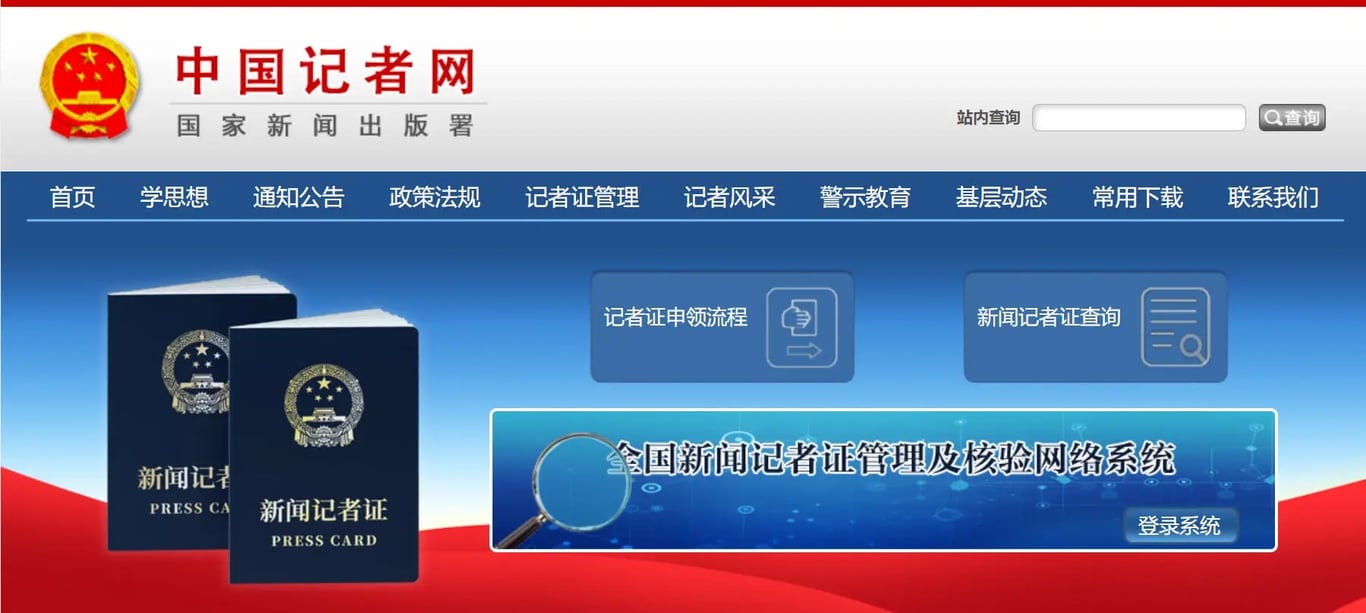
In China, professional journalists must hold a journalist certificate issued by the National Press and Publication Administration. Journalists must “hold a certificate and show the certificate for interviews and reports” during interviews and reports, and any unauthorized personnel are not allowed to work in the name of “journalist”. “Measures for the Management of Journalist Certificates” and “Interim Provisions on Continuing Education for Professional and Technical Personnel in Journalism” clearly point out that certified journalists need to renew their journalist certificates every five years, and professional and technical personnel in journalism need to participate in continuing education for no less than 90 learning hours per year, and pass the annual verification. This “qualified renewal mechanism” puts the legitimacy of journalists in a state of continuous review—they must constantly prove their “loyalty and competence” within the political framework set by the system.
A said that taking the institution he used to work in as an example, the employees under his jurisdiction went to the training base to receive two types of training, one of which was concentrated lectures, which focused more on ideology than news business. In addition, after the training, they need to take an exam, which is directly linked to the editing certificate and journalist certificate, and basically no one will fail.
“(Training) is to strengthen ‘Marxist view of journalism’, and this is not quite the same as the ‘Marxist view of journalism’ I learned in college.” He said: “What I learned more here is how to serve the overall situation.”
And the second type of so-called news business training, in A’s view, is more like safety awareness training, and is mainly lectured by the leaders of various departments—at least cadres at the bureau level or above. He said: “This safety awareness is not personal safety, but is similar to censorship safety.”
What impressed A the most was that in a certain training, a news picture of a senior official speaking at a press conference was taken as a negative example, because the microphone logo of a certain “overseas media” appeared in the front row of the picture. Image security is not only a technical issue, but also a reflection of political judgment.
“I didn’t realize at the time that I didn’t even know what this (overseas media) was,” A sighed.
The “security” of news images also reflects the institutional logic. As the British sociologist and media theorist Stuart Hall pointed out in his famous “encoding/decoding” theory, the essence of communication is not only content transmission, but also a mechanism of meaning construction and control. In China’s state media, every element in the image may be a symbol of political minefield. American writer and critic Susan Sontag also stated in “On Photography”: “Each photo is just a fragment, and its moral and emotional weight depends on where it is placed.” The picture that A could not forget was precisely the epitome of the “visual cleaning” mechanism.
This “boundary perception mechanism in news” and the ability to avoid risks are crucial for journalists within the system. In A’s view, the daily life of journalists within the system is far more than just editing and writing, but more importantly, in every link of content production, learning “to identify what cannot appear”.
Front-line reporters rely on themselves, recognize red lines, and avoid risks
“I am not from a financial background, but when I was assigned to the financial line, no one gave me any systematic training.” A recalled. His solution was to pay for an in-service postgraduate degree related to finance. Although he did not get a graduation certificate in the end, this experience allowed him to master the most basic industry logic and the decoding method of policy language. In addition, the leaders gave him many opportunities to allow him to have enough time to study the financial reports of listed companies and attend press conferences, “this workshop-style learning helped me a lot”.
In addition to the above two types of off-the-job training, A revealed that most reporters will also be sent to local areas for a one-year training, and he is no exception. This experience of practical experience on the front line has brought A a lot of gains.
“Freedom within the red line” is a more realistic portrayal of the daily life of journalists within the system. Reporters not only need to be able to interview and write articles, but also need to be vigilant about the boundaries of content at all times, understand and avoid institutional risks. Under this news production logic, the “content judgment ability” of editors and reporters has also become a political ability. A said that the “learning” of ideology made him overwhelmed, but he tried his best to combine news practice every time and try to break through the “freedom within the red line”. “For example, if a certain leader went to a certain place, we, as reporters, have to capture what the next policy information is.”
However, the premise of obtaining relative freedom is the support of the leaders and the unit. When other news units dare not touch sensitive social events, A wrote reports that had a considerable impact on local government governance, and even attracted the “attention” of local officials.
“Some small units feel that if I touch the mine, this unit will be wiped out.” He said: “But my leaders can also hold up, the local area comes to find, my leaders are on the same level as them, and they can be polite. But later, people of a higher level came to find, and my leaders couldn’t hold up.”
A sighed and said that there are still some intellectuals in the system. But even with the support of the unit and leaders, if a reporter wants to survive in the system, he cannot repeatedly touch the red line.
Full coverage mechanism of ideological training
“Many people think that ideological training is only for grassroots reporters, but the management is also the key object,” Cheng Yizhong commented on the political training mechanism in system news. “I was already the editor-in-chief of two newspapers at the time, and I still had to participate in the ‘Marxist View of Journalism Re-education’ training course and examination organized by the Propaganda Department of the Guangdong Provincial Party Committee.”
He emphasized that the training of “Marxist view of journalism” is highly regularized. In addition to annual centralized learning, “instructional guidance” will also be carried out before major and sudden events are reported, requiring reporters to focus on positive reports and prevent public opinion from getting out of control.
Cheng Yizhong said: “The propaganda authorities require the media to conduct so-called political mobilization, including before the ‘Two Sessions’ report, they must first conduct education, ‘publicize positively, do not report without authorization, and sensitive issues need to be consulted’, etc.”
This mode of “pre-reporting deployment” requires news media and reporters to operate within the institutional framework and implement the “communication task in the preset framework” rather than speak independently. News practitioners are transforming from “independent writers” to “safe information carriers”.
Cheng Yizhong believes that the internal training of state-owned media is very limited for the professional skills development of reporters. Currently, media organizations prefer “controllable and professional” writers. News positions are shifting from the traditional generalist logic to a dual-track system of “professional skills + political security”.
“We can find a large number of columnists, why should we continue to cultivate them? There are too many people who can be used, such as in the economy, I will directly recruit people from the economics department of a university.” He said: “The journalism major does not need such a high threshold, and the editor has the ability to judge.”
Mismatch between journalism education and system practice
The fundamental disconnection between the curriculum system of Chinese journalism education and the institutional orientation of journalism practice has long been a concern of the academic community. Professor Jiang Xiaoli of the Department of Journalism, Sichuan University, pointed out that there is tension between news organizations in “transmitting true information” and “undertaking the responsibility of guiding public opinion”, especially in many cases, news also shoulders the functions of the ears and eyes of the party and the people, and at this time often represents the specific interests of the country, region, and profession, and presents an ideological bias.
This disconnection leads to universities becoming “the production place of professional ideal”, while graduates often need to re-learn “public opinion-oriented expression” after entering the industry.
As Wang Weijia, Associate Professor of the School of Journalism and Communication of Tsinghua University, pointed out in “Questioning the ‘Myth of Journalism Professionalism’—An Analysis of History and Power“, the core of journalism professionalism is “independence”, but in China, this independence “lacks legitimacy from the beginning”. From national self-reliance, revolutionary nation-building to party spirit principles and national construction, the professionalism of news has always obeyed its political nature, and ideological goals always take precedence over professional ethics.
Under this institutional background, Chinese journalism practice is not a market-based professional labor, but a system-based communication configuration behavior, and its task is to assist the regime in achieving information stabilization management. Faced with the realistic structure of institutional orientation, political requirements, and resource monopoly, the ideals of freedom of expression, fact-checking, and supervision advocated by journalism education are forming an increasingly deep rift with journalism practice. This rift may be the most realistic distance between journalism students and the “orthodox way out”.
Discover more from 自由档案馆
Subscribe to get the latest posts sent to your email.