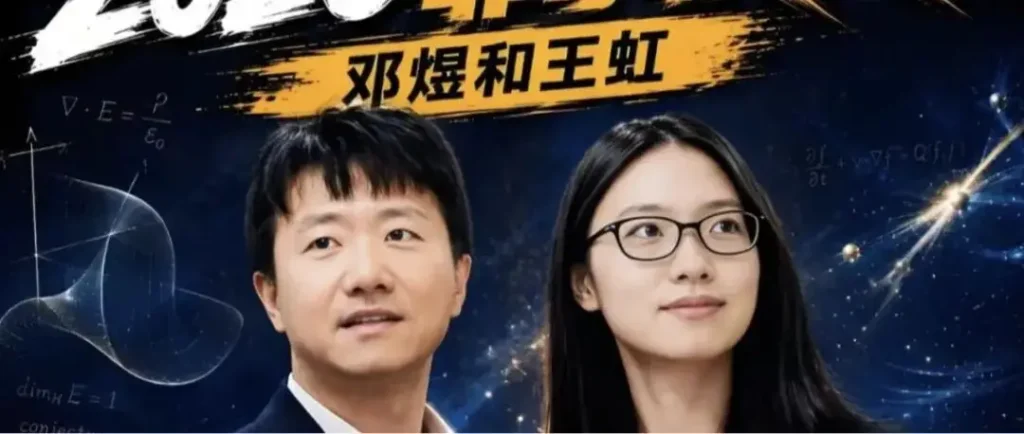
Wang Hong and Deng Yu win the Fields Medal, and social media is in an uproar.
It has been 44 years since Shing-Tung Yau became the first Chinese Fields Medalist in 1982.
This time, the two shared the honor, bringing this highest award in mathematics into their possession, which is the first time Chinese mathematicians have received such an honor.
This should be celebrated enthusiastically, but one fact cannot be avoided: both scholars studied at the School of Mathematical Sciences of Peking University as undergraduates, and the pioneering work on which they won their awards was not completed in Yanyuan.
Wang Hong is currently a tenured professor at the Institut des Hautes Études Scientifiques in France, and Deng Yu is currently a professor in the Department of Mathematics at the University of Chicago.
The former solved the conjecture of the three-dimensional hanging valley, which had troubled the mathematics community for over a hundred years, and the latter overcame the century-old problem that lay between mathematics and physics – Hilbert’s sixth problem in its special form.
Both breakthroughs, which have rewritten the landscape of their disciplines, were completed at top overseas academic institutions. The raw talent was selected by the domestic selection system (competitions + college entrance examination), nurtured by top undergraduate platforms represented by Peking University, and finally refined through top overseas training – Peking University, as the core carrier of ‘nurturing’, is inseparable from their growth.
Peking University’s undergraduate education nurtured the seeds of mathematics into seedlings – at least the first step on their mathematical journey – but they blossomed and bore fruit on the banks of the Seine and the shores of Lake Michigan.
This brings to mind a thought-provoking question raised by Yuan Yaxiang, an academician of the Chinese Academy of Sciences, at this year’s ‘Two Sessions’.
He used Zhang Yitang as an example: this mathematician, trained by Peking University, received systematic and rigorous mathematical training in the Department of Mathematics at Peking University and went to the United States to study in 1985.
Zhang Yitang remained on the fringes of academia for a long time, working as a delivery person and in fast-food restaurants, until he made a world-renowned breakthrough in the twin prime conjecture at the age of 58.
Yuan Yaxiang then asked, can our current scientific research evaluation system accommodate a quiet desk where ‘results are only achieved at 58’?
The reality does not provide a comforting answer. Yuan Yaxiang found in his research that although ‘breaking the five-only’ (唯论文, 唯帽子, 唯职称, 唯学历, 唯奖项 – only papers, only titles, only职称, only degrees, only awards) has been called for many years, in practice, ‘only papers’ has become ‘only top journals’, and ‘talent hats’ have become ‘super passes’ for project applications and职称 evaluations.
The deeper problem is that current talent programs and evaluation mechanisms generally use physiological ages such as 35 and 40 as hard entry lines.
This ‘short-cycle, fast-output’ evaluation model essentially treats basic disciplines as an industrial assembly line that can be assessed by piecework.
The result is that a few people with talent titles have their energy consumed by administrative tasks; while scholars without ‘hats’, even with original insights, fall into a cycle of limited development, difficult output, and lack of support.
Such an environment forces young scholars to chase hot topics, meet quotas, and rush for the ‘last train’, rather than tackling the tough problems that require ten or even more years to solve.
Two years ago, Shing-Tung Yau’s controversial statement – that Chinese mathematics has not yet reached the level of the United States in the 1940s – never referred to applied engineering capabilities, but rather to the foundation of original vitality, leading figures, and talent reserves.
The most iconic breakthroughs by Wang Hong and Deng Yu were mainly conceived and completed in top overseas academic institutions, which indirectly confirms Shing-Tung Yau’s judgment.
Their breakthroughs in foreign lands were not isolated.
Undoubtedly, they were part of the most active academic communities in their respective fields, received continuous and stable research resource support, and were in an evaluation environment that was more long-term and less constrained by short-term quantitative measures.
Ultimately, they lived in a system that allowed for the maximization of their self-worth.
This system does not judge a person’s value by age and title, but gives people enough time to concentrate on solving truly difficult problems.
Only by understanding the system that supported them can the significance of these two awards be truly appreciated.
It is worth being happy, but not necessarily ecstatic. Do not be overly self-deprecating, nor overly arrogant.
The two awards are a historic leap for Chinese mathematics, proving that Chinese undergraduate mathematics education, represented by Peking University mathematics, is fully capable of selecting world-class mathematical talents.
However, individual top breakthroughs do not equate to the maturity of the overall academic ecosystem; sporadic ascents do not mean we have achieved overall leadership.
While celebrating, we should calmly consider: can we leave an always-open door for scholars who are willing to sit on the cold bench?
Can a desk where ‘results are only achieved at 58’ be placed stably in an office in Beijing, Shanghai, or Guangzhou?
Can future Wang Hongs and Deng Yus, without having to travel across the ocean, achieve the leap from excellent students to pioneering scholars in their own academic gardens?
If that day truly arrives, Chinese basic mathematics will have truly established itself.
By then, more research results that truly open up new directions will grow from Chinese soil, and the awards that follow will be a natural consequence.
Discover more from 自由档案馆
Subscribe to get the latest posts sent to your email.