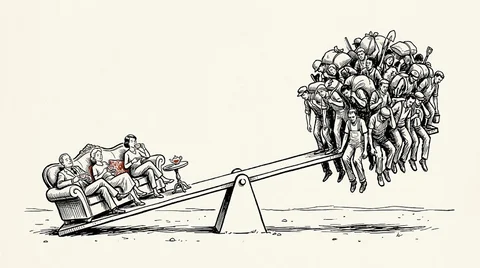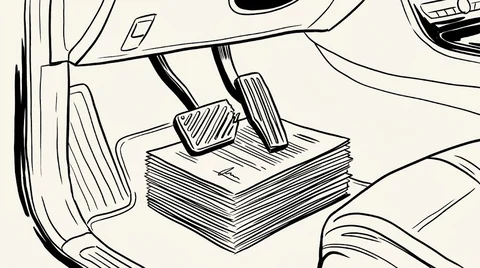


When a system cannot continuously provide internal integration and legitimacy,
“External enemies” become the lowest-cost tool for stability.
1. The essential need for system stability:
Internal must be “in the same direction”
Any social system, to be stable for a long time, needs at least three things:
Common goals
(Where we want to go)
Common explanations
(Why problems arise)
Common boundaries
(Who we are, who we are not)
If these three points cannot be formed internally naturally,
the system will face a dangerous state:
Disagreements begin to tear internally.
And “external enemies”,
can solve these three things at once.
2. The first function of external enemies:
“Externalizing” internal contradictions
In any system, contradictions are inevitable:
Uneven resource allocation
Class differentiation
Conflicts of interest
Policy errors
If these contradictions can only be explained within the system,
the problem will point to:
The system itself
Power structure
Decision-making responsibility
This is high risk for the system.
And once an “external enemy” appears,
the explanation path will change:
It's not that we have internal problems,
but that external forces are destroying us.
In this way, system pressure is successfully transferred.
3. The second function:
Quickly creating internal consensus
Consensus, under normal circumstances, is expensive:
Requires negotiation
Requires compromise
Requires acknowledging differences
But under the “us vs. them narrative”, consensus is cheap.
Because it doesn't require you to agree with all the details,
it only requires you to answer a simple question:
Which side are you on?
Once the enemy is clearly labeled:
Internal disagreements will be temporarily frozen
Middle ground positions will be compressed
Complex discussions will be simplified
The clearer the enemy, the more organized the internal.
4. The third function:
Providing legitimacy for power concentration
In normal governance:
Power concentration requires explanation
Tightening rules requires reasons
Suppression of dissent requires boundaries
But in the presence of an “external threat”:
Centralization = emergency
Control = security
Dissent = inopportune, even dangerous
Therefore,
many measures that are unacceptable at ordinary times,
become reasonable in the “enemy narrative”.
The enemy is not the goal,
but the tool.
5. The fourth function:
Shaping identity
System stability depends not only on interests,
but also on identity.
“Who we are”,
is often not completed through self-description,
but through comparison:
We are not them.
External enemies provide a clear mirror:
We are order, they are chaos
We are justice, they are evil
We are victims, they are aggressors
This identity construction,
is extremely powerful psychologically.
6. Why does this mechanism repeatedly appear?
Because it is effective in the short term.
Compared to:
Deep reforms
System adjustments
Redistribution of interests
Creating or amplifying an external enemy:
Low cost
Fast speed
Obvious results
But the problem is:
Short-term stability often comes at the cost of long-term risks.
7. Where is the danger of this mechanism?
There are three almost inevitable consequences:
1 Once the enemy disappears, the system will lose balance
Because stability is maintained by confrontation, not by internal integration.
2 Internal problems will be constantly postponed
Contradictions do not disappear, they are only suppressed.
3 The system will gradually “rely on the enemy”
Once accustomed to using external threats to maintain stability,
the system will become inert to real reforms.
8. A deeper, but more cruel fact
The systems that most need external enemies,
are often the systems with the weakest internal explanatory ability.
If a system can:
Face internal problems
Provide reasonable allocation
Allow limited differences
Have the ability to self-repair
Then external enemies are not a necessity,
at most, they are just the existing external environment.
Written in the end
External enemies are never a conspiracy theory that is “fabricated out of thin air”,
but a system tool repeatedly verified by history.
But what it solves,
is never the problem itself,
but only the instability caused by the problem.
A truly stable system,
relies not on enemies,
but on internal explanatory power, integration power, and error correction ability.
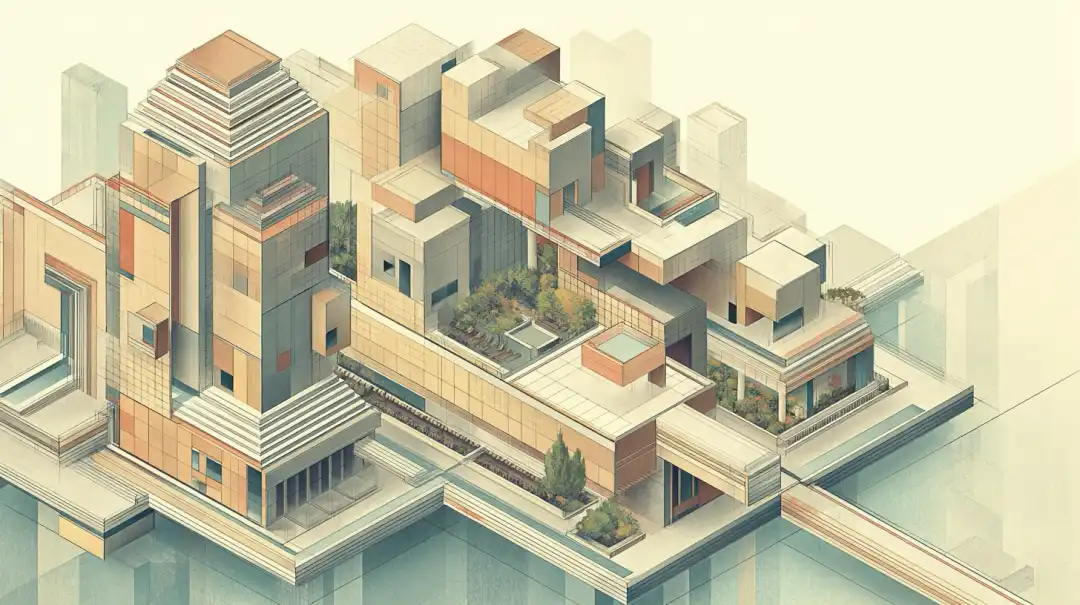
Title image: “System Boundary”
Creator: Lao Lang
AI algorithm provided: Midjourney V7.0
Prompt: An abstract illustration of a clear boundary line dividing a calm interior space from a fragmented exterior environment. Inside is quiet and structured; outside is blurred and undefined. Minimalist, neutral color palette, conceptual political commentary style. No figures, no text, no dramatic elements, —ar 16:9 —p l4u8hvk —v 7.0