

By the early morning of July 15, 48 hours after Shenyang was hit by heavy rain, the water had receded from most flooded roads. However, residents of several communities in the local Hunnan and Sujiatun districts were still seeking help online – some high-rise buildings had been without water and electricity for over 30 hours, and repairs were still underway as of the evening of July 15.
Most people did not expect that Typhoon \“Bavi\”, which made landfall in Zhejiang, would still have immense power after traveling about 1,700 kilometers northward. The typhoon's residual circulation, combined with factors like the Northeast cold vortex and the subtropical high, led to extreme rainfall, causing \“shocking impacts\” in Northeast and North China.
\“Northeasterners facing typhoons are as lost as Southerners facing freezing rain.\”
High-rise buildings lost water and power, garages were flooded, and the lighthouse in the center of the Hun River drifted 20 kilometers... On July 13, 2026, affected by the long-distance moisture transport from Typhoon \“Bavi\”, Shenyang City, Liaoning Province, experienced unprecedented heavy rainfall that broke historical records.
According to data from the Shenyang Meteorological Bureau, from 1:00 AM on July 13 to 4:00 PM on July 14, the average rainfall in Shenyang's urban areas reached 346.8 millimeters, breaking the highest record since Shenyang had complete meteorological records in 1951.
This heavy rainfall once put the city on \“pause\”. Many citizens woke up in the morning to find that the area downstairs had turned into a muddy \“sea\”. In some low-lying areas, not only were street-front shops and ground-floor houses submerged, but rainwater also flooded the underground garages of communities, soaking a large number of vehicles that were not moved in time. Classes were suspended and people were asked to work from home city-wide.
By the early morning of July 15, 48 hours after Shenyang was hit by heavy rain, Southern Weekend reporters learned that although the heavy rain had stopped hours earlier and the water had receded from most flooded roads, residents of several communities in the local Hunnan and Sujiatun districts were still seeking help online – some high-rise buildings had been without water and electricity for over 30 hours, and repairs were still underway as of the evening of July 15.
Most people did not expect that Typhoon \“Bavi\”, which made landfall in Zhejiang, would still have immense power after traveling about 1,700 kilometers northward. The typhoon's residual circulation, combined with factors like the Northeast cold vortex and the subtropical high, led to extreme rainfall, causing \“shocking impacts\” in Northeast and North China – in addition to the heavy rain in Shenyang topping the Weibo hot search, this round of rainfall also affected eastern Heilongjiang, eastern Jilin, northeastern Liaoning, southern Hebei, and other areas. According to reports from CCTV and other media, recent floods have also occurred in Kuanxian, Hebei, Fushun, Liaoning, and Huinan, Jilin.
In April 2026, Huang Jianping, an academician of the Chinese Academy of Sciences and a professor at the School of Atmospheric Sciences at Lanzhou University, wrote in an article titled \“Northern Heavy Rainfall Belt and Its Prevention and Control Strategies\”: Against the backdrop of global warming, the \“northern rain belt\” in China has shown a new spatial pattern different from traditional rain belts in recent years, characterized by high intensity, large scale, and long duration. Heavy rainfall has frequently hit northern Chinese cities, and the phenomenon of \“cities turning into seas\” is not uncommon.
Furthermore, in the process of urban development, there have been many instances of filling rivers (lakes) to create land, hardening shorelines, and turning open rivers into underground ones, encroaching on the city's original water storage capacity. \“If there is not enough space to accommodate floods, rainwater will inevitably flood the streets and communities, and even underground garages and subways.\” On July 13, 2026, Xu Zongxue, director of the Beijing Key Laboratory of Urban Water Circulation and Sponge City Technology and a professor at the School of Water Sciences at Beijing Normal University, told Southern Weekend reporters.
1
Some citizens were found lying in the water, yet others were swimming. Recalling the impact of the continuous super heavy rain on the city, many Shenyang citizens still have lingering fears.
Multiple local residents recalled that the heavy rain on the 13th began around 1 AM and caused severe waterlogging by morning. Some roads were submerged above the car roof, and some delivery riders braved the rain to deliver food, with their electric bikes submerged. Some subway lines were suspended. The rain gradually subsided by the evening of the same day.
\“I haven't seen such severe waterlogging in over twenty years,\” a citizen living in the Tiexi District of Shenyang told Southern Weekend reporters. In the afternoon of the 13th, the water level near his home \“reached his thighs\”, and \“some low-lying areas had their first floors and basements flooded\”.
A resident living in the Yuhong District of Shenyang told Southern Weekend reporters that around 10 AM on the 13th, he saw a man in his early twenties lying on his back in the street near a community, with the water level on the road nearly reaching his waist.
The resident said that he and several pedestrians used a wooden stick to pull the man to the steps of a nearby subway station and performed cardiopulmonary resuscitation for about 20 minutes. A doctor then arrived, and after ten minutes of rescue, took the man to the Shengying Hospital Huaxiang Campus.
Meteorological analysis shows that this heavy rainfall is related to the \“train effect\” caused by \“Bavi\” moving northward. Chen Tao, chief forecaster at the Central Meteorological Observatory, explained that in the typhoon's outer rain bands, when multiple convective cloud clusters pass through the same area sequentially like train carriages on the same path, it causes the area to be continuously affected by rainfall.
As the heavy rain continued, multiple rivers exceeded their warning flood levels. The Hun River, Shenyang's \“mother river\”, also saw its water level rise sharply. The landmark \“Shenyang Lighthouse\”, originally located in the middle of the river, was washed away and drifted eastward with the muddy water, hitting bridges and power lines, causing sparks to fly and attracting public attention on social media. After the rain subsided on the 14th, people finally secured it 20 kilometers downstream.
Amidst the heavy rain in Shenyang, some citizens were seen paddleboarding and even swimming in the rain, with related short videos going viral on social media. However, these seemingly \“relaxed\” behaviors actually harbor many hidden dangers. \“The water is very dirty, mixed with all sorts of garbage and sewage, and there's also a risk of electric shock,\” many local netizens in Shenyang appealed on social media.
In the morning of the 13th, the Shenyang Flood Control and Drought Relief Headquarters Office announced the closure of 73 waterlogged points. By the morning of the 15th, the water had receded from most of these points, and subway and bus services had resumed.
2
Waterlogging in the South of the City Difficult to Recede After Rain Stops To the confusion of some citizens, by the afternoon of July 14, the heavy rain in Shenyang had stopped, but the water levels in several residential communities in the city actually rose.
That evening, residents of Hunhe International City in Sujiatun District told Southern Weekend reporters that their community had lost water and power since around 4 PM on the 13th and had not yet been restored. \“The property management did not notify us in advance, so no one was prepared,\” said the resident.
\“On the evening of the 14th, the street near the community was still waist-deep in water. Without draining the water, it's difficult to restore water and power.\” Other residents from the same community also stated that rescue teams were on-site that day, and many people had been successfully transferred to hotels.
Southern Weekend reporters checked public information and found that the community has a total of over 3,000 households. Within the community, there are low-rise buildings built around 2014, as well as new high-rise buildings delivered in the past two years, including commercial housing, affordable housing, and other types of residences.
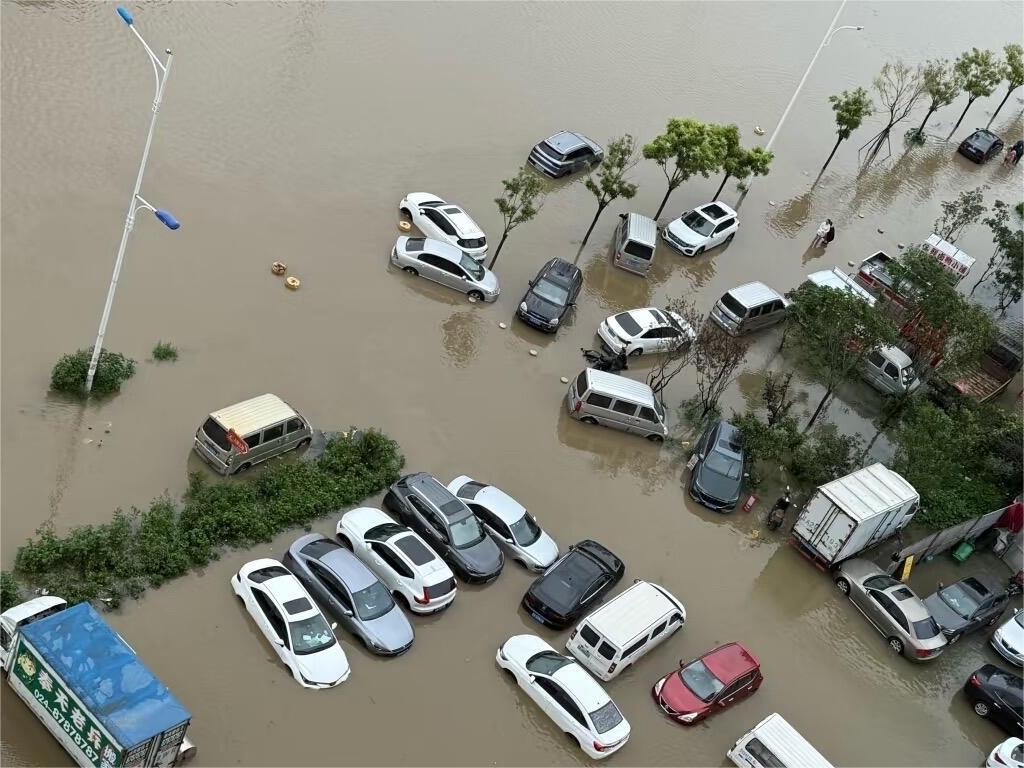
Hunhe International City in Sujiatun District, Shenyang, still had a large amount of waterlogging on the morning of July 15. (Photo provided by interviewee)
Southern Weekend reporters found that on the morning of the 15th, residents of communities such as Weimei Pingge, Dongruan Family District, and Yatai International Garden also posted on social media reflecting that although the water level had receded, water and electricity had not yet been restored in their communities. These communities are mostly located in Hunnan District and the neighboring Sujiatun District. Gaode Maps shows that a large number of roads in these two districts were still closed around 11 AM that day.
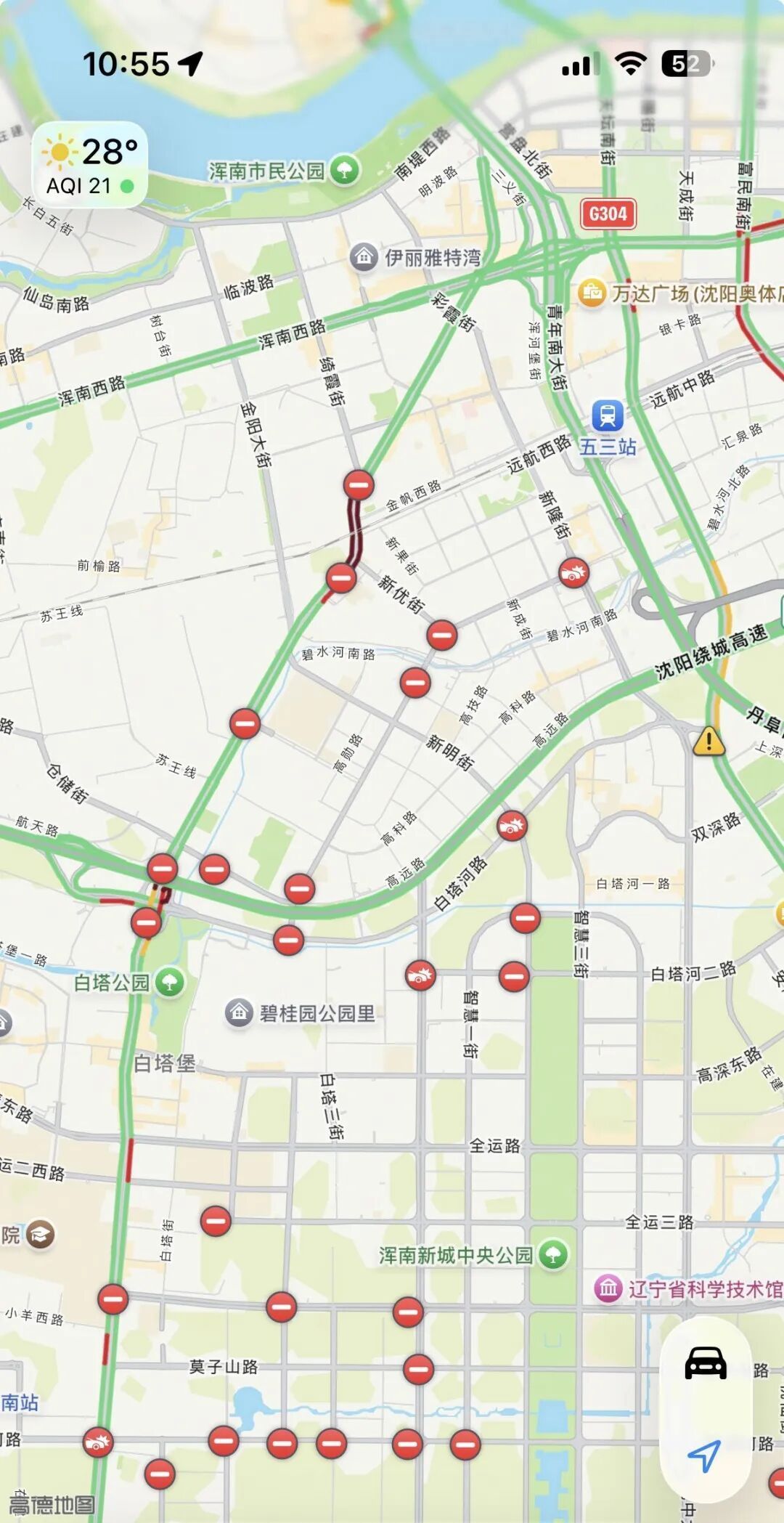
Around 11 AM on July 15, many roads in Shenyang's Hunnan and Sujiatun districts were still closed. (Gaode Maps screenshot)
Multiple citizens mentioned that waterlogging in Hunnan and Sujiatun has always been severe. Although they are new districts built after the city expanded southward, Shenyang's terrain is generally higher in the northeast and lower in the southwest, and both of these districts are located in the low-lying areas of the southern part of the city. Hunnan itself is named after its location on the south bank of the Hun River. Under normal circumstances, due to river flow direction and the Coriolis effect, the south banks of rivers in most parts of China are more prone to flooding.
The city's flood control engineering also confirms this. The \“Shenyang City Flood Control Emergency Plan (Revision)\” issued in 2025 shows that the flood control standard for the right bank (south bank) dike of the Hun River is a 300-year return period, while the left bank is only a 100-year return period.
Starting from the evening of the 15th, interviewed residents reported that the flooded buildings in Hunhe International City gradually resumed water and electricity, and by 8 AM on the 16th, it was basically restored, but the elevators in high-rise buildings were still out of order. At the same time, residents posted on social media that some surrounding communities were still without water and electricity, and some areas still had standing water.
3
Even \“Sponge City\” Demonstration Cities Experience Waterlogging \“Shenyang floods every year, but I haven't encountered a situation this severe before,\” a urban planner working in Shenyang told Southern Weekend reporters.
According to her observation, Shenyang's old urban areas have high population and housing density, but the drainage system is old and the drainage standards are low. \“It has been under repair for more than ten years, but there is still waterlogging on rainy days.\” In addition, new districts like Changbai Island originally had low plot ratios. With urban development, more buildings were added, \“but the drainage pipes were not widened\”.
A paper published in \“Municipal Technology\” in 2021 by Feng Shuang and others from the Shenyang Planning and Design Institute, titled \“Research on the Design Return Period Standard of Drainage Conduits in Shenyang City\”, mentioned that the design return period of Shenyang's existing drainage conduits is 3 years (meaning it can withstand a 3-year rainfall event), which is at the lower limit of the standard's requirements. According to the \“Code for Design of Outdoor Drainage\” (GB 50014-2021), the design return period for rainwater conduits in the central urban areas of megacities with a population exceeding 5 million should be 3-5 years, and 5-10 years for important areas in the central urban areas.
Old urban areas such as Huanggu, Heping, and Tiexi began industrial and urban construction in the 1950s. A large number of drainage pipelines were designed with low standards and are \“over-aged\” and severely deteriorated. The bottom data and ownership of pipelines in some state-owned enterprise factory residential areas are unclear. In April 2026, Ma Hongtao, a member of the Liaoning Provincial Committee of the Chinese People's Political Consultative Conference, suggested conducting a province-wide survey and unified renovation of the pipeline network.
Every time there is heavy rainfall, multiple points in Shenyang's urban areas repeatedly experience waterlogging. On July 13, 2026, citizens reported on social media that the intersection around Huanggu Wanxianghui, which experienced severe waterlogging this time, was also flooded in 2017. Shenyang has experienced urban waterlogging multiple times in recent years. For example, after heavy rain on July 12, 2022, there were 88 waterlogged road sections in Shenyang's urban areas, and many citizens in districts like Huanggu and Hunnan were trapped.
The aforementioned planner also mentioned that in recent years, ecological riverbanks and lake shores in Shenyang have been hardened into concrete surfaces. Ecological riverbanks are composed of soil, retaining walls, and multiple layers of vegetation, which can reduce peak flows and regulate floods. \“The Pu River near my home used to be a beautiful ecological riverbank, but last year the riverbank and riverbed were filled with cement. In recent years, some urban construction projects have been approved for ecological river construction, but concrete riverbanks have actually been built.\”
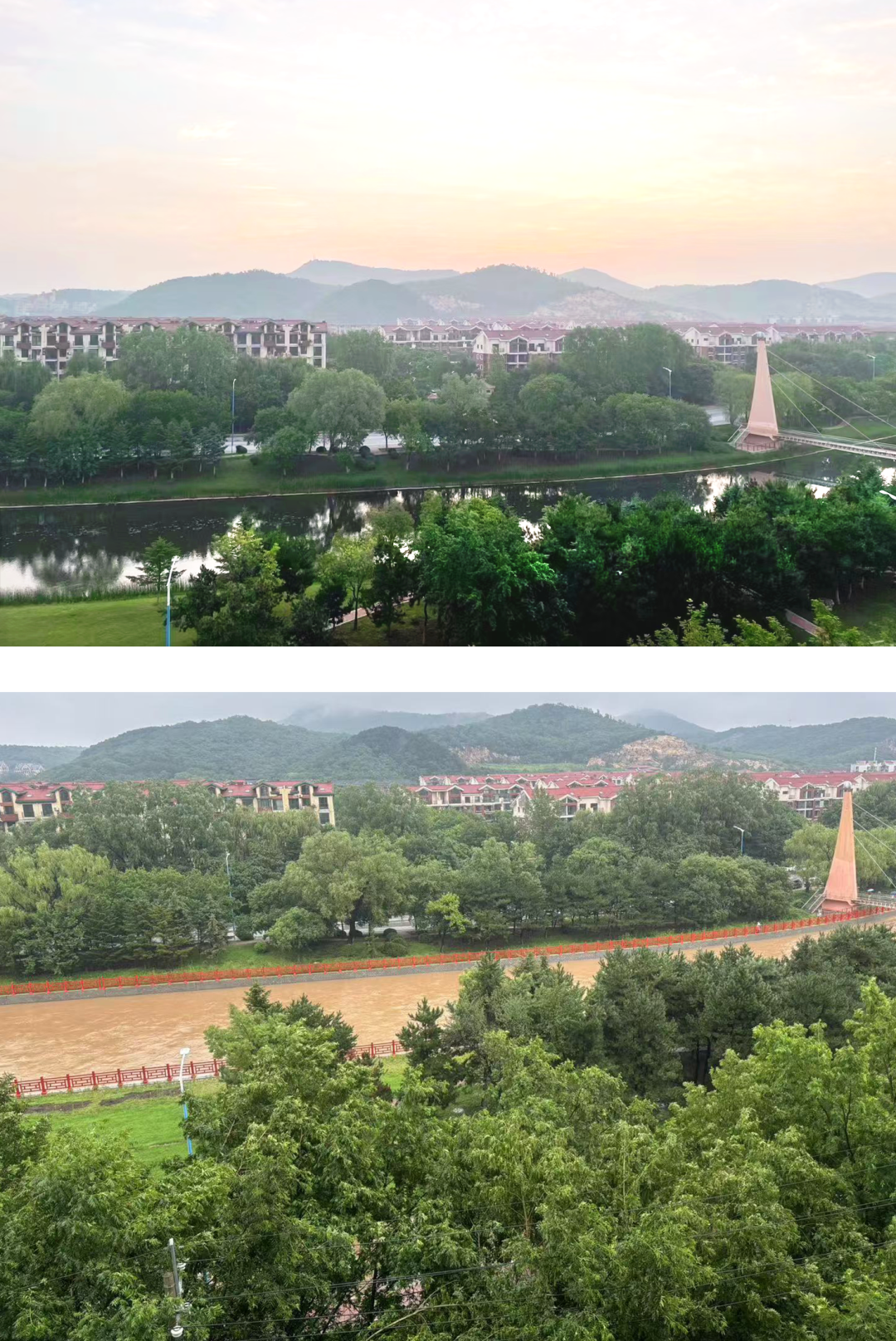
Comparison of the Pu River bank before and after hardening. The top photo was taken in June 2021, and the bottom photo was taken in July 2026. (Photo provided by interviewee)
It is worth noting that since 2016, Shenyang has been continuously promoting \“Sponge City\” construction. In May 2022, Shenyang was awarded \“Demonstration City for Systematically Promoting Sponge City Construction Across the Board\”, becoming the first city in Liaoning Province to be selected.
\“Sponge Cities\” absorb, store, and slowly release rainwater through permeable pavements, bioretention basins, green roofs, rain gardens, and other engineering and natural means, reducing the intensity of rainwater runoff. They are currently applied in many cities in China. However, in recent years, whenever extreme rainfall causes urban flooding, the flood control function of \“Sponge Cities\” is challenged.
\“Sponge City is not a panacea,\” said Xu Zongxue. \“'Small sponge' facilities such as sunken green spaces, rain gardens, and permeable pavements can only solve urban waterlogging caused by rainfall events with a return period of 5-10 years. However, the rainfall in Shenyang this time has far exceeded the drainage capacity that sponge facilities, urban pipe networks, and rivers and lakes can withstand.\”
Xu Zongxue also analyzed that Shenyang's generally flat terrain makes it difficult for rainwater-formed waterlogging to drain quickly. Moreover, the low density of the river network and the shallow and narrow river channels are natural shortcomings for drainage in many northern cities.
\“It's not just Shenyang; many cities have problems with low and uncoordinated standards for drainage, waterlogging control, and flood control,\” said Xu Zongxue. \“These three sets of standards belong to different departments, and the calculation methods are not unified. Drainage standards are based on rainfall, while flood control standards are based on flow series. For example, if a city has high drainage and waterlogging control standards, but the flood control standard of the river channel is very low, it will cause the waterlogged water in the city to flow into the river channel and form a flood, but the flood cannot be discharged downstream, which may cause the river water to backflow.\”
4
Northern Regions Are Not Immune to Typhoons \“Northeasterners facing typhoons are as lost as Southerners facing freezing rain.\” A Liaoning resident lamented on social media.
Besides Shenyang, other regions in Northeast and North China also experienced extreme rainfall caused by the residual vortex of \“Bavi\”. On the evening of July 12, Kuancheng Manchu Autonomous County in Chengde, Hebei, experienced heavy rainfall, triggering flash floods. From July 14 to 15, Heilongjiang and Jilin also experienced heavy rainfall, and multiple rivers flooded.
The southeastern coastal areas have rich experience in dealing with typhoons and were on high alert before \“Bavi\” arrived. However, the northern regions are still unfamiliar with typhoons. Even though meteorological departments issued warnings, many people did not move their vehicles or stock up on supplies before the heavy rain.
In recent years, northward-moving typhoons have become stronger and more frequent, and northern regions may also be affected by typhoons. People's inherent perceptions are being challenged. \“Gremon\” in 2024 and \“Doksuri\” in 2023 both \“re-emerged\” after moving north, causing widespread heavy rainfall in North China and Northeast China.
Typhoons that travel long distances inland can still \“weaken but not disappear\” and have a strong impact. Li Ying, a researcher at the National Key Laboratory of Disaster Weather Science and Technology and the Chinese Academy of Meteorological Sciences, explained that northward-moving typhoons transform rapidly after encountering cold air, changing from tropical cyclones to extratropical cyclones. Appropriate cold air activity can actually provide additional energy. Under the influence of multiple factors, the wind and rain impact brought by typhoon remnants should not be underestimated.
Cases of cities turning into \“seas\” during heavy rain have also occurred frequently in northern cities in recent years. For example, on July 25, 2025, Hohhot, Baotou, and other cities experienced severe waterlogging after heavy rain, disrupting urban transportation and industrial production.
Xu Zongxue believes that in the face of excessive floods, instead of passive defense, it is better to \“make way for water\” by proactively reserving flood storage areas through spatial planning, thereby fundamentally enhancing urban resilience.
\“Urban development over the years has encroached on a large amount of water space, significantly reducing the city's water storage and drainage capacity. This is a common problem faced by both northern and southern regions,\” said Xu Zongxue. \“A flood diversion ditch, after being leveled and turned into a road, may transform a relatively small and obvious flood risk into a hidden and greater flood risk.\”
He suggested that in the face of increasingly frequent excessive rainfall, cities should appropriately raise flood control standards. During urban renewal, efforts should also be made to restore the spaces of buried water bodies and appropriately increase flood storage spaces such as landscape lakes, green spaces, and river channels. When heavy rain occurs, underground parking lots in some non-residential areas can also be used for water storage after emergency evacuation. \“Green infrastructure should play a dual role of \‘leisure in normal times, flood storage in disaster times\’, combining \‘peace and war\’, to become a resilient buffer for cities to cope with extreme rainfall.\”
In the evening of July 14, the rain stopped in Shenyang, and a large area of sunset clouds appeared in the sky. Many citizens walked out of their homes and recorded this scene with their mobile phones. The order of life is gradually being restored, but the impact of the heavy rain has not yet ended: some are busy applying for compensation for scrapped vehicles, and some are planning to move to a house that is less prone to flooding...