

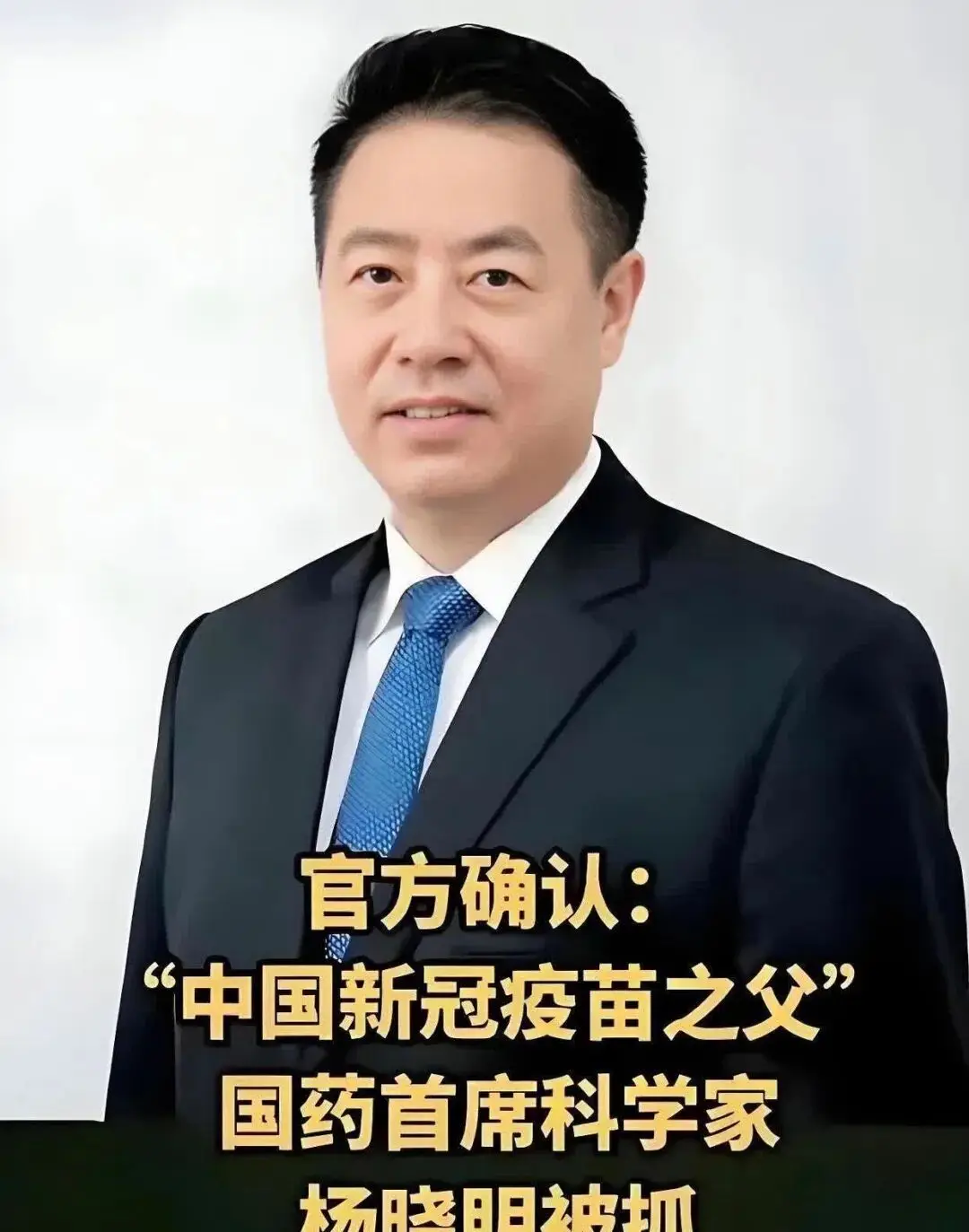
Could the person at the helm of the vaccines we entrusted our lives to be possibly corrupt?
This is a severely underestimated piece of news.
On November 28th of this year, an announcement was made. The China Association for Science and Technology announced the revocation of Yang Xiaoming's National Innovation Award medal and certificate. This award was given out only a few years ago, and the speed of its retrieval is indeed too fast.
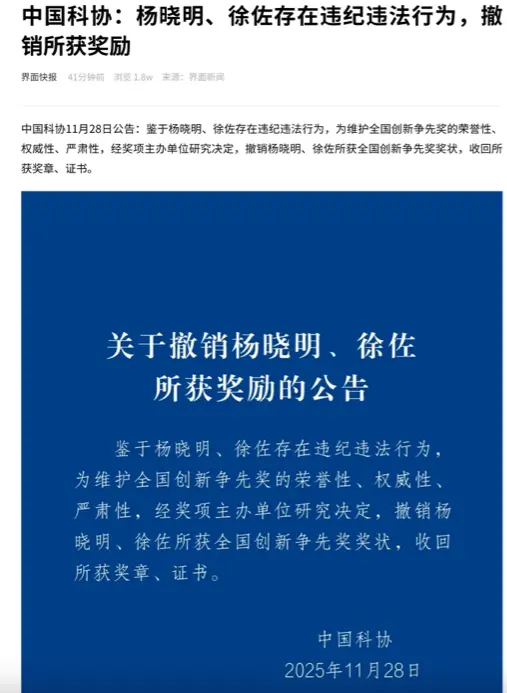
The medal was put back in its box, and the certificate was returned to the archives. The ceremony was silent, but it was more resounding than any judgment.
The "vaccine hero" who once stood in the Great Hall of the People, on the stage of the World Health Organization, and in front of CCTV cameras, is now a name marked as "suspected of serious violations of discipline and law" in the disciplinary review documents.
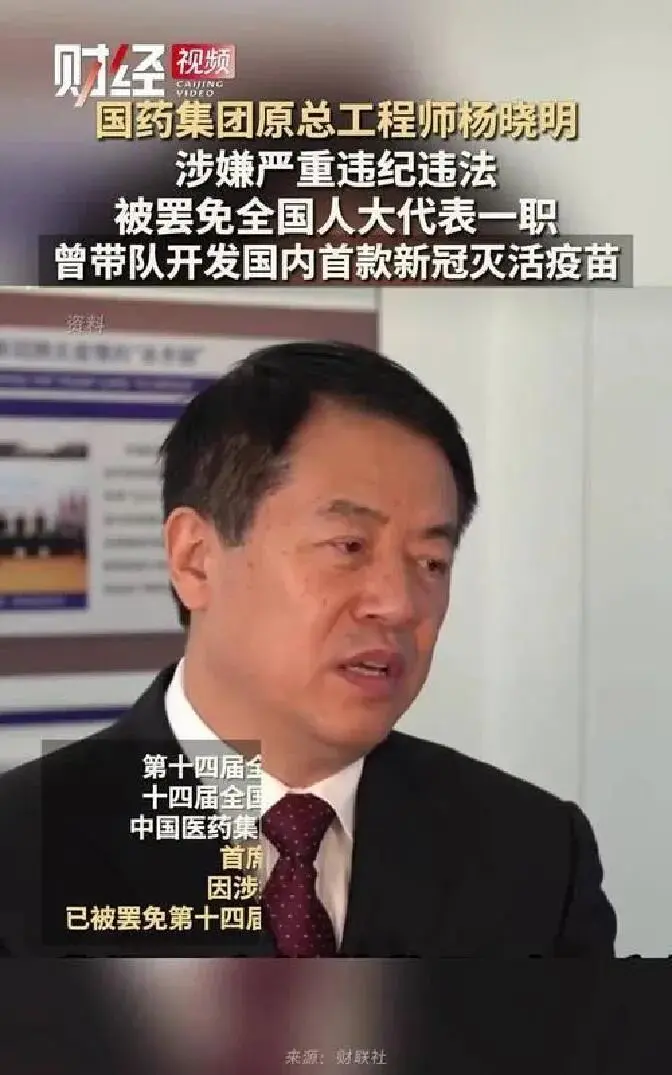
More than a year ago, on April 23, 2024, Yang Xiaoming was removed from his position as a representative of the 14th National People's Congress for suspected serious violations of discipline and law.
What secrets lie behind his crimes?
1
Rewind time back to February 1962, in Zhouqu, Gansu.
A Tibetan boy was born, and he later followed a standard elite path: preparatory school of Northwest University for Nationalities, Lanzhou Medical College, Lanzhou Biological Products Institute. Then, there was a dazzling international resume: National Institute of Preventive Health, Japan, US FDA, US NIH. These abbreviations are the brightest visas on his academic passport.
After returning to China, he became the "fire chief" and "leader." From Lanzhou to Wuhan, and then to Beijing; from the director of the institute to the chief engineer of Sinopharm Group, and then to the chairman of China National Biotec Group.
He held the "military talisman" of vaccines—polio, pertussis, rotavirus... Finally, there was the new coronavirus that changed the world and also changed his fate.
The three years of the new coronavirus were Yang Xiaoming's "high-profile moment" and also a "spotlight moment."
He led his team and claimed to have pushed inactivated vaccines to the world with a "Chinese speed" of three hundred and thirty-five days, becoming the first developing country vaccine approved by the World Health Organization.
During that time, he frequently appeared in the news, wearing a white coat, with determined eyes, telling stories of "fighting the epidemic with science and technology." He became a valid candidate for the academician of the Chinese Academy of Engineering, a member of the Chinese Academy of Medical Sciences, and a benchmark for "making significant contributions to combating the new G pneumonia epidemic and safeguarding people's lives and health."
Then, the spotlight suddenly changed color.
2
In March 2024, the Standing Committee of the Tibet Autonomous Region People's Congress removed Yang Xiaoming's position as a National People's Congress representative;
In April, the Standing Committee of the National People's Congress announced the termination of his representative qualifications.
The reason was those nine words: suspected of serious violations of discipline and law.
What exactly happened? The announcement did not elaborate. But the public is staring at his titles: former chief engineer and chief scientist of China National Pharmaceutical Group Co., Ltd. Medicine, vaccines, chief scientist, violation of discipline and law—these words together are enough to trigger a silent tsunami in the public opinion field.
People began to look back. Looking back at his every appearance and every promise during the epidemic; looking back at the rapid approval and global use of China National Biotec vaccines; looking back at the controversies over the effectiveness, safety, and fair distribution of vaccines...
Questions grew like weeds: Under the halos of "the world's first" and "major contributions," were there vines of interest hidden? On the life-and-death vaccine research and approval chain, did the hand of this "chief engineer" touch the boundaries of science and conscience, or did it cross the red line of discipline and law?
Behind public opinion, there are several complex public expectations rolling.
First, it is the anger and disillusionment after the "de-mystification" of "experts."
The epidemic pushed scientists and doctors to the altar, and the public expected them to be pure, transcendent saviors. And when the haloed figures fell from "national heroes" to "suspects," this sense of falling triggered not only disappointment but also the anger of being betrayed.
Could the person at the helm of the vaccines we entrusted our lives to be possibly corrupt?

Second, it is a deeper concern about corruption in the "deep water zone" of the pharmaceutical field.
High drug prices, procurement scandals, approval rent-seeking... Have these chronic diseases already eroded the vaccine, the "life defense line" that should be the purest?
The Yang Xiaoming case is like a probe, pricking the public's most sensitive nerves for fairness and justice in the field of medical health.
Third, it is a more rational expectation: expecting the truth, expecting procedural justice.
Public opinion is not simply "witch-hunting." What the public wants is not just the downfall of one person, but also the clarity of a field, and a transparent mechanism that can prevent the "next Yang Xiaoming."
Yang Xiaoming's life script, from a small town in Gansu to the world stage, and then from the peak of honor to the vortex of review, is full of the metaphors of the times.
He was once a sample of "knowledge changing destiny" and a symbol of "serving the country with science and technology," but he may eventually become a footnote to "power corrupting expertise."
The vaccines he developed were injected into the arms of hundreds of millions of people, resisting a virus; and his suspected "violation of discipline and law" is like another virus, eroding the public's trust in scientific authority and institutional guarantees.
The Yang Xiaoming case leaves the era with the most profound "reflection needle."