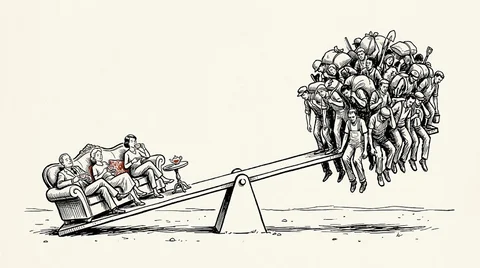


Author: Xinghui
In September, a piece of news that was almost ignored came from Xilinhot, Inner Mongolia - the police have been collecting blood samples from male residents in the jurisdiction since September 5 and entering them into the local DNA database. The official explanation is that this is to "improve citizen identity information", "prevent wandering" and "facilitate the processing of documents". However, this seemingly gentle announcement has opened up a heavy question: when the state begins to systematically collect male DNA, what kind of social threshold are we standing on?
After facial recognition and fingerprint entry, the collection of DNA information is another leap forward in information-based governance. But it is different from the former - fingerprint recognition is "me", while DNA recognition is "us", a whole family, bloodline and even potential kinship network. It is not only an individual identification technology, but also a family map, the deepest social archive of human beings.
1. From "crime-solving weapon" to "family network": the technological extension of power
In the field of criminal investigation, Y-chromosome family screening technology has indeed brought about a revolutionary breakthrough. The resolution of long-standing cases such as the Baiyin case and the Southern Medical University case cannot be separated from Y-STR comparison. The principle is: the male Y chromosome is stably inherited from the paternal line, so as long as one person in the family is entered into the database, potential suspects can be traced within the family. The public security system calls this idea "finding groups with Y and locking people with constants".
However, this logic of "finding groups" also means that the DNA information of any male individual represents not only himself, but also the entire paternal bloodline. In other words, when a person is sampled, the entire family is included in the invisible monitoring radius. The precision of technology does not eliminate its social risks, but instead expands the biological boundaries of national governance.
This is the essence of the Y database: it is not just a detection tool, but a family-based, bloodline-based social governance method. It allows the definition of "suspicion" to be expanded at the biological level, from specific individuals to potential gene communities.
2. "Technological legitimacy" without legislation: when the program is silent
What is even more alarming is the legal basis for this measure. According to the current Criminal Procedure Law, the collection of DNA samples is limited to suspects, victims or people directly related to the case. However, the Xilinhot police collected blood from all males in the jurisdiction under the pretext of "improving citizen identity information", which obviously crossed the boundary authorized by law.
In the principle of the rule of law, "no action without authorization by law" is the bottom line of public power. Any data collection that is not explicitly authorized by legislation is an act of exceeding its authority. However, this action covered the substantive existence of administrative pressure under the name of "non-mandatory" and "voluntary". In a small town, with the police visiting, village doctors accompanying, and village cadres mobilizing, how much space can the so-called "voluntary" still have?
The rupture between technological legitimacy and procedural justice is precisely the most prominent risk of contemporary Chinese information governance. We are too easily accepting the myth of "technological neutrality" - as long as it is effective, convenient, and can solve cases, it is tacitly considered "reasonable". But in the absence of law and the absence of supervision, the neutrality of technology is just an illusion, and what it is embedded in is an asymmetrical power structure: public power is collecting, individuals are being collected; information is accumulating, and privacy is disappearing.
3. "Surname gene" and "social genealogy": the re-politicization of privacy
The core of Y-library technology is the tracking of male families. The gene fragments it relies on are called "surname genes" because the way the Y chromosome is transmitted is very similar to the "surname transmission" of the traditional patriarchal society. This coincidence is highly symbolic: it digitizes and technologizes the cultural logic of Chinese society that is deeply rooted in blood ties and clans.
From a sociological perspective, this "biological bloodline" governance model is exactly the opposite of the modern concept of citizen identity. The modern state is built on legal relations, not blood relations; citizens should be equal individuals based on rights and obligations, not members of a certain family. When the state redefines citizen identity at the biological level - even if it is only for the purpose of detection - it invisibly pulls "family" back into the political arena.
This "re-politicization of privacy" is far more than a technical issue. It means that public power no longer only manages the behavior of citizens, but begins to manage the bodies and bloodlines of citizens. The "identifiability" of the information subject becomes infinitely extended: your identity is not only defined by your ID number, but also by your unchangeable genetic code.
4. Detection efficiency and citizen rights: the paradox of technological expansion
Those who support the Y database often use "detection efficiency" as a reason. Indeed, DNA comparison improves the case-solving rate and reduces costs. However, efficiency is not the only goal of social governance. Any governance method should maintain a balance between efficiency and rights.
In extreme terms, if efficiency is paramount, then installing cameras in every household, mandatorily wearing positioning chips, and collecting the genetic information of everyone will make crime almost impossible to hide - but is that still a society worth pursuing? The core of modern rule of law is not to maximize control, but to limit control. True civilization lies not in the speed of solving cases, but in not sacrificing the rights of the innocent for the sake of solving cases.
The DNA database is particularly special because it is almost impossible to "exit". Once the information is entered into the database, it may exist permanently. The "family representativeness" of the Y chromosome makes the data traceable indefinitely even after the death of the person concerned. This "immortality" in time also makes the responsibility of data governance permanent - and we have not seen the corresponding legal, technical and ethical mechanisms to bear this permanence.
5. From technological governance to body politics: future concerns
The emergence of the Y database is an extreme expression of the logic of technological governance: the more information the governors have, the more "safe" the society will be. However, the other side of safety is control. When the individual's body information is systematized, encoded, and databased, the body is no longer private, but becomes a resource that can be called upon.
Internationally, the ethical controversy over DNA databases has been going on for many years. European countries generally adopt the "proportionality principle", that is, DNA can only be collected in serious cases and when necessary, and strict destruction deadlines and usage restrictions are set. Even so, there are still a large number of questions pointing to "genetic discrimination", "data abuse", and "family association tracking". In China, there is no law that clearly stipulates the collection procedures, scope of use, regulatory mechanisms and exit systems of DNA databases. We are at a stage where technological development is far ahead of legal protection.
What is even more alarming is that this logic of biological information governance, once established, will be easily expanded. Today is the male Y chromosome, tomorrow may be SNP testing, appearance prediction, and even disease gene screening. Technology never restrains itself, it always slides rapidly towards "general use" after being found "useful".
When DNA data is included in the citizen identity system and is no longer just a detection tool, but a social governance infrastructure, the citizen's body will no longer be completely his own. This transition from "social management" to "body management" is one of the most profound trends in contemporary technological politics.
6. The silent society and the absent legislation
What is even more worrying is the silence of the public. After the Xilinhot incident was exposed, public opinion was flat. There was no large-scale questioning, nor a full response from the official explanation. Compared with issues such as facial recognition and personal credit, DNA seems too far away from ordinary people, and the technology is too complex to form an emotional resonance. This "knowledge blind spot" happens to be the most dangerous space - because people are not aware, they are more likely to default to "harmless"; because they do not resist, power can advance more smoothly.
However, the loss of privacy is often not a violent deprivation, but a slow slide. From fingerprints to faces, and then to DNA, each technological expansion appears in the name of "convenience", "safety", and "preventing wandering", and each time the public gradually retreats under the psychology of "I haven't done anything wrong". In the end, we may live in a completely transparent but completely unfree world.
7. The cost of lagging legislation: when supervision is always "catching up"
The speed of technological development far exceeds that of legislation. Since the rise of DNA databases in the 1990s, China has not had any specific laws to regulate their collection, storage, and use. The national standard "Construction Specifications for Forensic DNA Databases" only focuses on technical quality, not rights protection. The result is that DNA collection is in a gray area at the institutional level: neither explicitly legal nor explicitly illegal, as long as it is labeled with "solving cases" and "preventing wandering", it can be executed in a grand manner.
This "gray governance" is the most risky state. The use of power without legal constraints means that responsibility cannot be traced and abuse cannot be punished. Once the information is leaked, it will not only reveal family privacy, illegitimate children, adoption relationships and other social taboos, but also may trigger genetic discrimination in employment, insurance and other fields. Technical personnel, administrative departments, third-party contracting companies, data managers... every link may become a potential source of risk.
As the construction and expansion of DNA databases continues to advance, society must ask: who will supervise the collection behavior? Who can access the database? How long is the information kept? Does the person concerned have the right to request deletion? Without the answers to these questions, even the most advanced technology may become a tool to infringe on citizens' rights.
8. When "blood ties" become the logic of governance
The Y database is not a single technical project, but a mirror, reflecting our true attitude towards the relationship between power, privacy and security. What it represents is not only the progress of detection tools, but also a shift in governance thinking - from social control to body control, from behavior supervision to gene identification.
It makes us face a fundamental question again: in the name of pursuing security and order, how much of our body and private parts are we willing to give up? And who can guarantee that these data will not be used in another "legal" but dangerous direction?
Perhaps one day, we will find that what is more difficult to prevent than crime is the ambition of technology after being tamed by power. At that time, what is really locked down is no longer the suspect, but each of us ordinary people marked by the database.