

It's still beneficial to read the news every day. At least some of these things can serve as a "warning".
After all, if you haven't seen these things, you might violate the law, and then, what awaits you is imprisonment. Today, I'll talk about 3 small news items. Everyone must be vigilant after reading them and be careful not to get caught.
The first thing is that a female teacher was detained for discussing "false information about a teacher selling sex" in two WeChat groups of 3 people each. I checked the media reports, which stated that the female teacher's best friend, who was chatting with her, was also detained.
It's really bad luck.
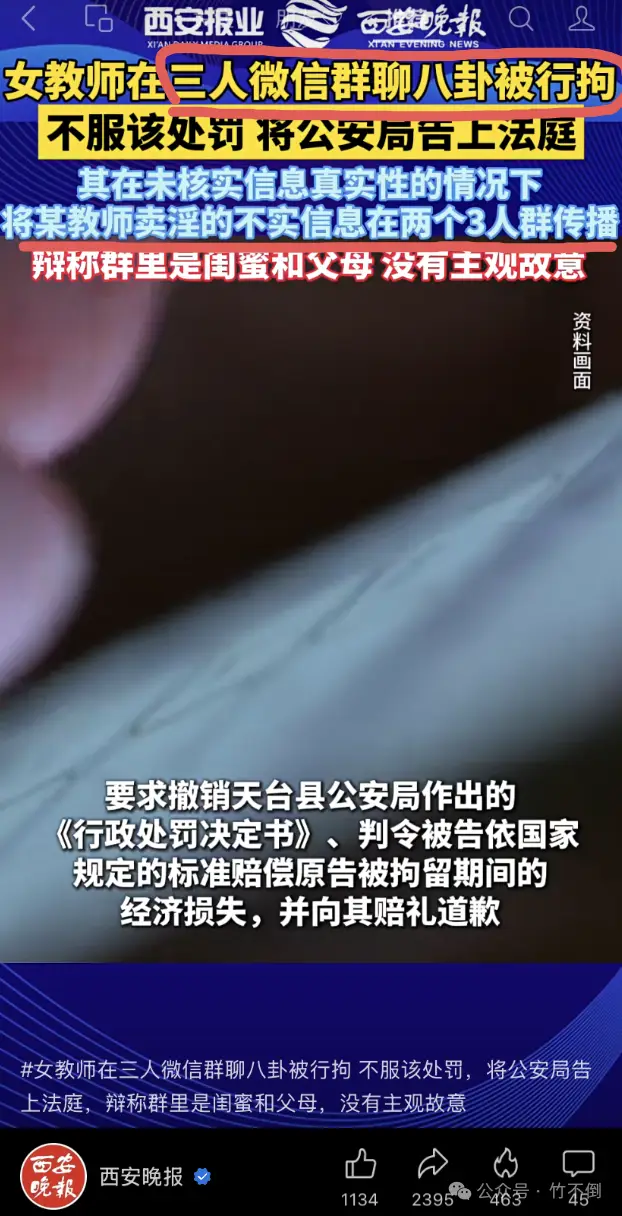
So, does this "detention" comply with legal procedures?
I consulted a professional, and I can clearly tell you: it is completely justifiable in legal terms. In other words, even if this woman does not accept the punishment and sues the Public Security Bureau, it is unlikely to have any effect.
This is "unsolvable". Don't underestimate it just because it's a "small group of 3 people", just "parents, best friends", it's useless.
Therefore, I want to suggest to everyone, don't argue about some things, and don't talk nonsense, protect yourself.
As for why you feel a little "strange" when you see this kind of news, this should be a matter of freedom of speech. In other words: what feels "strange" is that it feels "too strict", making people afraid: the detained woman is of course at fault, but does this fault need to be directly punished with public power detention?
In fact, administrative detention can be imposed, or "civil liability can be pursued".
That is to say, whoever is slandered and defamed should sue for civil compensation. If this happens in Western countries, the police are less likely to be involved, unless it causes a huge public impact. And according to the situation where doctors and teachers are defamed and affected, the compensation for civil lawsuits will be considerable.
In other words, how to handle it can be flexible.
The second thing is also the content reported by official media. "Heshan Release" released a video: Refusing to open the door to cooperate with household inspections can result in a maximum of 10 days of detention and a fine of 500 yuan.

Is that so?
Yes!
There are clear legal provisions in several cases. If you do not cooperate, they can arrest you. For example, infectious disease screening, public security issues, and fire safety. If it's not necessary, don't argue, you can't win. Especially related to "infectious diseases", don't argue, because it might not just be administrative detention, and you won't be able to sue.
But I want to emphasize that some household inspections are purely intimidating, such as neighborhood committees conducting surveys, population statistics, and what grid members "investigating", residents have the right to refuse to open the door or refuse to cooperate. If they say they want to detain you, there are only two possibilities: either they are scaring you, or they do not intend to abide by the law.
The interesting thing about this news is that the comment section is closed (see the screenshot above), obviously some netizens feel suppressed, so they "spoke out of turn". Why is this happening? I think it may be due to the "household inspections being too casual", which also makes people feel afraid.
Let me put it this way, sometimes, a "grid member" can rush into your home in the name of epidemic prevention. What is the identity of the grid member? Do they have law enforcement certification? Do we have the right to refuse or prevent it?
Therefore, in Western countries, there is generally no "household inspection" procedure. They can also force their way in, provided that the police obtain a search warrant issued by the court.
The third thing also sparked some controversy: a place in Inner Mongolia collected blood samples from male residents and entered them into the local DNA database.
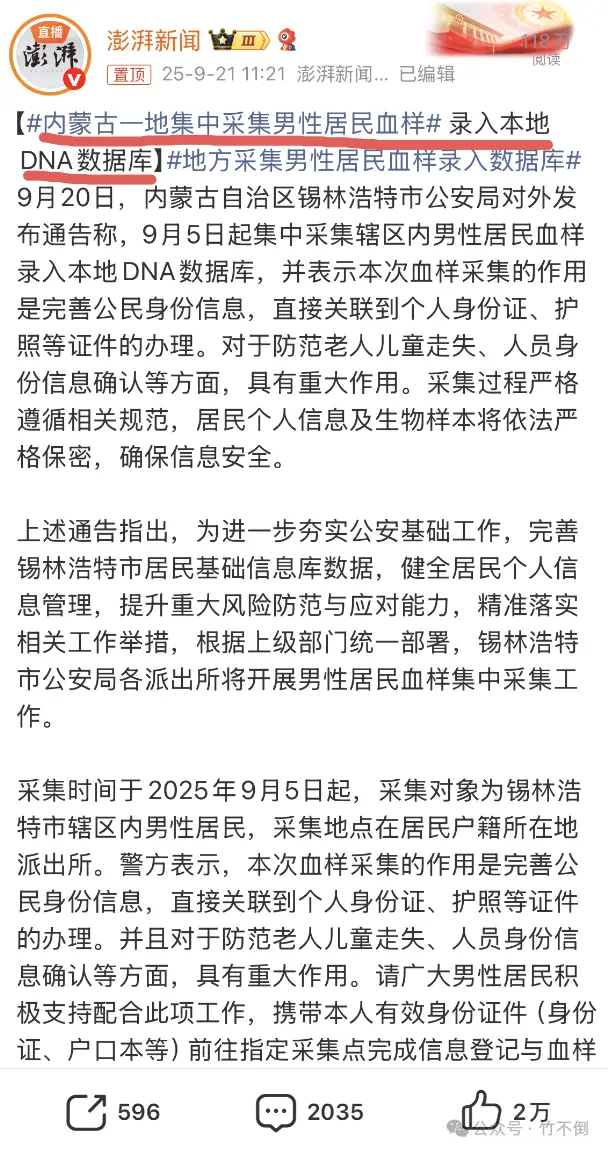
You can see that the top comment is this reply: Which regulation allows for collection?
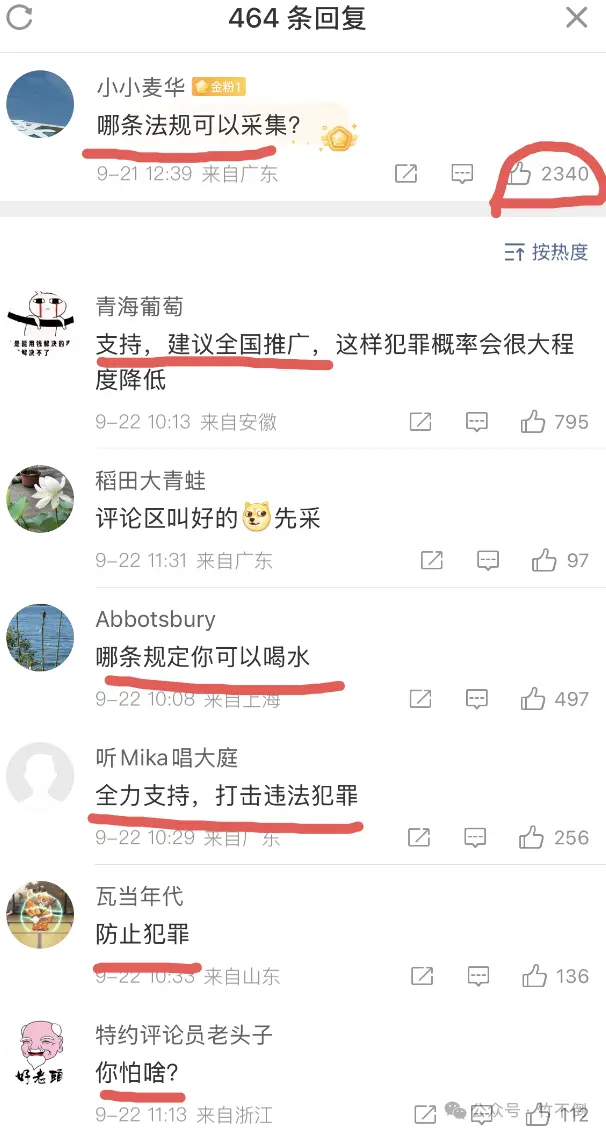
But it is also visible that there are many people refuting it below, believing that "the collection is good", and even with the prospect of "if you refuse to collect, you are guilty".
But in reality, the top comment's question is not wrong, which regulation stipulates that collection is allowed?
I haven't found the specific regulations, and the police don't have this power either. Generally speaking, public security organs can only collect biological samples such as blood, saliva, and hair from suspects and specific related persons when investigating cases.
This requires a prerequisite of "when a case needs it", and it cannot be "universally collected from all male residents".
And the "Personal Information Protection Law" and the "Data Security Law" also have clear provisions that this must be done with the consent of the person. After all, things like DNA, once abused, are extremely risky.
The same is true in European and American countries. DNA sampling is generally only for criminal suspects and must be authorized by the court.
So, in principle, people can refuse things that lack clear legal basis. But now, it gives people a feeling of "unable to refuse". On the one hand, the police ask you to collect in the name of "cooperating with the investigation and public security inspection", and you may be labeled or even harassed if you refuse.
And in reality, there are many people like those in the comments, their minds are rigid: if you are not guilty, what are you afraid of?
The problem is, I don't know what I'm afraid of, but I'm just afraid! And the law allows me to be afraid!
Just like you know there are no ghosts in the world, but when you ask yourself, can you not be afraid of ghosts at all? Humans can never overcome the fear generated by "unknown things".