

In April 2025, the national youth unemployment rate was 15.8%, a decrease of 0.7 percentage points compared to March's 16.5%, reaching the lowest level this year. Superficially, this set of figures seems to reveal a hint of a positive signal. Is the employment situation improving? The answer is actually not optimistic.
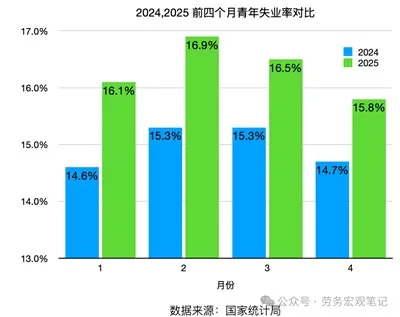
Compared to the same period last year, the employment situation has not improved. In April 2024, the youth unemployment rate was 14.7%. This year, it has increased by 1.1 percentage points year-on-year, reaching 15.8%. In other words, this year's data has not only not decreased, but is significantly higher than last year. If we compare the data from the first few months of this year, we can also find the same trend—the youth unemployment rate is at least one percentage point higher than last year. This indicates that, overall, the youth employment situation in 2025 is more severe than last year.
Seasonal fluctuations in the youth unemployment rate
So, why did the unemployment rate in April decrease compared to March? This is mainly due to the seasonal fluctuations and patterns of the youth unemployment rate.
Every July and August is graduation season, when many college graduates enter the labor market, and the youth unemployment rate will rise rapidly. After September, the labor market gradually digests this batch of graduates, and the unemployment rate will gradually decrease. By the spring of the following year, the youth unemployment rate is usually at its lowest point of the year. In addition, March and April are the peak recruitment seasons for enterprises (commonly known as "Golden March and Silver April"), with campus recruitment and social recruitment going hand in hand, which also makes the unemployment rate fall back in stages very normal.
It is worth mentioning that since the statistical caliber was adjusted at the end of 2023, excluding students in school, the impact of the graduation season on the youth unemployment rate is more intuitive. Therefore, the seasonal decline in employment data in March and April does not mean that the overall employment situation has improved.
In the first four months of this year, China's macroeconomy has performed well on the surface, especially considering external pressures such as the trade war. The implementation of fiscal stimulus policies (mainly the issuance of special bonds by local governments) has played a supporting role for the economy. But if you look closely, you will find that the employment foundation is still not solid.
In terms of fiscal revenue, in the first four months of 2025, the national tax revenue was 6555.6 billion yuan, a year-on-year decrease of 2.1%. The continued decline in fiscal revenue indicates that enterprises are under operating pressure and the internal driving force of the economy is insufficient. At the same time, local governments' land sales revenue is also declining. From January to April, the revenue from the transfer of state-owned land use rights was 934 billion yuan, a year-on-year decrease of 11.4%.
Electricity generation, as an important indicator reflecting industrial production vitality, also performed poorly: from January to April 2025, the electricity generation of industrial enterprises above designated size was 2.984 trillion kilowatt-hours, with a year-on-year increase of only 0.1%. This growth rate is almost stagnant, reflecting that industrial demand and the utilization rate of enterprise capacity are still weak.
In addition, although the total retail sales of consumer goods nationwide increased by 5.1%, the data from the two first-tier cities of Beijing and Shanghai are very bad. Beijing decreased by 3.7% year-on-year in the first four months, of which, retail sales of goods were 404.88 billion yuan, down 3.7%; catering revenue was 43.84 billion yuan, down 4.0%. Shanghai's social retail sales data decreased by 0.3% in the first four months, of which, catering revenue was 66.476 billion yuan, down 3.1%.
In short, although the youth unemployment rate in April decreased compared to March, this is more due to seasonal factors. If the timeline is extended, the youth employment situation this year is still more tense than last year, and macroeconomic indicators also reflect insufficient vitality. Short-term data changes are not enough to indicate a fundamental improvement in the current employment situation.